
ElPais
PinkPantheress, Gen Z’s Most Unmistakably British Star: Between Classic Tartan And A Chess Player’s Mind


The people have spoken. The United Kingdom has a new ambassador. Her debut party took place this past April at that great hub of cultural diplomacy known as Coachella. At the most popular festival in the United States, PinkPantheress displayed the improbable mix of quirks that, at just 25, has made her the most unmistakably British star of her generation — from her fixation with tartan prints (which she wears even on her lips) to the hyper‑accelerated pulse of viral tracks like Ilegal and, of course, the cool precision of a chess player’s mind inherited from a family full of champions.
However, that Coachella performance was only the tip of the iceberg of her first major world tour, which began a year ago and ends this summer. In less than five years, PinkPantheress has turned stages across half the world into her personal chessboard, moving with a balance of determination and agility worthy of the best players. When asked on Reddit what she would be doing if she weren’t a musician, she replied: “I’d be a chess player. My family are all chess players.” The only way to understand her career, then, is to read it as if it were a grand chess match.
This game begins in Bath, a city in southwest England, in 2001. Back then, she wasn’t yet PinkPantheress, but Victoria Beverley Walker — and thanks to her rich family heritage, she started on the board with an unusually strong set of pieces. Her mother is Kenyan and worked as a caregiver; her father is English and a statistics professor. And on her father’s side, she is the niece of Susan Lalić, a chess champion with prestigious titles such as International Master. Like the rest of her family, Walker learned to play chess early, but she had a very different calling.
When she grew up, she moved to London to study film, but it didn’t take long for her to realize her path lay elsewhere. She had played piano since she was 12, and in the dorms, she spent her nights composing music in her room. “I don’t like long processes. There needed to be some quick, quick way for me to do this,” she reflected in a 2023 interview with The Guardian. “As I realised that film is the hardest industry to get into, I just knew that it was going to be difficult. If I can’t be the best at something, I don’t want to do it.”
She had moved to the British capital dreaming of becoming a film editor, but she quickly redirected that computer‑driven instinct toward production.
That was when her great chess match in the music industry began, and she knew exactly how to move the pawns. Like many in Gen Z, she started uploading her songs to TikTok with videos titled: “Day 2 of sharing my music until someone notices.” And that’s exactly what happened: in less than a year, tracks like Just for me went viral on the platform.
Until then, she had insisted on staying anonymous — she didn’t even show her face, afraid it might affect how her music was perceived. “People are less willing to listen to electronic music that is made by a Black woman. That’s just fact,” she told The Hollywood Reporter.

However, with success — and with a serious label behind her — that anonymity became impossible to maintain. Walker’s strength had always been production: a signature sound halfway between electronic music and pop, between the nostalgia of early‑2000s samples and the pastiche and hyper‑accelerated pulse of the TikTok era.
But she needed a new strategy, new pieces on the board: she could no longer hide behind her computer. So if she had to share her image, she decided to separate it as much as possible from herself and build an alter ego with a sharply defined style.
“I’m so happy my stage name is not my real name,” she recently revealed in an interview with singer Cairo for Interview Magazine, founded by Andy Warhol. “There needs to be some separation — that’s why I can go so hard with these music videos. Because in my head, I’m like, well, this isn’t me on the regular, this is me playing into a character. I have to be Pink when I’m onstage dancing, otherwise I go crazy. I lose my sense of self.”
The name for this alter ego was already clear — PinkPantheress had been her TikTok handle, a nod to the famous Pink Panther cartoon — but everything else still had to be defined.

As she released, first a mixtape, To Hell with It, and then an album, Heaven Knows, she built a recognizable aesthetic she described as “young auntie” — and that fans online compared to the look of a department‑store floor manager. In other words, a return to Y2K: early‑2000s style full of tight jeans, tiny tops, and even tinier handbags, but with a more urban edge. Meanwhile, she began conquering major stages as an opening act for artists like Olivia Rodrigo and dipped into international projects such as the Barbie movie, for which she wrote the song Angel.
But she didn’t deliver checkmate until last year with her second mixtape. Fancy That pushed her onto the international board, and at that point, she knew exactly what the PinkPantheress character should look like. Through her lyrics, her sound and, above all, her image, she presented herself as the most camp distillation of what it means to be British.
“Low-key, being British is the strength that I have,” she told The Hollywood Reporter. “Every time I’ve tried to lean into a more American sound, it ends up being a song that I don’t necessarily think reflects my personal tastes as much as when I lean into being British — if I didn’t, I think it would be quite easy for [my music] to get lost in the crowd.”

The tartan print, typical of Scottish kilts, became her most recognizable trademark. Through elaborate music videos, she proved the pattern was as versatile as she was. In Tonight, she carried it into the era of the British Regency, in a video that looked like a cross between Bridgerton and the teen series Skins. In Romeo, she paired it (finally) with the world of chess, and in Stateside, she leaned into her most kitsch, airport‑souvenir side. That last song — a remix of one of her songs with Zara Larsson — became a defining statement earlier this year, surpassing 60 million views.
“Aesthetically, I led with that pattern, which ended up leading into some other British motifs — you’ve got some telephone boxes here and tea parties. The real word, I’d say, is kitsch. I tried to make it as kitsch as possible,” she told Vogue.
Her true goal, however, isn’t to represent her country but to represent all the young women who, like her, once felt insecure about stepping into the world of production. “I do want to represent for the girls who look like me. Who want to do what I do and don’t feel like they need to feel pressured to be able to be perfect at dancing, look amazing all the time, have a curvaceous build, dress a certain way,” she told the fashion magazine.
For now, it seems she’s not far from achieving that. This past February she reached an unprecedented milestone: at the latest BRIT Awards — the same ceremony many will remember for Rosalía’s unforgettable techno performance of Berghain — Walker became the first woman, and the youngest artist ever, to win Producer of the Year. Checkmate indeed.
Sign up for our weekly newsletter to get more English-language news coverage from EL PAÍS USA Edition














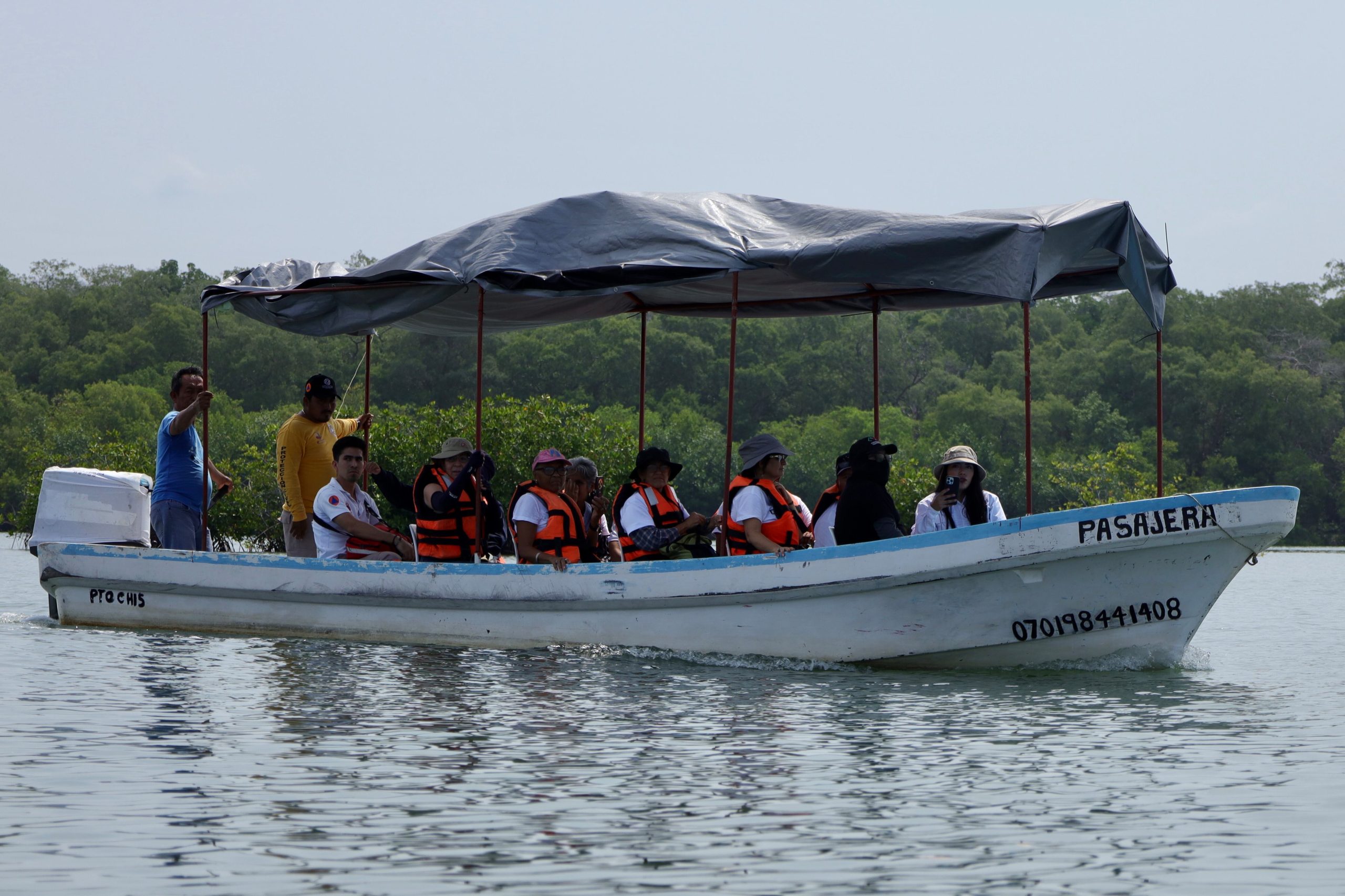
The heat presses down near the ocean’s edge. Hours pass, and the patrols look for shade, officials fan themselves, reporters lean back — but they keep going. They walk, they ask, they insist, they jot things down: a name, a date, another place they’ve never heard of. They work even with the life jackets from the boat ride still on; they don’t take them off, in case there isn’t enough time. They’ve spent 16 months searching, and this is the first time they’ve been able to do it while standing on the same ground their missing loved ones — their children, a grandson, a brother — once stood on; seeing the mangroves, the palm‑thatch roofs, the lagoon brushing up against the Pacific, all of it they are certain — certain — their loved ones also saw.
On December 21, 2024, the trail of 40 migrants vanished in San José El Hueyate, in the Mexican state of Chiapas. They boarded a boat bound for Juchitán de Zaragoza, Oaxaca, also in Mexico. They were never heard from again. The families didn’t know — couldn’t have known — that another group of at least 20 people had disappeared in the same place and along the same route just two months earlier, on October 21, 2024. And another group, 23 migrants, also vanished from a nearby port on their way to the same destination on September 5, 2024. They, the searchers, are seven; they, the missing, are 83. There may be more — they don’t know, they cannot know.
On December 21, 2024, 40 migrants vanished in San José El Hueyate, Chiapas, Mexico. They boarded a boat bound for Juchitán de Zaragoza, Oaxaca, also in Mexico. They were never heard from again. Their families didn’t know — they couldn’t know — but another group, of at least 20 people, had disappeared in the same place and on the same route just two months earlier, on October 21, 2024. And yet another group, with 23 migrants, also disappeared from a nearby port on September 5, 2024, heading for the same destination. Seven relatives are here to search for them; 83 are missing. There could be more; they don’t know, they can’t know.
Alicia Santos, Isis Pérez, Elizabeth Guevara, Margarita Bravo and Lázara Fernández have come from Cuba. Óscar Hernández, from Honduras, and José Quindil, from Ecuador. After 16 months, the government has granted them a visa to enter the country so they can “search.”
Search: put up posters with faces, ask questions, ask again, learn names they had never heard before. The permit — and this matters — is not to investigate. That, they are told, is something the Chiapas state Attorney’s Office must do. It is the office that holds the case file and that, in more than a year, has not traced the phones of the missing, nor those of their smugglers, nor those of the last people who saw them. The office hasn’t summoned anyone, and it has no line of investigation, much less any suspects.


“We wish the Attorney General’s Office had done more before we arrived,” says Margarita Bravo.
“We gave them enough information to search, and they didn’t,” adds Isis Pérez.
“The fact that we have to be here to look for our children means the authorities haven’t done their job,” remarks Alicia Santos.
These seven — taxi drivers, accountants, biologists, retirees, homemakers, government workers — boarded a plane for the first time, left their home countries for the first time, and landed in a country about which the only thing they knew was that it had swallowed their families.
The lack of answers from the Mexican Attorney General’s Office (FGR) — which took nearly a year just to give them a case number — has shaken the families, though it comes as no surprise in a country with more than 130,000 missing people, where families are left to search for their loved ones without any state support.
This week, the Inter-American Commission on Human Rights (IACHR) underscored something the U.N. has been warning about repeatedly: in Mexico, disappearance is “widespread,” “indiscriminate,” a humanitarian crisis that can affect anyone and that state agents allow or participate in. The government of Claudia Sheinbaum insists that addressing this crisis is now a “national priority,” but the last time — this past Monday — officials dared to say it out loud, a mother who has spent 21 years looking for her daughter shouted: “What hope can any victim in this country have?” Silence.
The detectives
Alicia Santos is tall, a leader, an owl‑eyed observer: she is searching for her son, Jorge Lozada, 24.
Isis Pérez hugs hard, investigates hard, remembers hard: she is searching for her daughter, Elianis Morejón, 18.
Elizabeth Guevara prefers to speak little in public and to pray on her knees; she is firm when she says she never feels fear: she is searching for her daughter, Lorena Rosabal, 28.
Margarita Bravo smiles even when she cries, the mother‑figure among the mothers: she is searching for her daughter, Meiling Álvarez, 40, and for her grandson, Samei Reyes, 14. That teenager with the shy smile is also being searched for by his other grandmother, Lázara Fernández. These are the Cuban searchers.
There is also Óscar Hernández, with his dark little notebook, his gentle smile, his wariness: he is searching for his younger brother, Ricardo Hernández, a 33‑year‑old Honduran.
And completing the group is José Quindil, who has been wiping away tears ever since he arrived from Cotopaxi, Ecuador, to find his son, Jefferson Quindil, 21.
Graciela Ramos, mother of Dairanis Tan, a 33‑year‑old Cuban, could not join the brigade, nor could the families of Hondurans Karla Hernández, 29, and Olvin Marin Maldonado, 61, who also disappeared on the same journey. So the seven detectives ask about them, too.

The families began filing missing persons reports — each on their own — in January 2025. They didn’t know one another, nor did they know the names of the people who had traveled with their children, because Mexican authorities dismissed each of their individual reports with ease. The Cuban mothers found one another through social‑media posts, and one phone call led to another.
They eventually reached the Foundation for Justice, the organization that accompanied them more than a year ago to file a complaint before the FGR. The federal agency declared itself not competent and sent the case file back to the Chiapas Attorney General’s Office, even though there were — and still are — signs of organized‑crime involvement.
The case was published in EL PAÍS in June 2025, and from that story, like a domino effect, the September and October disappearances were linked to it. Only a few months ago, Chiapas prosecutor Jorge Llaven acknowledged after a press conference that all the cases were “related” and that San José El Hueyate was home to “a network for smuggling undocumented migrants”: “As there must undoubtedly also be complicity from authorities.”
Two of the three disappearances already have U.N. Urgent Actions, which require the Mexican state to begin an immediate search. It was in that context that the 2026 Tejiendo Redes (Weaving Networks) Brigade was organized with the Regional Network of Migrant Families to bring the detectives to Mexico.
A crossroads
The town’s name is unusual. Even some locals get confused. San José El Hueyate belongs to the municipality of Mazatán; some call it the Barra de San José, and the owner of a restaurant insists people also call it La Encrucijada — The Crossroads. “Do you know what that means?” he asks. Then he explains that here, dozens of tiny islands, dirt paths, and waterways intersect and split apart, that a lot goes through here, that many people have passed through here. But he doesn’t recognize any of the photos of the missing. Another shop owner says bluntly that those who don’t turn up either drowned or were taken. She has a missing brother, just like another neighbor, just like a migration officer. People in town have never dared to hang the faces of the missing on these wooden walls. They are poor, afraid, and they have their reasons. On that, the detectives agree.
San José El Hueyate has been a drug‑trafficking corridor for decades; in the 1980s, small planes loaded with cocaine landed here, and for years, migrants have been hidden in safe houses because of the area’s isolation. No one is used to an operation like the one accompanying the seven detectives, and children stare wide‑eyed at the convoy made up of the National Guard, the Army, Municipal Police, State Police, the Migrant Prosecutor’s Office, the National Search Commission, the State Search Commission, the Executive Commission for Victim Assistance, Civil Protection, the Mazatán government, activists and a handful of journalists. It is an unusual deployment — at times promising, at others ineffective.


The sand is damp, and under the palm‑thatched shelter sit several dozen motorbikes and a handful of neighbors who had been calm until the entire brigade arrived. The families ask carefully, insist patiently. “If at any point you remember something, you can call this number — it’s all anonymous.” “Look, let me show you another photo.” “No, they didn’t disappear at night; it was 9 a.m., broad daylight — someone must have seen them.” “I can’t rest until I know where my son is.” “Have boat guides gone missing here?”
They receive timid answers, a few attentive eyes, and replies that reveal more than they say: “Why do you want to know that?”
“There’s a truth hidden in San José El Hueyate — everything we need to find our relatives is there,” says Óscar Hernández. “That’s what the prosecutor’s office needs to do.”
In 10 days, they have traveled through Mexico City, Tuxtla Gutiérrez, Tonalá, Paredón, Tapachula, Mazatán and San José El Hueyate; they have visited migrant detention centers, shelters, hospitals, prisons, churches, markets, government buildings; they have met with the National Migration Institute and the prosecutor’s office; they have held press conferences; they have given their samples to the Argentine Forensic Anthropology Team; they have left the border covered with the faces of Jorge, Elianis, Lorena, Meiling, Samei, Ricardo, Jefferson, Dairanis, Karla and Olvin; they have shown those faces to more than 1,000 inmates who filed past one by one under the sun to look at their photos; they have heard possible leads and many refusals; at times they wish they could go home and be far from here, and at times they don’t want to leave until they can do so with their families.
“As a son, it’s incredibly frustrating. What am I going to tell my parents when I get back?” Óscar Hernández asks sadly.
At the same time, they acknowledge the progress, the leads, a glimmer of hope once again.
“I think if we stayed here for a month, we could find them,” Alicia Santos muses aloud.
“What we want now is for our case file to be sent to the Attorney General’s Office so they can search the entire country,” says Isis Pérez.
They all hoped to return to their countries with something — with someone — but they know that this has been, after all, just the first attempt.
Sign up for our weekly newsletter to get more English-language news coverage from EL PAÍS USA Edition


Alexandria Ocasio-Cortez
US Lawmakers Demand The Pentagon Suspend Its Alleged Anti-Drug Operations In Ecuador



PinkPantheress, Gen Z’s Most Unmistakably British Star: Between Classic Tartan And A Chess Player’s Mind

The Seven Trackers Who Traveled To Mexico To Search For Dozens Of Missing Migrants

El Crucero Confinado En Burdeos Por Un Brote De Gastroenteritis Partirá El Viernes Rumbo A España


-

 New Developments4 weeks ago
How To Get A Tourist Rental Licence In Andalusia (Spain) – Step-By-Step Guide 2025
-

 Uncategorized4 weeks ago
Max Verstappen Nurburgring LIVE: NLS5 Schedule, start times and free live streams
-

 Competiciones2 weeks ago
E
-
Costa Blanca South4 weeks ago
Fire forces evacuation of six-storey building in Torrevieja
-
Costa del Sol3 weeks ago
Why home care is the new gold standard for living well in Spain
-

 Uncategorized4 weeks ago
Lando Norris unleashes F1 2026 criticism after Nurburgring test
-
Bullfighter injured3 weeks ago
Second serious injury in Spain’s La Maestranza bullring reignites controversy
-
Illegal building4 weeks ago
Mallorca’s building amnesty: A route out of legal limbo for rustic homes