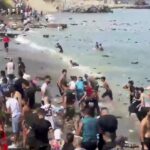
Floods of Moroccan residents invate Ceuta. Credit: Visigrad X
Spanish politicians finally admitted Friday night that more than 50,000 people mostly male, crossed from Morocco into Ceuta in a matter of hours. Local provincial president Juan Jesus Vivas put the number closer to 60,000. Nearly 48,300 had apparently already walked or swam back by early evening, leaving only about 2,000 still inside the enclave. However, those figures have not yet been independently verified. Fifty-seven people died in the crush and the water.
What remains is a deep sense of anger that any of this was allowed to happen at all.
How the human flood began
Young men, some still in swimming trunks and flip-flops, simply walked or swam around the Tarajal breakwater and border fence on Thursday. Border guards were overwhelmed within minutes. Reception centres filled past breaking point. Parks and streets became open-air camps. Shops slammed shut as groups were filmed looting. Residents reported broken doors, stolen goods, fights in the street and groups of foreigners demanding food or phones.
🚨#BREAKING: The Moroccan Muslims who have invaded the small Spanish city of Ceuta are now BREAKING INTO STORES by the HUNDREDS.
Police are completely overwhelmed.
Migrants can be seen running from one store to the next, grabbing items and running.
WHERE IS THE MILITARY?!!!!! pic.twitter.com/NjqQAI4zgD
— Matt Van Swol (@mattvanswol) July 31, 2026
Spanish police took scores of calls about clashes between the newcomers and locals. Army units and extra officers arrived late, after the damage was already done.
Prime Minister Pedro Sanchez flew in on Friday, called the whole episode a “violation of Spanish territory“, blamed trafficking gangs and a recent Supreme Court ruling, then promised quicker returns and a line of buoys in the sea. Residents who met him outside the heliport and the town hall could not hold back their frustration. They told him exactly what they thought of the government’s performance on immigration and protecting the borders. And it was not pretty.
Why this should never have happened
A Supreme Court decision earlier this month ruled that people intercepted at sea, for example, in a small boat, could not be turned straight back to where they came from. Word of that ruling spread fast on social media, and traffickers and rumour-mongers seized on it. Moroccan forces on the other side of the fence appeared to do very little to impede the illegal emigrants until the crowds were already moving. Some, even appeared to be facilitating it at first.
Spain has lived through previous border crises with mass runs at breaching the border. Lessons from those situations were said to have been learned. Instead, a tiny enclave of 83,000 people was left to cope with a human tide the size of a small city while Madrid reacted after the event.
Many in Ceuta spent Thursday night and Friday morning locked indoors, watching foreigners fill their streets. Local festivals planned for the weekend were cancelled. Businesses lost a full day’s trade. Anger in the population is raw and justified. Shops and services are said they will stay closed until after the weekend for safety reasons.
Mainland Spain stays clear … for now
Ceuta sits on the North African coast, separated from the Spanish mainland by the Strait of Gibraltar. No large groups from this particular crossing have appeared in Andalucia, Madrid or the Costa del Sol. Spanish authorities say the returns are continuing and the border is now under tighter control.
Mainland residents face no immediate risk from the people who entered Ceuta this week. That fact should bring some relief. It does not erase the disgrace of how easily the enclave was breached.
Questions that still need answers
Who left the border exposed after the Supreme Court restricted summary returns at sea? Why were Moroccan forces so slow to act on their side of the fence? How many more times will Spanish towns and cities be left exposed while politicians issue statements after the event?
Residents in Ceuta are already asking those questions. Expats and mainland Spaniards watching the footage have every right to ask them too. A country that cannot protect a small piece of its own territory has a diplomatic problem far bigger than one chaotic Thursday.
Security Alert: The arrival of thousands of migrants from Morocco to Ceuta and hundreds to Melilla in the past 24 hours may lead to unpredictable and dangerous situations. Spain has deployed the Spanish military to contain the developing situation, together… pic.twitter.com/X0j74vvZ3U
— U.S. Embassy Madrid 🇺🇸🇪🇸 (@USembassyMadrid) July 31, 2026