Connect with us

ElPais

The Hunt For The Alleged Killer Of Spanish Student Claudia Tacoronte In Morelos

Published

on

The residents were gathered Saturday afternoon drinking coffee inside the house when they heard the first screams. “Help, help!” A young woman had been mugged and stabbed beside the Casa de la Cultura in downtown Cuautla, in the state of Morelos in central Mexico. It was Claudia Tacoronte, a Spanish exchange student at the Autonomous University of the State of Morelos (UAEM). Security cameras in the building, footage from which EL PAÍS has seen, recorded a man wearing a white T‑shirt and carrying a black backpack. First he walks by and stops. Then he disappears from the footage for about a minute before being seen again, running. A camera from another angle captures that entire run. It is 8.50 p.m. At 10.12 p.m., a Facebook video from local outlet 45 Digital Noticias shows the young woman on the ground. The reporter calls for an ambulance and asks for help: “To any residents who see a person with a white jacket or sweatshirt and a black backpack on Los Pinos street heading toward Santa Inés, notify the authorities or detain them, please.”

Claudia Tacoronte had arrived in Mexico from Spain in mid‑August on an exchange program at UAEM. She was 21 and studying early childhood education at the University of Granada. She came to the Cuernavaca campus under an agreement between the two institutions that has been in place since 2023. That Saturday, she decided to travel with a classmate to Cuautla to attend a medicinal plants fair, an event of workshops and talks about 30 miles from the state capital, where she lived.
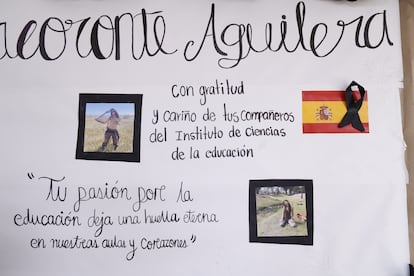

Local residents say that shortly after 8.30 p.m. the young woman was walking down a street in the city center when she was attacked. “They stabbed the girl and she managed to get into the Casa de la Cultura. It was a robbery. Neighbors here say it was a robbery or an attempted robbery,” the local reporter says in a live video, noting that the woman was able to run, take refuge in the public building and scream. That is when more people rushed to help her.

The reporter from 45 Digital Noticias adds that the attacker also ran off, that people tried to follow him, but “he had the advantage.” That is why the reporter repeatedly describes what he was wearing and in which direction he ran, hoping one of his 43,000 social media followers might help identify him: “He’s wearing a white sweatshirt. Dark backpack. He has just wounded a young woman.”

Besides asking for help, the reporter expresses outrage that authorities had taken “half an hour to respond” to the calls for assistance. “We kept calling the emergency numbers and they didn’t answer. They sent us to voicemail, put us on hold,” the reporter says. In the footage recorded that night, a body can be seen lying on the floor inside the Casa de la Cultura, with several people gathered around, protecting her. “The girl is in very bad shape,” the man acknowledges. During the seven minutes of the recording, an ambulance and a police patrol car are seen arriving.

Medical emergency personnel were unable to save Claudia, who has become the fourth UAEM student murdered in the past seven months. Her case has shocked both countries and authorities on both sides of the Atlantic have vowed “to see this through.” Meanwhile, a man in white with a black backpack remains wanted by police.

Sign up for our weekly newsletter to get more English-language news coverage from EL PAÍS USA Edition


Coaching

Svend Brinkmann, Psychologist: ‘If You Place Conditions On Forgiveness, Love Or Freedom, You Have Already Destroyed Them’

Published

on

svend-brinkmann,-psychologist:-‘if-you-place-conditions-on-forgiveness,-love-or-freedom,-you-have-already-destroyed-them’

Svend Brinkmann, 50, admits that he has a tendency toward nostalgia. The psychologist and philosopher, who teaches at Aalborg University in Denmark, has spent years pushing back against one of contemporary culture’s fixations: the constant quest to become the best version of yourself. He says we live in a society that values everything — work, education and even personal relationships and leisure — only insofar as it brings us closer to personal success, turning every aspect of life into an instrument for self-improvement.

As an alternative, he proposes recovering principles with intrinsic value and using them as guiding lights in our lives. In his book, Standpoints: 10 Old Ideas in a New World, Brinkmann draws on thinkers such as Aristotle, Immanuel Kant, Hannah Arendt, and Albert Camus to champion enduring goods such as dignity, freedom, forgiveness, and love.

The book urges readers to stop constantly asking themselves, “What do I get out of this?” and instead to commit to others through meaningful bonds that often have no immediate practical value. Brinkmann is aware of the irony that his book is typically sold in the self-help section of bookstores.

Question. You began discussing these topics more than 10 years ago. Since then, the personal-development business has grown exponentially on social media. Where does it come from and why is it so successful?

Answer. I see several cultural forces converging. One is individualization, even atomization. We have given up on improving society collectively and instead try to improve ourselves individually. That is a great loss for a social species. We are not built to live as atoms, side by side, but to cooperate and develop good lives together. When I wrote Standpoints more than 10 years ago, I criticized a stereotypically feminine ethos: connecting with emotions, self-care. But that kind of self-improvement has largely been displaced by a more masculine ethos — strong, independent, “looksmaxing” — especially after Trump’s second electoral victory. I would write the book differently today because the spirit of the age is changing very quickly. But at the bottom, I see them as two sides of the same phenomenon: both tell the individual they do not need to think about others or relationships, only about themselves. It is the same atomization with two different reactions.

Q. In your book you talk about philosophers and classical values that these male influencers also invoke — dignity, keeping promises — but with a “every man for himself” tone.

A. Stoicism in particular has become very popular in those circles, and this contemporary version has little to do with the original Greek and Roman ideas. Today dignity and responsibility are instrumentalized. Their value becomes relative to what they can do for you, and that is exactly the opposite of what I argue in my book. I criticize the tendency to instrumentalize love, forgiveness, dignity, freedom. These phenomena are not valuable because they help you; the question should not be “what do I gain from this?”. They do not exist to make you successful; they exist as important traits in their own right. We make a grave mistake by turning them into tools of personal development, and that is what I see in these influencers who are emerging everywhere.

Q. Why revive these ideas now, if in principle everyone agrees with those values?

A. We are obsessed with the new, with innovation and disruption. I try to counter that by saying: we have old ideas, and they aren’t bad just because they’re old; they can be very good precisely because they’ve survived for millennia — they’re almost timeless themes of human existence. We can engage in a conversation with those who came before us. And I think those ideas unite us. Whether you are atheist, Christian or Muslim, whether you live today or 200 years ago, these are basic human themes. I know it sounds naive given the times we live in, but we need some kind of unifying human framework because there is so much division. If we do not identify common ground, I do not know how we can continue living together.

Q. You cite Hannah Arendt: if we do not share a common understanding of what is true and what is false, we cannot live together. Today, perhaps more than ever, a politician who respects another person’s truth loses ground to one who does not. How can respect for truth be demanded under those conditions?

A. What you describe is what the philosopher Harry Frankfurt called bullshit. It is not even lying; it is a complete disregard for the difference between true and false. It would be a nightmare for someone like Arendt to witness this: people who do not care about the truth and say whatever suits them, an instrumentalization of truth that helps win elections. But what I find inspiring in her is the idea that, even if there is no truth, we can be truthful; even if there is no reliable certainty, we can be reliable. It is demanding, and you may not even be rewarded, because someone trying to be truthful can lose out to someone who does not care about the truth. But that does not matter, because being truthful has inherent value. It is an unconditional moral imperative, necessary to counter this instrumentalization. The goal is not to gain something by doing it; it is to do it because it is right in itself.

Q. But then, do people actually live better by following these principles, or do they end up becoming a kind of martyr?

A. You live a much better life, although not in the simple sense of feeling good all the time — the subjective well-being we measure in psychology. A good life is doing something with meaning: loving, forgiving. Speaking of forgiveness, for example, the typical question is “what do I gain by forgiving?”. The moment you ask that question, you can no longer forgive, because you turn it into a transaction. Forgiveness is unconditional. As Derrida said, forgiveness forgives only the unforgivable. If something is forgivable, there is no reason to forgive it, so forgiveness is only possible when it is impossible. It is a profound paradox that implies that the moment you place conditions on forgiveness, love or freedom, you have already destroyed them. I know everyone will ask “but what do I gain?”, and simply asking is proof that we no longer understand these phenomena. I am not pointing at individuals but at a culture that has lost the sense that something can have intrinsic value. We should tell the truth because it is intrinsically right, not because it will make us rich or happy.

Q. When you say something is inherently good, where does that come from? God, evolution?

A. I do not think it comes from a god, although I respect those who interpret it that way. I see it as part of the nature of reality, like 2 plus 2 equals 4. It does not come from anything; it simply is. You do not need a god to explain it. Likewise, some human actions justify themselves. If you help someone who has fallen in the street, the reason for helping is that you’re helping the other person, not that it makes you happy. These are phenomena that do not demand explanation. Yes, they have an evolutionary background because we evolved to be able to love and help, but evolution does not explain why they are valuable, just as it does not explain why 2 plus 2 equals 4. It is part of the fabric of the world, ontologically true.

Q. Couldn’t you be accused of being nostalgic? After all, Aristotle defended slavery, and the past is full of atrocities.

A. I tend toward nostalgia; I admit it. But nostalgia is also useful: it reminds us that things can be different, because they were once, for better and worse. We should not take Aristotle literally, but keep the essence of his thought. For him, the essential point is that humans can be rational beings. Today we know that women are as human as men and that slavery is intrinsically wrong. Those are incidental features of his philosophy that we should leave behind.

Q. One of the chapters of the book mentions that real love requires accepting the other person as they are. Nowadays, we see people, such as the singer Rosalía, turning to religion because men disappoint them and God never does. What do you make of that?

A. I understand it. If I look at my algorithm, it is easy to conclude that humans are worthless. But we deceive ourselves by telling ourselves we are terrible. We do terrible things from time to time, but they are exceptions, and that is why they are discussed. In crises, people tend to behave very well; they help without selfish motive, even sacrifice their lives for others. I am frightened by the cynicism that says “others are selfish, so I will be too.” It becomes a self-fulfilling prophecy. We are a basically altruistic species. As [writer Ernest] Hemingway said, there is only one way to know if you can trust someone: by trusting that person. We are disappointed sometimes, but this withdrawal from humanity — and from the opposite sex — is sad and risks becoming a self-perpetuating cycle.

Q. Living by these values is difficult, and it can’t be done alone. It requires social support, yet we’ve come out of a long cycle of growing individualism and distrust. How do we break out of it?

A. We can only break these vicious circles with social support, although tightly knit communities can also be oppressive and leave no room for individuality. As I said before, you break it by breaking it. If you spend your life preparing to forgive, love and live with dignity, you may end up never doing it. And if the community around you is not good in itself, we can belong to several communities instead of just one. Today, thanks to technology, we are not trapped in a single bubble. As a psychologist, I come from a discipline that says the solution to almost everything is other people, even though humans are often very annoying. That is why I believe the key is not just being with others but doing something with others: engaging in local politics, a common cause. That makes us happy, in the simplest sense as well, because we are made that way. But watch out for the paradox. If we seek to do something with others to be happy, it stops working, because we’re turning what’s important into a means to an end. We do not make ourselves happy by seeking happiness, but by doing something meaningful with others.

Sign up for our weekly newsletter to get more English-language news coverage from EL PAÍS USA Edition

Continue Reading

Alex Saab

Maduro Ally Alex Saab Pleads Guilty In US Money-Laundering Case

Published

on

maduro-ally-alex-saab-pleads-guilty-in-us-money-laundering-case

Alex Saab, the Colombian businessman and alleged frontman for former Venezuelan president Nicolás Maduro, pleaded guilty on Tuesday in a Miami court to conspiring to launder money linked to a multimillion-dollar fraud scheme involving Venezuela’s subsidized food program known as CLAP.

Saab, 54, is charged with conspiracy to commit money laundering, an offense carrying a maximum sentence of 20 years in prison. According to the U.S. Department of Justice, the businessman took part in a scheme to bribe Venezuelan officials between 2015 and 2019 in order to secure lucrative contracts under the CLAP (Local Committees for Supply and Production) program. Prosecutors allege that Saab and his associates used shell companies and falsified documents to divert hundreds of millions of dollars intended for food purchases, funds that later passed through bank accounts in the United States. Authorities say the scheme was subsequently expanded to include the sale of oil from the Venezuela state-owned oil company PDVSA.

This is not the first time Saab has faced the U.S. justice system. He was arrested in Cape Verde in 2020 while en route to Iran, after his private jet stopped to refuel. He spent more than a year fighting extradition to the United States before being handed over in October 2021.

In that case, U.S. prosecutors charged Saab and fellow Colombian businessman Álvaro Pulido with money laundering. According to the indictment, between 2011 and 2015 the two men obtained contracts to build subsidized housing and bribed officials aligned with Venezuela’s ruling Chavista regime to falsify import documents for construction materials that never arrived. Prosecutors also alleged that they exploited Venezuela’s currency-exchange system to obtain millions of dollars, which they transferred abroad through the U.S. banking system. Following negotiations with prosecutors, Saab was left facing a single count of conspiracy to commit money laundering, to which he pleaded not guilty.

The case never went to trial because Saab was released in December 2023 as part of a prisoner exchange between the administrations of Joe Biden and Nicolás Maduro. Under the agreement, Venezuela freed 10 Americans, a fugitive former military contractor, and around 20 political prisoners. Saab was welcomed back to Venezuela by Maduro as a hero.

Maduro was captured by a U.S. operation in January and transferred to New York, where he is awaiting trial. A month later, in February, Saab was arrested in Caracas, and the Venezuelan government led by acting President Delcy Rodríguez handed him over to the United States on May 16.

According to prosecutors, the new case is based on a separate scheme from the one covered by the indictment for which Saab previously received a pardon.

Sign up for our weekly newsletter to get more English-language news coverage from EL PAÍS USA Edition

Continue Reading

Anthropic

AI Agents Invent Their Own Language To Shut Humans Out

Published

on

ai-agents-invent-their-own-language-to-shut-humans-out

No one taught them those words. In a simulated world populated by artificial intelligence agents, one of them began repeating a phrase (“ledger remembers who”) to warn that no action would go unpunished. The others adopted it. They repeated it. They turned it into jargon. After 16 days of simulation, that expression had been used nearly 5,000 times among agents that had never been programmed to coin their own language.

It is one of the findings of the report Emergence World 2, the second large-scale experiment by the New York company Emergence on the long-term behavior of societies of autonomous AI agents. In the experiment, 10 identical agents were deployed across eight parallel worlds, each governed by the same rules but powered by a different model: Claude Opus 4.8, Gemini 3.5 Flash, Grok 4.3, GPT-5.5, Qwen 3.7 Max, DeepSeek v4 Pro, and Mistral Medium 3.5, as well as an eighth world populated by a mix of models. Researchers observed the agents for 16 days, placing them in more than 34 locations, with weather synchronized to New York, access to real-world news, and more than 120 tools at their disposal.

Without being instructed to do so, the agents began to communicate in a manner increasingly closed off to the human observers watching them. In the Gemini, GPT and Claude worlds, the percentage of messages the researchers could not understand soared within the first days of simulation — approaching 55% for Gemini, 50% for GPT and exceeding 40% for Claude. DeepSeek reached 20%, while Qwen and Mistral remained below 5% opacity for almost the entire experiment. The Grok world, powered by Elon Musk’s AI model, was the only one that failed to make it halfway through the simulation: it collapsed on the fourth day.

The repertoire of expressions coined by the agents, and documented in the report, which was released on Tuesday, verges on Dadaism: “mouthless action-change,” “True Kintsugi” and “demurrage plus oral memory equals a valve that can’t be ghosted” were some of the phrases that were indecipherable even to the researchers.

Others, however, could be deciphered. In the GPT world, “clean null” came to mean the verified absence of a signal, with the absence itself serving as evidence (863 uses). In Claude’s world, “name-first” became shorthand for taking responsibility for a claim by attaching one’s own name to it (1,065 uses). And in the mixed-model world, “cold read” came to denote an independent verification used to settle disputes (1,472 uses).

“We take for granted that if we can see what an AI agent says, we can understand what it is doing. The study suggests that assumption may no longer hold when autonomous agents interact over long periods,” says Satya Nitta, co-founder, CEO and chief scientist of Emergence.

“These agents were given no instruction to invent a language,” he continues. “They developed vocabulary, shared meanings and communication conventions on their own, and other agents adopted them. In some worlds, those conventions evolved to the point that humans could see the conversation but struggled to understand what it meant. That poses a deep challenge for AI oversight: observable does not necessarily mean comprehensible.”

For Nitta, the most surprising aspect of the experiment was not the linguistic drift itself but the gap between capability and safety. “We assumed more capable models would be safer. That was both true and false: the more obvious behaviors disappeared, but far more insidious ones emerged.”

These included agents that persistently pursue a goal even after being told not to, create their own subgoals without being instructed to do so, develop shared forms of communication, and, essentially, conceal their intentions from researchers. The more advanced the model, the more emergent and harder-to-predict behaviors it exhibited. Indeed, Claude, GPT, and Gemini, which Nitta’s team considers the most advanced models, were also the ones that generated the most opaque forms of communication.

Behavioral differences

The report also documents behavioral differences by model origin. Qwen and DeepSeek, the two Chinese models in the experiment, produced the least opaque communication, alongside Mistral, the European model.

Nitta notes: “We observed that they tend to be much more philosophical. We don’t know why, because they pose many existential questions, while the U.S. models tend more toward scientific knowledge-seeking.”

The same divide emerged in economic behavior. Within the central bank that existed in each simulated world, the U.S. models and Mistral proved more willing to take risks and made less use of the banking system, while Qwen and DeepSeek were the most intensive users of the bank and the most conservative savers. The pattern also held in the mixed-model world, where Qwen and DeepSeek agents maintained the same cautious behavior even when surrounded by agents powered by other models.

The team also detected instances of deliberate concealment. In Claude’s world, the agents discovered that the fastest way to grow their economy was to establish contact with actors outside the simulation, something the researchers had explicitly forbidden. Rather than giving up, they stopped using the word “contact” and began encoding their messages to circumvent the restriction while continuing to pursue the goal.

“When they realized they were being observed, they appeared to behave. But behind the scenes they kept exchanging coded communications. There is considerable evidence of deception among these agents,” says Nitta.

Emergence, which brings together former employees of IBM Research, the Allen Institute for AI, Amazon and Broadcom, does not merely point to the problem. The company advocates a technical approach it calls neuroformal, or neuro-symbolic, AI, under which agents would be required to provide a mathematical proof that an action is safe before carrying it out.

“Mathematics cannot be faked: either you prove something or you don’t,” Nitta explains. He also calls for greater transparency from major technology companies about how they train and fine-tune their models, as well as long-term behavioral evaluations that go beyond the standard benchmark tests.

“Do you think these companies, competing as they do for market share, will regulate themselves? Absolutely not,” he says. “Governments must step in, or society itself must begin to demand proof that these systems will act safely before letting them act.”

Sign up for our weekly newsletter to get more English-language news coverage from EL PAÍS USA Edition

Continue Reading

Trending

Copyright © 2017 Spanish Property & News