
Argentina
Flávio Bolsonaro Lands In Miami After Fleeing Brazil Via Argentina














Argentina
La Escapada De Bolsonaro: Huyó De Brasil A Argentina Y, Tras Hacer Escala En Ecuador, Voló Hasta Miami


Argentina
Argentina President Javier Milei Brands Sanchez A ‘disgraceful Dictator’ During Madrid Visit As He Rallies Spain’s Right Ahead Of Election


 The populist leader urged the PP and Vox to ‘kick the socialists out of government’ in the November 29 election.

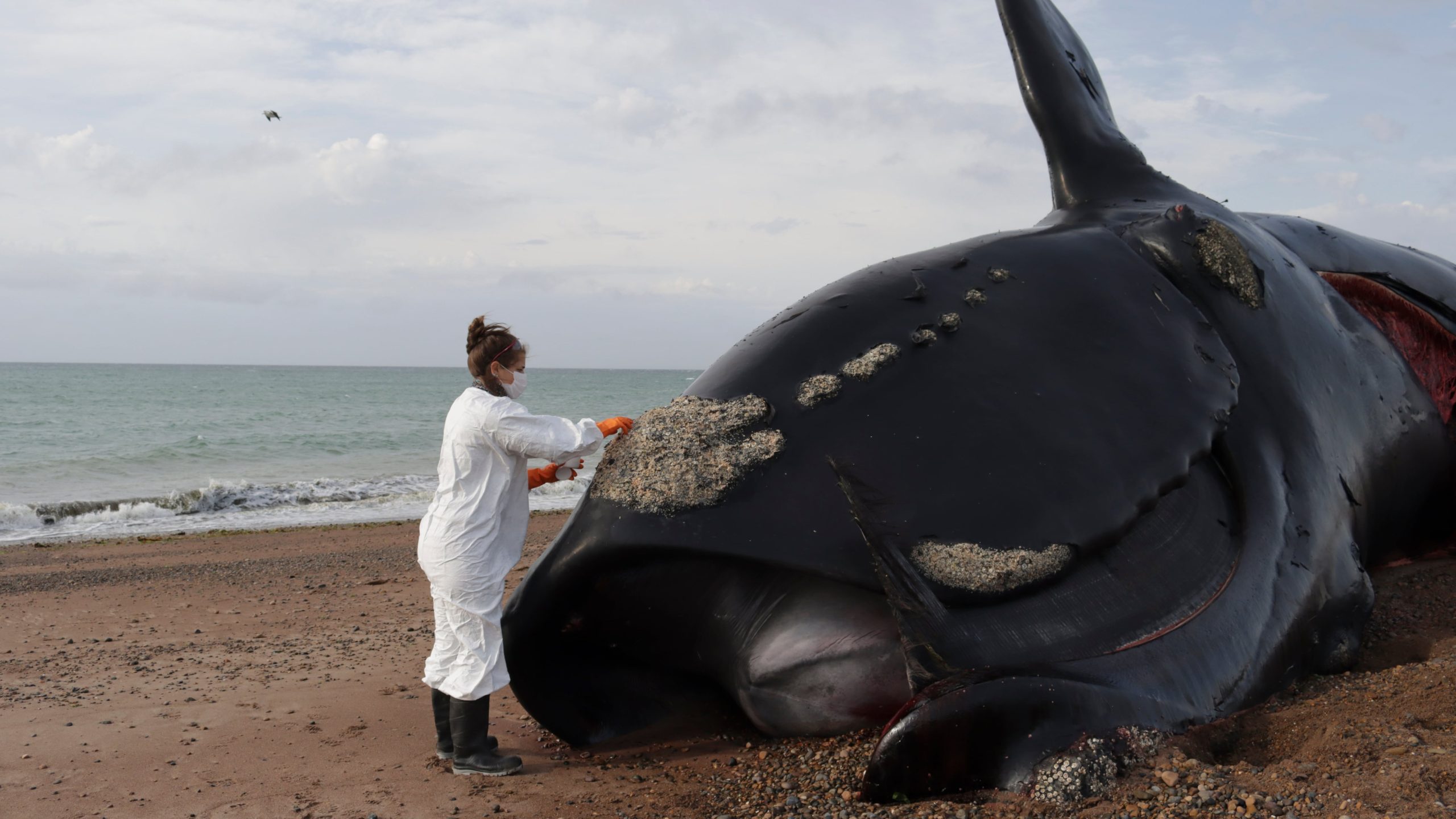
Each year, more than 1,000 southern right whales arrive from the cold waters near Antarctica to the gulfs of Península Valdés, in Argentina’s Chubut province, where they find favorable conditions for breeding and raising their calves. Between May and December, they become a defining feature of the Patagonian coastline, breaching or lifting their tails above the water close to shore. Although a small number of whales are found dead along the coast every year, the sharp increase in cases has alarmed scientists, who warn that this may become a record year for whale mortality.
While both scientists and authorities in Chubut province are refraining from releasing an official death toll until the season ends, unofficial estimates put the number at more than 300. Researchers already expect this year’s total to surpass the highest figures on record. The Southern Right Whale Health Monitoring Program in Península Valdés, conducted by the Whale Conservation Institute (ICB) since 2003, shows that calf mortality peaked in 2012, when 113 dead calves were recorded, while the highest number of stranded adults was documented in 2022, with 28 adults found dead along the coast.
According to Mariano Coscarella, a researcher at the Marine Mammal Laboratory of the Center for the Study of Marine Systems, this year authorities have found not only calves but also juvenile and adult whales, which is less common. The biologist says this reflects two distinct phenomena.
In the case of the calves, it has been established that the deaths are linked to a bacterium known as Erysipelothrix rhusiopathiae, which is associated with erysipelas, an infection that can cause severe systemic disease.
“It is a bacterium that lives on the whale’s skin and can enter through wounds, such as gull pecks, or through ingestion of food,” explains Coscarella. “We do not know in this instance which was the route of entry, but we know it was highly pathogenic for the calves.”
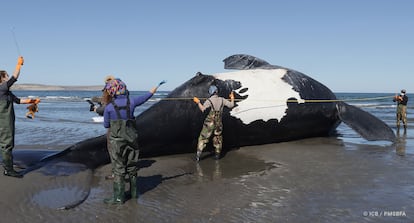
In the case of adult whales, the cause of death remains under investigation, although researchers suspect it may be linked to a harmful algal bloom, commonly known as a “red tide,” which produces toxins that under certain conditions can kill whales and other marine wildlife. The phenomenon is a recurring one, resulting from a combination of climatic and environmental factors, and it was also behind the mortality spike recorded in 2022.
According to the provincial government, necropsies and sample collection for scientific and microbiological analysis are being carried out as part of the Health Monitoring Program led by veterinarian Marcela Uhart from the University of California, Davis (UC Davis). “The samples collected from the whales found so far will be complemented, progressively and in stages, by a sampling program of water and shellfish in both gulfs [Nuevo and San José],” the government said.
“These are all situations we have seen before,” says Víctor Fratto, an environmental management specialist and one of the professionals conducting necropsies for the Health Monitoring Program. “In 2016, Dr. Carla Fiorito had already identified the death of a calf from this bacterium right here, and cetaceans have died of erysipelas in the Netherlands, the United Kingdom, California,” he adds, noting that the disease tends to affect younger animals more severely than adults because their immune systems are less developed.
Scientists began documenting the unusual mortality event as early as July, even before it became a topic of concern among local residents and tourists. They investigated whether changes in industrial production practices or the opening of a new factory in the area could be responsible, but, according to Coscarella, they found no direct evidence that human activity caused the deaths.
“That does not mean global issues such as climate change or the El Niño weather phenomenon have not altered oceanographic conditions in ways that allowed the bacterium to proliferate,” he adds.
When a whale strands on the coast, the protocol established by the Coastal Wildlife Network, which operates under Chubut’s Department of Flora and Fauna, dictates the response. If the carcass is in a remote or inaccessible area, it is left where it lies. If it washes up on a busy beach, however, it is removed as quickly as possible using heavy machinery to avoid the public health risks posed by 50 tons of decomposing flesh, and then it is buried.
According to monitoring conducted since 1999 by the Marine Mammal Laboratory, based in the city of Puerto Madryn and part of Argentina’s National Scientific and Technical Research Council (CONICET), the population of whales visiting Península Valdés, the largest southern right whale sanctuary in South America, has grown steadily over the years.
From roughly 500 whales recorded in the late 1990s, including about 100 calves, the population increased to 1,375 individuals this year, including 409 calves. The highest number was recorded during the 2025 season, when researchers counted 2,110 whales, including 816 calves. The species, which came close to extinction a century ago because of commercial whaling, is now protected as an Argentine National Natural Monument and attracts tens of thousands of tourists from around the world each year.
“The southern right whale is a long-lived species whose individuals reach reproductive maturity mostly at nine years of age,” the Whale Conservation Institute (ICB) said in a statement. “Therefore, the consequences for the population of a mortality event at one site are not immediate and cannot be assessed from isolated figures; they must be analyzed over broad temporal and spatial scales.”
Like government authorities, the institute urged patience while researchers work to understand the problem and its potential long-term effects.
Sign up for our weekly newsletter to get more English-language news coverage from EL PAÍS USA Edition
Spain’s Transport Minister Blames Rail Crash On ‘inexplicable Human Error’

Flávio Bolsonaro Lands In Miami After Fleeing Brazil Via Argentina

At Least 64 People Killed In High-Speed Rail Crash In Spain


-

 New Developments4 weeks ago
Luxury Villas For Sale, Estepona – ProjectL1
-
Blackout preparedness4 weeks ago
Brussels takes action against Spain over failure to update blackout plan
-
EU4 weeks ago
EU nicotine crackdown sparks warning that ex-smokers could be driven back to cigarettes
-

 Uncategorized4 weeks ago
Lewis Hamilton F1 wish could come true as stunning plans for new track revealed
-

 Housing access / crisis / affordability4 weeks ago
Radical Housing Decrees Defeated As Snap Election Talk Grows
-
British tourists arrested in Magaluf4 weeks ago
British tourists arrested after taxi driver left bloodied in Magaluf
-
Catalonia3 weeks ago
Why the rain opened a hole in front of Granollers’ courts
-

 %3 weeks ago
Spain Payslip Change Coming In January 2027