
Argentina
La Escapada De Bolsonaro: Huyó De Brasil A Argentina Y, Tras Hacer Escala En Ecuador, Voló Hasta Miami








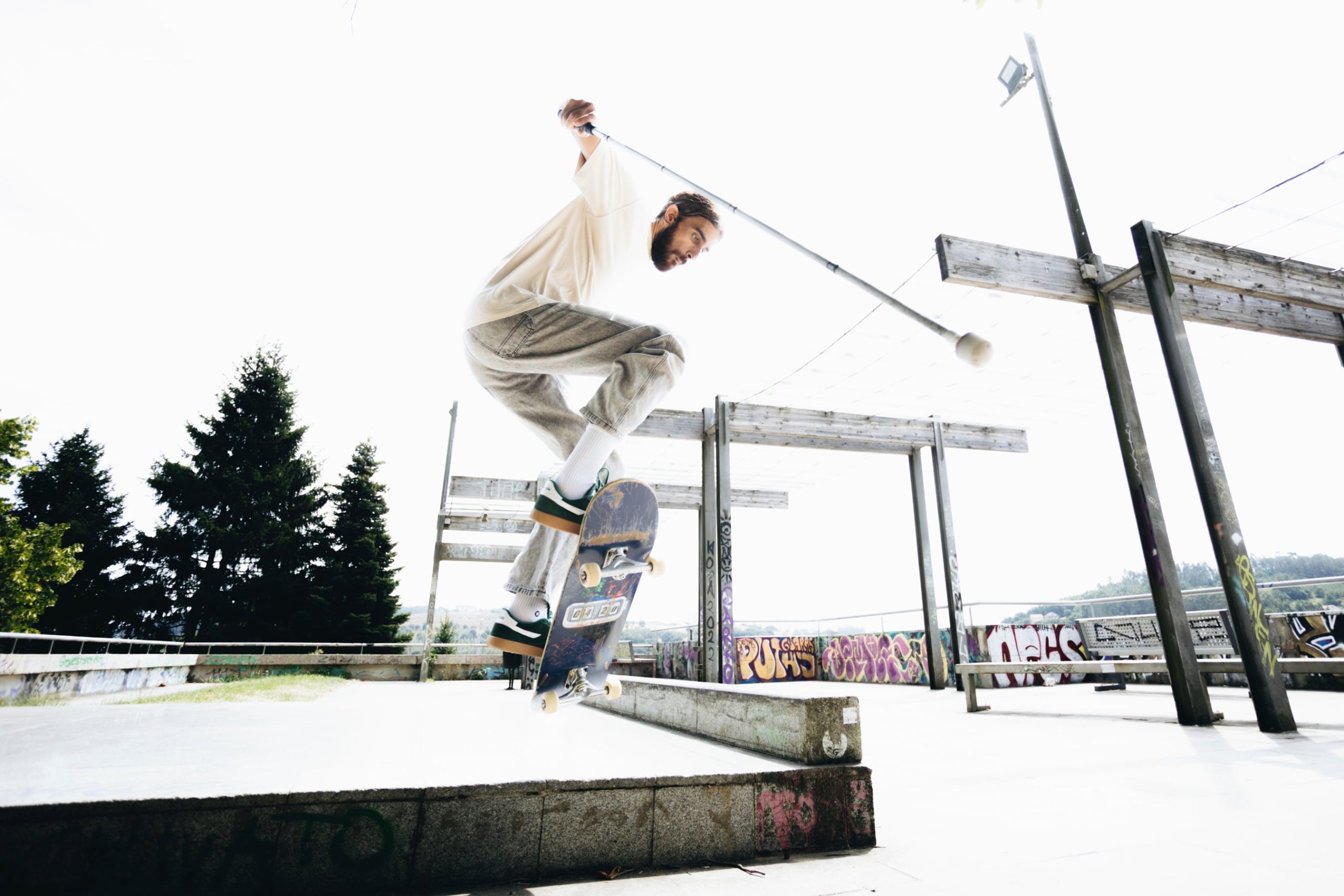
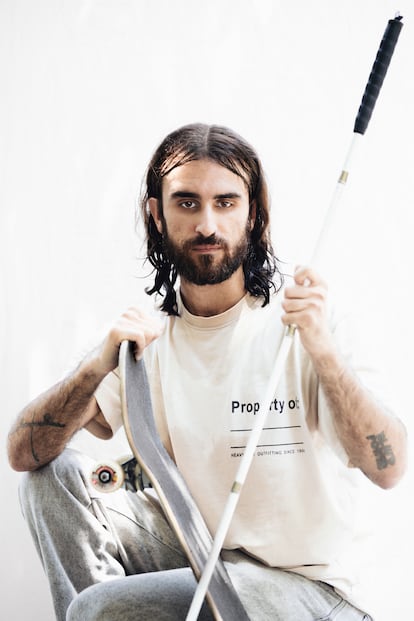
When Marcelo Lusardi went out to celebrate St. John’s Eve in the summer of 2016 with his skater friends in Spain’s northwestern region of Galicia, he never imagined how his life would soon change. While watching the bonfires on the beach, he realized something was clouding his vision, a kind of haze filling his right eye. In the weeks that followed the same thing happened to his left eye. Marcelo gradually went blind because of a rare disease, Leber’s hereditary optic neuropathy (LHON). He can see certain lights but, for practical purposes, he is blind. After 10 years, his story is considered one of the most inspiring in urban sports.
Lusardi, born 28 years ago in the capital of Argentina, Buenos Aires, has two major hobbies: skating and playing the electric guitar. As he was losing his sight, Marcelo would sometimes go down to the square with his instrument and a small Marshall amplifier. He wasn’t skating anymore. One day, already blind, a friend urged him to get back on the board for a spin. “I thought I was going to fall and that it was dangerous. But I agreed. And of course I fell,” he recalls as he does warm-ups before his skate session. He met us at the skatepark behind the regional parliament of Galicia in the city of Santiago de Compostela. He’s eager to finish soon so he can show two mates his new Telecaster guitar.
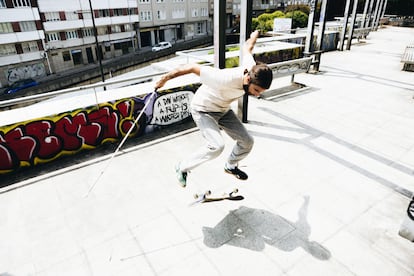
He returned to skating a few months after losing his sight. He’d skated since childhood but had to relearn almost from scratch. He mounts the board in the only viable way, with a cane in hand, and before attempting any trick he maps the spot with the cane’s wheel. “I never go alone to a new spot; always with someone who can see and warn me about things I might miss: curbs, handrails, changes in the surface… details I need to skate. I touch everything with the cane, with my feet, with my hands. I feel the material, the height of the curbs, the type of ground,” he explains. “Any information I can gather is useful to me.”
Eventually Lusardi threw himself off the top of a quarter pipe again, did flips, manuals and even jumped stairs. He began posting his feats on social media under the username The Blind Rider. One challenge he accomplished? “Getting back to doing an ollie to manual [jumping and landing on only the back wheels]. It’s something that’s very frightening when you’re blind and you can’t control well when you’re on the curb. It’s a sensation of flying without seeing,” he replies. “But it was also a challenge to learn Braille at 18.”
The surprise and admiration he provoked has translated into massive engagement. Someone very special shared his videos: the legend Tony Hawk, widely regarded as the greatest skater in history. “I really want to meet him someday and thank him from the bottom of my heart. When I saw it I almost cried, man,” he says.
Tattooed on his arm is his account logo: a skate and a white cane crossed to form an X. He now has more than 125,000 followers on Instagram. Many clothing and skate brands send him gear. He is an ambassador for the paraskate competition at O Marisquiño, the urban sports festival in Vigo that also hosts the World Cup Skateboarding event. It was a tough decision: “Ten years ago, when it all started, they had already asked me to participate as a solo exhibition. I’d been a fan of O Marisquiño since I was a kid and it intimidated me a lot. I advised them to hold an adapted skate competition, with people taking part with different disabilities, not just me there in the middle. They listened and I think it turned out really cool. I’ve been able to meet incredible people with very striking stories.” The competition offers the same prize money as the regular skate event.
In the world of skateboarding there is a debate about whether it should be included in the Olympic Games. One argument against it is how hard it is to judge. Lusardi has clear ideas about it. “I would love to see paraskate included too. There would be bigger sponsors, of course, but also more role models. When something like this happens to you you don’t know who to look up to, what to do or how to handle it. The role models I had were incredible people skating with one leg, but no blind skaters. Greater exposure helps you see that many problems have solutions or can be managed,” he reflects.
Not all tricks are coming off today: some look good in photos taken just before he falls, but Lusardi insists on repeating them even after the shot is taken: “Out of skater pride I have to do them properly.” One thing making it difficult are pebbles: small stones he can’t see that suddenly slow his board. People in the square sweep them away to help. There’s a striking moment in each of Lusardi’s falls. Rather than lifting him or treating him paternalistically, his friends cheer him on to keep trying.
Lusardi is defined by self-sufficiency. He works during the week and lives independently. “What I struggled with the most was cooking with flames. It’s pretty intimidating, but I make lentils that are amazing,” he laughs. He is an example of someone who overcomes adversity. The media have always treated him as a story of personal triumph. Does he feel comfortable with that? “Yes and no. I feel more like a survivor than someone who has overcome things in an epic sense. For me it’s more ‘I survived adversity’ than anything else.”
“I came out of a very dark place and today I’m happy and I do what I like,” he says. Which fears has he beaten and which still beat him? “I’ve won in the sense that I know I’m capable of much more than I thought; I’ve been pushing the limit upward and I’ve proven things to myself I never imagined. What still intimidates me is that, at my level, what I have to attempt now is very risky.” One trick he wants to conquer is the flip off a stair set. “I feel like it’s going to be the trick of my life. It’s a battle I have pending with myself.”
Some people write to him because they find him inspiring and others even ask for photos. “There were moments when it felt very crazy. I was a normal kid, not outstanding at anything. Suddenly standing out at something was intense. What stressed me the most were the numbers: I felt the pressure to make the most of the moment, to push it because a lot of people were watching me,” he reflects. “I contribute to the message that people shouldn’t obsess over the limits they think they have. They aren’t as solid as we believe; many barriers can be broken. It gives me peace to know that what I do serves more than just me.”
He has always said he wouldn’t change his process. “I wish I could see again, obviously. But going blind has given me so much that, strange as it may sound, I wouldn’t change my past. It has given me another way of looking at the world, it has made me value what skate, music and the people close to me bring.” Asked about gene therapies or Neuralink, he is concise: “No way I’m putting a chip in my head.”
There comes a moment when Lusardi speaks solemnly: “I have a very strong feeling: since I surpassed myself, returned to skating and became happy again, I feel that if I had died at that moment I would have left this world in peace.” His story is that of someone who became an example without seeking it. He simply looked for a reason to get up every day. “I went blind at 18 and since then I am at peace with what I was dealt.”
He finishes the day drenched in sweat and with his list of tricks completed. He changes his T-shirt and puts on sunglasses. He grabs his phone quickly. Fer and Alex are waiting to play guitar.
Sign up for our weekly newsletter to get more English-language news coverage from EL PAÍS USA Edition

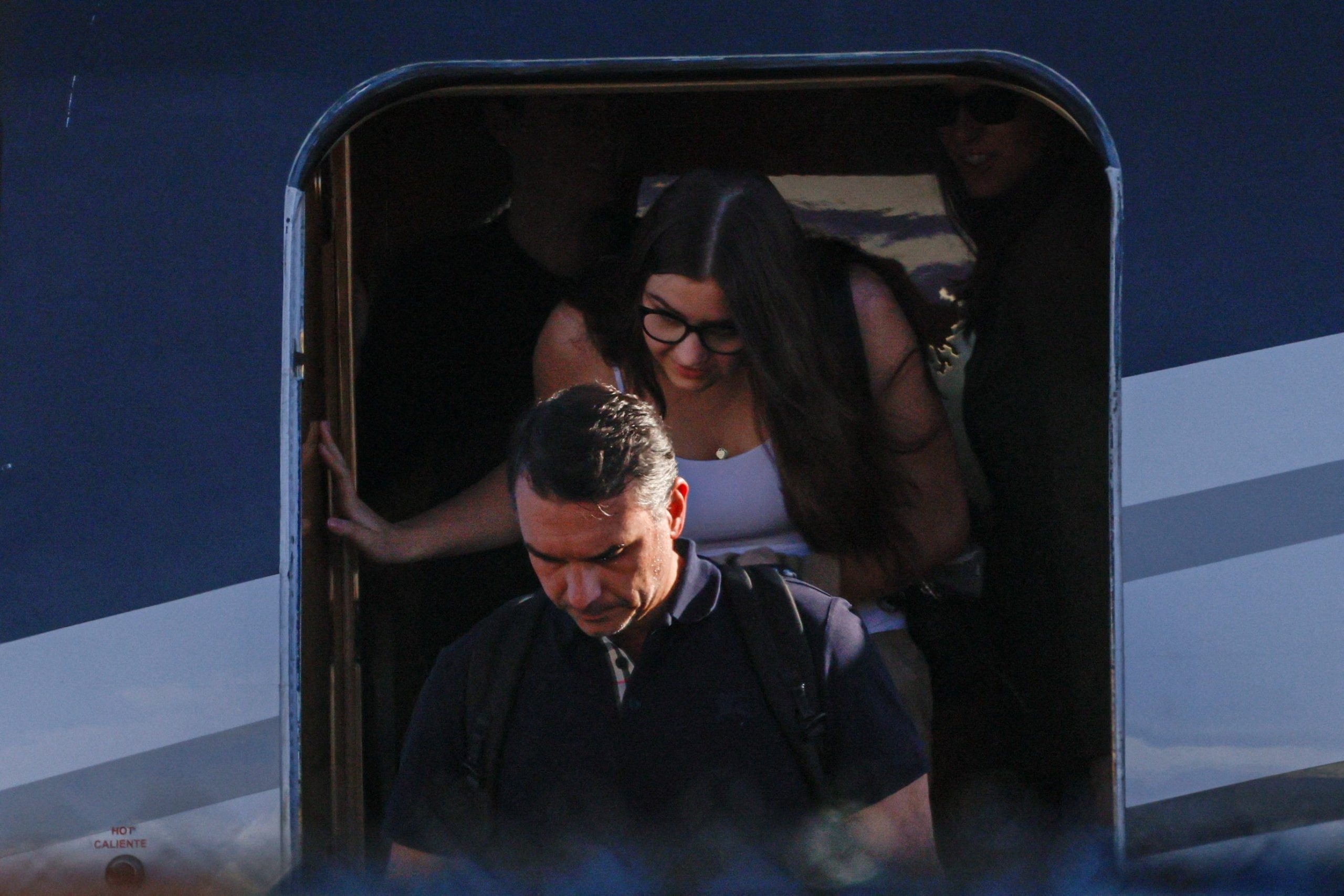
The flight of far-right Brazilian politician Flávio Bolsonaro has exposed covert support from the Donald Trump administration and a network of alliances among conservative governments on the continent, encouraged by Washington, that collaborated to enable his escape. Bolsonaro’s departure for Miami — just one day after insisting he would lead the opposition to the newly re-elected Luiz Inácio Lula da Silva — demonstrates the existence of a Latin American bloc not only ideologically aligned with Trump but willing to act according to his logic, disregarding international treaties, several analysts said.
“It’s a network behaving identically to Trump’s, where international law has no relevance. The U.S. administration feels no respect for it and the Bolsonaro case is further proof. This creates a contagion effect among his regional allies, who choose to ignore legality. Trump sets the pattern and his allies avoid any decision that might anger him: they are aligned and follow the policy he defines,” says Michael Shifter, former president of the Inter-American Dialogue and one of Washington’s most influential hemispheric policy analysts.
Shortly after returning to the White House for his second term, Trump infused the federal administration with his particular geopolitical vision — a view that seeks to restore U.S. preeminence in the Western Hemisphere, according to the National Security Strategy published by the Pentagon late last year. The Defense Department’s new plan aims to reinstate the Monroe Doctrine, named for U.S. President James Monroe, who in the early 19th century formulated the idea of “America for the Americans,” an ideology that consolidated U.S. hegemony across the Americas and encouraged interference and intervention in Latin American countries.
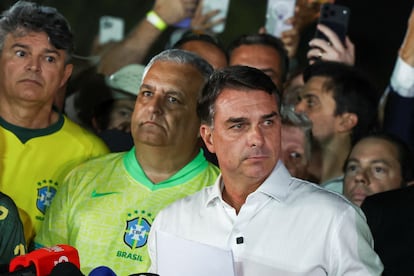
The strategy has found backing among his allies. A few months before Brazil’s election, the son of former president Jair Bolsonaro — who was sentenced to 27 years in prison for plotting a coup after the 2022 elections — visited Trump in the Oval Office, an unusual move for a candidate. There, according to U.S. media reports, they agreed that Trump would not publicly endorse Bolsonaro because it could be counterproductive, but in recent months the U.S. president has made things difficult for the Lula da Silva government. And now he has welcomed Flávio in his country.
The fact that the United States, under Trump’s leadership, allowed Flávio Bolsonaro to flee Brazil — where he is under investigation for corruption cases, including money laundering — sets a dangerous precedent in the region, Michael Shifter says. “Everything Trump does sets a precedent,” he notes. “There’s a long list of unprecedented acts, and this is a very worrying precedent because it shows there is no regard for any law, regulation or court order,” he explains.
The occupant of the White House has meddled in every presidential election held in the region over the past two years to favor the most conservative candidates. Trump openly backed Argentina’s Javier Milei in last year’s legislative elections. Washington facilitated a $20 billion financial rescue to sustain the Argentine currency during a period of financial turbulence. And without much hesitation it conditioned that aid on the populist Argentine’s electoral victory.
Imposing the Monroe Doctrine
It was the clearest example of interventionism, although Trump also meddled in other elections through explicit messages of support on his social network, Truth, designed to favor right-wing hopefuls aligned with his cause. He publicly backed Nasry Asfura in Honduras. He also staged his “full support” for Abelardo de la Espriella in Colombia’s presidential race. Over the last two years, Trump has kept the carousel of endorsements going with Keiko Fujimori in Peru, Rodrigo Paz in Bolivia, and Laura Fernández in Costa Rica. Last November he declared his support for far-right José Antonio Kast to become Chile’s next president.
All these new conservative allies signed an agreement to create the so-called Shield of the Americas, an association of American countries to fight drug trafficking and organized crime. Trump staged the founding of the new organization last March at Doral (Miami), in a summit attended by a large representation of leaders who bowed to the U.S. leader’s dictates. The Shield of the Americas, however, is also a Washington instrument to cement its new foreign policy toward Latin America: under a neocolonial vision dubbed the “Donroe doctrine,” a play on James Monroe’s strategy combined with Donald Trump’s name.
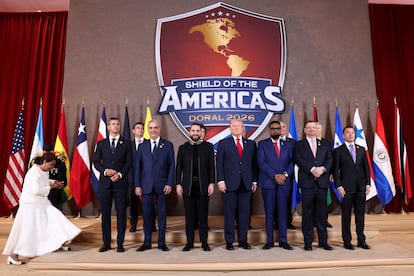
Since Trump returned to the Oval Office two years ago, this strategy has forged an alliance with Latin America’s conservative presidents, showing favoritism and at times disparaging their rivals.
The political shift in the region is evident. A total of 17 allied, right-leaning countries have joined the Shield of the Americas founded by the United States. In the region, practically only Brazil, Mexico, Uruguay, Guatemala, Nicaragua and Cuba are governed by leftist parties. Although Trump did not publicly back Flávio Bolsonaro in Brazil’s presidential race, he maneuvered to favor him.
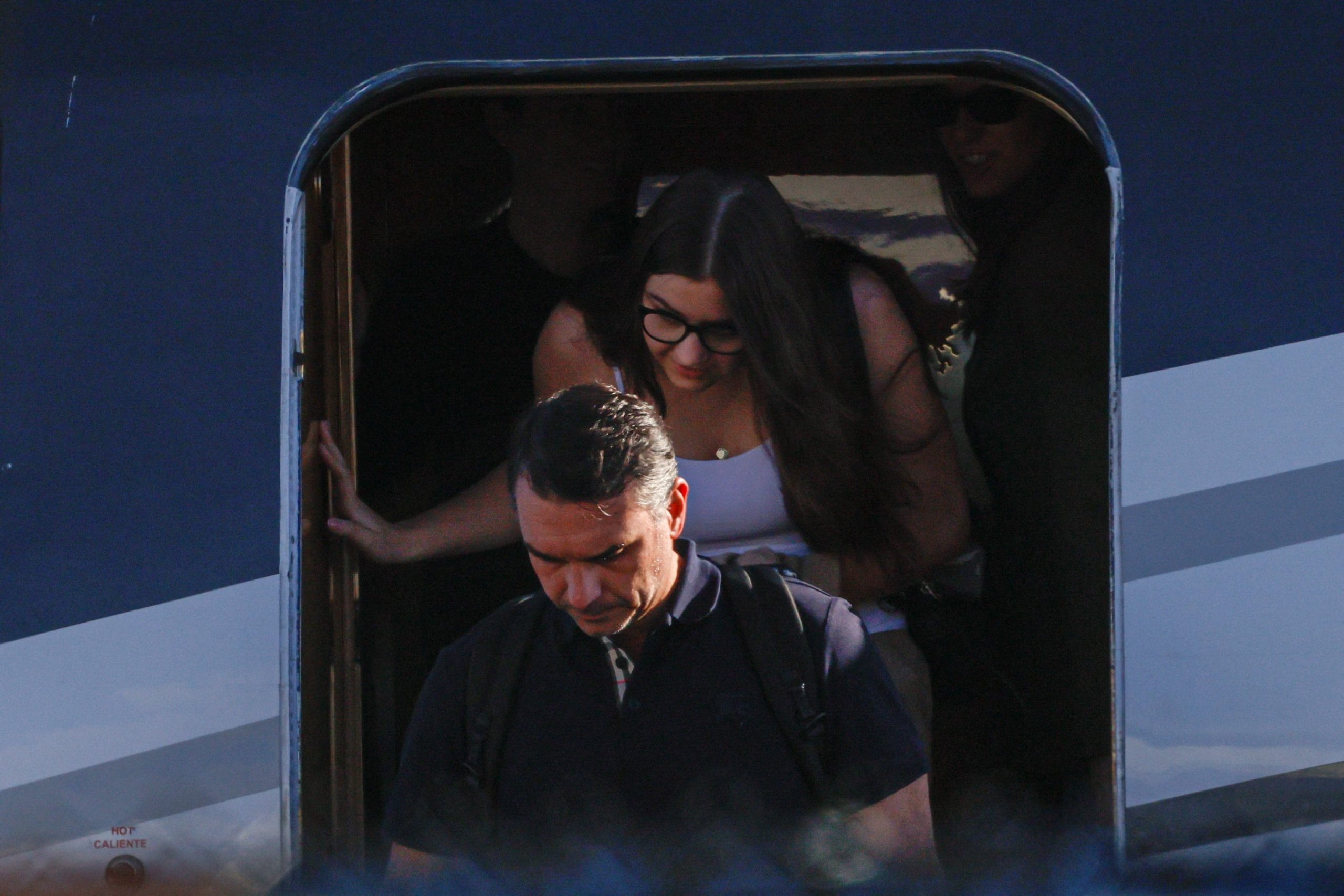
That alignment enabled Bolsonaro’s unpunished exit from Brazil, evading Brazilian law. Katya Salazar, director of the Due Process of Law Foundation (DPLF), an organization that promotes human rights and the rule of law in Latin America, criticizes the support provided by the governments of Argentina’s Javier Milei and Ecuador’s Daniel Noboa in facilitating the senator’s escape; late Tuesday night he crossed the land border into Argentina by vehicle with his wife and two daughters. At 11.30 p.m. (local time), the family boarded a private flight operated by Baires Fly S.A. bound for Guayaquil that departed after midnight.
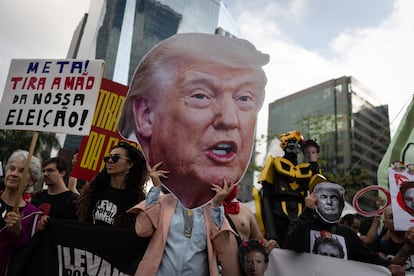
“Argentina and Ecuador’s support for Bolsonaro’s departure is especially troubling because there were explicit judicial restrictions preventing him from leaving the country. Ideological affinity weighed more than respect for justice,” Salazar says. “This kind of solidarity between governments is not exclusive to one political sector; we have seen it across the ideological spectrum. But precisely for that reason, we must insist on a basic principle: political affinity cannot justify evading the law or disregarding court rulings,” she adds. “The precedent is awful for the Americas, especially in a context where the United States plays an increasingly active role in backing like-minded leaders. Accepting these behaviors means normalizing a logic where alliances prevail over institutions. The region cannot afford that,” she warns.
Internal fractures
Both Ecuador and Argentina are part of the Shield of the Americas. For Michael Shifter, the bloc shows severe fissures despite the firmness of its rhetoric and joint maneuvers such as Bolsonaro’s flight. “The electoral result in Brazil was a very heavy blow to Trump’s policy toward Latin America and to his ambitions of showing a fully aligned region,” he says. “The two largest economies in the area, which account for more than half the population and the largest GDP, are now on the other side. That trend toward automatic alignment is going through a very complicated moment,” he argues.
Added to that is the fact that governments such as those of Chile, Argentina and Ecuador face serious internal problems that suffocate their leaders: from the uncontrolled wave of violence besieging Noboa, to the low popularity levels of Chile’s José Antonio Kast or Peru’s Keiko Fujimori, who has just assumed the presidency with severe political wear.
“You can see the consolidation of a bloc sympathetic to Trump, willing to operate outside traditional legal parameters, but at the same time it is a bloc weakened by each country’s internal circumstances, which raises doubts about the sustainability of that alignment,” Shifter explains. At the social level, polls also reflect a deterioration in the image of the United States compared with a more favorable perception of China.
“The relationship with Washington is complex. It is true that these leaders maintain loyalty to Republican leadership, but they also know the political map in Washington could be reconfigured after the midterm elections, which would alter their calculations,” Shifter warns. A possible weakening of Trump at the ballot box would directly affect dynamics with his Latin American partners. “Trump will keep a lot of power, but not the same. And that matters for the historic tutelary relationship the United States has with the region,” he concludes.
Sign up for our weekly newsletter to get more English-language news coverage from EL PAÍS USA Edition


Meet Rescued Horses In Coin

Minimum Wage Workers In Spain Could Get €65 A Month More From January

Casares World Cheese Awards Debut


-
DGT3 weeks ago
Viral video in Spain sparks fury over drivers who ‘have no idea how to drive’
-

 Arabia Saudí4 weeks ago
Un Ataque De Los Hutíes Contra El Aeropuerto De Riad Causa Al Menos 12 Muertos Y Más De 300 Heridos
-

 America4 weeks ago
Un Tirador Mata A Ocho Personas En Una Vivienda En Pensilvania
-
Automated supermarket3 weeks ago
Spain’s 24-hour shop with no tills expands to Barcelona Airport
-
 %4 weeks ago
Concrete Balcony Slabs Collapse Onto Marbella Street
-
News from Spain4 weeks ago
Spain police warn parents over WhatsApp scam that uses their children’s real accounts
-

 Uncategorized4 weeks ago
Williams F1 driver caught up in four-car pit lane pileup
-
Keeping cats and dogs outside3 weeks ago
Spain’s pet owners face fines of up to €200,000 for animal welfare offences