
Catalonia
Why the rain opened a hole in front of Granollers’ courts

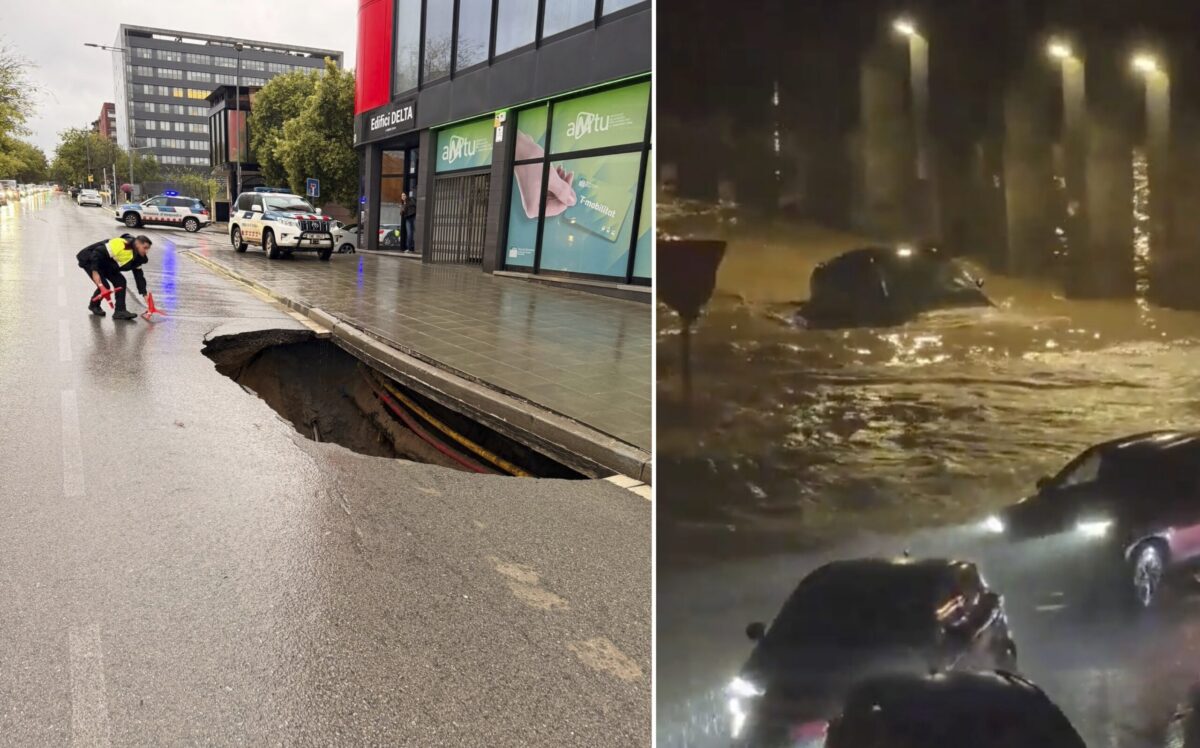
The weekend storm in Catalonia was already a serious travel story. Monday’s rain did something else. It opened the road.
Two sinkholes appeared in Granollers, in the Vallès Oriental, after ground soaked since Saturday took another 107 litres per square metre in a morning, about 50 of them in half an hour. The town’s running total is now about 350 litres.
The larger hole is on Carrer Josep Umbert i Ventura, in front of the courts. Firefighters put it at about five metres across and six deep. Offices opposite, including the courthouse, were evacuated. No one was hurt, the buildings were cleared, and staff were allowed back. The hole is still cordoned off, and crews warned it could grow. A second collapse opened on Carrer Equador, in the Font Verda neighbourhood. The ring road flooded, Rodalies stopped, water reached hospital stores, and schools stayed shut. Protecció Civil sent an ES-Alert and, for a time, told the county to stay indoors.
Sinkhole season: Beware post-rains roads
Holes like these are a regular Spanish autumn event, and they are not usually the limestone caves people picture. The word in Spanish is socavón, and most of the ones that open after a cloudburst are washouts. Rain finds a crack in the asphalt, or overwhelms a gully, and runs into the layers under the road. Once that sub-base is saturated it loses its strength, and the carriageway drops into the void. Spain is well set up for it.
Long dry spells bake and crack the surface. A Mediterranean downpour can then dump a month of rain in an hour, onto drains that were never built for that. Blocked culverts and ground already full from a previous storm do the rest. There is a slower kind too. Large parts of the east and south sit on limestone, and water widens fractures for years before a doline appears with little warning. The Granollers holes look like the first kind: a road that had simply taken all the water it could.
Autumn storms in Spain
Monday was a second burst, not a repeat of Saturday’s airport closures. It still added to the toll. A second person was found dead in a flooded garage in Montornès del Vallès, after the death at a Tordera campsite already reported. Crews are still searching for a person swept away on Sunday in the stream at Pineda de Mar. The day brought at least 1,650 calls to 112 and about 46 rescues, including a woman and a three-year-old pulled from a car in Coma-ruga. On Sunday the Besòs touched about 900 cubic metres a second at Santa Coloma.
Extremadura had its own red-alert afternoon on Sunday, separate from the Catalan coast. Tierra de Barros, La Serena and the south of Badajoz were the focus. The regional flood plan was switched on, an ES-Alert went to 90 municipalities, Barcarrota recorded 79 litres, and roads were cut around Salvatierra de los Barros. The damage has not matched events further east.
New alerts signal danger
Tuesday is still the wet day flagged on Sunday, but the warnings have shifted. Orange alerts now cover Huesca and Lleida. Extremadura, Toledo and Salamanca are on yellow, with the heaviest falls still expected there, across western Castilla-La Mancha, the Sistema Central and the Pyrenees. Hail is possible. Yellow warnings also cover much of Andalucia, Galicia, Madrid and the Barcelona coast. Stay out of streams and underpasses, and do not drive through standing water.





F1 star swaps four wheels for two on mammoth 350km Singapore ride
Spain faces major 24-hour general strike this autumn — how it could affect you
Why the rain opened a hole in front of Granollers’ courts


-

 Uncategorized2 weeks ago
F1 Qualifying Today: Azerbaijan Grand Prix schedule, times and TV channel
-

 %2 weeks ago
Is Your Supermarket Kefir Really Kefir? Spanish Study Raises A Surprising Question
-
Latest2 weeks ago
‘It’s The Law Of The Jungle’: Pensioner’s Eviction Exposes Spain’s Housing Crisis
-
Barter system2 weeks ago
British drug dealer swaps cocaine for Pokémon cards in bizarre barter deal
-
Balearic Islands2 weeks ago
Tourists driving to Menorca could soon need a permit and pay to bring their car
-

 Cody Gakpo2 weeks ago
Xavi Y Klopp Se Reparten Puntos En Su Debut Como Seleccionadores
-

 Uncategorized6 days ago
F1 Bahrain Grand Prix will be live and FREE on TV this weekend
-

 Argentina2 weeks ago
Mexico Joins Latin American Crackdown On Cellphones In Schools