Connect with us

%

The World Was Supposed To End Today: 1960 Scientists Got Their Doomsday Prediction Wrong

Published

on

the-world-was-supposed-to-end-today:-1960-scientists-got-their-doomsday-prediction-wrong

It was not a forecast of an asteroid or the physical destruction of Earth. Photo credit: porst13/Shutterstock

If anyone who follows predictions closely was expecting the world to end today, you can put the emergency supplies away. A prediction published in the scientific journal Science in 1960 named today as the date humanity would reach a mathematical breaking point. Thankfully for use the calculation was based on population growth continuing at a rate that did not last.

The paper, titled ‘Doomsday: Friday, 13 November, A.D. 2026’, was written by Heinz von Foerster, Patricia M. Mora and Lawrence W. Amiot, and appeared on November 4, 1960.  Its subtitle explained the claim: the human population would approach infinity on that date if it continued growing as it had over the previous two millennia. It was not a forecast of an asteroid or the physical destruction of Earth.

The researchers used historical population estimates to build a mathematical model. Extending the trend produced a curve that rose ever more steeply towards infinity, a point at which the equation could no longer describe a real population. Even the date came with uncertainty: the paper’s calculation gave an estimate of 2026.87, with a margin of roughly five and a half years either side, according to the original paper.

Why the prediction failed

The global population is still increasing, but it is not growing at the accelerating rate assumed by the 1960 model. According to Our World in Data, using United Nations figures, the annual growth rate peaked at around 2.3 per cent in 1963. By 2020, it had fallen below one per cent. Falling birth rates are a major part of that change. Families in many parts of the world have fewer children, while longer life expectancy means the total population can keep rising as growth slows.

Population forecasts depend on assumptions that must change when real-world behaviour changes. The model projected a population racing towards an impossible figure; the United Nations estimated the world population at about 8.2 billion in 2024.

The UN’s latest published projections do not suggest an infinite population or an imminent collapse. Its 2024 World Population Prospects report expects the global population to reach a peak of around 10.3 billion in the mid-2080s, before edging down towards the end of the century. It also says there is an 80 per cent probability that the world’s population will peak during this century.

A warning, not a date with doomsday

The 1960 paper’s dramatic title has helped it resurface whenever November 13, 2026 is mentioned. Population growth, resources and the pressure placed on the planet remain important questions. What has changed is the evidence. Birth rates have fallen, population growth has slowed and demographers now use far more detailed data and projections than the historical curve available to researchers in 1960.

So, while the date in the paper has arrived, the world has not reached the mathematical endpoint its authors calculated. Friday the 13th is simply another day, but saying that, there is still plenty of the day left, so hopefully I wont have to put my foot in my mouth. Still, the prediction is a reminder of what can happen when a trend is extended into the future as though it will never change.

%

Concrete Falls From Los Boliches Railway Bridge

Published

on

concrete-falls-from-los-boliches-railway-bridge

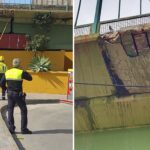
Falling to rack and ruin in Fuengirola. Credit: EWN

Fuengirola residents demand action as railway bridge deteriorates despite repeated warnings.

Residents in Fuengirola are increasingly concerned about the condition of railway infrastructure after another incident involving falling concrete from the elevated railway structure near Los Boliches station on Tuesday, November 10.

An elderly local woman was walking close to the station when pieces of concrete reportedly began falling from the structure above her. Concerned that somebody could be seriously injured, she immediately contacted the emergency services.

Police vehicles and two fire engines arrived within minutes. Firefighters subsequently removed fallen concrete and other loose material from the structure in an attempt to reduce the danger to pedestrians and passing traffic.

Photographs taken at the scene show a substantial area of damaged concrete, with sections of reinforcing metal exposed and visible deterioration around the affected area. A hole approximately one metre long was also reported in the concrete structure supporting the railway.

The incident has once again raised questions about the maintenance of the coastal railway, particularly as the central government, who is legally responsible in this case, have reportedly been warned about the problem previously. Today, nothing but a strip of police tape warns of the danger of falling concrete.

Adif warned but concerns continue

According to information provided by another concerned resident, both Fuengirola Local Police and the town hall have notified Adif, the state-owned company responsible for Spain’s railway infrastructure, about the deterioration. However, the local Malaga government says that despite these notifications, the situation has not been properly addressed.

The latest emergency response involved firefighters removing loose material, but residents want to know whether a comprehensive structural inspection has been carried out and when permanent repairs will take place.

There were also initial concerns about whether trains should continue running while firefighters dealt with the situation. Services were reportedly allowed to continue, with Renfe ordering trains to reduce their speed when passing the affected section.

In a previous incident, a pedestrian narrowly avoided being struck when a piece of concrete fell from the elevated railway structure at Los Boliches station. Firefighters attended and Local Police recorded a formal statement.

Read the earlier report: Crumbling railway: Fuengirola pedestrian narrowly avoids falling concrete at Los Boliches Station.

The recurrence of falling concrete in the same station area, following the earlier incident, raises fresh questions about what action was taken after the first warning.

Costa del Sol infrastructure under scrutiny

Concerns about deteriorating infrastructure are not limited to Fuengirola. Several Costa del Sol mayors have been publicly demanding improvements to transport links and greater investment in infrastructure.

Mijas mayor Ana Mata recently criticised the lack of progress, saying that the area had effectively been left with infrastructure dating back to the 1980s.

Speaking at a mobility forum in Malaga on November 12, she said: “En materia de infraestructuras, nos hemos quedado en los años 80.” (In terms of infrastructure, we’re stuck in the 80s). Her comments reflected growing frustration about the pressure on roads and public transport as the population of the Costa del Sol has increased.

Estepona mayor José María García Urbano has also repeatedly called for improvements to the A-7, including better access arrangements and investment in the busy coastal road.

For residents, the concern is increasingly about whether essential infrastructure is being maintained sufficiently, rather than simply whether new projects are being delivered. Many locals now complain how it looks like it is all going to “rack and ruin.”

Railway disasters increase public concern

The latest Fuengirola incident comes at a particularly sensitive time for Spain’s railway network. The January Adamuz disaster, which claimed 46 lives, and the October 28 collision near Urda, which killed 69 people, have shaken public confidence in railway safety.

The consequences have extended to the highest levels of the Transport Ministry. Óscar Puente resigned as Transport Minister on November 3, accepting political responsibility for the Urda disaster. Adif president Luis Pedro Marco de la Peña subsequently resigned. The tragedies have also prompted renewed demands from railway workers for greater investment in maintenance and improved safety procedures.

Although there is no suggestion that the damage at Los Boliches is connected to either railway disaster, the latest incident has added to public anxiety about the condition of the country’s transport infrastructure.

For the resident who raised the alarm in Fuengirola, the concern is straightforward: people should not have to walk beneath a railway structure fearing that pieces of concrete could fall on them.

With previous warnings reportedly already passed to Adif, residents now want answers about inspections, repairs and who is ultimately responsible for ensuring that the structure is safe.

How many more warnings will it take before something is done?

Continue Reading

%

Dog Biscuits Containing Cannabis Expose €600,000 Illegal Laboratory In Barcelona

Published

on

dog-biscuits-containing-cannabis-expose-e600,000-illegal-laboratory-in-barcelona

Officers also immobilised around 1,750 litres of oils. Photo credit: Guardia Civil

Dog owners buying treats and oils for their pets would hardly expect them to lead police to an industrial cannabis laboratory. But biscuits containing cannabis derivatives, found during inspections of specialist shops in Barcelona province, helped uncover a business producing and selling thousands of products, with narcotic substances worth more than €600,000.

The Guardia Civil dismantled the laboratory in La Llagosta in an operation announced on November 12. Two people are being investigated on suspicion of drug trafficking: the company’s owner and the chemical engineer who ran the laboratory. No arrests have been reported.

Following the Crumbs

The investigation began in July 2025, when officers inspected specialist cannabis-growing shops, known as grow shops, across Barcelona province. During those checks, they found biscuits and oils for animals containing cannabidiol, or CBD, supplied by a company based in La Llagosta.

The products prompted further enquiries into their origin and the business behind them. Investigators traced the supplier to two industrial units. One was used to store goods and prepare customer orders, while the second contained production areas and laboratories where oils were extracted and cannabis resin made, weighed, labelled and packaged.

More than €600,000 in drugs seized

The scale of the operation became clear when officers searched the premises. They seized 11.5 kilos of hashish, almost seven kilos of marijuana buds and more than 133 litres of cannabis oil, packed into 17,657 bottles. Thousands of vaping products and refills were also found. Laboratory testing by the National Institute of Toxicology and Forensic Sciences identified cannabis and cannabis resin, as well as psychotropic substances including hexahydrocannabinol (HHC) and H4-CBD.

The Guardia Civil said these substances are subject to controls and authorisations and cannot be sold freely as consumer products. The discovery does not make every CBD product illegal. Investigators focused on the substances identified in this case and the authorisations required to manufacture and sell them legally.  Officers also immobilised around 1,750 litres of oils intended for manufacturing, more than 705 litres of cannabis cosmetics and 416.2 kilos of plant material.

Seeds, CBD tea packaging, dog biscuits and machinery used to extract oils and make resin were among the other items secured. The estimated retail value of the substances identified as narcotics exceeds €600,000. That figure relates to the controlled substances, rather than the total value of every product and item found at the premises.

Orders were sold online

Customers placed orders through the company’s website. Once payment had been received, the logistics unit prepared and dispatched the goods. If an item was out of stock, it could be made at the company’s own laboratory. According to investigators, the owner managed the business from Thailand, while the chemical engineer oversaw the laboratory, including product formulations, composition and quality and safety checks. The company is believed to have been selling these substances since 2018.

The investigation was carried out by the Guardia Civil’s Manresa unit, with support from its Fiscal and Border Patrol and SEPRONA, the nature protection service. The case and seized materials have been placed before the Civil and Investigation Section of the Court of First Instance in Mollet del Vallès. The investigation remains ongoing.

Continue Reading

%

Chaparral 7 Walkers Arrive Home

Published

on

chaparral-7-walkers-arrive-home

Tired but happy after a wonderfully successful walk for local charities Credit: EWN

Tired legs, wide smiles and a welcome that only a close-knit community can give. The Chaparral 7 have finally arrived safely back in La Cala de Mijas, and the mood on the seafront was pure joy.

Chaparral 7 finish their 100-kilometre walk in La Cala

Seven friends set off from Nerja on Tuesday, November 10, determined to raise money for two much-loved animal rescue charities, ACE-SHIN and Donkey Dreamland. Four days, lots of laughs and 100 kilometres later, they reached the Torreon in La Cala de Mijas right on time at 3.45pm on Friday, November 13, to a crowd that had been waiting patiently to cheer them home.

Residents and visitors turned out in numbers, clapping, waving and snapping photos as the team came into view. Familiar faces joined the welcome too, with Jasmine Harman, Heather Mills and Mark Clattenburg on hand alongside a Channel 4 production team to greet the walkers across the finish line. Fabienne Paques from ACE-SHIN and Amaya Isert of Donkey Dreamland were both there as well with big smiles to join the welcome.

Rain had only just cleared, and the sun came out in time for the big moment. Remarkably, every one of the walkers looked fresh and in high spirits.

€17,000 so far raised for ACE-SHIN and Donkey Dreamland

Total raised stands at €17,000 at the time of writing, a figure that will go a long way for the animals in their care. ACE-SHIN, based in La Cala de Mijas, rescues and looks after animals in need, while Donkey Dreamland gives rescued and retired donkeys a safe and happy home.

Organisers had hoped to reach €20,000, and donations are still welcome for anyone who wants to help the team get there. Every euro goes towards the daily care of the animals who depend on these charities. Sponsors Runway Glass & Window Cleaning helped back the challenge from the start.

Rain, chiringuitos and plenty of laughs

Shaun, one of the team, told Euro Weekly News he was really happy, as was everyone else, and admitted he was glad it was not five days!!! Everyone did well, he said, even though the group had to battle four hours of on-and-off rain while walking past Malaga.

Spirits stayed high, helped along by regular dips in and out of chiringuito.. Despite the wet weather, Shaun described the whole experience as great.

How you can still support the Chaparral 7

The team were finishing up at the beach then heading on over to local’s favourite Biddy Mulligan’s Irish pub, where supporters could meet the walkers, join the raffle and give a little more to the two charities. Anyone who missed the finish can still donate through the Chaparral for Good website at chaparralforgood.com.

A rainy coastline, a big-hearted community and seven determined friends have shown once again what local people can achieve for animals in need.

Continue Reading

Trending

Copyright © 2017 Spanish Property & News