Connect with us

%

All Of La Palma Goes Dark As 50,000 Customers Lose Power During Maximum Storm Alert

Published

on

all-of-la-palma-goes-dark-as-50,000-customers-lose-power-during-maximum-storm-alert

More than 50,500 customers on La Palma were left without power on Monday. Credit: Brian A Jackson / Shutterstock

Residents across La Palma woke to no electricity at all on Monday as torrential rain battered the east of the island. The cause isn’t known yet, though the island’s only main power line had already failed earlier that morning.

More than 50,500 customers lost power

The whole island of La Palma lost its electricity at around 6.40am local time on Monday November 2, in what the Canary Islands Government is calling a ‘cero energético’. Endesa, the company that distributes electricity on the island, said 50,508 customers were left without supply.

The Canary Islands Government’s emergencies department then declared an alert under its civil protection plan, known as PLATECA, so the agencies involved can be coordinated and the impact on essential services checked. Spain’s Territorial Policy Minister Ángel Víctor Torres said Madrid was in contact with the Canarian authorities.

The island’s only main power line was already down

The 66,000-volt Guinchos-Valle line, the only transmission line on La Palma, had suffered a fault earlier that morning. It’s run by the national grid operator Red Eléctrica. The Los Guinchos power station, the island’s diesel-fired plant, also disconnected for reasons that haven’t been explained yet. Red Eléctrica is now bringing supply back as the plant’s generating units reconnect, although by mid-morning it hadn’t given a time for full restoration. Red Eléctrica sources suggested the storm could be linked. However, Endesa hasn’t identified the cause.

La Palma isn’t connected to any other island or the mainland, which is why one failure can take everything down. The Canaries run on five separate electricity systems, so there’s nowhere to borrow power from either.

Rain topped 138 litres per square metre in 12 hours 

The blackout hit with the island already under the highest level of rain alert, in force since 2am. The Canary Islands Government recorded 62 litres per square metre in a single hour in the east of La Palma and 138 litres over 12 hours.

In Breña Alta and Breña Baja, water had to be pumped out of homes and businesses overnight, with some drains overflowing.

The rest of La Palma, La Gomera and El Hierro are on alert, while Tenerife and Gran Canaria are on pre-alert. Very intense showers of more than 30mm an hour are possible on the western islands, most likely until 3pm, though authorities admit the forecast is uncertain. 

It’s not the first time La Palma has gone dark

A total blackout last hit the whole island in June 2025 and lasted more than three hours, as we reported at the time in our look at why the island keeps losing power. It was the first island-wide outage since September 2021, during the Tajogaite volcanic eruption, when 85,000 people lost power for 12 hours.

Back then, the Canary Islands Government blamed ageing generators at Los Guinchos. However, Red Eléctrica denied that the fault began at its own substation.

In July 2025, Endesa said it was the only company to bid in a state tender for new generation on the island, with diesel systems due to be replaced before 2029.

Authorities are telling residents to stay off the roads

Canary Islands president Fernando Clavijo said no one had been hurt, although there have been incidents from water building up. He urged people to avoid unnecessary journeys, stay away from flooded areas and use their cars as little as possible so emergency services can get through.

Updates on the restoration are being posted on the social media profiles of Red Eléctrica and 112 Canarias, the regional emergency service, so anyone on the island or with family there should check those first.

%

Murcia’s Best Marineras Crowned As 180 Restaurants Compete In 2026 Tapas Contest

Published

on

murcia’s-best-marineras-crowned-as-180-restaurants-compete-in-2026-tapas-contest

Murcia crowns two winners after month-long competition celebrating iconic regional tapa. Photo Credit: San Javier Town Hall

San Javier was the host of the grand finale of the 2026 edition of the Best Marinera of the Region of Murcia competition, which was held from September 18 to October 18. For one incredible month, more than 180 local bars and restaurants went head to head to create their best iteration of this iconic tapa, and the winning establishment was crowned in the lively coastal town.

More than 180 restaurants take part in the competition

The marinera is an iconic tapa from the Region of Murcia, particularly associated with the capital and with the Costa Calida hub city of Cartagena. It consists of a base of a crunchy, elongated-ring breadstick called a rosquilla, topped with a generous scoop of Russian salad made with boiled potatoes, tuna, hard-boiled eggs, carrots, peas or pickled vegetables, and mayonnaise, and crowned with a rich, salt-cured anchovy in brine. This delicious seafood snack goes hand in hand with the region’s reputation, and this 2026 edition of the competition inspired residents and visitors to go out, try new restaurants, and enjoy this delicious snack.

The jury’s assessment took into account aspects including product quality, technical execution, flavour, presentation, creativity and respect for the essence of the marinera.

Traditional and reinvented marineras take top prizes

Following the jury’s verdict and a tough competition, Con Sentido de Mari and its chef Mari Carmen Martínez Sánchez, from Cehegín, have won the award for Best Traditional Marinera 2026, while La Flota and its creators Rocío Fuentes and Antonio Fuentes, from Cartagena in La Palma, have obtained the recognition for Best Reinvented Marinera 2026. Both restaurants will receive a prize of 1,000€ each.

Special mentions celebrate Murcia’s culinary talent

The grand finale of the competition also recognised other delicious versions of the tapa through honourable mentions, awarded to La Posada del Pez in Murcia City and its chef Julián Valmayor, and the Best Mahou Reserva Pairing Award, given to Kiosco Ben Arabí, also in Murcia, and its chefs Consuelo Cánovas and Cristina Gil.

The competition brought together culinary professionals, representatives of the food industry in Murcia, and members of the hospitality sector at the Almansa Park Auditorium, celebrating the Region of Murcia’s strong culinary identity and the towns that create these outstanding tapas and meals. In particular, San Javier’s selection as the host for this event brought gastronomy and culture even closer to the town.

During the event, the mayor of San Javier, José Miguel Luengo Gallego, was appointed the Godfather of the Marinera 2026.

San Javier hosts celebration of regional gastronomy

The marinera is not only a tasty snack to try for those living in or visiting the Region of Murcia; it is a testament to the tradition, quality, and creativity that make up the landscape of Murcian gastronomy. Once more, restaurants in the Region of Murcia have showcased their prowess when it comes to keeping tradition alive, bite after tasty bite.

Continue Reading

%

Supermarket Cyberattacks Spread Across Europe

Published

on

supermarket-cyberattacks-spread-across-europe

Freezers turn to cookers across Europe. Credit: Wiliamhero – Shutterstock

Supermarkets across Europe are facing a growing cybersecurity crisis after suspected hackers remotely interfered with refrigeration systems, causing temperatures in fridges and freezers to soar and forcing retailers to throw away large quantities of food.

The latest incidents were reported in Sweden this morning, but have now spread to Belgium, Luxembourg, Ireland and Estonia, with several major supermarket chains affected. The attacks follow a similar incident in France last month, when hundreds of stores suffered refrigeration failures after their cooling systems were compromised.

The growing number of incidents has raised questions about the security of supermarket equipment connected to the Internet, particularly systems which allow refrigeration units to be monitored and controlled remotely.

Sweden supermarkets hit by overnight attacks

Sweden was among the first countries to report problems on Monday, November 2, with supermarket chains ICA and Coop confirming incidents affecting refrigeration equipment.

ICA said a limited number of its stores had experienced problems overnight, while Coop reported that six outlets had been affected.

One ICA supermarket in Sjöbo reported that its refrigerators and freezers had been remotely set to 50°C, leaving staff with spoiled stock to remove. At another ICA store in Stockholm, employees discovered that its freezers had stopped working following an overnight incident.

Sweden’s National Cybersecurity Centre is investigating several incidents involving supermarket refrigeration systems. Its director has also warned about exposed operational technology devices which need security updates and patches.

Belgium and Luxembourg report widespread disruption

Belgium has also suffered serious disruption, with several supermarket groups reporting problems. Around 40 Delhaize stores were affected by an IT incident involving their refrigeration systems, according to reports from Belgian news agencies.

Carrefour Belgium confirmed that 15 of its more than 700 stores had experienced problems, although the company described the impact as limited. Five Spar supermarkets operated by the Colruyt Group also reported attacks on their refrigeration equipment.

The disruption extended into neighbouring Luxembourg, where Delhaize stores also experienced refrigeration problems. Technicians were called out overnight to disconnect affected equipment and prevent further damage.

One Belgian refrigeration company said attackers had switched evaporators inside the cooling units into defrost mode, causing temperatures to rise.

Irish supermarkets forced to remove food

Ireland has now joined the list of affected countries after SuperValu confirmed that refrigeration equipment at 13 of its 223 stores had been affected. The supermarket chain’s parent company, Musgrave, said chilled and frozen products had been removed from sale as a precaution. Stores stayed open, with other products available to customers.

The company said the incident involved a specific model of refrigeration equipment and that its monitoring systems had alerted staff to the problem. Musgrave is working with equipment suppliers and cybersecurity specialists to investigate what happened and restore normal operations.

Estonia reports temperatures reaching 50°C

An incident was also reported in Estonia, where a supermarket refrigeration system was accessed remotely and its temperature settings raised to 50°C. Technology supplier Kitman Coldtech confirmed that one of its customers had been affected. The supermarket chain Selver subsequently confirmed that one of its outlets had experienced the problem. The incident was reportedly dealt with within minutes, limiting the damage. One suspects, it was dealt with by detaching fridges from the Internet.

France suffered an earlier attack affecting hundreds of supermarkets

The latest developments follow a much larger incident in France last month, when hackers gained access to refrigeration control systems used by hundreds of supermarkets. French authorities reported that up to 700 supermarkets were affected, with temperatures in some refrigeration units reaching 50°C.

Intermarché, Carrefour, Monoprix and other major retailers reported disruption and substantial food losses. Some stores also experienced fires linked to overheating equipment.

Investigators examined how attackers had manipulated remotely controlled refrigeration systems, interfering with temperature controls and defrost programmes. The incidents exposed weaknesses in older equipment which had not received important security updates.

Could Spanish supermarkets be next?

There have been no confirmed reports of Spanish supermarket refrigeration systems being targeted in this latest wave of incidents.

However, the developments are likely to raise concerns among retailers in Spain, where major supermarket chains also depend on electronically monitored refrigeration systems to keep fresh and frozen products at safe temperatures.

The attacks go to show how equipment designed to make supermarket operations more efficient can also create potential security weaknesses if it is not properly protected.

Spain’s National Cybersecurity Institute (INCIBE) is providing advice and assistance on digital security incidents, while the Spanish Interior Ministry’s Cybersecurity Coordination Office publishes guidance on protecting connected and industrial equipment.

Who is behind the supermarket attacks?

Despite the growing number of incidents, investigators have yet to identify those responsible. No group has publicly claimed responsibility, and authorities have not established whether all the reported incidents are connected.

The absence of obvious ransom demands has also raised questions about whether the intention is financial gain or deliberate disruption. For supermarket operators, the immediate concern is protecting refrigeration equipment and preventing further food waste.

For shoppers, the incidents raise a wider question about how vulnerable essential food supplies can become when everyday supermarket equipment is connected to the internet.

Continue Reading

%

Cycling In Spain? Misreading This Blue Sign Could Cost You €80

Published

on

cycling-in-spain?-misreading-this-blue-sign-could-cost-you-e80

Cyclists in Spain must obey signs making a cycle route compulsory. Credit: patpitchaya, Shutterstock.

A ride to the shops or an afternoon exploring the coast can become an expensive outing if you misunderstand a roadside sign. In Spain, two blue signs showing a white bicycle carry different instructions, and overlooking the distinction could leave you facing an €80 fine.

The detail to watch is the shape. A blue circle can make using a cycle route compulsory, while a blue square identifies a route reserved for bicycles.

EWN has previously explained cycling rules and fines in Spain. These signs deserve a closer look because they determine whether riders have a choice about where to cycle.

The circle that takes away your choice
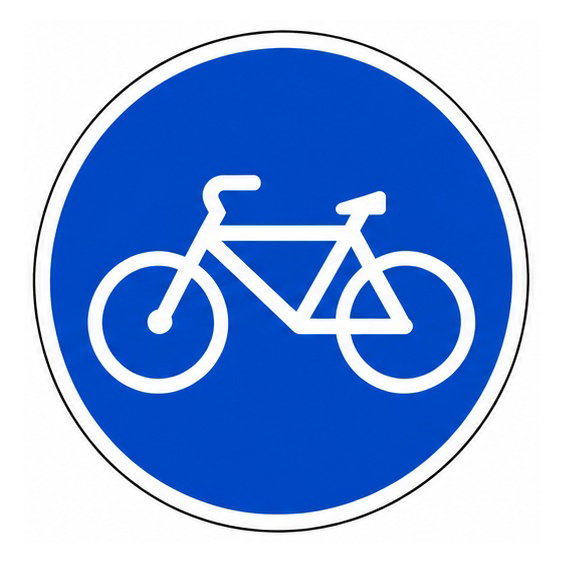
The circular blue sign with a white bicycle, officially called R 407a, means cyclists must use the route it marks.

If it directs you onto a cycle route alongside the road, staying on the general carriageway simply because you prefer it is not an option.

Spain’s General Traffic Regulations distinguish between a cycle route being available and its use being compulsory. The presence of a cycle lane alone does not automatically mean cyclists must use it. The circular sign can create that obligation.

Ignoring it could also put a dent in your wallet. The DGT’s national enforcement guide lists an €80 penalty for minor breaches involving mandatory signs. It separately lists €200 where the offence qualifies as serious, so €80 should not be treated as a fixed penalty covering every situation.

The square that means something different
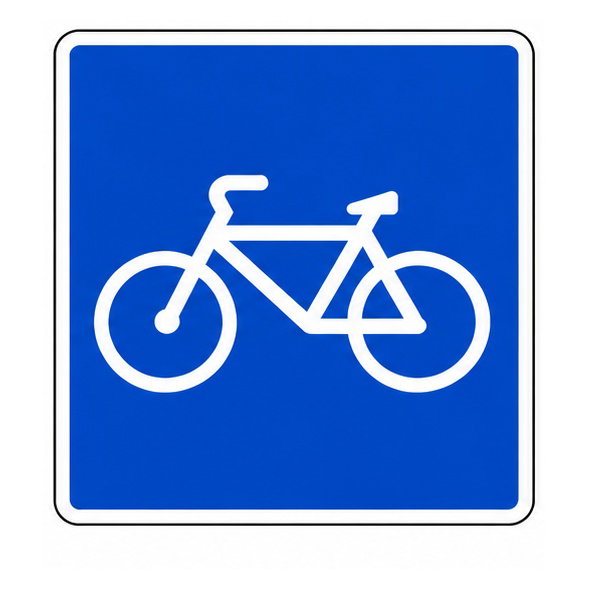
A square blue sign with a white bicycle, known as S 35, identifies a route reserved for cycles. Other road users are prohibited from using it.

The difference is that this sign does not itself order cyclists off the general road and onto that route.

Electric scooter riders should pay attention too. A separate sign, S 38, identifies routes reserved for both cycles and personal mobility vehicles. The bicycle symbol alone does not mean every scooter is welcome.

EWN has also covered Spain’s separate signs restricting electric scooters, highlighting why riders need to check which vehicles each sign applies to.

A path for both does not mean sharing every part
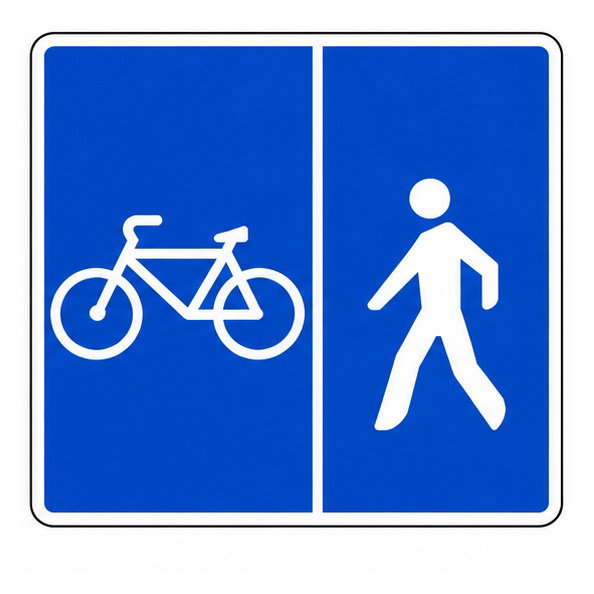
The S 41 sign shows a bicycle and a pedestrian in separate sections. It marks a route with different spaces allocated to cyclists and people on foot.

Check which side belongs to you before continuing. The arrangement shown on the sign can reflect the layout of the path, helping riders and walkers avoid straying into each other’s space.

Drivers need to know the difference too

A cycle lane beside the road does not automatically mean a cyclist on the carriageway is breaking the rules. The signs and restrictions on that stretch matter.

For cyclists, a quick glance at the shape could save money and confusion. Before deciding which route to take, check whether the sign leaves that decision to you.

Continue Reading

Trending

Copyright © 2017 Spanish Property & News