
Canada
Chrystia Freeland: ‘China Is The Biggest Winner Of US Behavior’


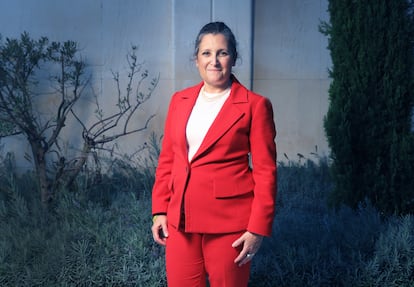
Chrystia Freeland, 58, has lived many lives in one. Born in Peace River, Alberta, she worked as a journalist at the Financial Times, where she was the outlet’s chief correspondent in Moscow, Eastern Europe, the United Kingdom and the United States. She entered Canadian politics in 2013, when she was first elected as a member of parliament for the center-left Liberal Party. Later, after Justin Trudeau’s victory in 2015, she served as minister of international trade, minister of finance, minister of foreign affairs and, finally, as deputy prime minister.
Freeland competed against Mark Carney for the nomination in last year’s Liberal Party leadership elections. And, after losing the vote to the current prime minister, she moved into academia — first at Harvard, now at Oxford. The daughter of a Ukrainian mother (she speaks the language fluently and her three children have Ukrainian names), Freeland is also one of Volodymyr Zelenskiy’s top economic advisers.
This interview took place after a conference at the Ramón Areces Foundation, in Madrid. It was the same day that her latest book was released: Unreliable Boyfriend: An Insider’s View of Dealing with a Chaotic Superpower, Plutocrats, and Other Complicated People (2026). In it, she recounts her wild years in politics, during which she became a favorite target of Donald Trump’s ire. He hurled all sorts of insults at her: “Nasty woman,” “totally toxic” and “terrible person,” among other pleasantries.
Question. How do you deal with someone like that?
Answer. I have sort of a double-barreled view. It’s important to stand up to the United States, and I think that it’s also important to be open to the possibility that America returns to the liberal democratic fold.
Q. Quite a few countries have capitulated to Trump, including several European ones.
A. Yes, I agree. And it’s a big and historic mistake. That’s why I give [Spanish Prime Minister Pedro] Sánchez and his government real credit for standing up to the United States: Spain is the European country that has taken the clearest position. The response to the tariffs and the challenges to the sovereignty of Canada and Europe have resulted in a united retaliation. If that had happened, we wouldn’t be seeing everything that has followed. The way President Trump behaves is to push you as far as he can. And, when [his] outrageous actions got results, we shouldn’t be surprised if this was then followed by even more outrageous actions.
Q. Remember that photo from last year, at his golf club in Scotland? When he posed with Ursula von der Leyen, president of the European Commission?
A. There’s a quote from [former European Commissioner] Thierry Breton in my book that I really like: “We were told humiliation was the price we had to pay for stability. But if we don’t push back now, we will get humiliation and instability.” A lot of leaders think they’re smarter and more sophisticated than Trump; that they can have a meeting with him and have a little joke and can kind of trick him. And the reality is that he’s the one who’s tricking them.
Q. It’s become a pattern.
A. It’s a very understandable mistake… and very easy to make. It seems like a mature person should swallow their pride and, for example, accept a 15% tariff. “So what?” they think. “It doesn’t seem like much… we can survive and, in exchange, we’ll have a good relationship [with the U.S.].” The problem is that, if you compromise, the next day, you’re faced with a territorial claim over Denmark. And, the day after that, you have a war in Iran, and you’re being attacked for not joining it. And then, the day after that, you have Trump siding with Putin in a war which is existential for Europe.
Q. In the book, you write: “We are living in a time of three big fights: the fight between democracy and dictatorship, the fight between people and plutocrats, and the fight between global alliances and predatory isolationism.” Are we losing all three battles?
A. I’m not sure we’re losing. But we’re not winning, either.
Q. That’s an optimistic way of looking at it.
A. I’m optimistic by nature, but I don’t think we’re totally losing. People thought Ukraine would fall in three weeks — and it’s still there. That’s a tribute to Ukraine, but also to Europe. Viktor Orbán’s defeat [in Hungary] is another example of how liberal democracy endures. And we’ll see what happens in the midterm elections [in the U.S.]. But the things I really worry about are Russia, China and the absence of a united Western alliance. Without that, among other things, it’s impossible to rein in the oligarchs. That’s why it’s so important to fight for liberal democracy in the U.S., but as long as the Americans aren’t part of that effort, we’ll fail.
Q. You’ve said that U.S. democracy is on life support.
A. That’s obvious. We’re seeing American law enforcement terrorize American people with total impunity. We’re seeing the creation of masked paramilitary forces. We’re seeing a group of people actually in government who refuse to accept the results of the 2020 election. We’re seeing blatant corruption which goes unpunished. And we’re seeing America siding openly with dictatorships and explicitly menacing the sovereignty of democratic allies. It’s appalling.
Q. The polls point to a resounding defeat for Trump on November 3. If he loses both houses of Congress, his domestic power will be limited, but he’ll still have a free hand when it comes to foreign policy. Could that be even more dangerous?
A. It could be, that’s true. But what I hope to see is increasing resistance within the United States, including within the Republican Party. There’s a good chance that will happen, because many traditional Republicans disagree with a lot of what he’s done. And they’ve gone along with it because of fear and self-interest. But if they feel that the president is no longer able to deliver at the ballot box, there’s a chance he’ll start losing significant support in his own party. And that could function as a restraint.
Q. Is Brussels’ offer for Canada to become an associate member of the European Union viable?
A. I think so, and I hope so. In my dream scenario, we would have an alliance that would include the EU, Canada, the United States and the CPTPP countries [the Comprehensive and Progressive Agreement for Trans-Pacific Partnership]. It would not be a supranational entity, like the EU but I would like to see a much closer economic and security partnership among the world’s democracies. That’s what we need.
Q. Isn’t that wishful thinking, given the current situation?
A. If you had asked people in 1940 if, 40 years later, you would have an economic and political partnership between Germany and France, a military partnership between the United States, Germany and France, as well as a military partnership between the United States and Japan, no one would have thought it was possible. The post-war period — especially in Europe — is a story of miracles: it’s astonishing how we went from the situation in 1939 to that of 1991. Anyone who imagined it would have been considered a mad fantasist, but it actually happened. It’s a mistake to put limits on our dreams.
Q. Are Trump’s policies allowing China to expand its influence and fill the power vacuum?
A. Yes, absolutely. The biggest winner from U.S. behavior is China. Russia is also a winner, but the way that Europe has united weakens Russia’s victory. America’s traditional partners are seeking a balance and, therefore, are getting closer to China. It can be dangerous, but it’s understandable. And countries that are not America’s traditional allies are also seeking a balance. That’s great for China. And the other thing that’s great for China is that there’s no moral high ground for America to claim right now.
Q. As an adviser to Zelenskiy, how do you assess the recent “energy ceasefire” announced by Trump?
A. Nothing that he puts forward is credible.
Q. He’s also demanding elections: he says that “it’s time for Ukraine to get a new president.”
A. It’s appalling, it’s absolutely appalling. The only positive thing is it will make President Zelenskiy more popular in Ukraine.
Q. How do you assess the US-Russia diesel agreement?
A. It’s a betrayal and a gift to Putin. What’s especially shocking is that it isn’t economically significant for the U.S. But it explicitly shows that Trump is siding with Putin.
Q. You’ve said that Ukraine is winning the war.
A. 100%.
Q. Why?
A. There was a widespread expectation that Russia would make territorial gains this summer and they haven’t. It’s horrifying what Russia is doing with the strikes on Ukrainian civilians, but that’s a direct result of Russia failing on the battlefield.
The Ukrainians have devised a formula that might force Russia to limit its attacks: if they hit your energy infrastructure, you hit theirs. That could serve as the basis for a limited ceasefire.
The impact of the attacks on Russian data centers is also very interesting: Russian disinformation campaigns influence us more than we realize, so perhaps the Ukrainians will help us all to have healthier democracies by taking out data centers there. It could be a gift from Ukraine to global democracy.
Sign up for our weekly newsletter to get more English-language news coverage from EL PAÍS USA Edition






Canada
Justin Trudeau Quit Politics, But Not Fame: From His Life With Katy Perry To His New Projects

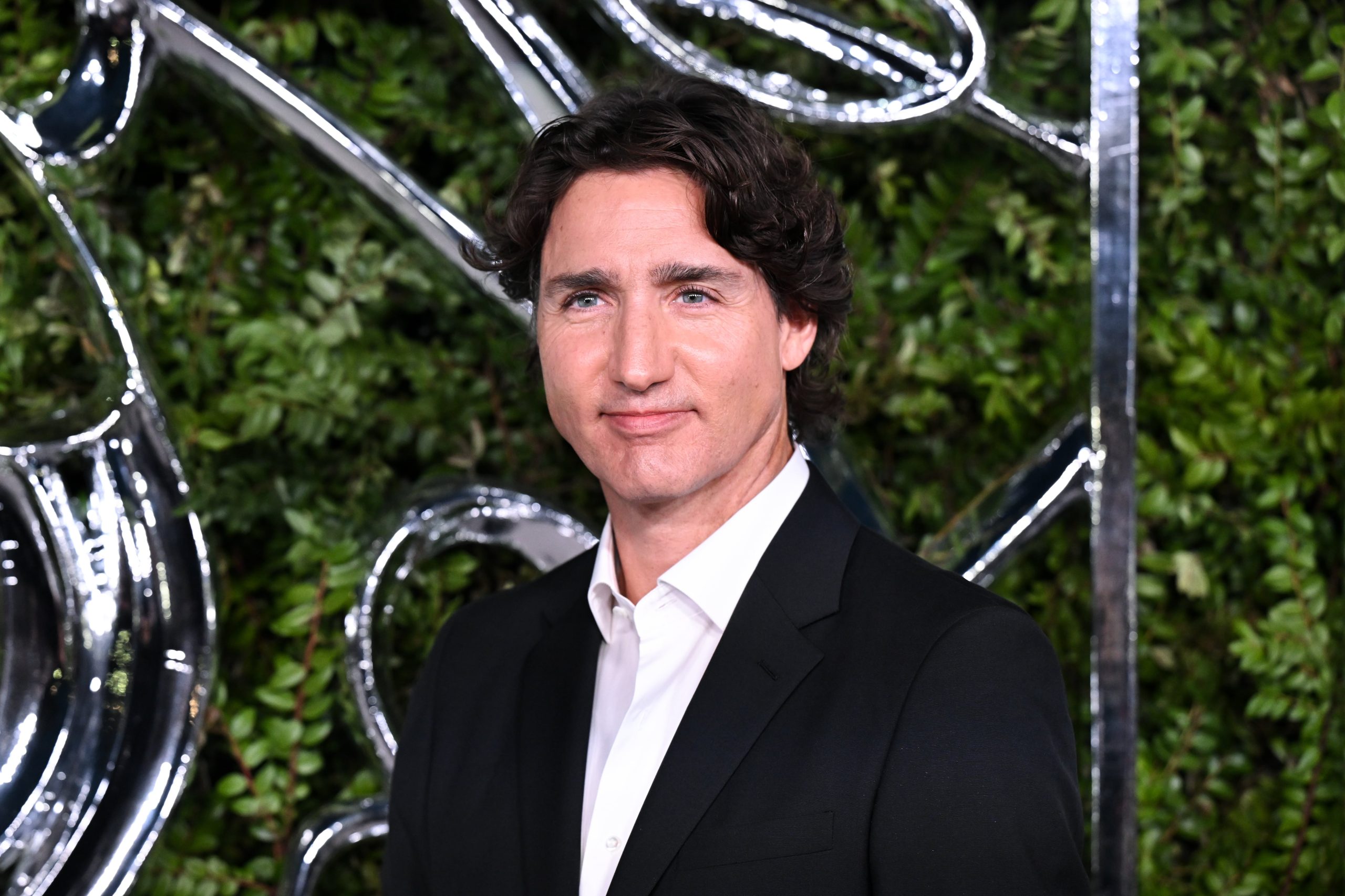
Mark Carney has become one of the most watched figures on the international stage. The Canadian prime minister draws admiration and recognition for the way he has steered his country amid trade hostilities with the United States; also for the alliances he seeks to forge with other middle powers as the geopolitical landscape shifts. His predecessor, Justin Trudeau, also enjoyed high levels of popularity, though for different reasons. In fact, fame has followed Trudeau since birth, being the son of another prime minister — Pierre Trudeau, who served in the 1980s. Even though Justin Trudeau’s final years in politics were marked by an unstoppable decline from the summit, he has comfortably settled into a new stage of his life, and has not abandoned the public spotlight.
Justin Pierre James Trudeau led Canada’s executive for more than nine years starting in 2015. However, his bid to head a fourth consecutive government collapsed in early 2025 amid infighting within his Liberal Party and notable public discontent, and he officially left office and withdrew from political life on March 14 of that year. After his farewell, however, he did not retire to a cabin in the woods to write a memoir about his time as prime minister. Nor did he quietly join a mission to monitor the habits of endangered animal species —his environmental achievements, one of the most significant aspects of his time leading the Canadian government, have been substantially rolled back by the Carney administration. Trudeau remains the same man: he is accustomed to life in the spotlight, and he needs constant attention.
Four days after his farewell, he posted on his Instagram account, where he has 4.5 million followers: “Gotta love a Monday morning at Canadian Tire.” The message was accompanied by a photograph — in which he wore a cap and jacket — showing him pushing a shopping cart inside the iconic retailer. After that, Trudeau made other social media appearances tied to his son Xavier’s musical career, known as a singer by the stage name Xav.
Earlier, in August 2023, Trudeau and Sophie Grégoire announced their separation after 18 years of marriage. After the split, speculation about the former politician’s romantic life grew. Finally, images taken at a Montreal restaurant in July 2025 drew attention: he was photographed with none other than American singer Katy Perry. Three months later, more photos showed the two on a yacht in California and later strolling through Paris in an affectionate manner. They made the relationship official during a trip to Japan in December 2025, and they made their first red-carpet appearance last June at the premiere of the documentary Katy Perry: The Lifetimes Tour – Live from Paris at the Tribeca Film Festival in New York. Then, in an interview with People magazine, the artist said of him: “He is the love of my life.” Since that event, the couple has been photographed at other entertainment events, such as the Coachella Festival, and it is now common for them to share moments of their life and travels on their respective social media (Perry has 195 million followers on Instagram).
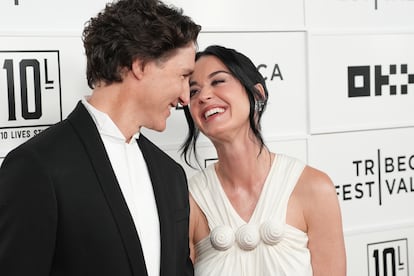
The former prime minister has been busy on matters beyond the heart. On September 11, as part of the Toronto International Film Festival, he announced the launch of Hope & Hard Work, a multidisciplinary media and entertainment company. The initiative was created in partnership with Katie Telford, his chief of staff throughout his time as prime minister. According to a statement, the production firm is focused on “scripted and unscripted productions, audio and live experiences.”
Hope & Hard Work already has five projects in development. One is the television adaptation of Closer by Sea, a novel by Perry Chafe set on a remote island off Newfoundland. Another is the original series Le Collège, by writers Jessie Gabe and Shebli Zarghami, whose plot takes place in a private high school in Montreal.
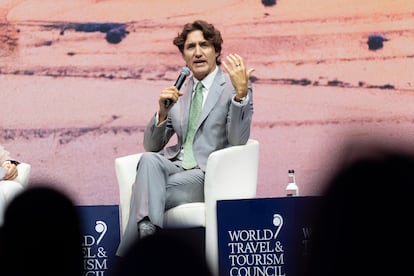
Trudeau has also joined the ranks of figures who command substantial fees for speeches and appearances at conferences and other events. His most recent appearance took place at the World Travel and Tourism Council Summit, held earlier this month in Malta. In his speech, he said that the trade hostilities between Ottawa and Washington are affecting Canadian travelers who traditionally crossed the border in large numbers, noting that the choice of a travel destination depends not only on prices and attractions. “The United States has not been very good in recent years at making travelers feel welcome,” he stressed.
Justin Trudeau was born while his father, Pierre Elliott Trudeau, was head of government. The family has been the closest thing Canada has had to the Kennedys: power, money, media attention and jet-set connections. One detail cannot be overlooked: Pierre Elliott Trudeau, who died in September 2000, had romances with Barbra Streisand and Margot Kidder, the actress who played Lois Lane in Superman. Therefore, he was a well-known face among Canadians before entering politics, and no one can doubt that all this worked to his advantage when he set out to conquer the government’s inner sanctum. The family name and fame combined with charisma, dynamism, good looks, reform proposals and a natural ease in front of cameras.
However, his personality, his appetite for attention and his limited self-restraint also took their toll. There were several embarrassing moments. For example, on an official trip to India, where Justin Trudeau bordered on the ridiculous, and an admonition from the ethics commissioner for spending a vacation on the Aga Khan’s private island. It is hard to know how much all this influenced the drop in his popularity, but if during his years as prime minister this behavior cost him a few sleepless nights, it seems to bother him not at all now that he is away from political life.
Sign up for our weekly newsletter to get more English-language news coverage from EL PAÍS USA Edition
America
Trump Sale Al Rescate De Candidatos Republicanos En Apuros Con La Exención De Aranceles A Algunos Productos De Canadá


El Gran Desfile De Día De Muertos 2026, En Imágenes

El Oficio De Coleccionar Un ‘cachito’ De La Fórmula 1 En México
Young woman left horrified after Gibraltar restaurant receipt carries shocking racist slur


-
Catalonia4 weeks ago
Why the rain opened a hole in front of Granollers’ courts
-
DGT2 weeks ago
Viral video in Spain sparks fury over drivers who ‘have no idea how to drive’
-

 New Developments4 weeks ago
Stylish 3-Bedroom Apartment With Panoramic Sea Views – Benalmádena
-

 %4 weeks ago
Spain Payslip Change Coming In January 2027
-

 Arabia Saudí3 weeks ago
Un Ataque De Los Hutíes Contra El Aeropuerto De Riad Causa Al Menos 12 Muertos Y Más De 300 Heridos
-
200 people quarantined4 weeks ago
Russia plague alert as lab worker dies and 200 people are placed in quarantine
-

 America3 weeks ago
Un Tirador Mata A Ocho Personas En Una Vivienda En Pensilvania
-
Afesol mental health4 weeks ago
Cosplayers queue for free mind-portraits as Fuengirola artist packs Comic-Con Malaga floor