
ElPais
Do Tutankhamun And Nefertiti Share A Tomb?

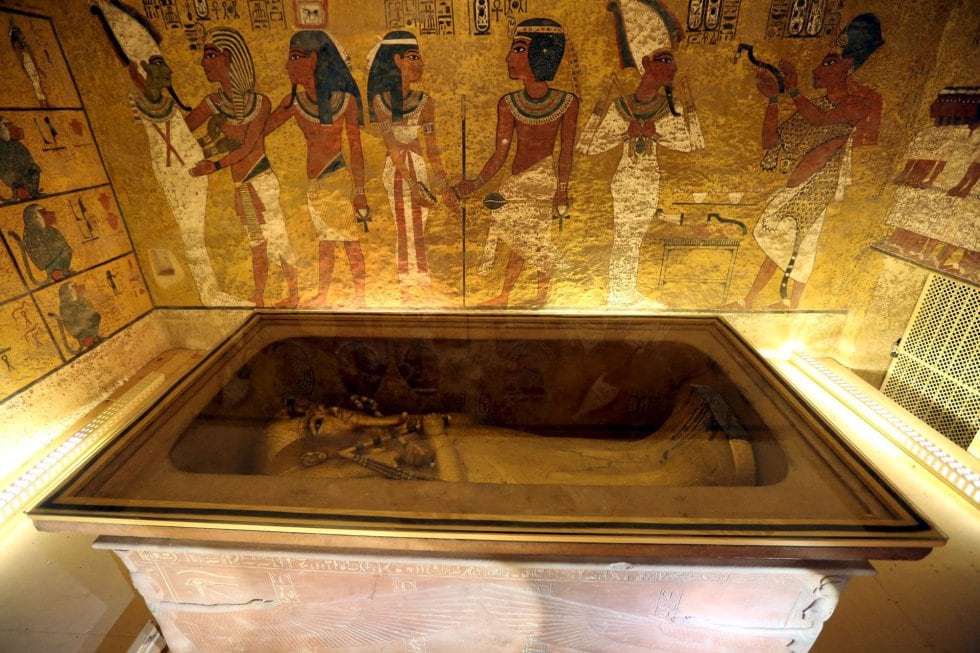
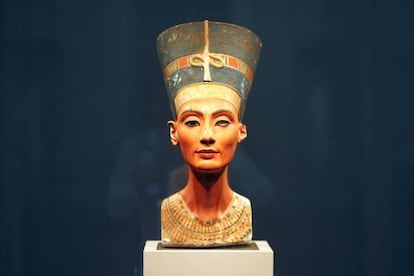
In a development that has revived one of Egyptology’s most intriguing debates, the theory that Tutankhamun and his stepmother Nefertiti, the celebrated chief queen of Akhenaten whose bust is one of the most iconic images of Ancient Egypt, may share the same eternal resting place has returned to the spotlight.
New research has once again revived the remarkable and tantalising hypothesis put forward in 2015 by the prominent British Egyptologist Nicholas Reeves, which sent shockwaves through the field of Egyptology. According to the theory, Tutankhamun’s small tomb in the Valley of the Kings (KV62) contains additional unexplored chambers and is in fact only part of a substantially larger burial complex, hidden behind what appear to be the solid walls of the known tomb.
Reeves has stuck to that view ever since, against all odds. Drawing on a meticulous iconographic analysis of the paintings in the burial chamber and on high-resolution photographs taken by the Spanish company Factum Art while scanning the tomb to produce a replica — photographs that appear to suggest the presence of sealed doorways — he argues that the tomb was originally designed for Nefertiti, with Tutankhamun effectively an interloper, and that the queen’s mummy may still lie within undiscovered chambers.
Eleven years ago, we seemed to stand on the very threshold of a potentially historic discovery. The tests carried out at the time proved inconclusive. We were told that further investigations would be needed. Eyebrows were raised across the Egyptological community. Zahi Hawass, in his characteristically categorical fashion, dismissed the whole idea as nonsense. And there matters were left, mercilessly so, as we continued to wonder, with a mixture of anticipation and scepticism, what secrets and marvels might lie, if any did, beyond Tutankhamun’s burial chamber.
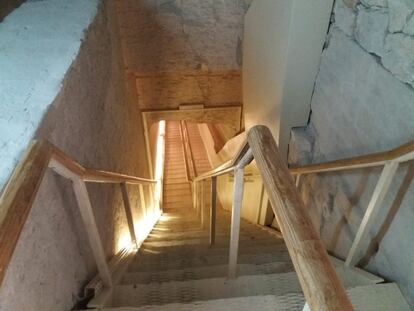
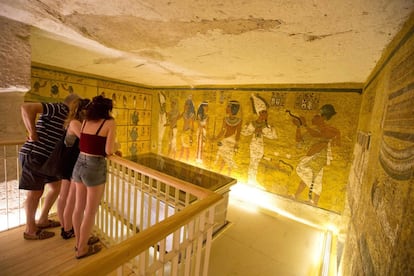
Visiting Tutankhamun’s tomb has never been the same since. A new mystery gnaws at you. Are you standing only in the outer portion of a tomb that extends much farther beyond? With Nicholas Reeves’s theory in mind, you find yourself in the antechamber, looking to the right, unable to shake the thought that something — a passageway, perhaps, or undiscovered rooms — may lie hidden behind the northern wall of the burial chamber, beyond the sarcophagus, where the famous scenes of the young king’s funeral are depicted.
Yet no matter how intently you stare, however hard you try to pierce the wall with your gaze, you see nothing. Nothing except your quickened pulse and a marked tendency to sigh. Nor does Tutankhamun himself offer any clues. Behind you, his mummy seems almost to mock your curiosity with its faint, rabbit-like grin.
Is Tutankhamun merely an intruder, a cuckoo chick in Nefertiti’s nest, as Reeves so poetically suggests? Stranger discoveries have been made in Egypt. One need look no further than neighboring KV5, the tomb of the sons of Ramses II. Excavated in 1825 and long thought to be relatively modest, it was revealed in its full extent by Kent Weeks in 1995: a vast funerary complex comprising 130 chambers linked by a network of corridors.
The obvious question is why no holes are drilled to find out whether anything lies beyond the walls of KV62. So far, the Egyptian authorities, along with most Egyptologists, have not considered the evidence strong enough to justify such invasive tests on one of the most famous monuments in Egypt, and indeed the world. As a result, researchers have had to rely on non-invasive methods, which are rarely capable of providing conclusive answers.
And now Reeves and his supporters are back on the offensive. On September 17, they published a lengthy, detailed and scholarly study, A Review and Archaeo-Geophysical Assessment of the Structure and Morphology of the Tomb of Tutankhamun (KV62), the fourth paper in a series collectively titled The Burial of Nefertiti?, a veritable soap opera by now, some might say.
The 57-page paper, published in the Occasional Papers of the Amarna Royal Tomb Project, directed by Reeves himself, and once again highlighted by Nature, is co-authored by Reeves, former antiquities minister and archaeologist Mamdouh Eldamaty, a firm believer in the extended-tomb theory; geophysicist Abbas Mohamed Abbas; and George Ballard, a specialist in the investigation of historic structures.
The article details two new research campaigns carried out inside and around the tomb under the auspices of Egypt’s Supreme Council of Antiquities (SCA). In their search for evidence of unknown spaces, the researchers deployed an array of technology worthy of the Death Star, including microgravimetry, a non-destructive geophysical technique that measures minute local variations in the Earth’s gravitational field to detect differences in subsurface density.
The authors of the study argue that it can now be said that “the structure of KV62 predates the interment of Tutankhamun and is likely to be more extensive than traditionally understood.” That alone, the possibility that Tutankhamun’s tomb is larger than previously thought, would be a bombshell.
I read the paper with all the excitement you might imagine, an excitement that gradually waned as the text ventured ever deeper into dense scientific terminology that lies well beyond my modest understanding (“this simple program used the Talwani algorithm to calculate the Bouguer anomaly over a polygon”; and they say hieroglyphs are difficult). Still, taken as a whole, it is highly stimulating.
The researchers place themselves under the patronage of Howard Carter, who, they argue, had already suspected that the tomb continued beyond its known limits, although the exploratory trenches he allegedly dug in secret to test the idea were, according to the authors, in the wrong place. He failed to take into account that queens’ tombs turn to the right.
The authors begin by revisiting earlier work and Reeves’s original hypothesis that the layout of KV62 extends beyond what is visible today. They acknowledge that the results of the initial tests carried out between 2015 and 2018 were insufficient to prove anything, but argue that the new approach, combining multiple disciplines in a “holistic” methodology and making use of new technologies such as ground-penetrating radar, electrical resistivity tomography and microgravimetry, places us in a very different position.
In the first part of the paper, Reeves, who has incorporated the theory into the new edition of his reference work The Complete Tutankhamun, revisits the argument that Tutankhamun’s tomb is highly unusual for a royal burial of the 18th Dynasty and that there are two possible explanations.
The first is that it was originally a private tomb that was hastily adapted to house Tutankhamun and his funerary equipment following the young pharaoh’s unexpected death. The second is that KV62 was in fact a queen’s tomb, whose outer sections were repurposed for Tutankhamun’s burial, while the original owner’s interment was left undisturbed in deeper, inaccessible chambers.
According to Reeves, and it is all tremendously exciting, when Tutankhamun died, alterations were made to the front part of that queen’s tomb, namely Nefertiti’s, to accommodate the dead king and his possessions, while the remainder of the funerary complex was sealed off.
The Egyptologist points to modifications in the tomb’s decoration that, he argues, reveal this repurposing. In an initial phase, the central figure in the painted scenes would have been Nefertiti herself, acting as pharaoh after the death of her husband Akhenaten and ruling under the throne name of the enigmatic Smenkhkare, while Tutankhamun was depicted officiating at her funeral rites. In a second phase, the deceased became Tutankhamun and the officiant his successor, Ay.
What is now the burial chamber, the “House of Gold” in Ancient Egyptian terms, would originally have been little more than a passageway leading to the deeper reaches of a much larger tomb where the queen rested, or perhaps still rests. Reeves also identifies a number of apparent anomalies in the walls that, he contends, may indicate the presence of blocked entrances leading to the supposed corridor and to additional storage chambers for funerary goods.
To be precise, and to complicate matters still further, Reeves identifies four phases in the tomb’s development: an initial construction phase for a queen consort; a second modification following Nefertiti’s supposed elevation to co-regent; a third when she assumed the full rank of pharaoh after Akhenaten’s death; and a final phase, a decade later, when Tutankhamun died and the golden boy was put in there.
The second, highly technical section of the paper is authored by George Ballard and focuses on the tomb’s geophysical investigation. He reviews earlier studies, including those by Watanabe and Porcelli, as well as some findings that have not previously been published. None of these, he notes, proved conclusive in determining whether the cavities and voids detected beyond the tomb’s walls were anthropogenic in origin, that is, created by human activity.
Ballard nevertheless concludes that Reeves’s hypothesis has not been definitively disproved. “Geophysical investigation of the area surrounding KV62 has led to the identification of a number of intriguing features that could be passages or chambers,” he writes.
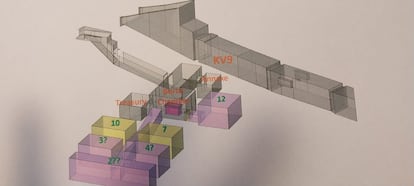
Ballard himself, together with Abbas, authors the paper’s third section, the heart of the matter. They describe the new tests carried out both inside and outside the tomb and emphasize that echoes consistent with rubble have been detected in two areas beyond the northern wall of the burial chamber. These could correspond to the fill customarily used to seal passageways in tombs.
These and other findings, they argue, are consistent with the proposition that chambers and passageways exist beyond the northern and western walls at the far end of Tutankhamun’s tomb. Particularly intriguing are a series of rectangular features on the other side of the northern wall. Equally compelling is the suggestion that readings indicating high-density material in the center of one of these spaces are exactly what one might expect to find “in a well-stocked, undisturbed funerary chamber.”
In their summary, the researchers state that they have identified, “with a high probability,” a funerary complex extending some 20 to 30 meters north of KV62. They add: “Five or six chambers are likely to exist in this space, and there is a clear expectation that the voids detected connect to themselves and to KV62 by passageways deliberately filled with rubble in antiquity.” Access to the complex, they suggest, appears to be “via a corridor whose access is concealed behind a mortared stone wall at the eastern end of the current burial chamber.”
In his conclusion, Mamdouh Eldamaty argues that the evidence strongly suggests ”the existence of at least one further storage chamber” in Tutankhamun’s tomb (which would be located behind the west wall of his burial chamber), as well as a continuation beyond the northern wall in keeping with the layout of royal burials.
“Even if this latter hidden complex does not ultimately prove to be the burial place of Nefertiti herself, the evidence increasingly points towards a connection with the Amarna royal family and the immediate circle of Akhenaten’s court,” he writes.
If the extension of the tomb were to be confirmed, he concludes, “it could potentially rank among the most transformative archaeological discoveries of the modern era, fundamentally reshaping our understanding of the political, religious, and dynastic history of the Amarna Period itself.”
The obvious next step, the researchers stress, now that non-invasive methods have been exhausted, is “direct investigation by finding a means to access directly one of the proposed new chambers and achieve a photographic inspection of its nature.”
For now, all we can do is keep wondering.
Sign up for our weekly newsletter to get more English-language news coverage from EL PAÍS USA Edition

Donald Trump
Richard Dean Anderson, The Iconic MacGyver: ‘He Was Different, A TV Hero Who Didn’t Use Guns. He Would Think, Look And Solve The Problem’

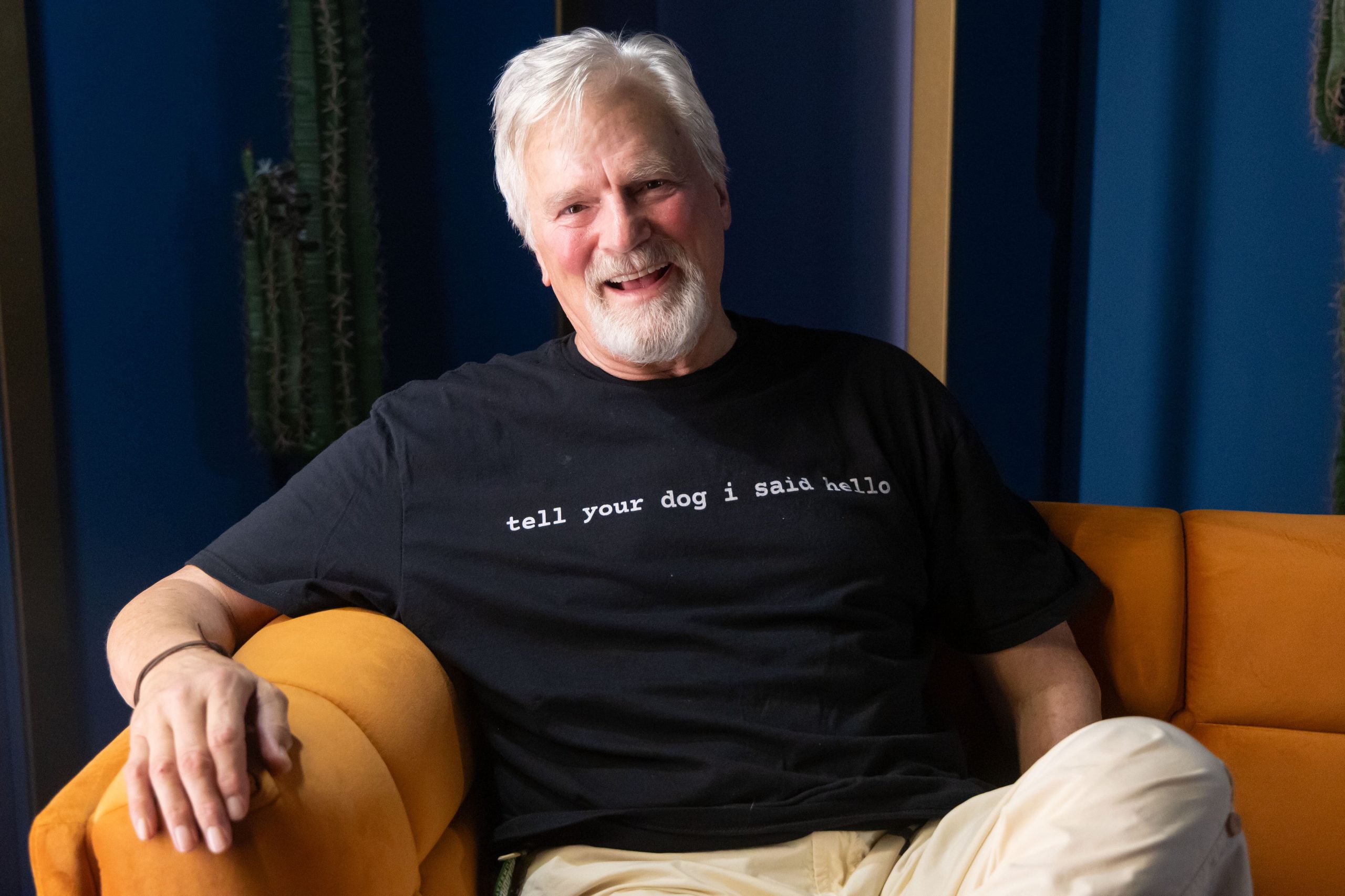
He had a solution for everything. There was no problem he couldn’t tackle. Whether it was forcing open a lock by melting ice, building a defibrillator out of two candlesticks and a microphone cable, making a bomb with a stick of chewing gum or defusing one with a paper clip. He could even stop a sulfuric acid leak with milk chocolate bars. As a popular Spanish saying inspired by the character goes: “You’re more dangerous than MacGyver in a hardware store.”
“I had no idea people said that in Spain. That’s fantastic,” says Richard Dean Anderson, the actor who brought the resourceful hero to life, bursting into laughter. Warm and engaging, the 76-year-old was one of the biggest nostalgia draws at last weekend’s San Diego Comic-Con Málaga. At the event in the Spanish city, he signed autographs, posed for photographs with fans and took part in an entertaining panel discussion. He also spoke with EL PAÍS.
“Meeting fans is wonderful. It’s the best part of all this,” says the U.S. actor, who appreciates the warmth of the public, if not the warmth of the weather. “I’m from Minnesota. I have thick blood. Yesterday [Friday] was really hot. It was terrible,” he says while figuring out how to use a handheld fan.
He adds: “We ran into a bit of chaos that didn’t seem to keep the fans in mind. I don’t know if they are getting what they came for. I suppose I could adjust and accept that’s the way it is here, but I think about the fans, the people who pay the money to come and meet me and get an autograph or whatever… It all feels a little casual.”
“Still, I don’t really have a social life where I live and it’s always nice to meet people,” says Anderson, who lives north of Malibu, California, and leads a lifestyle far removed from that of a typical superstar.
Anderson spends most of his time with his dogs and walking by the sea, away from television and the media. It’s a personal choice. After appearing in more than 600 episodes of the daytime drama General Hospital and becoming MacGyver, he later took on the role of Lt. O’Neill in Stargate, a character that further cemented his popularity in the United States. It also proved to be one of the last major chapters of his acting career.
The turning point came with the birth of his daughter, Wylie Anderson, 28 years ago. He says he quickly realized that nothing was worth spending time away from her as a newborn. “Now she writes, directs and produces. I try to help her however I can, even if that means getting out of the way,” he says.
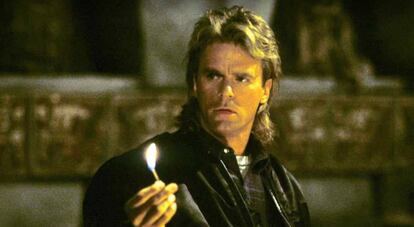
His face may have disappeared from television screens, but at last weekend’s event in Spain, four decades later, it was one of the most recognizable thanks to the enormous success of MacGyver. Created by Lee David Zlotoff for ABC, the series aired on Spanish public broadcaster TVE between 1985 and 1992. Over the course of its seven seasons, it became a global phenomenon, drawing huge audiences and turning Anderson into an international star. He says he landed the role after asking to keep his glasses on during the audition so he could read his lines.
“The people in charge looked at each other and said: if he doesn’t mind being seen with glasses in a role like this, we’ve found our MacGyver,” he recalls.
The character also closely resembled the real-life Richard Dean Anderson. “The writers put in things that I was interested in, which included the environment, animal rights, anti-gun [measures]. And then there’s a certain part of living as a human being, like I ski, played hockey, and did all those jocular things,” he says.
“MacGyver was different: a TV hero who didn’t use guns. He would think, look and solve the problems without killing somebody, without shooting them,” he explains. “That allowed parents and children to watch the show together. And that’s what I feel most proud of and happy about: those relationships, especially between daughters and dads. I think that combination made the series memorable to a broader audience than normal.”
His role was that of a superhero who, instead of a cape and powers, always had pliers within reach. He was an ordinary person who saved lives, rescued people, and solved conflicts using science, never guns. “I don’t think there are enough people in the world who are intrigued or humbled by science on television today. Because you really have to watch, listen and observe. Whereas a sitcom or a regular drama, you can just hear,” says Anderson.
The actor says he helped devise many of the ingenious fixes his character used to get out of trouble. “We had collaborators — advisers from technical schools and universities near Los Angeles. They told us how something could be solved with what was in the room, and others contributed too. It was a collective effort,” he remembers before pausing to consider whether MacGyver would have used artificial intelligence if it had been available to him.
“He’s more of a practical solver of problems, more physical,“ he says. ”He uses his science mind to see angles or possibilities of what is real, what is right here and now. I don’t know enough about AI, but it’s a little frightening because it appears to me that it takes away the human element. It becomes automatic; it solves. I like the human mind and the way it works now. I understand that AI is not going to let us decide. It’s going to dictate. That scares me. But MacGyver and AI? Maybe he’d just be intrigued, like: how could I use this?”
MacGyver and the Basques
With Anderson visiting Spain, it was impossible not to bring up something rather more peculiar: a first-season episode in which Angus MacGyver travels to the Pyrenees to go undercover, disguising himself with little more than a towel, among a group of “Basque mountain fighters who have been at war with France and Spain since time immemorial,” as the show’s narrator puts it.
The group — whose members wear txapelas and use pelota baskets to hurl grenades — look less like Basque separatists than an unlikely cross between highwaymen and Sicilian gangsters. In the episode, which later went viral on YouTube in Spain, the hero must rescue a geologist whom her captors mistakenly believe to be a physicist and whom, MacGyver suspects, they intend to use to help build an atomic bomb.
“It was so long ago that I don’t remember it,” says Anderson. He has much clearer memories, however, of past holidays in Barcelona and Ibiza, and admits he arrived in Málaga a couple of days early in order to explore the city. “The beach, its castle, it’s incredible,” he says.
During a panel on Saturday afternoon at the San Diego Comic-Con Málaga, Anderson took it upon himself, without being prompted, to describe U.S. President Donald Trump as “a piece of shit.” “Yes, he’s a piece of shit,” he said.
In his later conversation with EL PAÍS, he reiterated the point. “I dislike very much what he is. I don’t like his behavior, his policies, his ego. He’s a negative man. I just don’t respect him, which is the worst thing I can say about a human being. I don’t respect him at all. But it’s one man’s opinion,” he said.
Strong words from the man who played MacGyver, and they came just days after he found himself in a scene few would ever have imagined: posing for a photograph with the cast of Los Serrano, one of Spain’s most beloved television series. What a crossover that would have been.
Sign up for our weekly newsletter to get more English-language news coverage from EL PAÍS USA Edition
Arnold Schwarzenegger
Sylvester Stallone: ‘I Don’t Know What The New Masculinities Are. It’s In A Man’s Nature To Conquer’

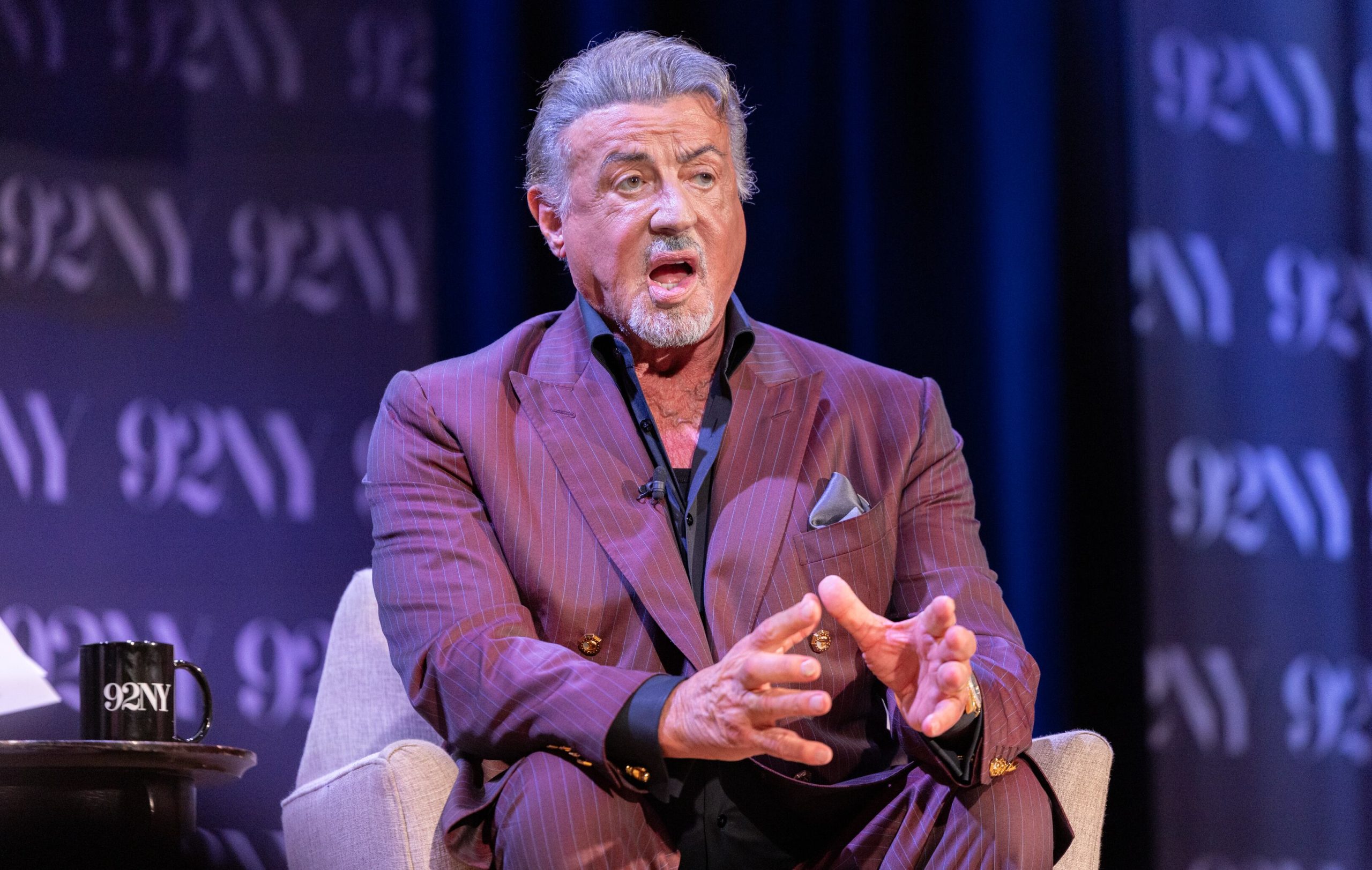
It is Sylvester Stallone’s fourth interview of the day. Is he tired of talking yet? “No, because this is the first one about my memoirs,” he replies from a hotel room in New York, his hometown, overlooking Central Park, where he is meeting with EL PAÍS.
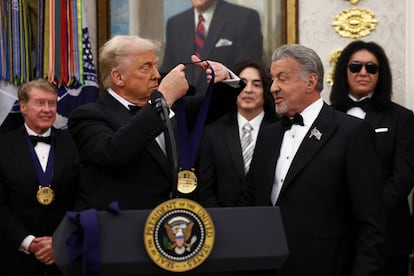
The conversation that follows confirms the impression that he has come eager to talk. For more than 40 minutes, the actor expands on subjects ranging from his frustration with a career that never took off as much as he would have liked, to his hatred and subsequent friendship with Arnold Schwarzenegger, and his change of attitude toward Donald Trump. Stallone introduced the U.S. president at an event in Mar-a-Lago in November 2024, shortly after his election victory, describing him as “a mythical character” and “a second George Washington.” Now, however, Stallone criticizes him for leading the United States into the hornet’s nest of Iran.
“Don’t get me involved in politics. I just said I hate war,” he says as the interview draws to a close.
He does not shy away from any question, not even the most painful ones about the death of his 36-year-old son in 2012 or the trauma of a brutally difficult childhood with parents who, he says, never loved him. Even at 80, it is something that still hurts.
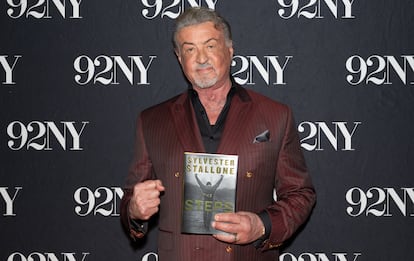
The reason for the interview is The Steps, a surprisingly candid memoir in which the tough guy opens up like never before. It is not a conventional autobiography. Instead, it focuses on five pivotal moments in his life and reveals that, contrary to what his parents always told him, he is no fool.
Stallone peppers the conversation with sound effects, gestures such as clenching his fist to convey anger or the urge to hit someone, and impersonates the voices of people in his stories as he recounts anecdotes. He constantly compares himself to animals. All of this is delivered with the characteristic half-smile caused by a difficult birth that left part of his mouth paralyzed, a defect that did not stop him from becoming a global superstar with franchises such as Rocky and Rambo. Watching him now reflect on the 1980s and 1990s, when he was one of the most famous actors in the world, is a show in itself.
Question. In your book, Rocky is the only film shoot you discuss. Do you feel that the rest of your career failed to live up to what you expected after that extraordinary success in 1976?
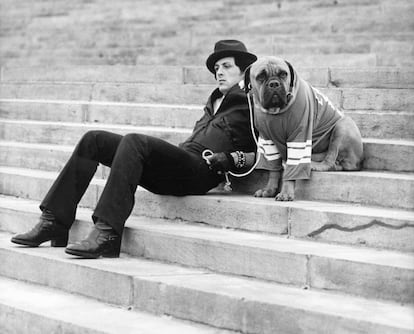
Answer. Absolutely. I was not happy with my career. It all happened because I didn’t understand the rules of the game. The character Rocky and I were inseparable. And when people saw me acting like an arrogant, angry and spiteful person, they began to hate me — deservedly. My whole life everyone said, “You’re stupid, you’re a loser.” And when I finally proved them wrong, I overreacted. That was my mistake. I reacted like a child.
Q. When did things start to go wrong?
A. After Rocky, I shot F.I.S.T., a very good film with a very good director. But people hated it. They wrote my funeral. And what did I do? I fought back. I said: “Why don’t you say that to my face? We’ll fight.” It was just like I was still on the street, like an animal. I hadn’t learned humility. I didn’t realize a damned miracle had happened: I was the luckiest man in the damned world [with the success of Rocky], but I didn’t act that way. And it carried over into my life, my marriage and my children. It was a bad stretch that lasted many years.
Q. Rocky won three Oscars, including Best Picture and Best Director. But you were nominated for Best Actor and didn’t win. How did you react?
A. It hurt because I felt I had lost it because of my words. I realized I had made enemies at the Academy. I thought we were going to win. How did we lose the Oscar for best score?
Q. Does it still hurt today, 50 years later?
A. Of course it does. I understand I did it. It was my fault.
Q. In your memoir, you write that when you finished the Rocky screenplay, you had just $80 in the bank, had spent nights sleeping in shelters and on park benches, and your wife was pregnant with your first child. Yet you turned down an offer of $360,000, more than $2 million in today’s money, because the deal required you to give up the lead role.. How were you so convinced you would succeed? Have you always had that much confidence in yourself?
A. No. I grew up with a tremendous inferiority complex. I wasn’t muscular. I had a mother and father who said non-stop: “You weren’t born with any brains, so build up your muscles; there’s nothing here” [he points to his head]. But something told me: do not sell it. I swear to God, I knew in my heart that this was the moment: either I landed a good acting part, or I would never be a star. At the first screening, people kept leaving the theater. Even my mother walked. I went home thinking: “I’m going to fucking kill myself. I’m going to be a broken, horrible man. I won’t recover. I have no skill. I have no work. I have nothing.”
Q. Your book carries a message about perseverance and never giving up. But isn’t there a flaw in the idea that people who don’t succeed simply didn’t try hard enough?
A. The only way to know whether you will succeed or fail is complete dedication and sacrifice. If it doesn’t work out, you can say you did everything you could, and it still didn’t work. That’s my philosophy.
Q. You also write that all your efforts were driven by a desire to be loved by your parents. Has that search defined your life?
A. It still does today. It’s such a sadness and regret! Why couldn’t you just love me? How about a kiss? Why do you fucking hate me so much? The more I got successful, the more they hated me. Because I reminded them that they didn’t have such things. They didn’t have talent. But they wouldn’t accept that.
Q. Did you make peace with them?
A. With my father, yes. With my mother, no. My father was physical; she was emotional. No one can hurt you more than your mother. You are part of her.
Q. How did growing up in a violent home affect your approach to parenting?
A. I was very physical. I knew I was strong, although I never used that strength against my children — only on the street. If someone looked at me… I felt like it was my father challenging me. I had a terrible temper. That temper also made me work hard. Even to this day, I’m competitive. I see guys in their fifties, and I say: “I can do that.” It’s weird. And I don’t like it. But it’s part of the animal. It’s like a Doberman; it’s built to be competitive.
Q. You went through one of the worst experiences possible: losing a child. Can anyone ever recover from something like that?
A. No. Even if you did nothing wrong, you have a horrible sense of failure. I still feel it today. I can’t even look at a photo; I don’t have any pictures of him at home. It’s too horrible. He was making movies. He was different; he wasn’t an action person but rather intellectual — he liked horror movies and strange foreign films. I know it was hard for him to be my son.
Q. Rocky V is based on your relationship with him.
A. Yes, it’s very autobiographical. A man my mother had just married called me and said: “Sly, you don’t know me. I just married your mother. I have bad news. He’s gone.” I asked who he meant, and he said: “Your son.” “What the fuck are you talking about?” I said. “Yeah, he died. I’m sorry,” he replied. Then he hung up. It was too fucking much; I couldn’t even breathe. I kept it inside. Two weeks later, I exploded. I fell apart. Like an animal.
Q. There has been a lot of talk about your rivalry with Arnold Schwarzenegger. How real was it?
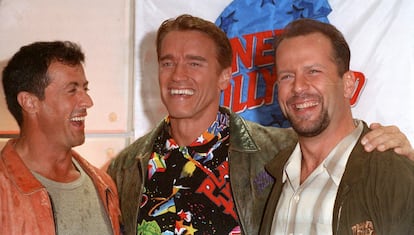
A. We hated each other. It was deep. The hatred came more from me. The press pitted us against each other. He was smarter than me and would say: “Sylvester will make a good movie someday.” And I thought: “Fuck.” He was very political. He’s my favorite actor. I like him.
Q. But now you are friends.
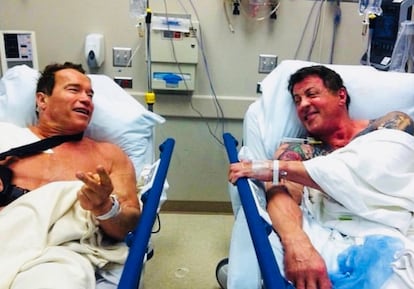
A. Yes, because he’s special. We’re in contact. We even crossed paths about 10 years ago in a hospital. I couldn’t believe it. I was going in for shoulder surgery and there he was, coming out of the same operation, also for a shoulder. I’ll show you a picture. Isn’t that wild?
Q. President Donald Trump appointed you ambassador to Hollywood. What does that role mean?
A. When I was made ambassador, I didn’t even know. I was watching CNN, and they announced it. I called the White House to say I didn’t want the job. Ambassador? As if Hollywood were a foreign country! It seemed ridiculous. They also named Mel Gibson; I called him and asked: “Mel, are you an ambassador?” “I don’t even know what you’re talking about,” he answered.
Q. You have defended Trump. What do you think your country saw in him?
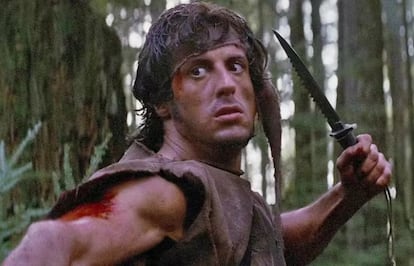
A. Sometimes you say things you probably shouldn’t. I’ve changed a lot when it comes to politics. He appeals to many people, but things are changing. War is horrible. I hate it! The only people who get rich are the military-industrial complex, with the blood and bones of those poor people who make no money. I hate the idea of being in Iran. When I did Rambo, I was talking about the Vietnam War. Since Korea, we’ve been going to countries for no fucking reason. War is only justified if you’re attacked. Why do we go there? I feel so bad for the soldiers. Their entire lives are wrecked, and yet they keep defending the flag.
Q. You shaped the idea of masculinity in the 1980s. How do you view today’s obsession with fitness and gym culture?
A. It’s very important, because men need to conquer something to prove their masculinity. It’s part of their nature. That’s why they go to war. Only men do crazy things, like jump out of windows or throw themselves off motorcycles. I never see women doing those things. Every man needs to challenge himself to see if he’s brave.
Q. And what do you think of the new masculinities?
A. I don’t even know. What is that? A real man is physical. That’s what he’s put on this planet for. That’s what he was and always has been.
Q. How does someone who came to embody masculine strength and vigor come to terms with aging?
A. It’s an adjustment. The gym is the church of the soul. I go just to be in that environment. I can no longer lift 300 pounds. That’s over. But there are other ways to feel strong and masculine. Otherwise I would die. Everything would fall apart if I stayed home watching TV. I would get depressed. I feel pretty good. Dying is easy. Living is hard.
Q. What do you think about the woke movement?
A. It’s kind of boring. I like outrageousness. I like people to say outrageous things and do outrageous things. That’s what I loved about the 1980s, with Andy Warhol and people like that… just crazy. But it’s coming back. It’s all a cycle.
Sign up for our weekly newsletter to get more English-language news coverage from EL PAÍS USA Edition
Alaska
The Most Relevant Initiatives That Will Appear On The Ballots In November’s Midterm Elections


Do Tutankhamun And Nefertiti Share A Tomb?

Croacia – España En Directo | Perisic Adelanta A Croacia

Lula Pretende Movilizar A Los Abstencionistas Para Consumar El Milagro Y Vencer A Bolsonaro En Brasil


-

 Uncategorized2 weeks ago
F1 Qualifying Today: Azerbaijan Grand Prix schedule, times and TV channel
-

 %2 weeks ago
Is Your Supermarket Kefir Really Kefir? Spanish Study Raises A Surprising Question
-
Latest2 weeks ago
‘It’s The Law Of The Jungle’: Pensioner’s Eviction Exposes Spain’s Housing Crisis
-

 Uncategorized1 week ago
F1 Bahrain Grand Prix will be live and FREE on TV this weekend
-
Barter system2 weeks ago
British drug dealer swaps cocaine for Pokémon cards in bizarre barter deal
-
Balearic Islands2 weeks ago
Tourists driving to Menorca could soon need a permit and pay to bring their car
-

 Cody Gakpo2 weeks ago
Xavi Y Klopp Se Reparten Puntos En Su Debut Como Seleccionadores
-
Adamuz2 weeks ago
Deadly crash and landslide chaos wiped out 800,000 Málaga-Madrid journeys