
ElPais
Down The Pipes With Super Mario: An Interactive Journey


Mario never has time. He’s always rushing off towards the next adventure. When he’s not saving worlds, or his beloved Peach, he’s racing cars, playing tennis, healing patients, or dancing. “Mario excels at sports including tennis, golf, baseball, soccer, and even kart racing. He’s good at all of them! He’s a plumber by profession but is really a jack of all trades,” reads his profile on the Nintendo website. “Mario is always bright and cheerful.”
A universal talent — and universally loved: Nintendo estimates it has sold 452 million video games, although some estimates reach double that. A survey in the U.S. concluded in the 1990s that he was more famous than Mickey Mouse. A colossal success, but an exhausting one. Indeed, in some video games, if the player sets the controller down, Mario takes the chance to sit. He immediately falls asleep and even starts snoring. Because Mario is unique and, at the same time, just like anyone else. And that’s why everyone feels at least a little fondness for him. Even more so now that he’s celebrating his 45th anniversary. Let this article serve as a gift.
His creator, Shigeru Miyamoto — whose message of thanks to EL PAÍS readers appears at the end of this article — said that the character is “between 24 and 25 years old.” But the truth is, he first appeared 45 years ago: although, in 1981, he didn’t have the name or the prominence he has today. He was called Mr. Video, or Jumpman. And, in the video game Donkey Kong, he was the guy who dodged the barrels thrown by the evil ape to rescue the princess. At the time, the story cast him as a carpenter. So the myth required some tweaking: a more appropriate profession, since he went down so many pipes; or the chance appearance during a meeting at Nintendo’s U.S. offices of Mario A. Segale, an Italian-American businessman who leased the building to the company. He had come to demand the rent, with some insistence. But he ended up giving his name to the 1985 game Super Mario Bros.
The rest was down to technical limitations: a cap, to avoid designing the hair; a mustache, to hide the mouth; and overalls, which spared them from drawing extra clothing movements. So, it’s been 45 years since Mario embarked on his journey to his beloved stars. And four decades of his solo epic, whose celebrations continue. These weeks, he’s also dominating the box office again with Super Mario Galaxy. No other video game character has become such a pop culture icon. Restaurants, theme parks, and even Niall Breen’s comic book, The Lonely Plumber, are dedicated to him. He’s featured in museums, on T-shirts, toys, watches, backpacks, Legos, and even rattles, thanks to the recent My Mario baby line. Because the young players who grew up with him are now passing on their passion to their children and grandchildren. Mario’s online profile says he loves “partying with his friends.” He has plenty of reasons to.
C H A N G E
There are also several reasons for its success. “It’s like the line from The Leopard: ‘If we want things to stay as they are, things will have to change.’ A player of the first Mario game who tries the latest one will understand. You can play with a joystick and a button; it has a simple introduction, although it’s difficult to master afterward. There’s always something different, but the core gameplay remains,” reflects Manuel Curdi, marketing director of Nintendo Spain for the past 20 years. “The most important thing is that it’s very entertaining, for all ages and audiences,” adds Pablo Díaz, a violinist with a passion for the plumber’s work. “It was literally the first video game that an entire generation held in their hands. It helped invent and define what we expect from video games,” adds Chip Carter, who followed the character’s growth since 1990 through his pioneering column in The Chicago Tribune.
In the history of video games, Mario’s importance is, to say the least, difficult to overstate. He’s not just a popular character or a long-running franchise, but a way of understanding design and the relationship between user and world. Journalist Paula Sáez Pérez highlights the foundational nature of the first Super Mario Bros.: how it “established side-scrolling” and how it introduced learning mechanics without the need for text. “The first level of the game is still studied in design schools,” she notes, precisely because of its ability to teach without words. Some consider it the best implicit tutorial ever created.
I C O N
“Its influence is absolute and still relevant. At first glance, it seems to only affect the mechanics, but it also encompasses the very concept of adventure and how to present it to the player,” notes Adrián Suárez, co-author of the book On Mario: From Plumber to Legend. That idea, condensed into minimal resources, was revolutionary at the time. “There were secret places, changes in the sky, very few elements… and yet it offered a vast journey,” adds Suárez. The key wasn’t quantity, but precision. From the structure to the smallest visual details, Mario laid foundations that continue to be replicated. “Prestigious authors like Hideo Kojima and Hidetaka Miyazaki have acknowledged its influence,” says the expert, who holds a doctorate in video game narrative and is a professor at the International University of La Rioja (UNIR).
The saga, to date, comprises 24 main games. And around 200, if you include the Kart series and any other appearances on screen. Mario’s biggest misstep also came on screen: the 1993 live-action film. Consoles have come and gone, from the Nintendo and the Game Boy to the current Switch 2, but Mario has remained its standard-bearer. Unmatched in popularity by any rival, be it Sonic — for once doomed to run behind him, not ahead — Lara Croft, or Pikachu. He’s unbeatable in the market too, just as he is when he grabs a star or a mushroom. Miyamoto, for the record, has clarified that the magic of those mushrooms was inspired by folklore, not Alice in Wonderland, and certainly not by hallucinogenic experiences.
All of this remains unchanged even in the most recent Super Mario Bros. movie, Wonder, from 2023. Although in their development diary, the creators explain that they sought to recapture the “wonder” of the first Mario. In keeping with the quote from The Leopard, the plumber still moves forward and jumps from left to right, collecting bonuses and coins along the way, until he faces the most fearsome turtle of all: Bowser. Around him, however, the ideas keep coming even faster than the threats. A proposal for a realistically proportioned Mario who would hum the famous theme as he walked — and shout “Boing!” when he jumped — didn’t make the cut. But the game does completely reinvent the gameplay of many levels, with flights, dragons, and bubbles, and transforms the hero into an elephant or even one of those Goombas that try to chase him with their tiny legs.
R E V I E W
R E V I E W
The paradox is that Mario’s simple coherence has slowly turned him into something of an outlier. In a medium striving for sophistication — where plot and graphics increasingly dominate, sometimes even overshadowing gameplay — the plumber flips that logic on its head. “If we look at how he constructs the world, we see a story that isn’t fully told, that remains implicit,” says Suárez. This narrative style, based on suggestion and exploration, has ultimately become one of the pillars of modern design. “Mario showed us how to tell adventures within playable environments. Gameplay comes first,” he adds. “Often, in pursuit of a more complex and artistic status, the industry has moved towards niche markets. Mario embodies the opposite, the ambition to include everyone,” says Manuel Curdi. In 1985, when each gamer barely had a couple of cartridges and often one was a Mario game, and today, when he dominates amidst an overwhelming array of options, the effect is the same. The overlap of anniversaries, the debut of the Switch 2, and the long wait since his last 3D game (Odyssey, 2017) have only fueled speculation about new announcements.
Curdi, however, isn’t giving anything away. For now, we’ll have to make do with what we have. “Mario is charismatic, powerful, someone you can easily identify with,” says Suárez. His simplicity — a plumber with a cap and a mustache — is one of his greatest strengths. “He’s almost a blank slate; he has very specific attributes, and adding more could exclude someone. He tries to be universal in everything, including the plot and the interface,” Curdi notes.
For someone so famous, remarkably little is known about him — certainly nothing resembling political, social or philosophical positions. He hardly speaks, except for the occasional “mamma mia!” he always smiles, helps, never gives up, and little else. That same tradition, which has cemented his success, has also become the subject of critical re‑examination, especially regarding gender roles. Journalist Marta Trivi points out that the classic structure follows a deeply rooted narrative logic: “Peach is kidnapped because in traditional stories, princesses… the hero has to rescue them. That structure is sexist.” She clarifies that it’s not about demonizing the saga, but about understanding the context in which it emerged and is repeated. “There has always been a tendency to represent women as passive figures and men as agents of action,” a dynamic that Mario has reproduced without question for decades.
Paula Sáez agrees, pointing to the “damsel in distress” trope as one of the saga’s most recognizable elements. However, both experts acknowledge certain advances in recent years. Trivi highlights that current reinterpretations seek to “turn these tropes on their head,” not only due to the influence of feminism, but also because of the need to surprise an audience already familiar with these narratives. Sáez, for her part, mentions the growing prominence of characters like Peach, albeit still in a limited way. In this sense, they point out that the future lies not only in gameplay innovation, but also in rethinking the dynamics that have defined its universe for years. Even the ending of Odyssey — where the Peach rejects marriage proposals from both Mario and Bowser and walks away — ultimately fell back into the stereotype: both characters immediately chase after her to win her over.
At least in the recent films, Peach is portrayed as a wise stateswoman and a brave warrior — someone Mario learns from. However, no major revolutions are expected in the short term. “The character can only be stretched a little. Every single detail is overseen by Japan, perhaps even by Miyamoto himself. It’s the intellectual property that defines the company. We have the trust of many families; that’s a treasure that must be protected,” says Curdi. Nintendo now entrusts its symbol to other companies, like Lego or Universal, to help explore toys or film, but it always keeps control. After all, that’s how it has secured 45 years of success — with more to come. It’s enough to make you say, “Mamma mia!”
There’s no break ahead for the icon, unless the player grants him one. Then, finally asleep, the plumber will begin to dream of spaghetti, ravioli, lasagna, or carbonara. Even his fantasies are simple — pure nostalgia for home. No matter how much they call him Super, deep down, he’s always just Mario: an ordinary guy.

“Hello to all EL PAÍS readers. I’m Shigeru Miyamoto from Nintendo. It’s been 40 years since we released Super Mario Bros. for the Family Computer in Japan back in 1985. Thank you for your continued support of Super Mario!”
Credits
Coordination: Brenda Valverde Rubio
Design: Ana Fernández and Ruth Benito
Art direction: Ruth Benito
Development: Fernando Anido and Alejandro Gallardo


It all began on the shores of the English Channel. John Gillard remembers himself at just 11 years old, walking along the path that led away from the sea, through a sea of blue and white shirts, scarves, and flags, to the austere and venerable Goldstone Ground, in the heart of the town of Hove. In that century-old stadium, demolished in 1997 and now replaced by a shopping center, Brighton & Hove Albion, the legendary Seagulls, the pride of Sussex, the team of Gary Stevens and Gordon Smith, played their matches.
Gillard, a graduate in modern history, designer, writer, and creative writing workshop coordinator, was infected there by the football bug, a persistent affliction that, in subsequent years, has taken him all over the world. As he explains in the introduction to his book, The World Atlas of Football Stadiums (published in Spain by Cinco Tintas), professional obligations and sports tourism have taken Gillard from the floating pitch of Koh Panyee, in a Thai fishing village, to the futsal courts of the Rio de Janeiro favelas, the spectacular grandstand of Sydney’s Accor Stadium, and the new Santiago Bernabéu, with its unusual retractable pitch system.

The author concludes that no two stadiums are alike, that football is palpable in every one of these venues, and that each one “offers something unique and surprising,” related to its surroundings, its architecture, its tradition, or “the richness of its fans’ experience.” The book, to which writers Joseph O’Sullivan and Neel Shelat also contributed, includes descriptions and images of up to 1,000 iconic stadiums across five continents, including some as picturesque as La Bombonera in San Cristóbal, located on a tobacco plantation in the shadow of the Sierra del Rosario mountains in Cuba; the almost always packed Mobolaji Johnson Arena on Lagos Island in Nigeria; and the futuristic Glass House in Dunedin, New Zealand. With Gillard and his team as guides, readers travel a transoceanic route through Europe, Asia, Africa, and the Americas in 10 stops, from the most imposing and technologically advanced stadiums to the most peculiar, historic, and peripheral ones. In the words of the book’s author, “it is possible that a particular stadium may awaken your curiosity to the point that you decide to visit it, or even travel across an entire country jumping from one stadium to another, soaking up its culture along the way.”

Pier 5 (Brooklyn, New York)
The United States is one of the three host countries for this summer’s World Cup, with matches scheduled in historic venues like Seattle’s Lumen Field, Santa Clara’s Levi’s Stadium, and Miami Gardens’ Hard Rock Stadium. But the future of soccer — the kind that might allow the United States to emerge as a global power in the medium term — is slowly being forged in places like this: the public pitch on the Brooklyn piers, amid pleasure boats, the cries of seagulls, and the bustle of dockworkers, in the shadow of the Manhattan skyline. Aside from the school and corporate leagues held at Pier 5 between March and November, you can sign up on the Brooklyn Bridge Park website, pay an access fee that varies depending on availability, and simply play soccer.

León Stadium (Guanajuato, Mexico)
Colloquially known as Nou Camp, due to its obvious resemblance to FC Barcelona’s home, the stadium of the fourth most-populated city in Mexico, León de los Aldama, belongs to the Pachuca Group and has a capacity for more than 31,000 spectators. Here, the England national team was brought to its knees in an epic 1970 World Cup quarter-final against West Germany (as Gillard recalls, the English manager, Alf Ramsey, decided to substitute Bobby Charlton when they were winning 2-0 so that he would be fresh for the semi-final against Italy, and they ended up losing 2-3, after succumbing to an irresistible surge from Germany that dismantled them in just 20 minutes) and here, Club León — the Esperanzas de Guanajuato or Panzas Verdes — have celebrated 17 of their 19 national titles, including the surprising league title of 1992. It is not the Azteca Stadium nor the Olympic University Stadium of Mexico City, but it is one of the most beautiful and prestigious stadiums in North America.

Maracanã (Rio de Janeiro, Brazil)
Brazilian stadiums are in a league of their own, due to their colossal dimensions and the passion that fills their stands. There are colossi like the Mané Garrincha in Brasília, the Aderaldo Plácido Castelo in Fortaleza, the Morumbi in São Paulo, and the Mineirão in Belo Horizonte, all enormous, even though successive renovations have reduced their capacity. But the largest of them all, and the mecca of Brazilian football, is the Periodista Mario Filho stadium, better known as Maracanã after the populous neighborhood in which it is located. For Gillard, this stadium is exceptional because of its setting, nestled between the Atlantic beaches and the fertile hills of Rio, and because of the overwhelming proximity of Christ the Redeemer atop Corcovado Mountain, the 30-meter-high Art Deco statue that “watches over it like a guardian angel.” Also because it was, of course, the site of one of the most famous matches in football history: the 1950 World Cup final, in which Juan Alberto Schiaffino’s Uruguay were considered easy prey for the Brazilian constellation of stars, only to triumph with a goal that sent chills down the spines of 178,000 spectators. And because it is home to Rio’s two main teams, Flamengo and Fluminense, fierce rivals but, despite everything, brothers, united by a stadium that exudes sporting mystique from every pore.

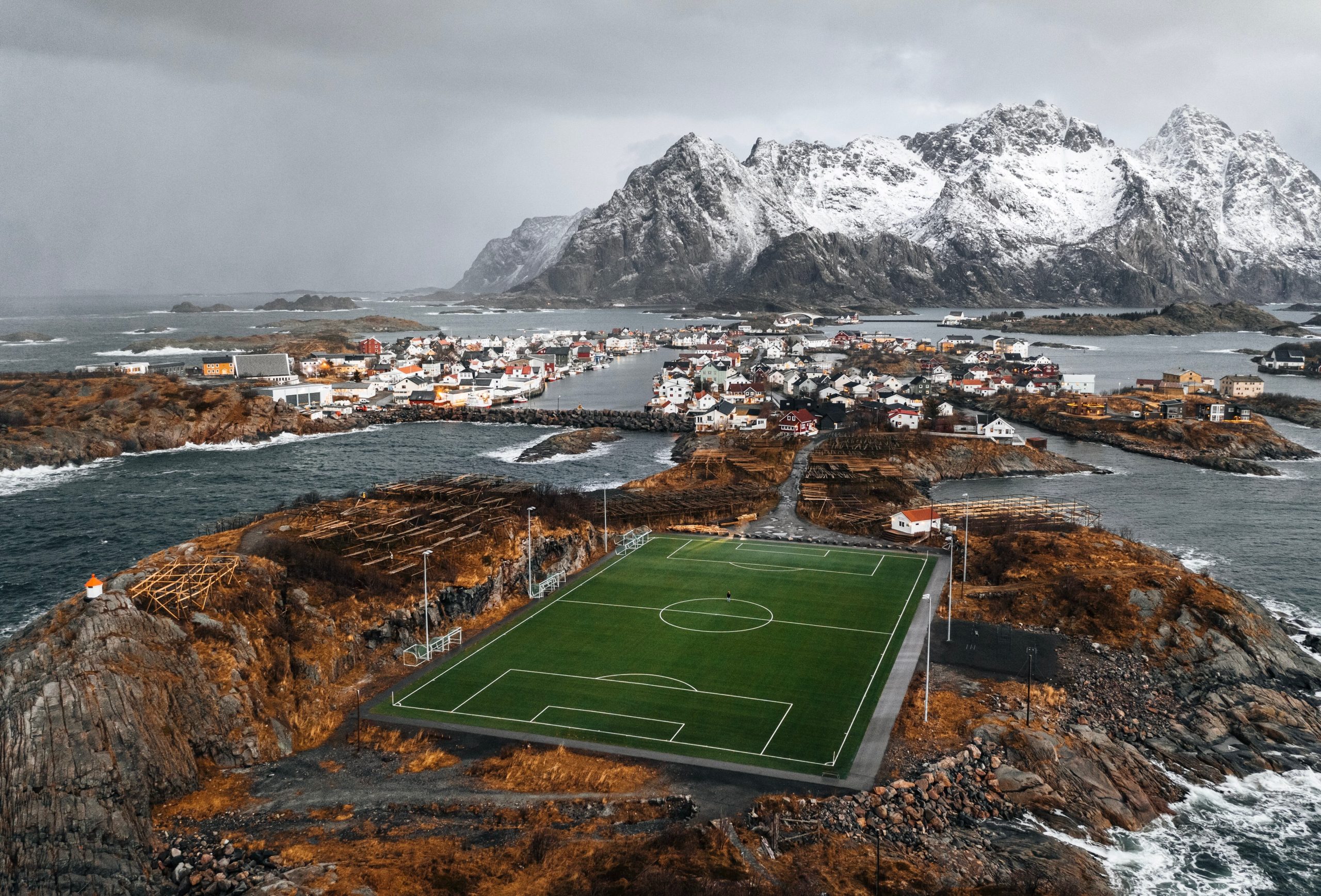
Hennigsvaer Stadium (Norway)
Another kind of soccer is possible. And it’s played, far from the multimillion-dollar spotlight of metropolitan soccer, in places like this pitch on the island of Hellandsoya, in the Lofoten archipelago, beyond the Arctic Circle. In this place of stark beauty, with white sand beaches where swimming is only possible for a couple of weeks a year, Gillard has featured what he considers one of the most beautiful stadiums in the world. To get there, as the British writer explains, you have to “cross bridges and tunnels, wait by the roadside for the infrequent local buses, and walk over bedrock.” Once you’ve completed the journey, upon arriving at a fishing port of about 400 inhabitants “that houses a contemporary art gallery where there used to be a caviar factory,” you can’t help but be amazed to see that someone has created something so beautiful on a rugged bed of petrified lava so that the locals can play soccer under the midnight sun or the Northern Lights.

Qeqertarsuaq (Greenland)
Also highly valued in the exotic category is this Greenlandic stadium surrounded by icebergs, right on the migration route of humpback whales, which frequently surface beyond the ice floes during matches. Despite its rugged appearance, it is a semi-professional pitch, where the Qeqertarsuaq team, G-44, one of the 16 that regularly compete in the Greenlandic Championship, plays its matches.

Stadio Diego Armando Maradona (Naples, Italy)
Fans of a certain age will remember that this multi-purpose stadium in Naples’ Fuorigrotta district was always called San Paolo, in honor of the apostle and one of the city’s main basilicas. But no saint can compete with the secular idolatry generated in Naples by the Argentinian Diego Armando Maradona, who established his headquarters in this stadium between 1984 and 1991, shifting the center of gravity of Italian soccer from the north to the south during those glorious years. Napoli fans continue to pay homage to the man who, for the first time in history, put the Campania club on par with Piedmontese, Lombard, and Roman teams. And they do so, above all, in this stadium famous for the roar and vibrant colors of its stands, starting with the legendary Curva B, which, match after match, boasts of erupting “like a bomb” the moment their team steps onto the pitch. It may not be the most beautiful stadium in Italy, but it is certainly among the most genuine and passionate, a coliseum animated, according to Gillard, by the tribal enthusiasm of “us versus them” so characteristic of a city that has often felt isolated from the rest of the nation, clinging to its own traditions and historical inertia. “It’s no wonder,” Gillard concludes, “that other fans know it as the cauldron of hatred.” Both the city of Naples and soccer have reasons that reason cannot comprehend.

Jean-Bouin and Parc des Princes (Paris, France)
Although the Vélodrome in Marseille and the Gérard Houllier in Lyon are, each in their own way, masterpieces of contemporary design, no snapshot of French soccer would be complete without starting with these twin stadiums on the outskirts of Paris. Separated by a four-lane avenue, the homes of the multi-billion-dollar PSG and the much more modest FC Versailles are an ode to neo-brutalist avant-garde, to the merciless power of soccer, and to the austere beauty of concrete behemoths. The Jean-Bouin opened in 1925 and has been renovated and expanded twice, most recently in 2011, when its striking Art Deco-inspired metal mesh was completed. Its illustrious neighbor has stood there since 1897 and consolidated its current appearance in 2016, when it was last remodeled, following expansions in the 1930s and 1960s and a complete reconstruction in 1972, led by architect Roger Taillibert.

Estadio Santiago Bernabéu (Madrid, Spain)
What does Gillard think of the new Bernabéu, the attempt to provide Madrid with a landmark building of international renown to rival the Sagrada Familia or the Taj Mahal? To begin with, he says that from afar it looks more like a spaceship than the sardine can its detractors perceive it to be. Once inside, according to the author, it’s an imposing “cathedral of football” that forces players leaving the tunnel to tilt their heads back to appreciate the intimidating grandeur of the stadium they’re in. A behemoth with a capacity of 83,000 spectators, a retractable roof equipped with weather sensors, that retractable pitch everyone’s talking about, and a 360-degree video scoreboard. For Gillard, it’s “a stage worthy of the most successful club in football history.” The author also praises examples of excellence in Spanish sports architecture such as the new San Mamés, the pilot version of the future Nou Camp, and the Metropolitano, which he describes as “one of the most modern stadiums in Europe.”

Sükrü Saracoglu Stadium (Istanbul, Turkey)
The authors of the World Atlas of Football Stadiums are captivated by the richness and diversity of Turkish soccer. In particular, they admire the fertile and fierce rivalry between the three major teams (Besiktas, Galatasaray, and Fenerbahçe) of Istanbul, that megalopolis of 15 million inhabitants that lives and breathes soccer and consumes it with unbridled passion. Of the three local stadiums, Fenerbahçe’s home ground is perhaps the most striking, due to its location between the city’s busiest thoroughfare and the shores of the Sea of Marmara. Inaugurated in 1908 and with a capacity of over 47,000 spectators, this stadium was last renovated in 2006 and today presents an appearance somewhere between the melancholic grandeur of its origins and the understated efficiency of contemporary sports architecture.

DHL Stadium (Cape Town, South Africa)
There are plenty of reasons to enjoy sports tourism in sub-Saharan Africa. You can choose from stadiums in Tanzania, Senegal, Nigeria, or Ethiopia, and in all of them you’ll find boundless passion, striking settings, and local color. But the continent’s greatest stadiums are in South Africa, which hosted the World Cup in 2010. There you’ll find the FNB Stadium in Nasrec, Johannesburg, the astonishing bowl covered in turned wood (as Gillard describes it) where Andrés Iniesta scored a goal for the ages. And 745 miles away, at the other end of the country, is the DHL Stadium in Cape Town, home to Ajax Cape Town, the younger sibling of Ajax Amsterdam and the pride of the Parow suburb. The stadium in the former colonial city sits at the foot of the bucolic Signal Hill and on the shores of the South Atlantic, with the rugged Table Mountain looming over the north stand. Gillard points out that, alongside the new venue, inaugurated in 2009 and with a capacity for 55,000 spectators, the previous version of the stadium, dating from 1897, is preserved: “It is a strange image, seeing the old and the new resting next to each other.”
Sign up for our weekly newsletter to get more English-language news coverage from EL PAÍS USA Edition


“A pop and a hiss,” like when you crack open a can of soda. This is the sound a voice can make when it breaks.
That’s how American singer Joanna Newsom described what happened to her in early 2009, when she discovered that she had developed vocal cord nodules due to excessive concerts and a lack of vocal technique. Instead of opting for surgery, her decision was to remain silent. She spent two months without speaking or singing. And, when she reappeared in 2010 with her third album, Have One on Me, the change in her vocal register was evident in the songs. She went from singing “wildly” to doing the complete opposite.
Although Newsom could have gotten over her fear of surgery, certain precedents explain her decision not to go under the knife. A vocalist’s greatest fear is losing their voice. And, for a multitude of artists, for decades, this nightmare has come true countless times. The case of Julie Andrews is particularly noteworthy, as she was renowned for her pure and crystalline voice.
In 1997, an operation to remove polyps (benign growths) from her vocal chords left Andrews unable to sing. The actress sued the doctors who operated on her for negligence, claiming they had unnecessarily operated on both sides of her throat and that she had never suffered from nodules, but rather from muscle striations caused by overuse of her voice. Andrews had been forced to withdraw from the musical Victor/Victoria and admitted to prioritizing “bright, happy” songs in her repertoire, which led her to overuse her high register.

Although the lawsuit against Mount Sinai Hospital in New York was settled in 2000 for an undisclosed sum, there were far greater repercussions than solely monetary ones: Andrews had to abandon music and focus instead on acting and writing children’s books. She managed to reinvent her career, to the point that many who saw her, for example, in The Princess Diaries (2001), are unaware of this sad episode in her professional life. Her case highlights the psychological consequences that arise when a vocalist loses their instrument and livelihood, consequences that are often subtle.
Andrews fell into a deep depression. She said that she felt like she had lost her identity. Other vocalists have compared this feeling to the experience of an athlete who loses a limb. The link between the voice and self-identity is even evident in the figurative sense associated with the word “voice”: when someone says they have their own voice or that they want their voice to be heard, they are implying that they want to be seen, appreciated and taken into account. But the voice is also a muscular tool. And, when it tears, identity is also broken or disfigured.

Some go further, pointing out that the voice as identity represents an “epistemological conundrum,” since it is “conceptually, impossible to ‘locate,’” as Canadian journalist John Colapinto noted in The Guardian. “[The voice] is ‘in’ the speaker’s body as an act of breathing and articulation, but doesn’t exist until it is manifest in the air as a sound wave. Arguably, the voice comes into existence, as voice, only when someone is around to process that sound wave in the brain’s auditory cortex.”
So intrinsic is the voice to an artist’s identity that some admit to having lost it for strictly psychological reasons. For instance, The Weeknd lost his voice during a concert in Los Angeles. And the show’s cancellation was traumatic for him, to the point that it’s been documented on his latest album, Hurry Up Tomorrow (2025), in the interlude: “I can’t fucking sing.” In that line, Abel Tesfaye (known professionally as The Weeknd) expresses his frustration at not being able to perform. Tesfaye attributed the loss to having played the role of Tedros on the TV series The Idol (2023). He commented that his voice became psychologically linked to the character, who couldn’t sing. Hence, reassuming his identity as The Weeknd was more difficult than expected.

The identity component of the voice is also evident in opera singers, who undergo a remarkable vocal transformation during their training. For most opera singers, a 2015 academic study points out, “voice type will determine future roles, the music they perform and potential career trajectory,” meaning that “voice type becomes a facet of identity and position within the operatic world.”
This makes stories like that of the celebrated British baritone George London, whose operatic career was cut short, particularly tragic. London developed unilateral vocal cord paralysis that impaired his voice. Despite several medical attempts to restore it —including silicone and Teflon injections into the affected vocal cord — the doctors were unable to return him to the vocal quality that he demanded of himself.
Using your voice carries inherent risks, due to the physical nature of the activity. The vocal cords are muscles that, in the case of singers, must be trained and cared for, as they’re vulnerable to injury, fatigue and other problems. Sometimes, artists themselves neglect their vocal health, by abusing drugs and alcohol. But record labels also encourage overexertion, by subjecting artists to grueling tours and almost daily flights. “Recovery days are the most important days,” Miley Cyrus said on a podcast.
Cyrus suffers from Reinke’s edema and a polyp on her vocal cords. She underwent throat surgery in 2019. The singer explained that she didn’t have rest days because “the off days are the days that money’s not coming in,” recalling that her record label tended to prioritize financial productivity over vocal care. “I definitely didn’t get the training that I needed to say, ‘Hey, I don’t want to do this until I’m 15; I want to do this until I’m 80.”

A video of a 2001 interview with Björk frequently goes viral on social media. In it, the Icelandic singer explains that she traveled from Hamburg to Cologne by train, in order to preserve her voice. This surprises the interviewer, who can’t understand why a star of her caliber doesn’t travel by plane. The singer’s response (“air pressure forces the molecules to go tiny”) is often perceived as an unintentionally comical example of her eccentric personality… but her explanation is logical. The intensity of touring and frequent flights causes vocal problems when one sings excessively for many years. The first step toward severe vocal cord damage is inflammation, which can be caused by various factors.
“One of the big risks for performers these days is that this inflammation, which you get from having to use your voice more than the average person, can also be caused by the dryness of airplanes, the dryness of hotel rooms, the smoke that’s on the stage, etc.,” vocal coach Dane Chalfin explained in an interview. “It’s not just the hour a performer’s on stage. It’s the press they do in the morning; it’s their soundcheck; it’s their meet and greet afterward. Eventually, the inflammation in their vocal cords will reach a critical mass, where it becomes unmanageable.”
“If a performer keeps performing while their larynx is already inflamed,” he continues, “they start running the risk of developing hemorrhages, where they burst blood vessels. And they also run the risk of creating other problems, like nodules and polyps.”
Chalfin adds practical tips for preserving your voice while touring: avoid performing immediately after long flights, rest at least 24 hours between a flight and a performance, stay hydrated, use steam inhalations to protect the larynx, and keep caffeine and alcohol intake to moderate levels.

It’s ironic that the music industry itself encourages the misuse of the voice. This occurs whether through overuse in concerts, or because of bad habits being encouraged, since the timbre resulting from such excessive effort, like that which led Björk to have vocal cord nodule surgery in 2012, or from alcohol and drug use can be commercially appealing. For instance, Jazz singer Julie London was famous for her smoky, sensual voice, but the reality is that she achieved that timbre by smoking three packs of cigarettes a day. Her voice deteriorated prematurely and she spent her final days ill. The acclaim for an album like Marianne Faithfull’s Broken English (1979), on the other hand, demonstrates that audiences are fascinated by imperfect and worn voices, since timbre is paramount: it’s interesting. Faithfull recorded her masterpiece after years of a troubled life, with that experience reflected in the songs through her voice.
However, singers whose careers rely on vocal power and polished technique cannot afford to market their voices from the perspective of esthetic deterioration. Modern vocalists like Adele and Sam Smith, fearing the permanent loss of their instrument, have undergone vocal surgery at the hands of Dr. Steven Zeitels. Numerous artists have placed their trust in the renowned surgeon. Zeitels performs delicate and successful operations, but some experts question whether resorting to his expertise always addresses the underlying problem.
“How many surgeries would Dr Zeitels consider performing on Adele? Or on anyone?” asks voice coach Lisa Paglin. A former opera singer, she describes Zeitels’ operations as temporary fixes. “After surgery, unless a singer makes major changes, [a] ‘return to performing’ means a return to the vocal abuse that put [them] on the operating table in the first place.”
Although the voice can be retrained after a period of decline as Joanna Newsom did, even improving her technique in the process, the esthetic result of that effort doesn’t always convince the public. Pop and soul icons renowned for their voices, such as Aretha Franklin, Frank Sinatra and Whitney Houston, left behind albums and live performances before their deaths that revealed the serious deterioration of their voices, making them seem like mere shadows of their former selves.
However, there’s something profoundly poetic in great vocalists not only continuing to take the stage with deteriorating voices, but choosing to display that decline openly. Mariah Carey is firmly established as one of the greats of music, but a few days ago, videos of an event in New York went viral on social media, showing her voice no longer possessing its former virtuosity. But, with time, we’ll remember that her latest album, Here for It All (2025), also offered something valuable: a seasoned, authentic voice, present in the moment and unfiltered. After years of experimenting with vocal editing, works like this one by Carey demonstrate that the voice continues to define an artist’s identity, even when time wears it down to the point of being practically unrecognizable. The alternative isn’t always to withdraw or hide; sometimes, the most honest act is for a singer to show themselves as they truly are… even if it confronts the public with their own inevitable decline.
Sign up for our weekly newsletter to get more English-language news coverage from EL PAÍS USA Edition
Donald Sutherland
Philip Sharkey, The Eye Behind Celebrity Passport Photos: ‘They Came Without Assistants Or Makeup Artists, They Were Simply Themselves’

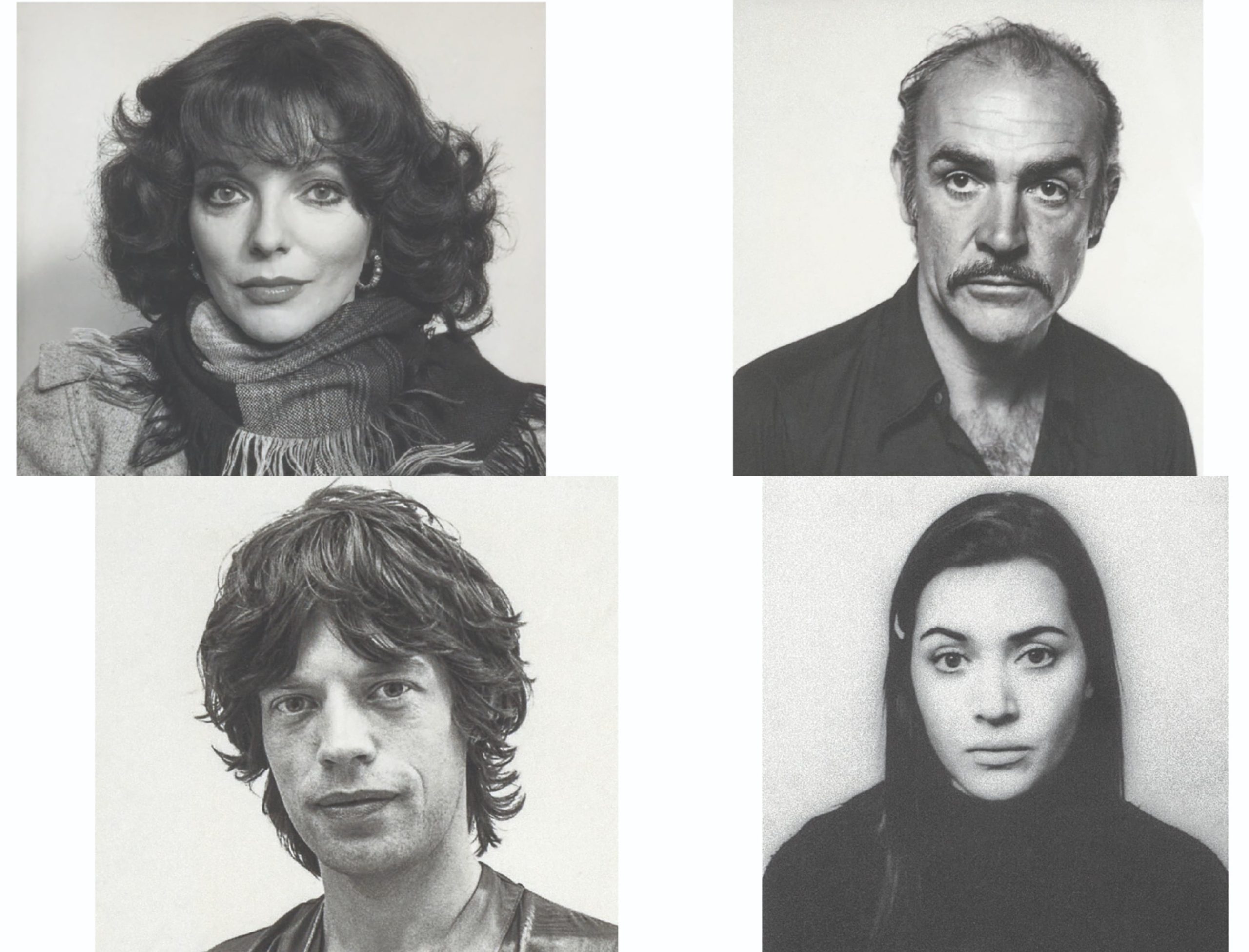
There is a type of photograph that can disarm even the most photogenic subject: the passport photo. That small, no‑frills portrait levels everyone — anonymous and well‑known, rich and poor, beautiful and not so much. Everyone needs one at some point and submits to the same ritual: sitting up straight before the flash with an expression as neutral as the backdrop behind them. Some people come out unscathed; others feel the image doesn’t represent them.
But with public figures, something strange happens. Accustomed as we are to seeing them dazzling and meticulously produced, gaining access to this tiny slice of their private selves feels like meeting them in their purest, most honest, most real form.
“We had like 800 celebrities [come by the studio]. Nobody had any makeup or PR people saying ‘do this, do that.’ They were simply themselves,” says Philip Sharkey, 60, on a video call with EL PAÍS. He was the last owner of Passport Photo Service, the London photo studio most frequented by the stars.
This modest family business — started by his father, former boxer David Sharkey — opened its doors on busy Oxford Street back in 1953. Philip was born a minute’s walk from the studio and started working there in 1973, at the age of 16. His memories of the shop are memories from an entire lifetime.
“When my brother and I were little, they would take us to the studio during school holidays. One day, Jean Paul Getty was there having his picture taken. My father said to me, ‘This is the richest man in the world.’ I was about eight years old. And I said, ‘Why isn’t he smiling? He looks very serious.’ When he finished taking the pictures, my father encouraged me to wait on him in case he would give me a tip, but Paul Getty asked for the minimum of three photos and already had the exact amount of money ready to pay me. I guess that’s how you become the richest man in the world,” he quips, laughing.
Sharkey has compiled this and many other anecdotes related to the celebrities who visited the studio in Passport Photo Service: An Unexpected Archive of Celebrity Portraits (2026), which was published this past April. It serves as an archive of the hundreds of famous faces immortalized by his family between 1953 and 2019, when the business finally closed its doors. From a young Iggy Pop, Kate Winslet, Muhammad Ali, Daniel Day-Lewis, and Mick Jagger — to a not-so-young Tom Jones, Ava Gardner, Sting and Valentino — the faces of more than 300 actors, singers, directors, fashion designers, and athletes make up this unprecedented visual journey.

“One of the keys to having so many famous celebrities is that we were very close to the American Embassy and the Canadian Embassy and the Japanese Embassy,” Sharkey explains.
Another important factor, as he recounts in his book, is that the studio boasted it could produce photos in 10 minutes, back when instant film development was still a pipe dream: “That’s how we found our niche.”

The photographer says actor Donald Sutherland was particularly impatient: “He was in a big hurry because the embassy closed at like 12 p.m. and it was half past 11 a.m. He needed to get straight back. I said, ‘Do you want to take your coat off?’ He said, ‘No, I haven’t got time.’ He turned his collar up, and it’s a fantastic photo.”
The proof is on page 116, where the piercing gaze of the Klute and Hunger Games actor — captured on May 2, 1977, at age 41 — cuts straight through the reader.
“Some were in a hurry. Others were a bit more haughty, and you knew you shouldn’t talk to them too much, because they’d just walked down Oxford Street to come to us, so they were probably hassled all the way there. But, in general, they were lovely,” says Sharkey.

The photographer has all sorts of stories. There’s the one about Christopher Reeve walking into the studio at the height of his fame, after Superman (1978), to have his two sons’ ID photos taken. “His children were looking at all the photos we had on the wall. I said, ‘Well, look at that, there’s Arnold Schwarzenegger, and there’s Donald Sutherland: you should be up there.’ He said, ‘Alright then.’ And he sat down, and I took a lovely photo of him,” he recounts. The result is a smiling Reeve, dimpled, on June 25, 1988, seven years before the equestrian accident in which he severely damaged his spinal cord.
Rod Stewart’s reaction was completely different when he accompanied a woman to the studio. “Rod Stewart came in with one of his… I don’t know if it was a wife or a girlfriend… and I photographed her. And I asked, ‘Shall I photograph you?’ He said, ‘No, I don’t need one today,’” the author of the collection recalls.

Passport photos accounted for between 70% and 80% of the business, he says. Some celebrities trusted the family so much that they visited the studio repeatedly, allowing the passage of time to be seen in their portraits. This is the case with Sean Connery, who appears in the book: he was photographed in 1977 — the year he starred in A Bridge Too Far, at age 47, with a mustache and an attentive gaze — and in 1989, at age 59, when he appeared in Indiana Jones and the Last Crusade, with a gray beard and a much more relaxed expression.
Joan Collins, meanwhile, appears at three different stages of her life: first in 1971 (at age 38), with long, straight hair; the second in 1979 (at age 46), with curly hair above her shoulders; and the third in 1988 (at age 55), with a bouffant hairstyle that was characteristic of the era. “It’s interesting to see the fashion trends,” Sharkey points out. “You’ll see that, in the 1950s and 1960s, all the men have got a tie and suit on. And then, everything gets a lot more casual. And you’ll see [how] Pattie Boyd — who was married to George Harrison and then Eric Clapton — is dressed like a real hippie. Looks fantastic.”

Working at the photography studio allowed Sharkey to meet all sorts of celebrities, though he still wishes that he had met a few others, like Frank Sinatra or Elvis. With some — like the comedian and actor Stephen Fry, who wrote the book’s foreword — he’s even developed a friendship.
“He’s been a client for many years, since he was young. And he always comes in, says hello, introduces me to his husband [Elliott Spencer], who is lovely,” the photographer says.
He also remembers a particularly special encounter with George Michael, back in 2006: “I had a lovely time with George Michael, because we grew up very close to each other in the same little village. And I used to do a paper route, delivering the morning papers and evening papers. And when I met George, I said, ‘I’ve got to tell you George, your father was such a lovely man, he was so generous.’ Because he gave very good tips. I remember, one Christmas, I went to deliver the newspaper to him, and he gave me a five-pound note, which was a lot of money in the 1970s,” he reminisces.

When Philip Sharkey’s family started the business in 1953 — his father, David, and uncle, Peter, were the photographers, while his mother, Ann, was the receptionist — it wasn’t common to have a camera at home. However, over the years, digitization and the selfie culture made the need for the studio — which had been indispensable for decades — disappear. “The U.S. embassy — which was our main source of clients — moved miles away from us. Besides, by then, the digital age had arrived: people could take photos with their phones, so I knew the end was near. When people could take their own passport photos, they didn’t need me anymore,” the photographer laments.
The studio closed in 2019, but Sharkey continues taking photos. He has an agency and specializes in photographing boxing matches, a hobby he inherited from his father. He distributes images through Shutterstock. “You never stop taking photos. As long as I can see, I’ll be alright,” he says.
What’s not guaranteed is the generational handover that he maintained: “When my son and daughter were little, they used to come on Saturdays to lend me a hand. But these days, they’re not into photography. They want other kinds of work. I’m afraid it’s a skill that’s disappeared,” he sighs.

The video call shows Sharkey — always smiling — against a white, studio-like background, demonstrating the naturalness and skill of someone who has spent a lifetime perfecting portraits. He says he doesn’t particularly like his own passport photo, but he’s happy to share some simple tips for looking your best in these situations.
“You have to stand up straight, and you need good lighting,” he explains, demonstrating this through the computer camera. “You could always hold a little reflector under your chin. Maybe just get some silver foil: that’ll throw a little light under there. And relax, it’s not that difficult. Think about your lips: you can’t smile, but a slight upward curve makes you look happier. Just think of something cheerful.” These are tips that he’s been repeating to his clients for decades, to both the camera‑shy and the camera‑savvy.
Sign up for our weekly newsletter to get more English-language news coverage from EL PAÍS USA Edition


Dinero En Efectivo Guardado En Casa Y La Devolución De Los Gastos Del PSOE: La Expareja De Koldo Protagoniza La Cuarta Jornada Por El ‘caso Mascarillas’

Mercedes F1 star Kimi Antonelli feeling the pressure after Italian heartbreak
DGT launches week-long speed crackdown on Spanish roads


-
 Caso Koldo4 weeks ago
Dinero En Efectivo Guardado En Casa Y La Devolución De Los Gastos Del PSOE: La Expareja De Koldo Protagoniza La Cuarta Jornada Por El ‘caso Mascarillas’
-
 Uncategorized4 weeks ago
Mercedes F1 star Kimi Antonelli feeling the pressure after Italian heartbreak
-
DGT4 weeks ago
DGT launches week-long speed crackdown on Spanish roads
-

 New Developments3 weeks ago
How To Get A Tourist Rental Licence In Andalusia (Spain) – Step-By-Step Guide 2025
-

 Uncategorized3 weeks ago
Max Verstappen Nurburgring LIVE: NLS5 Schedule, start times and free live streams
-

 Andalucia4 weeks ago
La Policía Detiene A Un Hombre En Córdoba Por El Asesinato De Su Pareja
-

 %4 weeks ago
Young Engineers Hold STEM Day Workshop
-

 Elecciones4 weeks ago
Péter Magyar, El Hombre Que Admiraba A Orbán Y Acabó Con él