
Donald Trump
Emmanuel Carrère, Writer: ‘There Is Only One Rule: Do No Harm — and I Broke It With My Mother And Girlfriend At The Time’


The wooden staircase spirals up to the top floor of a small building hidden away in one of those narrow streets in the second arrondissement of Paris. A handwritten note is still affixed to the door: “Proceed. The party is here.” There had been a celebration the night before in the old workshop turned light-filled apartment where Emmanuel Carrère lives with his partner. The writer, who asked to push back the interview by a half hour, perhaps due to a certain amount of hangover, opens the door in bare feet, removes the note and smiles. Then, he makes coffee and situates his guests.
When asked how he’s doing, he says, “Very well, it’s a good moment. Let’s say that things haven’t gotten complicated since the last time.”
Carrère, one of the most influential writers of recent decades, a standard-bearer in the non-fiction genre and author of works like The Adversary, Limonov and My Life as a Russian Novel, has overcome all the problems that at one point came his way, and which led him to be admitted to a psychiatric hospital. He is at peace with himself, but also with life and the literary and biographical conflicts that have been unleashed regarding both reality and some of the characters who, against their will, have formed part of his books. “Let’s say I crossed a few lines,” he says.
The writer receives EL PAÍS hours before embarking on a long trip to the West Bank. During his absence — and this is the purpose of our visit — Kolkhoz (whose English-language version was published by Fern Press) will be published in Spain. The book is an impressive story of his family’s Russian and Georgian roots, meticulously intertwined with that of the development of war in Ukraine. This material is collected through his characteristic reporting, which helps to evoke a new awakening of Russian imperialism. But Carrère’s life has never been distinguishable from the stories he tells. Or perhaps, the reverse is true. “The thing is that Russia, for better or worse, is to me a family matter,” he says.
As such, Kolkhoz becomes a raw and emotional portrait of the life, and particularly the death, of Hélène Carrère d’Encausse, the author’s mother. Born Hélène Zourabichvili to a poor immigrant family, she became a fundamental figure in French society, as proven by the state funeral organized for her by President Emmanuel Macron that opens the book. She was the eternal secretary of the French Academy, at-times pro-Putin and forever flirting with the far-right, in all senses. Historian and expert on the Soviet Union, she was the reincarnation of Russian grandiosity and tragedy; of its fascinating power, but also its severe cruelty. Carrère, despite his old conflicts with his maternal figure, had no doubt: her death, as Roman as her life, had to be a book.
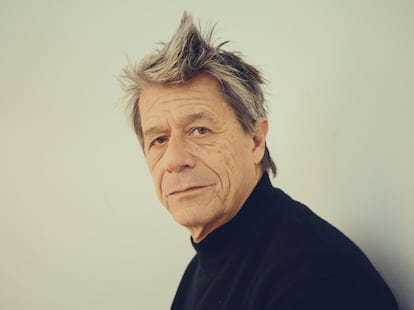
Question. Your telling of your mother’s death could have been that of Louis XIV’s.
Answer. She announced her death to us 10 days prior. She told me, “People don’t want to die nowadays. It’s ridiculous! But don’t worry, everything is going to be OK.” She was 93 years old, she was sick, and had hid it from everyone. We found ourselves before a death communicated in real time, that managed to dominate us, as she had done in life. The sadness was immense, but a feeling of admiration prevailed. Her death was just as majestic, just as Roman, it really surprised us. She was calm, smiling. She left no space for tears.
Q. And then you began to write.
A. Yes, which may seem strange, but after three days, right when she was admitted to the palliative care clinic, I began to take notes. I had the sensation of being in attendance for something important, the unraveling of a life that deserved to be told. I had no scruples, and that helped.
Q. Given your past as a writer, your mother probably could have intuited was you were planning…
A. I think she understood what I was doing when I began to record her. I was afraid at first that she would say no, but that didn’t happen. And if she had any doubts, she would have said so. Fifteen years ago, when I wrote My Life as a Russian Novel, she expressed her opposition quite early on…
Q. And you didn’t pay her much mind. In My Life as a Russian Novel, you told the story of your mother’s father, a collaborationist, which cost him his relationship with her for two years. Did she ever forgive you?
A. At the time, no. A few years later, with zero solemnity, entering or leaving a room, she told me, “You did well writing that book.” Ah, very good, I thought. And we never spoke of it again. My mother was very “never explain, never complain.”
Q. The Polish poet Czesław Miłosz once said, “When a writer is born into a family, that family is finished.”
A. I hope not to its final destruction. But it is well-known that the presence of a writer in the family, unless they write fantasy novels, leads to problems. There are different levels, of course, depending on intimacy.
Q. Do you regret having overly exposed certain people?
A. There is only one rule: do no harm — and I broke it. I did that with my mother and girlfriend at the time, Sophie. I exposed their intimacy in a way that I regret. The book exists, nothing catastrophic happened, and I reconciled with both of them. But I think I crossed a line that I would not like to cross again.
Q. Who do stories belong to? The people who live and inhabit them, or those who write them?
A. It’s very complicated, its like having shared custody of a child. Morally, you have to take it case by case. I think that the rule, as I said, is to not cause suffering. It’s important to take care with the people who are at your mercy. But that’s in regard to private people. If they are public people, we can say almost anything we want.
Q. And if someone declines to be written about, or have their family written about, should that be respected?
A. It is very complex for me to set an absolute rule. There are limits, but also abusive prohibitions. People who say, “you have no right to write about my parents.” But look, sometimes you have to say, “That story also belongs to me.” You have to guide yourself by what you think is right.
Q. This book has two centers of gravity: the war in Ukraine and your mother’s death. They could have been two different titles.
A. At the beginning of the war, I began to report from the region. I was interested because of my family’s Georgian heritage, to which I had never paid much attention. And I wanted to write about those countries and the face presented by Russia beginning with the start of the war. Reporting is a good way to advance, to order. And then my mother died, first her and then my father. And I immediately had the impression that they were the same book.
Q. Your mother did not share your opinion on the role of Russia.
A. My mother was very close to Russia, it was her life’s central theme. She was a kind of informal ambassador between the two countries [France and Russia]. She was obsessed with calming their relationship. And that made her a bit indulgent with faces of power. When the war in Ukraine began, she was greatly impacted. And not only because of the fact in itself that she had been wrong, which was something she hated. When we spoke about it, when I began making trips, you could tell that it bothered her. In the last two years of her life, that story caused her a lot of pain.
Q. She always defended Putin
A. She did not think he was a formidable guy. She believed that he was a brutal and realist politician, but that he was playing with the same rules of the game. The war in Ukraine proved the opposite. And that impacted her quite a bit.
Q. This book is a homage to your mother. But also, to your father, a lesser-known figure.
A. His place in the book grew. It began with my mother’s funeral, its official status, its pomp… and ends with a man walking alone in a forest, looking for something that has to do with his past. I like that contrast. But ultimately, it arrived unexpectedly.
Q. You had to force your mother to say goodbye to him before she left for the palliative care clinic…
A. Yes, that is the saddest part of the book. She had said goodbye to everyone except him. It gives me vertigo to think about it, and profound sadness.
Q. Your father gives the impression of having been a kind of collateral damage of your mother’s emotional imperialism.
A. Yes, but he gave his consent. She was the great love of his life, and he accepted his role. He never would have changed it.
Q. You don’t exactly portray her as a saint.
A. No, her bad faith was proverbial. She lied even when telling the time. She had a lot of defects, but she was a person who lacked pettiness and mediocrity. There was something grand about her, which culminated in her death, which showed the best of her.
Q. Do you think she would have liked this book?
A. Not all of it. The most intimate part, especially about her conjugal relationship, no. Though her global portrait would have enthused her. I couldn’t cut out the part about her private life and make her an official statue.

Q. You are a great non-fiction author, a genre that is very much in style. The paradox is that we are living in a time of Trumpism, in which people no longer need to know that things have taken place to believe in them.
A. Trump is a big leap for humanity toward another world. He doesn’t just represent the insanity of an era, but an unprecedented insanity. I wrote the biography of Philip K. Dick and I believe we have entered completely into his universe. A world of parallel truth, alternative facts, canned reality. Remember that demented quote from Elon Musk: “There’s a one in billions chance we’re in base reality.” That’s crazy. But it’s what he believes. And the worst part is that it’s starting to be true.
Q. Have you thought about writing on this parallel world of Trump?
A. I’d love to. But I don’t know how to do it, because his reading and analysis of information is so crazy that I don’t see how I could impose any kind of order on that fiction. Trump is such crazed and novelistic material that he discourages the idea of a novel. It’s such a cliché: reality has gone beyond fiction.
Q. It gives the feeling that Putin and Trump don’t have such different views of the world and their nation’s destiny.
A. Trump has something of a child about him, the all-powerful ghost. And since there is no resistance, that ghost continues to grow. It gets everything it wants. We will see if we can stop him with this story about Greenland, that would be healthy. If not, it’s all over, we’ll be dead.
Europeans try for Trump to be friendly to us, for him not to crush us, even if doing so means being the most servile on Earth
Q. It doesn’t seem like Europe is very prepared.
A. Europeans try for Trump to be friendly to us, for him not to crush us, even if doing so means being the most servile on Earth. I once wrote an article about a G7 in Canada and it was fascinating to see how all the heads of state only spoke about how they were afraid of how things would go with Trump that day. Is he going to wipe his shoes on my suit? Will he be friendly? Will he last? But Trump resets every morning, and you can no longer know who he is friendly with, who is his enemy, who is his ally… it’s all the same. He decides everything. Macron tried to deal with him smilingly, but Trump makes him seem ridiculous, he insults him. It’s atrocious.
Q. Do you think this is a parenthesis on history?
A. He has said that his only limit is his own morality, which changes from day to day. And look, if Vance comes after Trump, meaning the same but more malevolent, we won’t be any better off.
Q. Is Putin more predictable?
A. Yes. There’s a classic Russian somewhere within him. He waits, he is patient. He thinks that time is on his side. His character is easier to understand, less unprecedented.
Q. After your trips and articles, how do you think the war will end?
A. I don’t see any other option besides Ukraine’s loss of territory. The power relationship is very unequal. The last time I was there was in the fall of 2024 to make a documentary on the trains. It was a portrait of civilians, soldiers… They were trains that came and went from the front in Kyiv and I always had the impression that they couldn’t take any more, that they wanted it to be over. But at the same time, they didn’t want to cede any territory because it didn’t just belong to them, but also to all those people who had died for nothing. But as Trump told Zelenskiy during that atrocious scene in the Oval Office, “you’re not in a very good position”.
Q. What is Putin’s limit?
A. There’s a guy named Sergey Karaganov. He’s not an organic part of the Kremlin, but he spies and translates confidential elements. He says that Russia and the United States’ absolute enemy is Europe, and that it must be eliminated because it is the source of all problems, in particular because of its “detestable” ideologies. He believes that this must be done through military force. In the United States, there are theoreticians in the MAGA movement who defend dictatorship. They believe that it is the next political phase, the most desirable. All this was unimaginable until recently, but that’s where we’re headed.
Q. France, a historical counterpoint to the United States, doesn’t seem to be at its best moment.
A. France’s decline is a recurrent theme. But we are bound by such strong chains that our internal decline is secondary. I would not be happy to have the ultra-right or La France Insoumise in power. But that is a secondary response to a situation of servility and vassalage in which we find ourselves internationally. Though I, as a privileged bourgeoisie, might prefer Macron.
Q. Is Europe’s entire future in the hands of Trump?
A. The definitive test for Europe is Greenland. At some moment, physical confrontation might take place. And yes, I know that it would be insanity, but wouldn’t that be better than not doing anything? I am not an expert in international relations, but the thing is that no one has any idea about what is happening, because the rules are over.
Q. Now they are Trump’s rules.
A. It reminds me of something Philip K. Dick said. When his stepdaughters were small, he came up with a kind of Monopoly to keep them from getting bored. The person who was the bank was called the Rat. And instead of limiting their role to that of referee, they would have the discretionary power to change the rules of the game, whenever and however they wanted, without anyone having the right to hold them accountable. A perpetual clean slate, the negation of the idea of law, dictatorship in its purest form. And for a game to be successful, it was in the players’ interest to choose the most perverse and creative person as Rat.
Q. That’s Trump, I suppose.
A. A Rat worthy of their name has to know how to dose out the torments they inflict on the other players, to let them imagine that there is a hidden plan that guides their arbitrary decisions. That way, between cruel deceptions and false stimulants, they are submerged in the chaos. Today, we are in a kind of game of Rat on a global scale with the most demented person possible. An enormous child who does whatever he wants, and no one resists. An unprecedented historical situation.
‘Kolkhoz’. Emmanuel Carrère. Translation by John Lambert. Fern Press, 2026. 560 pages.
Sign up for our weekly newsletter to get more English-language news coverage from EL PAÍS USA Edition










Mensaje Enviado

11 Del 11 De La ONCE: Comprobar Los Números Premiados

IN PICS: Burning Tyres, Baton Charges And Blocked Motorways As Millions Brave Storm Charles For Spain’s First General Strike In 14 Years
Viral video in Spain sparks fury over drivers who ‘have no idea how to drive’
Spain’s pet owners face fines of up to €200,000 for animal welfare offences
EU offers extra year of warranty on phones, but Spain faces delays


-
DGT4 weeks ago
Viral video in Spain sparks fury over drivers who ‘have no idea how to drive’
-
Keeping cats and dogs outside4 weeks ago
Spain’s pet owners face fines of up to €200,000 for animal welfare offences
-
Consumer Rights Spain3 weeks ago
EU offers extra year of warranty on phones, but Spain faces delays
-
Council tax (IBI)4 weeks ago
Barcelona plans 150% property tax increase on tourist flats ahead of 2028 ban
-
Age Concern Marbella - San Pedro2 weeks ago
Halloween lunch sells out as 51 join Marbella get-together
-
airports4 weeks ago
Travelling between Spain and Italy? The extra border checks could soon end
-
 %4 weeks ago
Santa Pola Museo Del Mar
-

 New Developments2 weeks ago
How To Get A Tourist Rental Licence In Andalusia (Spain) – Step-By-Step Guide 2025