
CSIC
How Thousands Of Sperm Squeeze Into A Space 10 Times Smaller Without Getting Tangled

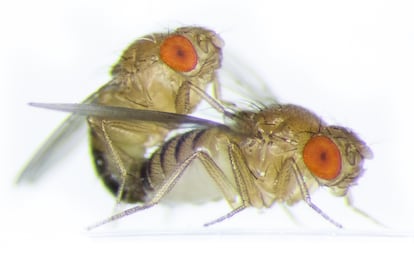
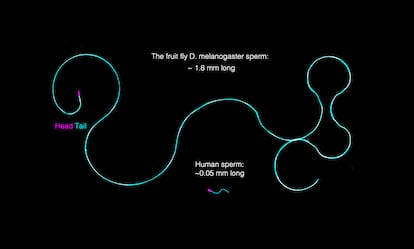
The sperm of the fruit fly are enormous—the largest in nature relative to body size. The male Drosophila melanogaster rarely exceeds 1.8 millimeters in length. Its sperm measure the same — 1,800 microns. And it doesn’t produce just one, but thousands, which cluster in the seminal vesicle while they wait to encounter a female. After mating, the problem falls to her. These thousands of sperm cells end up in the spermathecae and the seminal receptacle. There they remain for up to two weeks before reaching the uterus and completing this delayed fertilization. Both organs are shorter than a single sperm cell. So how do flies keep them from getting tangled up? A theory first proposed in the 1970s — one that helped underpin the plastic age — has provided the answer.
A group of researchers has taken an in-depth look at how flies manage this. D. melanogaster is no ordinary insect: it is the most studied in science. Like mice among mammals, it is a key model organism and underpins much scientific and medical research (many human diseases have parallels in these flies). A team of physicists, biologists and mathematicians set out to understand how so many sperm — each 1,800 microns long — can fit into a space measuring just 200 × 150 × 150 microns, the volume of the seminal vesicle. Their findings, published in Nature Physics, show that the sperm are able to self-organize and generate movement through a physical mechanism.
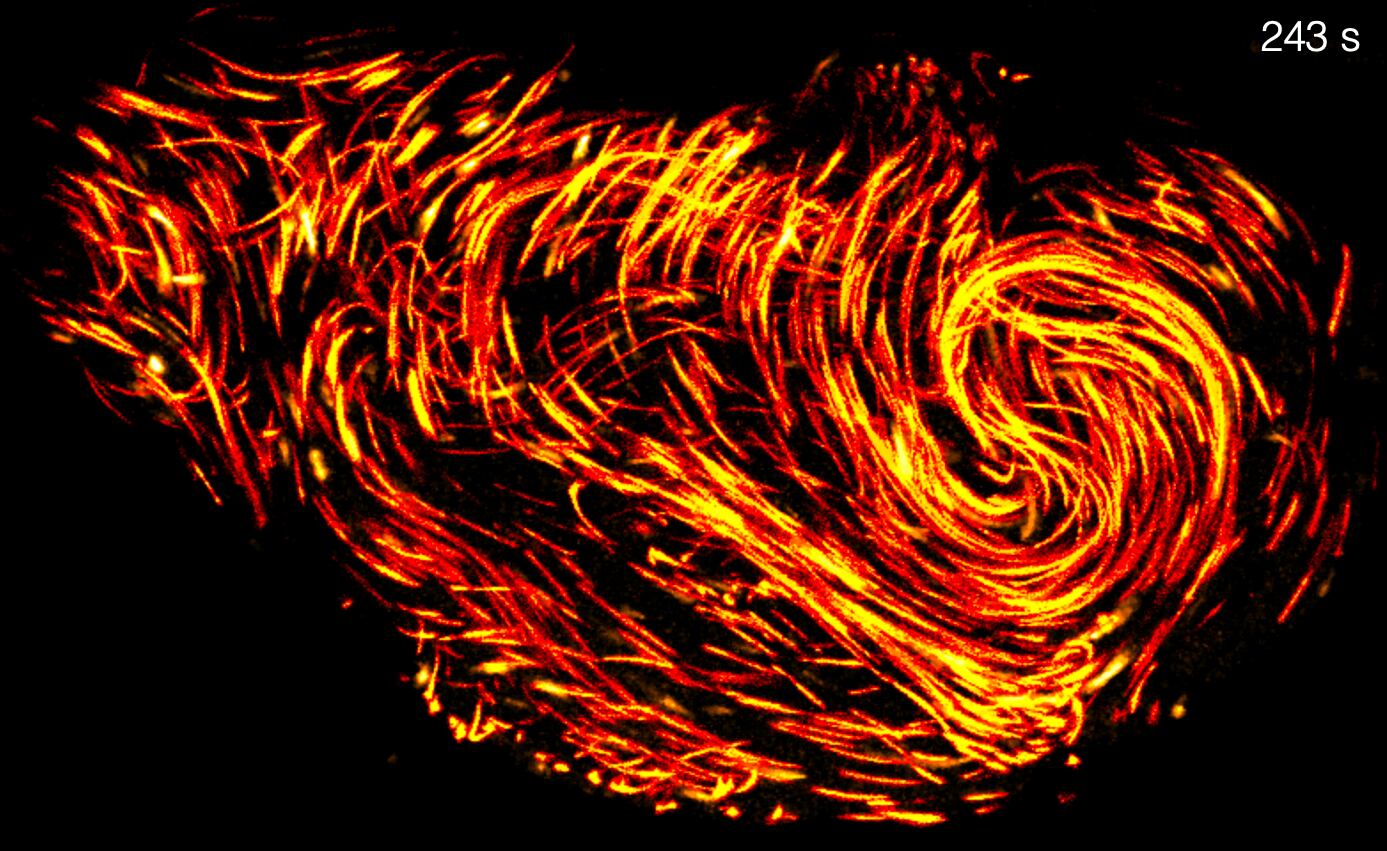
Under the microscope, a human sperm cell looks like a tadpole: it moves on its own, beating its tail in a fluid medium, propelling itself forward as if swimming. It is programmed to do so. The sperm of the male fruit fly also moves under the microscope — it waves its tail — but it does not advance. What researchers discovered (see video above) is that its flagellum oscillates, but always in the same place. It only moves forward when it does so collectively: observed in the seminal vesicle, the sperm never stop moving in sync. What is striking is that, unlike in mammals, there is nothing in these sperm cells that makes them move autonomously.
“We found that two adjacent sperm in the male’s sperm-storage organ often swim in opposite directions rather than moving in the same direction,” says Jasmin Imran Alsous, from the Flatiron Institute in the United States. “This happens in any region of the seminal vesicle.”
It is as if they were gears: the oscillation of one in one direction forces, through contact, the movement of the other. “In one area of the vesicle, sperm can be aligned in a particular direction [even if they swim in opposite directions relative to each other], while in another area they can be aligned in a different direction [also maintaining opposite motion],” she continues. This dynamic allows the sperm to move without their flagella becoming tangled.
They appear to move like flocks of birds or schools of fish. But there are radical differences. “In those cases, the emergence of collective behaviors is often tied to sensory and behavioral cues such as vision, predator avoidance or a tendency to keep a fixed distance from others,” says Michael J. Shelley, also of the Flatiron Institute and senior author of the study. “That is possible because fish and birds are highly evolved organisms.”
He continues: “Individual sperm, as far as we know, have no communication system beyond mechanical interactions arising from their extremely dense packing. Therefore, the appearance of large-scale collective flows in these sperm aggregates is a mechanical consequence of their density and activity.”
In other words, a giant sperm cell that cannot move forward on its own — despite constantly beating its tail — manages to stay untangled and in motion only thanks to its interactions with its neighbors when packed in large numbers.
In nature, there are many examples of dense packing to make the most of space or of collective movement to gain efficiency. The DNA packed inside a tiny human cell can stretch to two meters. If the sperm whale, at nearly 20 meters long, is enormous, consider the length of its intestines — about 150 meters. And as for self-organized collective motion, in addition to bird flocks and fish schools, certain insect species — such as the black sawfly (Perreyia flavipes) — also move in coordinated groups.
“An isolated sperm differs from an isolated fish or bird in an important way. A fish can swim by itself, a bird can fly alone, and a mammalian sperm can also move individually,” Shelley notes. But the giant sperm of the fruit fly generate the typical bending waves seen in any sperm cell, yet remain motionless when isolated. “Hence both the large-scale flows and the rapid directional mobility observed in the seminal vesicle are the result of collective interactions,” the researcher concludes.
For the authors, this dynamic can be explained by the theory of polymer reptation. It was proposed by the French physicist Pierre-Gilles de Gennes in 1971. Developed in the years that followed, “it explains the most important phenomena in the use and recycling of plastics,” says Juan Francisco Vega, a researcher with the BIOPHYM Group at the Institute of Structure of Matter at Spain’s research center CSIC. Plastic is made of macromolecules that tangle and untangle during processing. “They move through an imaginary tube formed by adjacent polymers,” adds Vega, who did not participate in this study. Two decades later, Gennes would receive the Nobel Prize in Physics for his ideas on reptation and the physics of soft matter.
“But in this biological context reptation is active,” says Vega, who applies Gennes’s theory to ocular fluids and the design of eye drops: “Tears are made of highly confined macromolecules,” he notes. In plastics, molecules are passive; they move due to heat or an external force applied during processing. “By contrast, fruit fly sperm use their tails to writhe forcefully.” This self-organized movement — each one pushing against its neighbor — is, in Vega’s words, “the most efficient and fastest traffic jam in nature, where extreme density itself allows the system to function and not stall.”
Sign up for our weekly newsletter to get more English-language news coverage from EL PAÍS USA Edition



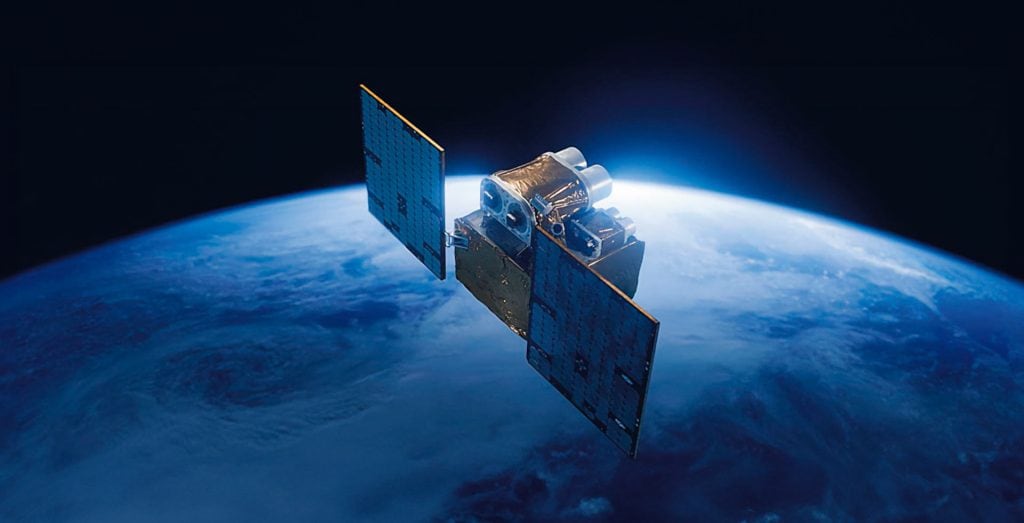
Dark matter, one of the universe’s most enduring mysteries, is not exactly dark — it’s invisible. Astronomers know the cosmic component has to be there from the force of gravity it exercises, but no one has managed to see or capture it. Now, the European Space Agency has approved Arrakihs, a mission designed to study dark matter, and evaluate current theory surrounding it. There is a possibility that the project could find that our ideas as to how the universe works are incorrect, which would be a historic discovery.
The scientific father of Arrakihs is astronomist Rafael Guzmán, who has spent years perfecting the project at the University of Florida, and is now leading the charge from the University of Cantabria and the Spanish National Research Council’s Institute of Physics. “We wanted this mission to be simple, but for it to have optical quality that pushes the limits of what physics allows,” says the astrophysicist, who was born in Don Benito, Badajoz, 62 years ago.
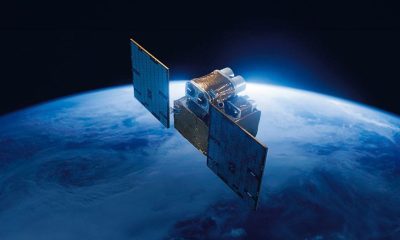
So far, the result has been a space observatory with four small telescopes, measuring a mere 15 centimeters across. Arrakihs’s two pairs of eyes will contemplate at least 80 galaxies similar in shape and structure to the one humans inhabit, the Milky Way, in order to observe light emitted across different wavelengths from ultraviolet to infrared and including the visible spectrum. “We have broken molds,” summarizes Guzmán. “Instead of going with very complex designs, very large telescopes that would have been much more expensive, we are demonstrating that with an unbeatable optical quality, tested entirely in Spain, it is possible to compete with the most advanced missions.”
The European Space Agency has recently extended definitive approval to the scientific mission, which is classified as type F for “fast,” and is designed so that only a decade will pass between its initial selection, which took place in 2023, and its launch. The Spanish team would like to accelerate that timeline even more, and begin in 2030. This is the first time a scientific space mission has been led from Spain, which will coordinate the participation of Switzerland, Austria, Belgium, Norway, Portugal, and Sweden. Its total budget is $371 million and its primary contractor is Satlantis, a company based in Bilbao.
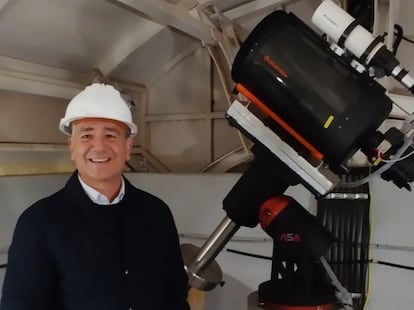
Turning space observation technology around to point it toward Earth is a part of the company’s origins, explains Guzmán. That’s how its primary service came about, which is detecting gas leaks on oil fields. “Detecting gases like methane follows the same methodology and uses the same technology that astronomers use to detect, for example, hydrogen in galaxies beyond the Local Group,” he explains. The same technology can also be applied to early fire warning. “Our mission didn’t first come up with a scientific use case and then design the camera; instead, it adapted the existing camera to the scientific objectives. This has allowed us to move forward very quickly and led us to being selected as a fast mission,” Guzmán notes.
Arrakihs is an astrophysics mission, but its angle of attack when it comes to the issue of dark matter is almost paleontological. According to current theory, galaxies form throughout millions of years by eating dwarf star systems and galaxies that orbit around them. Those dwarf galaxies are destroyed and leave behind a trail known as stellar streams. In the final stage, the system reaches equilibrium, and this stellar trail is faintly imprinted on the galactic halo — a massive, invisible sphere surrounding the galaxy and containing dark matter, whose gravitational force is essential to the galaxy’s existence. These streams “are a kind of fossil record of the galaxy’s history. Although they are very faint, they are still present. They would allow us to test the cold dark matter prediction regarding galaxy formation, according to which all galaxies like the Milky Way should be full of stellar streams,” says Guzmán.
The theory in question is called ΛCDM, and it is the most-accepted model in describing the universe, which is in its vast majority unknown. Lambda, the tenth letter in the Greek alphabet, represents dark matter, which makes up 68% of the cosmos and is one of the greatest mysteries of physics. CDM stands for cold dark matter, which makes up 27%. Lastly, the only well-known fraction, conventional matter, makes up all visible things and accounts for the remaining 5%.
Stellar streams in our own galaxy have been observed by the ESA’s Gaia mission, and other observatories have detected them in Andromeda. What Arrakihs will now provide is a much larger set of observations, spanning between 80 and 100 galaxies, yielding a statistical measure of the presence of these phenomena, which are closely linked to the mystery of dark matter.
It is possible that the observations will confirm the theory, although it would be exciting if they did not. “The current model predicts the behavior of the universe on a large scale fairly well, but it fails when it comes to the planes of galaxies like the Milky Way [that disk-shaped structure where most stars and planets are located, including our solar system],” explains Guzmán. Theories are valid until an experiment comes along that contradicts them. If that happens, it would bring about “a radical change” that would force us to revise them, the scientist concludes.
After its launch, likely from the European spaceport in French Guiana, Arrakihs will enter Earth’s orbit at a distance of about 500 miles from the surface of the planet. It will have three years of official operation and the possibility of being extended, if everything goes well.
Sign up for our weekly newsletter to get more English-language news coverage from EL PAÍS USA Edition

Marshal reacts after being SLAPPED by angry racer following crash

The Strange Tale Of The Frigate That Traveled The Mediterranean Buying Archeological Artefacts

How Thousands Of Sperm Squeeze Into A Space 10 Times Smaller Without Getting Tangled
A major EU border system goes live today – What changes for travellers?
El Pentágono, Evacuado Por Una Falsa Alarma Ante La Sospecha De Un “incidente Con Materiales Peligrosos”
Mallorca launches new plan to save its beaches as coastal erosion threatens popular resorts


-
EU rules1 week ago
A major EU border system goes live today – What changes for travellers?
-
America2 weeks ago
El Pentágono, Evacuado Por Una Falsa Alarma Ante La Sospecha De Un “incidente Con Materiales Peligrosos”
-
Coastal erosion2 weeks ago
Mallorca launches new plan to save its beaches as coastal erosion threatens popular resorts
-
fira de ses herbes2 weeks ago
Selva herb fair returns: Mallorca’s most magical tradition blooms again
-
european airport delays1 week ago
1,225 delays at major European airports raise summer warning for Spain travellers
-

 %1 week ago
Barcelona Tests Olive Pit Asphalt That Could Transform How Cities Build Roads
-

 Uncategorized2 weeks ago
WATCH: Kim Kardashian steals F1 Monaco GP winner Antonelli
-

 california2 weeks ago
Migrants At The Mercy Of Gangs: ICE Detainees Forced To Live Alongside Organized Crime