
Costa del Sol
Kinahan ‘hitman’ Arrested In Marbella Amid Claims He Is Linked To Disappearance Of Premier League Footballer’s Brother


 The north Dublin man – a former associate of slain drug boss Martin ‘Marlo’ Hyland – was also detained on suspicion of membership of a criminal organisation.















Mijas distributes 33,000 super-seeds across its Sierra to regenerate plant life scorched by wildfires and combat creeping desertification.
In a hands-on bid to reverse decades of environmental damage, the Spanish town of Mijas has distributed more than 33,000 “supersemillas” across its Sierra, aiming to regenerate plant life scorched by wildfires and threatened by creeping desertification.
The plan, led by the Ayuntamiento de Mijas in partnership with the local firm Exploramás, relies on a centuries-old Japanese technique known as nendo dango. Volunteers crafted small balls of clay, natural fertilizer, substrate and meadow seeds. Once scattered on the ground, the clay casing shields the seeds from birds, wind and sun until rainfall gradually dissolves it, allowing germination without any need for planting or irrigation. A similar nendo dango approach has already been used on the Costa del Sol dunes.
Deployment of seeds follows successful experiments
The second phase of the project saw the seed balls dispersed around the former Los Arenales quarry near Mijas Pueblo and in the Hipódromo area, zones still recovering from recent fires. The effort builds on an earlier workshop held between 20 and 21 October at Cortijo Don Elías, where roughly 700 residents, students and association members rolled the balls by hand. Participants included pupils from the Las Lagunas, Sierra de Mijas, Torre Almenara and Villa de Mijas institutes, students from Kampus Formación, and members of the Fuenmijas Parkinson’s association and Afesol.
Organisers had originally planned for 27,000 seed balls; the final tally exceeded 33,000, a figure chosen in part to symbolically represent the workforce of General Electric, which supported the social action through Exploramás.
Mayor Ana Mata takes part
Mayor Ana Mata joined Environment Councillor Marco Cortés and Education Councillor Juan José Torres for the distribution. She described the Sierra’s recovery as a collective responsibility and stressed that involving schools, associations and businesses turns a practical restoration project into broader environmental education. This latest action continues broader volunteer-led efforts to revive the fire-damaged forests of the Sierra de Mijas.
“When administrations, companies, young people and social groups work together, we achieve results that go far beyond a single environmental action,” Mata said. “We are also teaching values and respect for nature.”
By combining traditional low-tech methods with broad community participation, Mijas is betting that a few tens of thousands of carefully made seed balls can help tip the balance toward greener slopes and greater resilience against the Mediterranean’s intensifying dry spells.


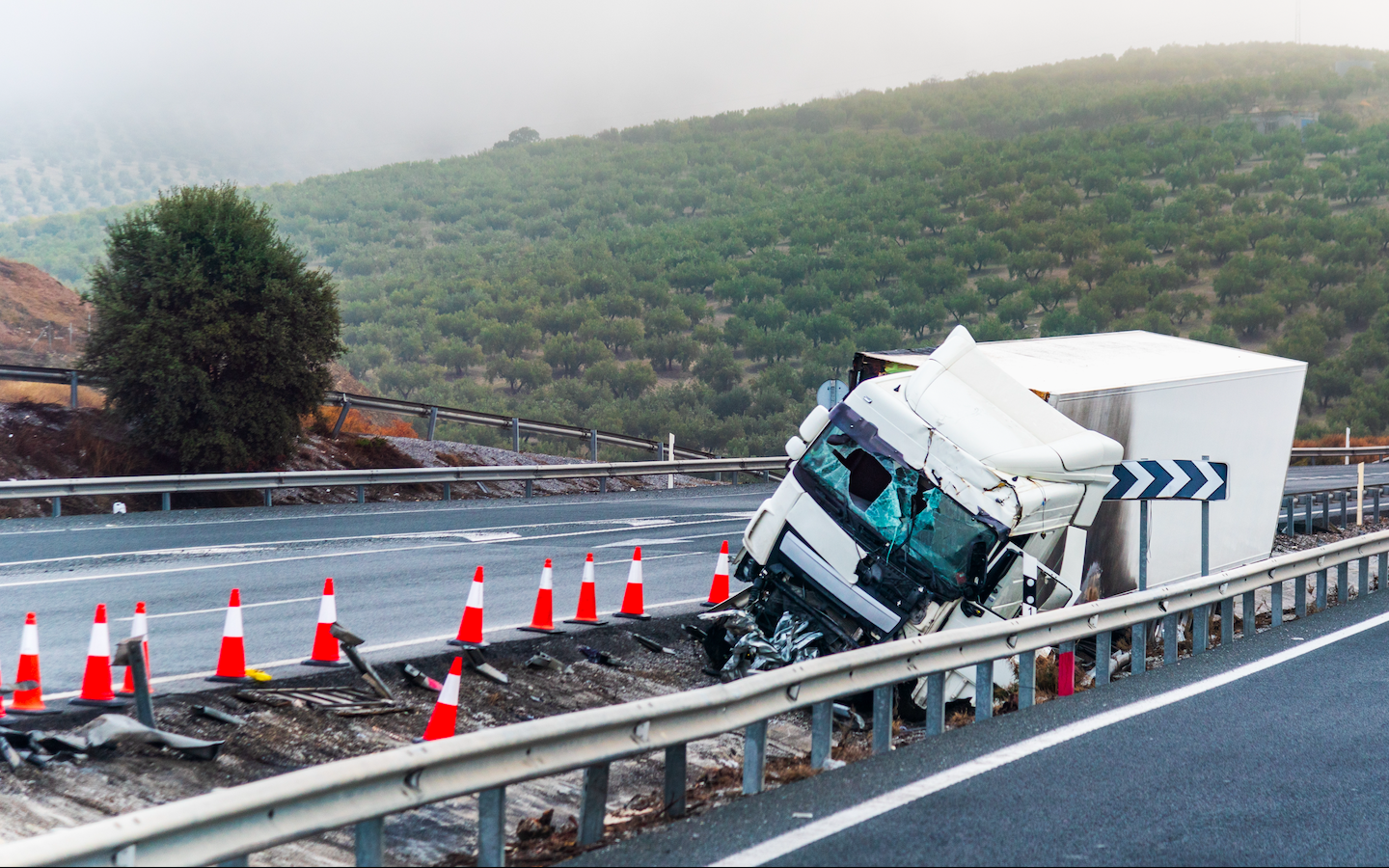
Recovery can cost thousands of euros. Photo credit: Miguel Perfectti/Shutterstock
A broken-down lorry can bring parts of Málaga to a standstill, leaving commuters trapped in traffic, workers late and families struggling to get where they need to be. Yet when a heavy goods vehicle is involved in an accident on the province’s main roads, there is no dedicated Government recovery service ready to remove it.
The problem is not simply a shortage of recovery vehicles, the Government has actually acknowledged that there is no specific protocol for removing heavy goods vehicles from roads such as the A-7, leaving the operation dependent on insurance cover, private companies and the availability of specialist equipment.
Why can removal take so long?
Unlike a regular car, a loaded lorry cannot necessarily be moved with a standard breakdown truck. Depending on its weight, position, cargo and damage, operators may need heavy-duty vehicles, cranes or machinery and a specialist team. The Guardia Civil can secure the scene, manage traffic and contact recovery companies, but it has no fleet of heavy recovery vehicles.
The DGT also has no public roadside assistance service for removing broken-down or accident-damaged lorries. The process can slow down when the haulage company has no recovery cover. The insurer may need to authorise the work, a company must be found and a price agreed. Some operators are reluctant to take jobs involving foreign-registered lorries if payment is uncertain.
The cost of leaving a lorry stranded
Recovery can cost thousands of euros. In complicated cases, the bill can reach €20,000, according to industry sources cited in reporting on Málaga’s roads. The Government says removal is arranged through compulsory insurance, with response times depending on availability, vehicle type and condition. The consequences reach beyond the driver and haulage company.
A lorry blocking a motorway can close lanes or force a diversion, pushing traffic onto surrounding roads. Commuters lose hours, deliveries are delayed and businesses wait for staff or supplies. A recent incident in the Carlos Haya tunnel, where an overturned lorry landed on a taxi, showed how difficult recovery can be in confined conditions. Two specialist companies were needed, and the cargo had to be removed before the vehicles could be cleared. The crash and its impact on the taxi driver can be read here.
Calls for a different system
The issue was raised after lorry breakdowns caused long queues on Málaga’s roads in 2025. The PP asked the Government why there was no dedicated service for removing heavy vehicles. The Executive replied that there had never been a specific protocol. The DGT has said it was studying alternatives, including agreements with private recovery firms.
However, motorists have no clear timetable for when any arrangement might be introduced. Málaga’s traffic volumes make the question pressing. When a heavy vehicle cannot be shifted quickly, disruption spreads beyond the stretch of road where the incident happened. Until a reliable system is in place, drivers may continue to face lengthy delays whenever a lorry becomes stranded on a key route during the morning rush hour.
Leonid meteor shower returns to Spain with its best display of shooting stars

Leonid Meteor Shower Returns To Spain With Its Best Display Of Shooting Stars
Gibraltar plans lifetime cigarette ban for anyone born after 2008


-

 New Developments2 weeks ago
Luxury Villas For Sale, Estepona – ProjectL1
-

 New Developments3 weeks ago
How To Get A Tourist Rental Licence In Andalusia (Spain) – Step-By-Step Guide 2025
-
Age Concern Marbella - San Pedro3 weeks ago
Halloween lunch sells out as 51 join Marbella get-together
-
Consumer Rights Spain4 weeks ago
EU offers extra year of warranty on phones, but Spain faces delays
-
Barcelona riots3 weeks ago
Looting and street violence hit Barcelona as El Corte Inglés customers are trapped
-

 %3 weeks ago
Spain Orders Replacement Of Eight Million Gas Meters: New Rules, Costs And Deadlines
-
Gibraltar3 weeks ago
Proud to be British: HMS Queen Elizabeth opens its doors in Gibraltar
-
Costa del Sol3 weeks ago
Where are they? Expat questions local police presence