
ElPais
Lack Of Self-Esteem And Poor Mental Health: Why Vincent Van Gogh Didn’t Always Put His Name On His Work

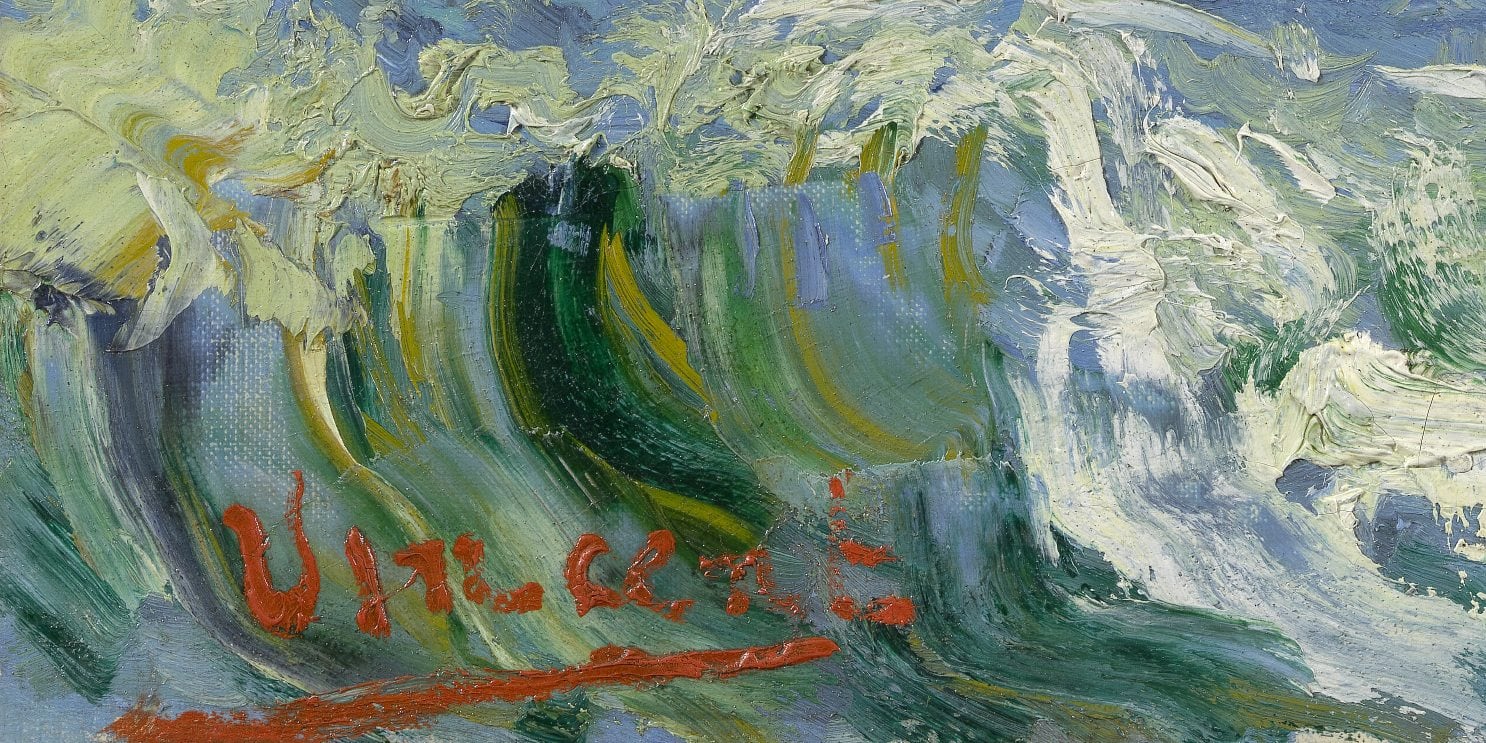
“Vincent.” That’s how Van Gogh signed his works, using only his first name. But the famous Dutch artist didn’t always do so. In fact, his name appears on only 133 of his 840 known paintings… and his mental health and self-critical nature influenced this decision.
Over 10 years of his professional career, he only used the name “Vincent” on about 15% of his work. This finding forms the backbone of the first systematic study of the painter’s signature, recently published by the Van Gogh Museum in Amsterdam. Researcher Julia Engelmayer examines the relationship that this decision had with different stages of his life.
It’s true that, beyond the Netherlands, the surname “Van Gogh” is difficult to pronounce correctly. Hence, the use of “Vincent” was also a direct and distinctive way to sign his work. However, the painter elaborates on various reasons why he preferred to sign his work this way (or not sign at all) in the letters he sent to his brother, Theo, an art dealer. In one of the letters, dated December of 1883, he even notes that he feels “rather different” from the other members of his family. “Essentially,” he writes, “I am not a Van Gogh,” referring to the fact that he didn’t identify with the traditional ideas of his clan.
In 1884, he put his name on a painting for the first time, although he had already been working as an artist for several years. He felt that he was still learning the craft, which is why he referred to a portion of his work as being part of his “studies.”
Throughout a career as dizzying as it was short (what is now considered to be Van Gogh’s professional period spans roughly from 1880 until his death in 1890), he confided in Theo about his artistic practice. He reflected on the quality of his work and revealed his self-critical nature. Van Gogh was very hard on himself.
“During his time in the Netherlands (1880-1885), he very rarely signed his work. Once he moved to Paris (1886-1888), influenced by his fellow artists, he hoped to sell more and may have signed [his paintings] more frequently,” explains Engelmayer, author of the study on the painter’s signature, in a telephone interview with EL PAÍS. “Based on the research data, there seems to be a link between his own well-being and the frequency of his signing, because his name appears more often during his time in Paris and Arles,” she adds. It was a period of hope: he had the desire to exhibit and sell.
The artist’s mental health declined shortly after leaving Paris for the South of France. He first settled in Arles, where he tried to create an artists’ community with Paul Gauguin. It was a very productive period for him, during which he painted The Night Café (1888) and Sunflowers (1888-1889), among other works. However, he also went through great emotional distress: the artistic project failed and he ended up cutting off his ear. He then moved to Saint-Rémy-de-Provence, about 15 miles away, and spent a year in a psychiatric hospital. “There, his mental health got worse. That must have affected his self-esteem and led to dissatisfaction with his work. Even though he painted 151 works, he signed very few of them,” Engelmayer points out. One of those paintings — without the artist’s name written in any of its corners — was The Starry Night (1889). And it was this painting that led the researcher to analyze and catalog the painter’s signature.
In 1890, Van Gogh traveled more than 400 miles north, to Auvers-sur-Oise, on the outskirts of Paris. Theo thought it would be beneficial for him to be under the supervision of Dr. Paul Gachet, a specialist in nervous disorders and a patron of the Impressionist movement. Vincent (a Post-Impressionist) worked frenetically for about 70 days, “but he only signed two works… and it must be said that, once again, his mental health and [lack of] self-confidence played a role in his reluctance to do so,” Engelmayer continues.
Van Gogh did sign some works as gifts and also ones that he exchanged with other painters. Hence, “it is possible to conclude that Van Gogh did so when he felt particularly proud of a painting to exhibit,” the researcher writes in her work.
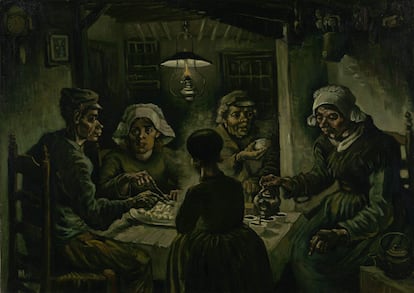
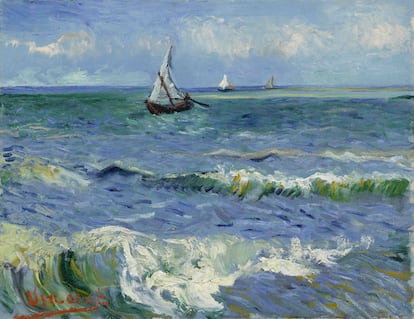
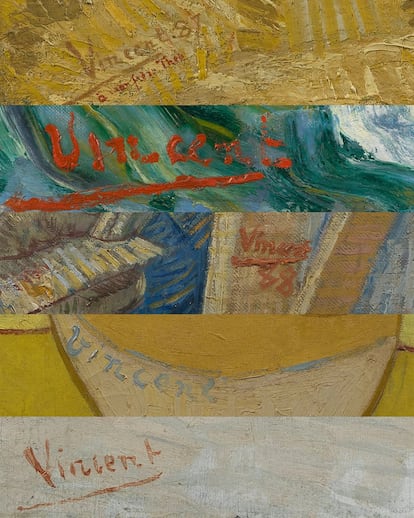
Although Vincent’s name appears in his works in various colors and places, the most frequent variant — whether light or dark — is red. In some cases, such as in The Potato Eaters (1885), which the artist himself considered to be his first masterpiece, the signature (which isn’t red) is integrated into the back of a chair, on the left of the painting. Today, however, it’s almost imperceptible. In other paintings, he included his name “as a stylistic device,” Engelmayer says. This occurs strikingly in Seascape near Les Saintes-Maries-de-la-Mer, an oil painting done outdoors and dated 1888. According to the Van Gogh Museum’s records, the painter wasn’t entirely satisfied with the color combination. He wrote to Theo that he put “a very outrageous red signature” in the lower left corner, “because I wanted a red note in the green.”
In Sunflowers — a famous series of five versions that he painted between 1888 and 1889 — his name follows the curve of the vase: it can be seen in red or blue. These flowers (disliked by his colleagues for their rough appearance) served as a vehicle for experimenting with color — yellow, in particular — and his signature stands out, even though it’s quite difficult to find.
How many of the great artist’s unsigned pieces have been presented as authentic? “Van Gogh died very young. And, since he wasn’t successful in selling his work, most of his paintings remained in the family collection,” says Teio Meedendorp, a senior researcher at the Van Gogh Museum. “From that safe place, some were sold by Joanna Bonger, Theo’s widow.”
The museum intermittently receives supposedly unknown works by Van Gogh. The experts analyze them, in order to establish authorship. “Since it’s well known that he didn’t sign his work much, we ask more questions when his name appears than when it’s missing,” Meedendorp explains.
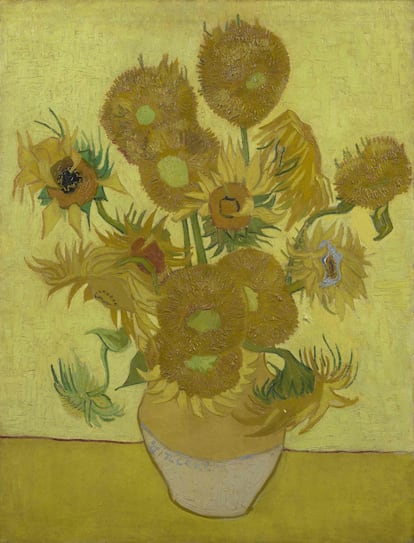
During the last months of his life, while living in Auvers-sur-Oise, Van Gogh only signed Portrait of Adeline Ravoux (1890), an oil painting that depicts the daughter of the innkeeper at the Ravoux Inn, where he stayed. In another work, Daubigny’s Garden (1890), he wrote the title as if to clarify that it wasn’t just any garden, but that of an important painter: Charles-François Daubigny.
“Van Gogh sometimes exhibited paintings he hadn’t signed… and it’s possible he didn’t appreciate the pieces that we now consider to be masterpieces,” Engelmayer reflects.
Sign up for our weekly newsletter to get more English-language news coverage from EL PAÍS USA Edition



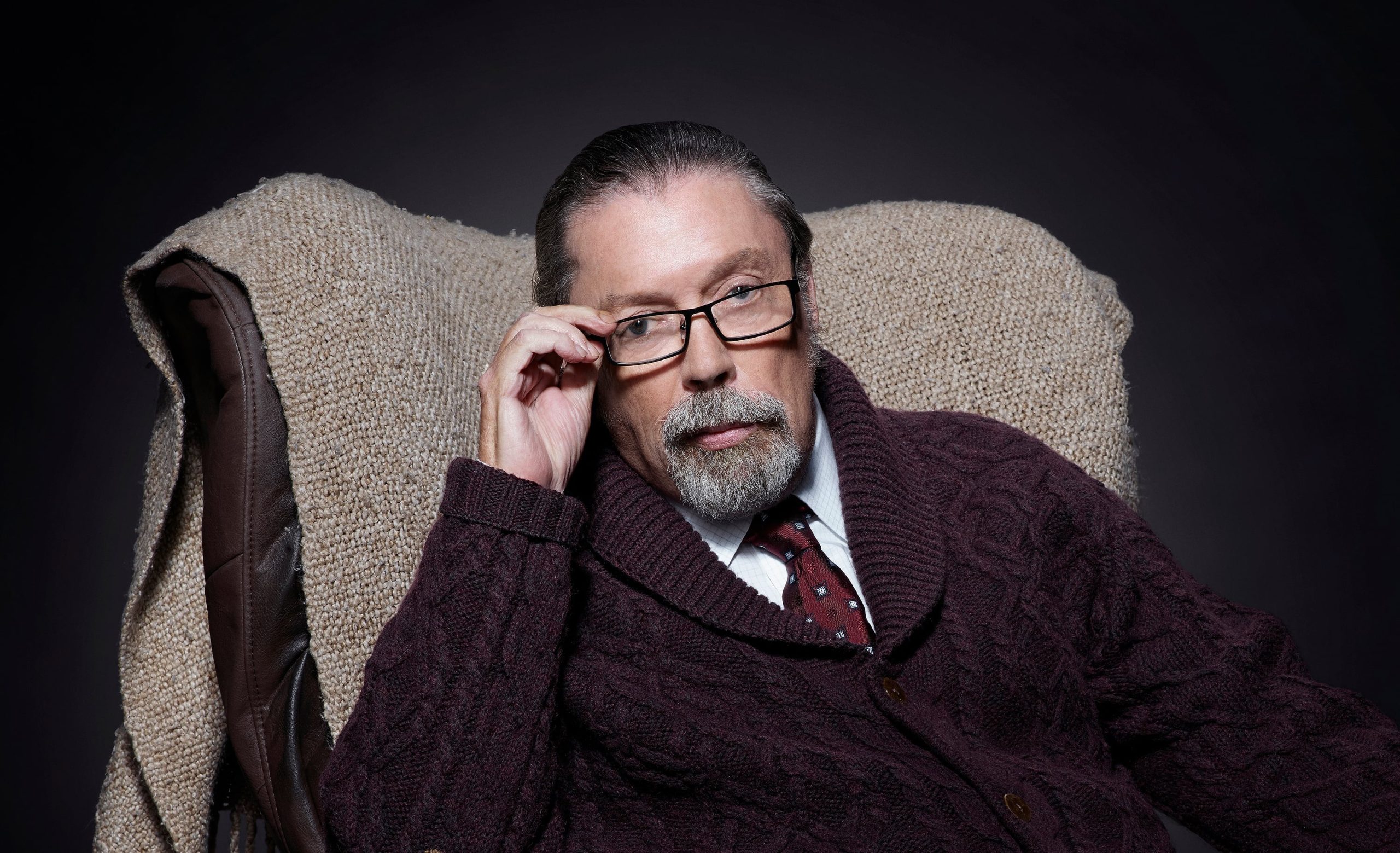
The British actor, who appeared in films such as ‘Muppet Treasure Island’ and was the first actor to play Pennywise in an adaptation of ‘It,’ suffered a stroke in 2012 and afterward withdrew from public life
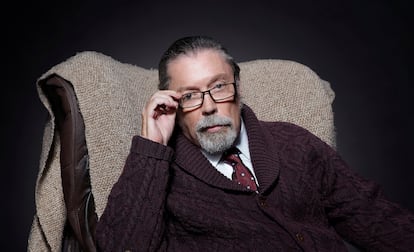

British actor Tim Curry died on Tuesday night at his home in Los Angeles at the age of 80, according to TMZ. Curry had used a wheelchair and largely withdrawn from public life after suffering a stroke in 2012, the first in a series of health problems that gradually worsened his condition.
Gifted with a remarkable voice and an extraordinary ability to control every muscle in his face, Curry achieved worldwide fame as Dr. Frank-N-Furter in The Rocky Horror Picture Show (1975). He also appeared in Muppet Treasure Island as the pirate Long John Silver alongside Jim Henson’s beloved creations, and in popular films including Clue, Kinsey, Home Alone 2: Lost in New York, Annie, The Hunt for Red October, Scary Movie 2, and Congo. He also lent his distinctive voice to dozens of animated television series throughout his career.
Curry also portrayed the clown Pennywise in the 1990 adaptation of Stephen King’s It. Alongside his screen work, Curry enjoyed decades of acclaim and success on the stage, where he was equally respected for his theatrical performances.
This is a breaking story. Please refresh your browser for more updates.
Archived In


Cali
Displaced By Colombia’s Conflict, Now Uprooted Again By The Earthquake: ‘We Arrived With Nothing And We’re Back To Having Nothing’


Mario Suárez was already awake when the ground beneath his feet began to shake. He waited a few seconds, but the tremor did not stop. Grabbing his children by the hand, he and his wife rushed outside, where they watched their home crumble before their eyes. They were not alone: the three-story building in the Miraflores neighborhood of Buenaventura housed 22 families, nearly 100 people. All belonged to the Wounaan Nomaan Indigenous community, which had been driven from its ancestral lands four years earlier by the violence of Colombia’s armed conflict.
Two weeks after the August 10 earthquake that struck western Colombia and left more than 300 dead, these families are still living in a makeshift shelter. Their plight reflects that of hundreds of victims of forced displacement who had already lost everything once and now fear having to uproot their lives again amid deep uncertainty.
“We arrived in Buenaventura with nothing, and today we’re back to having nothing. This is a hard economic and psychological blow for the entire community,” Mario says by phone. His name has been changed for security reasons. A member of the Valledupar Indigenous council, he recalls that until a few years ago his community lived peacefully in Bajo San Juan, a Pacific region straddling the departments of Chocó and Valle del Cauca, north of Buenaventura. Everything changed five years ago.
“Armed groups began to move through the area. We tried to resist the recruitment of young people, the disappearances and killings, but in 2022 we couldn’t do it any longer, and that is why we left. We abandoned our homes, the school and our crops,” says Mario.
Several armed groups operate in the region, which remains fiercely contested territory. Colombia’s Ombudsman’s Office and other institutions have documented the presence of the Gulf Clan, the ELN guerrilla group and dissident FARC factions, all seeking to control drug-trafficking routes and access to the Pacific Ocean.
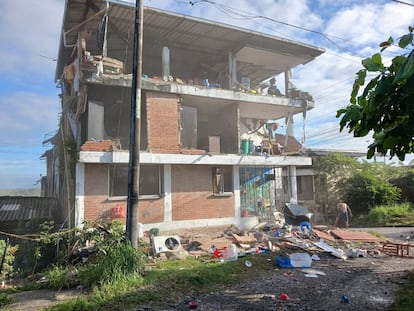
Until August 10, the roughly 20 families who had been forcibly displaced to the Pacific port city were living in a building that once operated as a local radio station. They worked as artisans and made a living from their handicrafts. All of their products were buried beneath the rubble. “We are victims twice over. It is a terribly sad situation,” Mario laments.
In the 15 days since the earthquake, which left their home uninhabitable, the nearly 100 residents of Buenaventura have gone from sleeping on the streets to sheltering in a makeshift refuge not designed for long-term use. The Indigenous leader explains that since their initial displacement, they have been waiting for the national government to relocate them permanently to a municipality in Valle del Cauca, close to the area where they lived before being driven out by armed groups.
This community is not an isolated case. Giovanni Rizzo, director of the Norwegian Refugee Council in Colombia, says the organization has documented several similar situations in the departments of Valle del Cauca and Chocó, both major hotspots of organized violence. Among the affected populations are not only internally displaced people but also Venezuelan migrants.
“The earthquake not only damaged infrastructure, it also deepens vulnerabilities and widens gaps in access to services such as education,” the expert says. The severity of the conflict must be taken into account because of its particular dynamics, he adds. “I met a woman who said she would rather have a roof collapse on her than sleep in the street because of her fear of armed groups.”
The international aid organization has documented several cases of displaced people who fear they may be forced to move once again after the earthquake damaged their homes. According to the Internal Displacement Monitoring Centre and local authorities, Colombia was home to 7.2 million internally displaced people as of last year.
Although the vast majority were forced to migrate because of the armed conflict, an increasing number are being displaced by natural disasters or extreme weather conditions such as droughts or floods. This phenomenon, known as climate migration, is recognized by the United Nations and affects more than 30 million people worldwide. Most displacements occur within the affected country.
This is a concern for Juan Carlos Palacios, president of the neighborhood action committee of La Victoria, located in Quibdó, the capital of Chocó. He himself is displaced. Palacios was born in Bojayá, one of those municipalities etched into Colombia’s collective memory, in this case because of the massacre in a church that claimed the lives of more than 100 people, according to figures from the National Center for Historical Memory.
“I am a victim, but I was lucky this time. My house has minor cracks, but schools in the area collapsed and many neighbors’ homes were destroyed,” he says by phone.
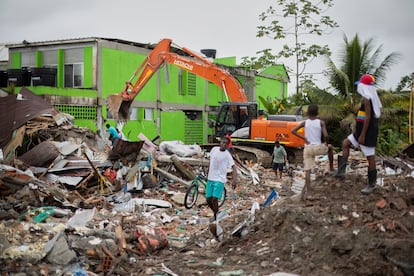
Among those who lost their homes were people who had already been displaced by violence. Some are now weighing whether to move again. “Some people have already moved to other neighborhoods or to relatives because they have nowhere to stay. They have to relocate because renting is very difficult,” says Palacios.
By difficult, he means rents have soared in the city, a trend that has also been reported in other cities, including in Cali. Those who remain in the neighborhood are staying in a shelter that was never equipped for an emergency of this scale. “We have mattresses and pillows, but no blankets. There are no bathrooms and no electricity.” About 40 families are currently living there.
Across the region, survivors of the earthquake are making the same appeal: that local authorities remain engaged beyond the immediate aftermath of the disaster, continue reconstruction efforts and take into account the additional vulnerabilities affecting hundreds of residents.
In the case of the Indigenous council in Buenaventura, Mario is urging authorities to allow the community to resettle as soon as possible and ensure they can remain together. “Some officials wanted to move us to shelters, but they only held two or three families. We must stay together because we risk losing our community organizing process,” he argues.
For his part, Palacios is calling on both authorities and civil society to maintain their support. “The rescue phase is over. What remains is relief efforts and reconstruction, which can take years.”
Sign up for our weekly newsletter to get more English-language news coverage from EL PAÍS USA Edition

British Second-Home Owners In Spain Will Be Able To Legally Pay Ten Times More Cash Than Their Spanish Neighbours

Ceuta Crisis Latest: Spain Pledges €165m Emergency Package As Migrant Tensions Continue To Boil Over

GP De Aragón En Directo, La Carrera De MotoGP En Vivo
Make a small donation at Miramar shopping centre and transform a child’s first day back at school

How Kimi Antonelli saved Red Bull as Max Verstappen signs blockbuster F1 deal

How To Get A Tourist Rental Licence In Andalusia (Spain) – Step-By-Step Guide 2025


-
back to school2 weeks ago
Make a small donation at Miramar shopping centre and transform a child’s first day back at school
-
 Uncategorized1 week ago
How Kimi Antonelli saved Red Bull as Max Verstappen signs blockbuster F1 deal
-
 New Developments2 weeks ago
How To Get A Tourist Rental Licence In Andalusia (Spain) – Step-By-Step Guide 2025
-
 ElPais2 weeks ago
Family Of Former Mexican Federal Police Officer Killed On Ukraine Frontline Faces Agonizing Wait For His Remains
-

 Ceuta2 weeks ago
Hundreds Of Migrants Left In Ceuta After Mass Border Crossing Stage Protest To Demand Asylum From Spain – ‘I Don’t Want To Return!’
-
 BCE2 weeks ago
Los Precios De La Energía En Europa Volvieron A Escalar Por Encima Del 10% En Julio
-
 benefits ban2 weeks ago
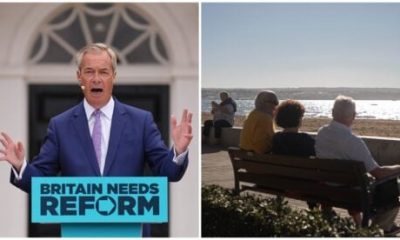
EXPLAINER: Which Benefits Could Brits Living In Spain Lose Access To Under Reform’s EU Welfare Ban – And Would It Include Pensions?
-
airports in Spain2 weeks ago
British families flying between UK and Spain given fresh EES warning for under-12s