
ElPais
Lena Dunham’s Body Is Back Again… And Her Memoir, ‘Famesick,’ Reads Differently Now












Donald Trump
Operation Save The Yen: Japan Partially Turns Off The Cheap Money Tap, With A Little Help From Its ‘American Friend’


Dwight D. Eisenhower
The Perfect, Affordable Home: The Utopia That Architecture Has Been Promising For A Century

In 1927, the American architect and inventor Richard Buckminster Fuller proclaimed an idea that sounded like a joke: the possibility of owning a house for the same price as a car. Thus, the Dymaxion house was born: it had a hexagonal aluminum frame as light as a tent, and was designed to be manufactured on an assembly line, just like a Ford.
Buckminster Fuller (1895-1983) was convinced that traditional housing was inefficient and expensive. And he felt that the same industry that had made the automobile accessible to the middle class could do the same for the roof over their heads. However, despite the thousands of orders he received, only two prototypes were ever ultimately built.
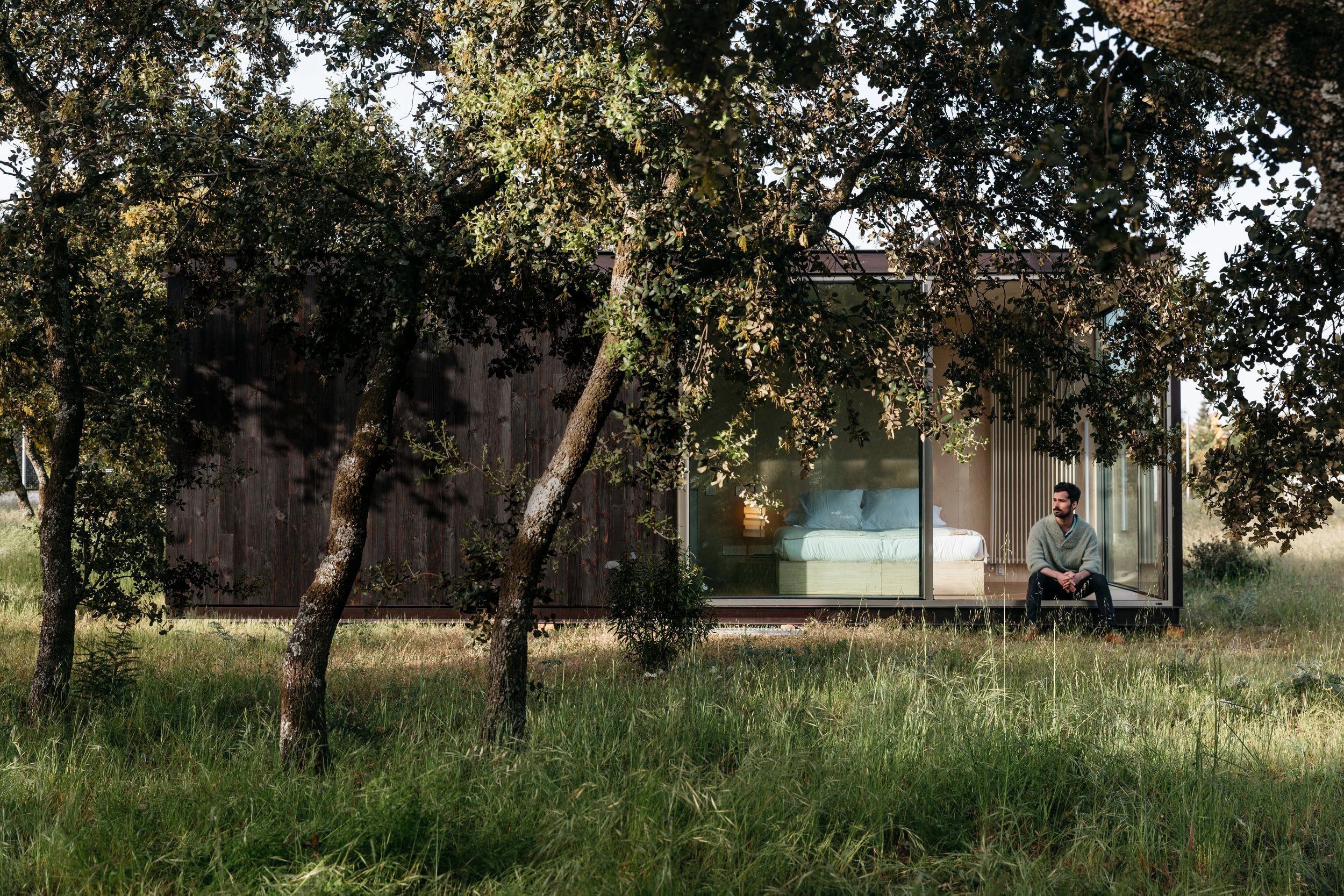
The comparison he made to the automobile wasn’t accidental, nor was it original. “That’s the aspiration of any industry or sector… and architecture wasn’t going to be an exception,” the architects Pilar Cano-Lasso and Ignacio de la Vega note. They’re the co-founders of the delaVegaCanolasso architectural studio. And, through Tini Living, their Spanish brand, they design sustainable, prefabricated homes. The problem, they explain, is that “good,” “beautiful” and “cheap” are highly subjective concepts in residential architecture.
Housing has always been understood as needing to be custom-built; it doesn’t easily fit with the logic of mass production and repetition. The architects summarize that we’ve spent almost a century “trying to reconcile two ideas that haven’t always coexisted: the efficiency and repetition that’s inherent in [the industrial world], with architecture’s capacity to respond sensitively to each place and each person.”
Nearly a century after Fuller’s proposal, architecture continues to promise the same thing, under different names: tiny houses, micro-apartments, co-living, modular housing… the list goes on. Each generation has its own version of the dream of fair housing and assumes (without much historical perspective) that, this time around, it will finally come true.
The question that begs to be answered is why, with so many attempts behind us, have none of these architectural visions truly succeeded?
Frank Lloyd Wright shared the same ambition as his predecessor, albeit with a different approach. In the late 1930s, he developed the Usonian houses, a model of family housing designed to democratize access to residences for the American middle class. They featured local materials, open-floor plans, and a connection with nature. In short, he created an anti-urban utopia in which the landscape was the protagonist.
The first of these houses, built for the Friedman family, in the state of New York, was budgeted at $30,000, but ended up costing more than double that. The gap between the promise of accessibility and the actual cost — one of the main problems that would be repeated over time — was already beginning to emerge back then.
A house for the middle class
After World War II, Jean Prouvé, a self-taught French architect, took metal prefabrication to its most ambitious level. As early as the 1930s, he had experimented with the Maison Démontable, a house designed for easy assembly and disassembly. And, during the German occupation of France, his prototypes were commandeered as military barracks.
At the end of the war, with France in urgent need of housing for hundreds of thousands of refugees and displaced persons, the government commissioned him to develop a system of mass-produced houses. The panels, which were to be manufactured in a workshop, would form a lightweight structure and allow for rapid assembly on-site, using the same logic applied to furniture.
Prouvé was convinced that there was no difference between building a chair and a house. And, while he manufactured several hundred units for this purpose, his government contract never reached the scale he had envisioned. In 1953, his factory Ateliers Jean Prouvé went bankrupt. And the model he pioneered failed to survive beyond occasional commissions and collaborations with social organizations, such as the emergency housing he developed for Friar Abbé Pierre’s Emmaus movement, founded amidst the homelessness crisis in Paris.
While prefabrication was being tested in France as a response to a housing crisis, in the United States it was taking the opposite path: that of abundance and leisure. The country was experiencing one of its greatest golden ages and needed to provide an outlet for a middle class that, after World War II, was repeatedly promised the “American Dream.” In 1964, the New York department store Macy’s began selling complete vacation homes — lot, house, furniture, dishes and even toothbrushes included — which were mass-produced under the brand name “Leisurama Homes.” In just six weeks, 200 units were sold, representing a great and unexpected success.
These houses, of course, had a name behind them: Andrew Geller, one of the icons of mid-20th-century architecture. In 1959, the Eisenhower administration commissioned him to design “the typical American house” for an exhibition in Moscow. The resulting media buzz caught the attention of department store chains, which bought the patent and commissioned him to create a collection of houses. These were intended to be sold like any other product being stocked in their warehouses.

In the 1960s and 1970s, while some developers promised the same old house at a new price, others decided that the future should literally look like the future. One of the most outstanding projects in this architectural world’s quest to make housing more affordable was the Futuro House, designed by Matti Suuronen of Finland in 1968. The origin of this structure, however, wasn’t a social housing plan. Rather, it was built on a whim.
In 1965, a Finnish doctor named Jaakko Hiidenkari asked Suuronen, his friend, to design him a ski cabin that could be heated quickly and assembled on steep terrain, far from any road. The architect fulfilled the request with a lightweight, fiberglass-reinforced polyester shell. Transportable by helicopter if necessary, the interior temperature could be increased by thirty degrees in just half an hour.
But Suuronen and Polykem, the company that financed the project, quickly saw something bigger than a mountain refuge. If this UFO-like structure could be mass-produced, assembled in a single day and placed on any terrain, it could also become cheap and accessible housing wherever it was needed, without multiplying construction costs. However, as often happens, reality kicked in: the same innovative materials that could be easily transported resulted in higher manufacturing costs. And, with the 1973 oil crisis, plastic became inaccessible. Hence, only about a hundred of these homes were ever manufactured.
Almost simultaneously, on the other side of the world, the Japanese architect Kishō Kurokawa was leading the Metabolist movement, which proposed buildings that were capable of growing and adapting via prefabricated modules. His most famous work, the Nakagin Capsule Tower, was built in 1972 in a business district of Tokyo. The purpose was to provide affordable and functional accommodation for salarymen, office workers who needed cheap living space in the downtown core. There, they could rest, making do without the needs and luxuries that a standard apartment was equipped with.

Each of the 140 capsules — each barely 100 square feet, with a bed, bathroom and integrated appliances — was mass-produced and bolted to one of the two concrete cores, with the idea of replacing the capsules every 25 years, so that the building could remain standing for years. Half a century later, however, not a single capsule had been replaced. And the hot water was cut off in 2010. The tower ended up abandoned and neglected, resulting in it being dismantled, piece by piece, until its eventual disappearance in 2022.
Design was never the issue
“It’s much easier to present housing as a technical problem, rather than as a political one,” says Erik Harley, a researcher and content creator specializing in Urban Studies. He’s the creator of the architectural concept known as pormishuevismo, roughly translated from the Spanish slang as “because-I-say-so-ism.” Harley coined this term to describe land speculation and ego-driven architecture in his native Spain.
“Every so often,” he explains, “a new format appears with an attractive name. In the past, it was ‘garden cities.’ Then, ‘industrial parks.’ Then ‘lofts’. Now we have ‘co-living’ or ‘prefabricated modules.’ [We’re sold the idea] that design can fix what, in reality, has to do with land prices, financing, ownership and regulation. Architecture ends up functioning as a showcase; it doesn’t address the roots of the problem.”
As an example of the housing crisis, he cites the Spanish construction boom prior to 2008, in which hundreds of thousands of homes were built in the country, without guaranteeing access for those who needed them most. For Harley, this is further proof that “the real estate market doesn’t operate on the simplistic logic of ‘more supply automatically means lower prices.’” His diagnosis, in essence, is simple: “Architecture can greatly improve how we live… but it can’t decide who lives where, or at what price.”
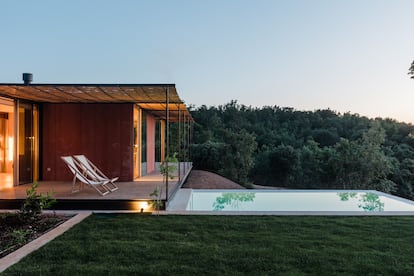
The architectural firm delaVegaCanolasso reaches a similar conclusion from the other side of the drawing board: “Architecture can optimize a building, but it cannot, on its own, solve the problem of land prices or the housing shortage. There’s a point at which the problem ceases to be purely construction-related and becomes economic, urban and [inherently] political.”
De La Vega and Cano-Lasso also offer a little-known fact: a large portion of the banking sector still doesn’t recognize a home as collateral while it’s being manufactured in an industrial building: financing is only released when the modules arrive on the site. “For [the concept of] prefabricated [homes] to grow and reach a wider audience, it’s not enough to transform architecture or construction processes. Financial tools, regulations and bureaucracy must also evolve in parallel,” they conclude.
With their Tini Living project, compared to traditional alternatives of the same quality, delaVegaCanolasso has managed to fast-track construction and get a handle on costs. Still, the architects make a clarification: “Tini isn’t just cheaper; it’s difficult to achieve this using natural and durable materials, while still maintaining our high-quality craftsmanship.” They do believe, however, that building a house entirely in the traditional way will eventually become a luxury item, reserved for those who can afford the increasingly-scarce skilled labor.
For his part, the journalist Pedro Bravo – the author of Antes todo esto era ciudad (2026), translated from the Spanish as Back Then, This Was All City – places the problem on an even larger scale. “Housing has been a battleground since we began to live together in cities,” he states. And, regarding the trendy language surrounding “co-living” or “tiny houses,” he’s very frank: “Since we’ve been led to agree that housing is a market, it’s only natural that those who control the business use marketing strategies.” He recalls how Friedrich Engels warned in his 1872-1873 essay series, The Housing Question, that the housing shortage could extend even to the bourgeoisie. The German philosopher – a lifelong friend of Karl Marx – proposed that housing be decommodified.
“Housing is generating higher returns for large international financial institutions than the stock market,” Bravo argues. “That’s why it’s proving so difficult to reverse all the processes that have led to this situation. Making affordable housing possible isn’t just a way to serve the common good, it’s a way to do it for a long time.”
Architecture can improve how we live, but it doesn’t determine who lives where, or at what price. Almost 100 years after Buckminster Fuller promised a house for the price of a car, time has confirmed the idea that architecture certainly knows how to build better, faster and cheaper. And it’s clear that this utopia of affordable housing is possible. However, according to all the experts, the market must change for this to become reality.
Sign up for our weekly newsletter to get more English-language news coverage from EL PAÍS USA Edition
Barcelona
Naomi Lautier: The Pure Talent Of A 14-Year-Old Creator Living Between Autism And The Art World

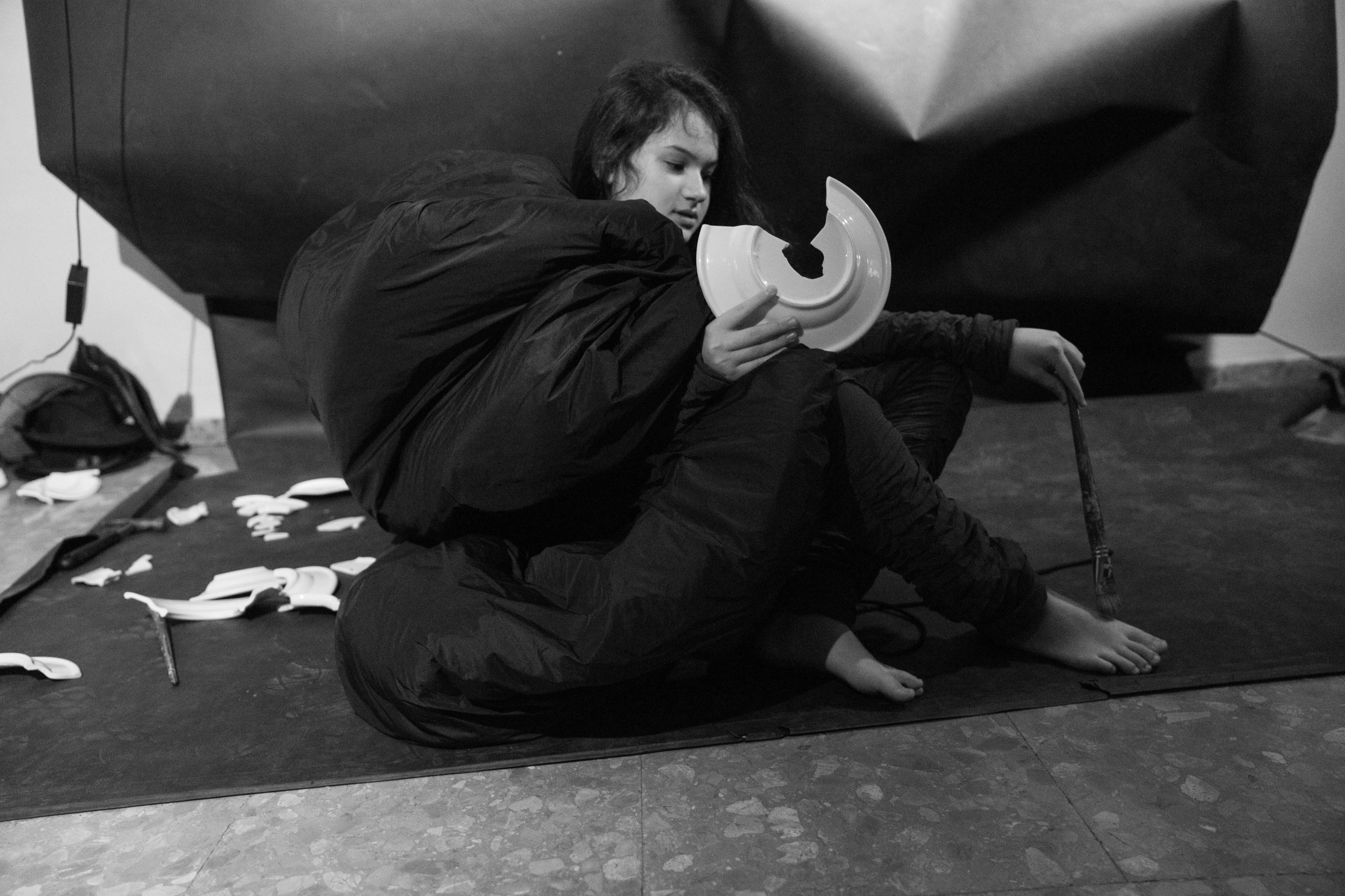
Naomi Lautier is 14 years old. Born in 2011 in Paris, she paints as if the world were speaking to her in its own language. There isn’t a single learned gesture in her work, nor any desire to fit into recognizable traditions. Her art springs from elsewhere: it has a direct, almost physical connection with what she sees, what she feels and what she needs to express.
Naomi is on the autism spectrum, but that hasn’t stopped her from making her mark on the art world. This year she’s been participating in a group exhibition at Espacio 123, in Barcelona. And she’ll soon be embarking on a journey that will take her to a dozen solo exhibitions across the globe. The art world is about to discover Naomi Lautier.
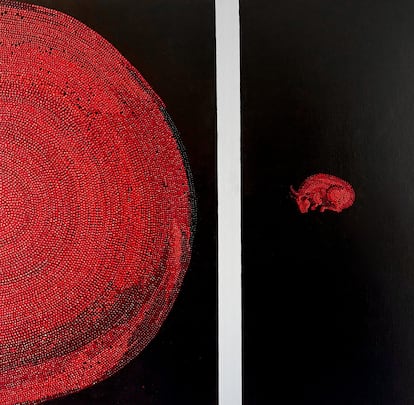
“It all started with the flowerpot incident,” her parents Joel and Alissa Lautier recall with a smile. They were living in a town near Barcelona (they now live in Málaga, where Naomi attends school; they chatted with EL PAÍS in perfect Spanish) when Naomi started painting on a flowerpot in their rental home. Then, she moved on to painting the wooden fence. And then…
“Then, it became clear that, if we didn’t find canvases urgently, the next exhibition would be the walls of the house,” Alissa laughs. That domestic scene marked a turning point. “It was no longer a game. [She had] an attentive, almost investigative gaze,” they explain.
Since then, painting has ceased to be an activity and has instead become a necessity: it’s through art that Naomi connects with the world. And her parents have given her all the space possible to develop as an artist. Joel and Alissa have learned to accompany this process without interfering. “We don’t reconcile it, we adapt,” they explain, when speaking about her condition on the autism spectrum. “Autism doesn’t interfere with her childhood. [Rather], it makes it different: more subtle, more focused, sometimes more fragile… but, at the same time, surprisingly profound,” Joel maintains. In their daily lives, this translates into constant attention being paid to their daughter’s internal rhythms: she lives with a level of sensitivity that doesn’t allow for haste. “Where others simply look, she observes. Where others pass by, she stays. And we believe that’s reflected in her art.”
Naomi works in series, repeating motifs that evolve over time: complex forms made up of colored dots, bubbles, fruits, animals. “There’s an inherent logic to [her process] that isn’t obvious,” her parents explain. The animals rats, roosters, hobbyhorses — reappear as symbols that are charged with emotion: “They aren’t just images. They carry an inner state,” Alissa notes. “For her, color is an event: a flash, a tension, an energy that arises in the moment,” Joel adds. “There’s something both very childlike and very adult in what she does… like a memory that doesn’t fade.”
Naomi and her art are not professional. She doesn’t have a gallery representing her. And, until now, everything has been thanks to word of mouth and her mother’s modest initiative. But now she’ll be embarking on an international tour that includes stops in Málaga, Copenhagen, Barcelona, Dubai , Pisa, as well as several cities in Kazakhstan and Kyrgyzstan. These will be the first public exhibitions of a unique artist, whose beginnings can be traced back to her family and a series of fortuitous and essential collaborations.
Art as therapy
Naomi has never had drawing or painting lessons (she doesn’t even let her parents into her room to see how she paints). However, before she found a means of expressing her language on the canvas, there was a key space in her development: Anna Andreu’s art therapy workshop in Premià de Dalt (Barcelona). She arrived there at age 10, during a difficult moment. “It was the first time that she had been separated from her mother,” Andreu recalls, on the terrace of a local café. “She barely spoke Spanish; she shouted a lot.”
In that context, the work didn’t begin with paint, but with the tactile. “What interested her at first was salt dough. She [wanted] to knead it; she used kilos and kilos of flour,” Andreu laughs. She understood that Naomi’s access to the creative world came through the body: “We made cookies, things that could be eaten… at first, she painted with chocolate.” The workshop, where Naomi spent a couple of years, until the family moved to Málaga, functioned as an open laboratory.
“She had complete freedom to experiment,” Andreu explains. She recalls that Naomi then began painting on dough, on paper… on any available surface. “She had her OCD tendencies and she needed to touch everything. Once, she even ate one of her own creations! But beyond that anecdote, I think an emotional evolution began: she started socializing with other children for the first time.”
The art therapist remembers moments of great intensity: “The only time she cried was when a child took away her yellow paint. I thought that crying is the most human thing we have.” The relationship between them was profound: “She was my student, my patient… she taught me so much. I learned to listen without intervening, to not try to cure [her]. To be silent.”
Today, seeing Naomi’s progress, Andreu doesn’t hide her emotion: “It’s a privilege to have had her by my side and to see what she does now.” Today, Naomi no longer shouts: her personality is very different. She goes to school with a learning support assistant and her classmates are delighted with her.
A leap and recognition
Institutional recognition came almost unexpectedly. “It all happened by chance,” Naomi’s parents note. Curator Natalia Shustova discovered her work in a domestic setting: “Not in a gallery, but at home; we were introduced to her by mutual friends.” Her reaction was immediate: these paintings had to be shown to the public. The first piece Shustova saw “was an octopus, almost [resembling something] from an early Dalí period. But there were many of her paintings around the house.”
The curator felt the urgency to bring Naomi’s work to an exhibition space, although not without initial resistance from her parents, due to the child’s age. “We had to organize something,” Shustova recalls. In 2023, she proposed taking Naomi’s paintings to a charity auction linked to the Ronald McDonald House Charities. There, one of her pieces was sold for the first time.
Since then, this art expert has closely followed an evolution that she describes in almost organic terms: “She works in series, each one deeper than the last, as if she were climbing a ladder.” For Shustova, Naomi’s painting isn’t a medium, but a language in and of itself: “She hardly speaks; it’s with her brush that she communicates with the world.” And, in that communication, Shustova recognizes an uncommon technical skill and a “highly refined” sensitivity to color, which seems to develop at its own pace. At the same time, she insists on not reducing her interpretation to a diagnosis: “I don’t want her to be treated as disabled; it’s precisely her way of being in the world that allows her to convey what she conveys.”
This mark of quality hasn’t only been bestowed by Shustova: thanks to social media, many institutions and personalities have praised or expressed interest in Naomi’s work, from the director of the Barcelona Museum of Contemporary Art (MACBA) to the prestigious American art critic Jerry Saltz, as well as Spanish artists like Javier de Juan.
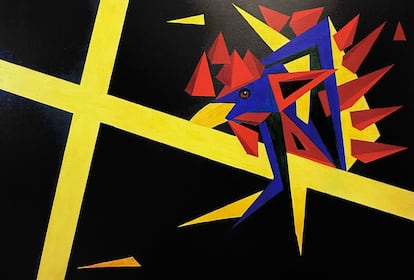
José María Luna, now the cultural director of the Unicaja Foundation in Málaga, first met Joel Lautier when he was in charge of several museums in the city. The truth is, Naomi’s parents have their own unique story: Alissa is half-Russian and half-Ukrainian. Joel, half-French and half-Japanese, is a chess grandmaster who was a candidate for the world title in 1994 (he defeated Garry Kasparov on several occasions). Luna met Joel at a Málaga chess tournament.
After seeing Naomi’s work, Luna offered them a space in the Russian Museum of Málaga. “She didn’t have formal training, but she did have enormous technical skill and, above all, her own unique vision,” Luna recalls. “She has to grow as a person and as an artist, of course; she still has a way to go. But her ability to construct a universe and convey it is incredible.” Luna shifts the focus from recognition to a more essential dimension: “The most important thing, really, is that this helps Naomi grow as a person.”
Partners behind the camera
Naomi isn’t just a painter: her exhibitions will also feature art installations, collages and videos. This evolution has been closely observed by a friend, with whom Naomi has developed the most recent stage of her art: Eugene Hrotchuk, a 37-year-old Ukrainian photographer who arrived in Spain 20 years ago. Their meeting was by chance.
“One day, her mother came to see some paintings I had [displayed] on the street and said to me, ‘Naomi is also an artist,’” Hrotchuk recalls. From there, the relationship grew organically: “When I saw her work for the first time, I was incredibly surprised. I couldn’t imagine that a 14-year-old girl could create something so meaningful.” Together, they’ve worked in photography and video. “At the heart of our work is always the artistic idea of a performance, in which Naomi acts as the performer. My role in this process isn’t to reinterpret or modify her, but rather to attentively enter that space and try to translate her language into photography, without disrupting its internal logic.”
From this collaboration (and friendship), several series have emerged, such as a black-and-white one that portrays Naomi as Mickey Mouse. “Naomi, as an artist, doesn’t possess the usual filters through which we perceive the world. Perhaps this has to do with her autistic perception, which is completely different: purer, more direct, born from within, without trying to please anyone,” Hrotchuk observes, astutely. “She conveys the world with a very particular honesty and sensitivity, as if she were capturing what’s happening in the air and transferring it to the canvas. That purity and intensity ensure that her work leaves no one feeling indifferent.”
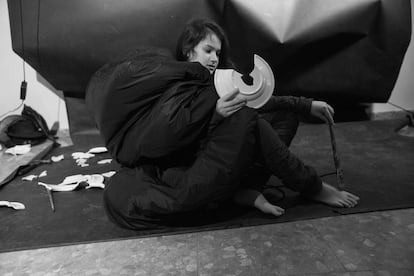
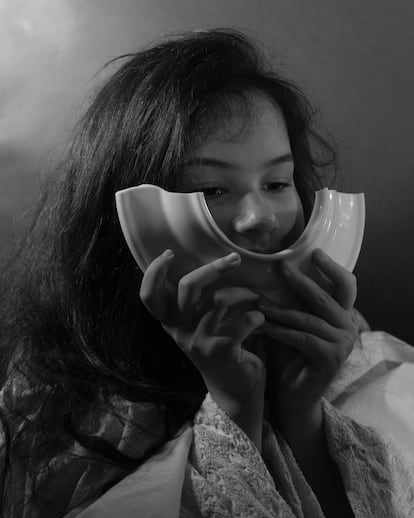


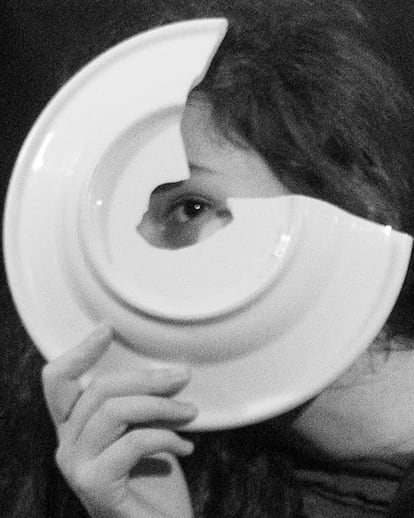
That purity is, in the end, what Naomi’s parents value most: “When we saw her first exhibition, we felt like we were seeing her world in its entirety for the first time. And we understood: this is just the beginning.”
“For any artist,” they emphasize, “with or without autism, it’s important to be heard and understood.”
Naomi’s unique voice is ready to be shared around the world, on a journey that perhaps has an even more important dimension than the artistic one: “What’s truly important isn’t so much that she finds a place in the art world,” José María Luna concludes, “but that she finds a place in life.” Painting and art — as an obsession, as a home, as a permanent center of gravity — can offer solace. “If success comes — if, in a few decades, we’re talking about her as an important figure — well, that’s wonderful,” Luna points out. “But what’s truly important is understanding that she’s happy doing this.” Perhaps therein lies the key to everything: in that quiet and stubborn happiness, in that need to create without asking permission, Naomi has already found what is essential, long before the world sets its eyes on her.

Sign up for our weekly newsletter to get more English-language news coverage from EL PAÍS USA Edition
A mysterious map in a 1599 Bible points towards the location of the lost Garden of Eden
Petrol thieves in Spain see their getaway go spectacularly wrong
Tied-up bull video rattles Fuengirola as Romería day prepares to kick off


-
Latest2 weeks ago
The Vocabulary You Need To Understand The Spanish Citizenship Process
-

 Alex Saab2 weeks ago
Maduro Ally Alex Saab Pleads Guilty In US Money-Laundering Case
-

 New Developments2 weeks ago
How To Get A Tourist Rental Licence In Andalusia (Spain) – Step-By-Step Guide 2025
-

 %2 weeks ago
Benahavis Wildfire Stabilised: 300 Hectares Burnt
-

 Uncategorized2 weeks ago
‘Lewis will never trust Charles again’ – F1 journalist issues shocking Ferrari statement – GPFans.com
-

 Arganzuela1 week ago
Detenido Un Hombre Por La Muerte De Una Mujer De 47 Años En El Distrito De Arganzuela De Madrid
-
Best airlines1 week ago
Spanish airline Vueling named Europe’s best low-cost carrier for 2026
-

 Coaching2 weeks ago
Svend Brinkmann, Psychologist: ‘If You Place Conditions On Forgiveness, Love Or Freedom, You Have Already Destroyed Them’