Connect with us

%

Local Mar Menor Charity Actively Seeking New Volunteers

Published

on

local-mar-menor-charity-actively-seeking-new-volunteers

Local charity seeks volunteers for office, outlet, and driving roles. Photo Credit: HELP Murcia Mar Menor

Locals and residents in the Los Alcazares area have a chance to make a positive impact in the area, meet new people, and become part of a kind-hearted group: the non-profit organisation HELP Murcia Mar Menor has announced that they are actively seeking new volunteers to join the long-standing charity, inviting enthusiastic and passionate people in the area to help its dedicated team across a variety of roles.

Crucial roles currently open to volunteers: Administration, store helpers, and van drivers

To be specific, the organisation is currently seeking volunteers in three areas. Those who are well-organised and enjoy administrative tasks can assist in the local Los Alcazares office by handling phone enquiries, filing, and data entry to keep operations running smoothly behind the scenes. For those who prefer meeting people and working in a more social environment, the San Javier outlet shop needs friendly helpers to serve customers, price items, and sort through incoming donations. Finally, the charity is looking for van drivers with a valid driving licence to handle the collection and delivery of donated goods and store purchases.

What is HELP Murcia Mar Menor? Supporting the community through times of need

HELP Murcia Mar Menor, which was first established in 2002, provides essential support, information, and emergency assistance to local residents and visitors in the Region of Murcia. For example, the charity has lent vital mobility equipment including wheelchairs to individuals during health crises. 

More recently, in June, the organisation made a sizeable donation of €2,000 to another local charity dedicated to helping those with dementia, the Forget Me Not centre in Camposol. In July, HELP Murcia Mar Menor also raised awareness to help Paul Gaynor, an active volunteer and nurse, who suffered a devastating brain aneurysm.

As HELP Murcia Mar Menor approaches its 25th anniversary in 2027, volunteer support is needed more than ever to ensure its vital community work continues to thrive.

How a few hours can transform lives: Volunteering at the charity

Those who are interested in collaborating with the charity do not need to commit to a lot of hours to make a difference. Even a couple of hours a week can directly help to raise vital funds and support good causes throughout the local community. Volunteering at the charity can also offer a rewarding opportunity to learn new skills, connect with fellow residents, and enjoy plenty of good company along the way.

Those who want to lend a hand, can reach the team by emailing helpmmm@gmail.com, or visiting their official website at helpmurciamarmenor.es.

%

Morocco Stops Hundreds Of Migrants Near Ceuta Border

Published

on

morocco-stops-hundreds-of-migrants-near-ceuta-border

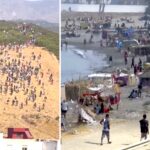
Hoards of people run towards border fence August 15, 2026. Credit: Viral X videos

Spanish and Moroccan security forces kept a tight grip on the frontiers around Ceuta and Melilla this Saturday, August 15, after social media calls urged another mass attempt to cross into the Spanish enclaves. Calm held on the Spanish side while Moroccan police broke up a large group of would-be crossers outside Castillejos, detaining nearly 300 people, most of them reportedly of sub-Saharan African origin.

Heavy police presence on both sides of the border prevented any repeat of the late-July chaos when tens of thousands entered Ceuta in a matter of hours. Guardia Civil, PolicĂ­a Nacional units stayed on high readiness in Ceuta. Similar reinforcements, around 150 officers plus a patrol boat, helicopter and specialist teams, operated in Melilla.

Government officials there described the day as normal and free of incidents. A floating barrier and extra fencing on the Melilla breakwater added extra layers of control following a Supreme Court ruling that limited certain push-backs by sea.

La situación en Ceuta va cada cada vez peor, más de 10.000 invasores ya están creando campamentos en la playa, la situación de insalubridad es total, la playa está llena de mierda literalmente, la basura se acumula, cada vez aparecen más chabolas, ya van más de 8 violaciones a
 pic.twitter.com/k8JtYuBiQH

— Javier Negre (@javiernegre10) August 14, 2026

Moroccan forces break up mountain gathering near Castillejos

Moroccan security sources said hundreds of migrants, largely sub-Saharan, had hidden in the hills southwest of Ceuta near Castillejos. Agents used tear gas and a helicopter to scatter the group before making the arrests for encouraging illegal migration. Road checks remained in place on the main routes from Tetuan and Tangier. The urban centre of Castillejos itself stayed quiet under a large police presence.

Ceuta under Islamist attack from two sides. pic.twitter.com/AhwORyrRMC

— RadioGenoa (@RadioGenoa) August 15, 2026

This came two weeks after the biggest recent influx, when estimates put arrivals into Ceuta somewhere between 50,000 and 80,000 people, many swimming or walking around coastal barriers. Most returned within days, yet several thousand, mainly sub-Saharan men and some minors, were still in the city. Officials counted at least 90 deaths across both sides of the border during that earlier rush, the majority by drowning.

Spanish reporters told to leave Castillejos at once

A local representative of Morocco’s Interior Ministry, identified as Youssef Hajji, ordered journalists from the most respected Spanish news agencies, EFE and TVE, to leave Castillejos while they were covering the police operation against the migrants. He gave no reason beyond saying he was following instructions and warned that press credentials and equipment could be seized if they stayed. Hotels later told the teams the same message from local authorities.

La policĂ­a marroquĂ­ abre fuego contra los asaltantes de Ceuta mientras la Guardia Civil mira. pic.twitter.com/XynvCEhsaQ

— Muy.Mona/đŸ‡Ș🇾💚 (@Capitana_espana) August 15, 2026

Why keep the cameras away right now?

Questions quickly arose about Morocco’s decision to push Spanish media out of the area. Controlling the images and narrative around these events matters for Rabat. Past episodes have shown how migration flows at Ceuta and Melilla can become a pressure point in relations with Spain. In May 2021, after Spain allowed Polisario Front leader Brahim Ghali medical treatment, Moroccan forces eased controls, and roughly 8,000 to 10,000 people crossed into Ceuta, many of them Moroccan, including minors. Controls tightened again once diplomatic talks advanced.

Analysts have long described the ability to open or close the tap on migrant movements as a recurring tool linked to wider disputes, including Western Sahara.

Morocco routinely cooperates with Spain and the EU on returns and interdictions, and has used force against attempts, as seen in the deadly 2022 Melilla events. Yet selective non-enforcement has appeared during periods of tension. Illegal emigration itself carries serious penalties under Moroccan law, which helps explain why many who reach Ceuta fear being sent back.

Unconfirmed reports have circulated of Moroccan police opening fire during some past crossing attempts, adding to the climate of risk for those involved.

Spanish side stays locked down

Miguel Angel Perez Triano, the government delegate in Ceuta, spent the early hours checking the Tarajal crossing in person. Extra barriers on the Spanish side, including the floating one at Melilla, reflect lessons from July. Social media calls for another August 15 push had circulated widely, so both capitals prepared in advance. EU migration experts were already on the ground in Ceuta assessing needs after the earlier crisis.

Residents in both enclaves continue to feel the strain and have been crying out for more security from central government. Ceuta’s reception centres remain under pressure from remaining arrivals and unaccompanied minors. Local leaders have called for more mainland support while insisting the situation is under control for now.

Looking back at the pattern

Migration pressure at these two Spanish cities on the North African coast has flared repeatedly for two decades. Scale varies, yet the geography stays constant: short sea or land distances, economic gaps, and political undercurrents. Morocco does not recognise Spanish sovereignty over Ceuta or Melilla and has used the frontier as leverage before. Spain maintains both are integral parts of its territory and the only land borders between the EU and Africa.

For the moment the fences held, and the planned mass attempt failed. Whether the calm lasts depends on continued coordination between Madrid and Rabat, plus the ability of authorities on both sides to keep social media-driven crowds from gathering again. Spanish media exclusion from Castillejos leaves fewer independent eyes on the Moroccan side of the story just when tensions are still high.

Continue Reading

%

Major Change Hits Lidl Stores Across Spain As New Rules Take Effect

Published

on

major-change-hits-lidl-stores-across-spain-as-new-rules-take-effect

shoppers may find that some familiar products have different nutritional compositions. Photo credit: Marco Gallo/Shutterstock

Anyone popping into Lidl in Spain today could notice something different on the shelves, as the supermarket introduces a major change to part of its own-brand range. The change came into effect on Friday, August 14, and affects Lidl’s own-brand food aimed at younger consumers.

The supermarket says the products are being brought into line with new nutritional requirements, with the changes being introduced across its stores in 30 countries. The company says it wants to make it easier for shoppers to find products that meet its nutritional standards without having to scrutinise every label.

New nutritional requirements take effect

Lidl says its own-brand food products covered by the initiative must meet the nutritional criteria established by the World Health Organization (WHO), alongside the supermarket’s own requirements. That means shoppers may find that some familiar products have different nutritional compositions from previous versions. The changes affect products including pasta, fish fingers, cereals and corn snacks. 

The supermarket has linked the move to its broader aim of making healthier choices easier rather than expecting customers to work through nutritional information on every product before deciding what to put in their trolley. Lidl’s Stefan Haensel, responsible for Quality & Sustainability, said the company wanted to make choosing suitable products easier for families.

What will shoppers see on shelves?

The changes will not mean every Lidl product is being reformulated. The initiative applies to the supermarket’s own-brand range covered by its nutritional requirements. Some of the products will also feature Paw Patrol branding as part of a promotional collaboration linked to Paw Patrol: The Dino Movie. The campaign is expected to run for around ten weeks.

The branding is designed to make the products more appealing to younger shoppers, while the nutritional reformulation is intended to meet the standards Lidl has set for the range. For customers, the most noticeable difference will therefore be the products appearing on shelves rather than a change to the way Lidl stores operate. There is no indication that shoppers will need to change how they pay, use Lidl’s stores or access its usual services.

Lidl is changing the recipes

The supermarket’s move goes beyond simply putting new packaging on existing products. Lidl says the relevant own-brand products have been reformulated to meet its nutritional criteria. The company has presented the changes as part of its effort to improve the nutritional profile of the food it sells.

The approach is being applied across Lidl’s operations in 30 countries, making it a wider private-label policy rather than a change limited to Spain. For Spanish shoppers, however, the practical effect is straightforward: some products in the relevant section will gradually appear in their updated versions.

Why Lidl says it is making the change

Lidl’s stated aim is to remove some of the difficulty involved in choosing food with a more favourable nutritional profile. The supermarket says it is combining the WHO criteria with its own nutritional standards when developing the products covered by the policy.

The company has described the approach as a way of making the choice easier rather than relying entirely on customers to compare products themselves.That is also where Lidl’s “Queremos ponĂ©rtelo mĂĄs fĂĄcil” message comes in. The phrase, which translates as “We want to make it easier for you”, is being used to explain the reasoning behind the changes.

The change is already underway

Customers should not expect the entire relevant range to disappear overnight. The reformulated products are being introduced as part of the new requirements, meaning shoppers may encounter a mixture of existing and updated products while the transition takes place. The Paw Patrol promotion will also be temporary, with the collaboration expected to last approximately ten weeks.

The nutritional requirements, however, represent the more significant part of the announcement because they concern how Lidl develops its own-brand products. For shoppers in Spain, there is therefore no need to make any change at the checkout or adapt to a new Lidl store system.

The difference will be found on the shelves, where some of the supermarket’s own-brand products are being replaced by versions that Lidl says meet its updated nutritional requirements. And while the change is aimed at making food choices easier, the immediate question for shoppers will simply be whether their usual products look the same when they next visit Lidl.

Continue Reading

%

AndalucĂ­a Mosquito Alert As Doctors Expose The Truth About Citronella

Published

on

andalucia-mosquito-alert-as-doctors-expose-the-truth-about-citronella

Candles, plants and scented products are often used on terraces. Photo credit: Tetyana_Pidkaluyk/Shutterstock

Most of us have reached for a citronella candle, plant or spray when mosquitoes start becoming a nuisance. But people across AndalucĂ­a are now being warned not to mistake the familiar citrus scent for proper protection, with health centres displaying advice telling residents that citronella does not provide a reliable mosquito-repellent function.

The warning comes as Andalucía continues to deal with mosquitoes capable of transmitting diseases including West Nile virus, with cases already confirmed in people this summer and mosquito circulation detected in multiple municipalities.  The Junta is urging residents to use registered topical repellents instead of relying on products that may give them a false sense of protection.  The regional health authority has also produced dedicated 2026 posters and information materials on preventing mosquito bites, including specific guidance on authorised repellents. 

Citronella is not proper mosquito protection

The message being displayed in health centres is extremely important because citronella has become one of the most familiar ways of trying to keep mosquitoes away. Candles, plants and scented products are often used on terraces, balconies and around doors during the summer.

But the presence of citronella does not mean that someone sitting nearby has the same protection as they would get from an authorised repellent applied correctly to exposed skin. The Junta’s current guidance specifically recommends registered, topical mosquito repellents and provides lists of products authorised for use. It also advises covering as much skin as possible with light-coloured clothing. 

The warning comes as West Nile cases rise

This is not simply about avoiding an itchy bite. Andalucía has already recorded human cases of West Nile fever this season, including one death in Dos Hermanas. The Junta also confirmed six cases by July 28, all described as mild. They were identified in Palomares del Río, Villamanrique de la Condesa, La Puebla del Río, Coria del Río and Aznalcåzar, all in the province of Sevilla. 

The same report said virus circulation had been detected in mosquitoes in 15 municipalities declared areas on alert, while viral circulation had also been detected in two municipalities where the capture sites were more than 1.5 kilometres from the urban centre. Mosquito densities were also increasing in several areas. 

Mosquito protection matters more in high-risk areas

The situation is being closely monitored because West Nile virus is transmitted through the bite of infected mosquitoes. Most infections do not cause symptoms, but some people develop illness and a small proportion can develop serious neurological complications.

The Junta has therefore been increasing surveillance across Andalucía rather than waiting for human cases to appear. More than 200 mosquito traps are being used to monitor circulation, with public health teams also carrying out checks in municipalities across the region.  That makes the advice being displayed in health centres particularly relevant to people living in or visiting areas where mosquito activity is high.

What should people use instead?

The advice is not to abandon every household measure used against mosquitoes. Screens, reducing standing water and using appropriate environmental insect-control products can all help reduce exposure. But anyone relying on protection for their own skin should use a registered topical repellent and follow its instructions.

The Junta maintains updated lists of authorised products, including repellents registered through the relevant Spanish and European systems.  People are also advised to wear clothing that covers the arms and legs where practical and to take extra care around dawn and dusk, when mosquito activity can be higher. Strongly scented perfumes and soaps should also be avoided because they can attract mosquitoes. 

Don’t let the smell create false confidence

A citronella candle burning on a terrace may make the area smell strongly of citrus, but that should not be confused with having protected your skin from mosquito bites. That distinction matters when the insects present are capable of carrying disease. Someone who assumes the citronella beside them is enough may spend an evening outdoors without using an appropriate repellent or covering exposed skin.

And Andalucía’s health authorities are already seeing why prevention matters. The region has recorded human West Nile cases this summer, while infected mosquitoes have been detected across several municipalities.  The message from the health campaign is therefore simple: don’t rely on citronella as your main defence against mosquito bites. Use a registered repellent, cover exposed skin and take steps to reduce mosquitoes around your home.

Continue Reading

Trending

Copyright © 2017 Spanish Property & News