Connect with us

%

Málaga Businessman Jailed For Cutting Salesman’s Steering In Revenge Plot

Published

on

malaga-businessman-jailed-for-cutting-salesman’s-steering-in-revenge-plot

The National Police homicide unit led the investigation, ending in a father and son in jail. Credit: Sauce Reques / Shutterstock

A salesman drove home from a business lunch with no idea someone had sliced through part of his new car’s steering in the car park. Now a Málaga court has sentenced the guilty retired garage owner who blamed the man for the collapse of his business and plotted his revenge. 

The plot began when a supplier pulled the plug

A retired Antequera business owner has been sentenced to five years and five months in prison over attacks carried out in 2017 and 2018, after the Provincial Court of Málaga convicted him of attempted murder, causing injuries and making threats. His son was given one year and three months for joining a later roadside attack on the same man, a sales representative the father blamed for the downfall of his car repair and machinery business. 

The trouble started in August 2017, when a German multinational supplier began ending its distribution agreement with them. Turnover fell by nearly 60 per cent, and although his daughter had been the firm’s sole director since 2016, the business owner still ran it day to day.

The steering was cut while the salesman was at lunch

In October 2017, the supplier held a convention at the Parador de Antequera. The father followed the salesman’s movements through text messages with his daughter, then walked into the car park with an angle grinder fitted with a metal-cutting disc while the salesman sat through a business lunch. He partly cut through the track rod (the part that links the steering to the front wheel) beside the front right wheel of the salesman’s new car, hoping to cause a fatal crash on the drive back to Marbella.

The salesman drove home with no idea, however the next day the car started veering about on a main road, but he was able to keep control and pulled onto the hard shoulder unhurt. Mechanics and an independent industrial engineer appointed by the court later confirmed the part had been deliberately cut with a specialist power tool.

Then came an ambush on the A-92

The story deepens even more, as the supplier formally ended the agreement in December 2017, and on Monday March 5 2018, the father and son boxed in the salesman’s car with two vehicles on the A-92 dual carriageway as he drove towards Marbella. The son smashed the driver’s window with a car jack, punched him in the mouth and pressed an electric shock device against his thigh. The father then repeatedly threatened to kill the salesman and his family if he went to the police. 

The salesman suffered facial wounds, upper jaw injuries and trauma, and needed 29 days to recover. 

The salesman died before the trial

The salesman died of natural causes before the case reached court, so the evidence had to speak for him. That included the son’s fingerprints on the car’s frame and the family’s car jack, which was found inside the vehicle.

His widow joined the case as a private prosecutor, and her lawyer, Alfonso Choza, said he was satisfied with the verdict and praised the National Police homicide unit for its investigation.

The court took the long delays in the case into account as a mitigating factor. In the end, the father must pay €10,000 to the salesman’s widow and heirs for emotional harm, and both men must jointly pay €11,000 for the physical injuries, lasting scarring and moral damages.

%

Toledo Train Disaster: People & Their Testimonies

Published

on

toledo-train-disaster:-people-&-their-testimonies

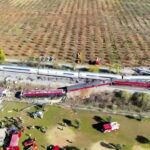
Horrific scenes from latest train crash. Credit: GC

Passengers aboard the two high-speed trains involved in Wednesday’s (October 28) disaster near Urda, in Toledo province, have described scenes of devastation, with some immediately turning to help the injured while others struggled to understand what had happened.

Harrowing accounts from survivors, relatives and local residents paint a picture of confusion and fear after the high-speed train collision near Urda, when a Renfe AVE train collided with a stationary Iryo service on the Madrid–Seville line.

Among the most harrowing testimonies is that of architect Joaquín Torres, who said he survived by a miracle after going to the toilet shortly before the impact. Others have spoken of being thrown against luggage and seats, while residents working nearby rushed towards the wreckage to help.

Architect describes woman dying in his arms

Joaquín Torres, who was travelling in carriage five of the AVE, said he had gone into an accessible toilet minutes before the collision. He managed to hold on to the grab rails as the impact threw the train into chaos.

Describing the experience to Spanish television, Torres recalled being plunged into darkness and losing his bearings. He initially feared for the life of his business partner, who had been travelling with him.

After getting out, he tried to help an injured woman who was cold and asking about a friend. Torres gave her his jacket, but she died in his arms. His account, broadcast on Spanish television, captured the shock experienced by passengers who found themselves confronted with devastating injuries and scenes of destruction.

Passengers thrown about by the impact

Ana María, 60, was travelling in carriage six with her husband. She said the train had stopped briefly because of problems on the line before moving again. Within minutes, the collision occurred. Ana María was thrown towards the luggage area, with belongings falling on top of her. Her husband suffered a serious blow to the head, and the couple were taken towards hospital in Toledo.

Another passenger, Jesús Jerónimo, was working on his laptop in carriage two when he felt a sudden acceleration followed by a violent impact. He said people were thrown from their seats and passengers initially thought the train had derailed.

Despite suffering a suspected broken nose and a cut to his hand, Jesús began helping other injured travellers. When he spoke to Cadena SER, he was still assisting medical teams by holding an intravenous drip for an injured person. “I felt helpless,” he explained, describing the difficulty of trying to help people amid the wreckage.

Local workers rush to help

David Gómez, a bricklayer working with colleagues on a nearby property, heard the collision and went towards the trains.

He found passengers attempting to escape through windows, with some injured and others sitting in the surrounding fields. David and his colleagues cut through fencing to reach the wreckage and used the first-aid kits they had with them to treat people. His account illustrates how local people became involved in the rescue effort before the full emergency response was in place.

Other passengers also helped one another leave the damaged trains, while emergency services worked to reach those trapped in the worst-affected carriages.

British mother leaves baby with local woman

One particularly moving account concerns a British woman who was trying to find her husband after the collision. According to Spanish newspaper elDiario.es, María José, a resident of Marjaliza village, took care of the woman’s baby while the mother went to search for him.

The story offers a glimpse of the fear and uncertainty experienced by families caught up in the disaster, as well as the kindness shown by people living near the crash site. The family’s eventual circumstances have not been established in the reporting available, and no conclusion should be drawn about the husband’s fate.

A mother desperate to reach her son

Marisol, whose son Adrián was travelling on the AVE with friends, spoke to Spanish television programme Espejo Público after managing to contact him. She said her son was deeply distressed by what he had witnessed and had told her that people were dying and passengers could do little to help them. One of his friends had suffered a serious leg injury. Marisol said she wanted to go and find her son, who was struggling to cope with the scenes around him.

Her account reflects the anguish felt by relatives waiting for news of loved ones, with many families facing hours of uncertainty after the collision.

Strangers helping strangers

Across the accounts, a common theme is the way passengers and local residents tried to help despite their own injuries and shock. Some survivors helped others out through windows, while people working nearby made their way to the wreckage with first-aid supplies. Passengers who were less seriously hurt also assisted emergency teams as they arrived.

The testimonies offer a deeply personal account of the disaster near Urda, with survivors describing not only the terrifying force of the collision but also the moments when strangers tried to comfort, protect and save one another.

As investigations continue, their accounts will form part of the wider picture of what happened on the Madrid–Seville high-speed line on Wednesday morning. The disaster also follows the January Adamuz train disaster, another fatal collision that had a profound effect on rail passengers in Spain.

For the practical impact on travellers, read our report on the suspension of Malaga to Madrid trains.

Continue Reading

%

Expat Questions Local Police Presence

Published

on

expat-questions-local-police-presence

La Cala de Mijas at night. Credit: Caron Badkin – Shutterstock

Steve Marshall says he has been hearing “disquieting stories” from La Cala, Mijas, including a reported attack on a man returning home at night.

According to the account he received, three youths wielding what were described as “bats” attacked and robbed the man close to Butibamba. Even after he handed over his money, the attackers allegedly stood on his arms and beat him black and blue, leaving him with a bloody gash to his head.

Marshall also refers to a robbery at the Galp garage, where Amazon collection boxes were reportedly vandalised. He says he was told that security cameras were operating, but questions their deterrent value.

“Why does this seem to be happening now?” he asks. “Were the same culprits who attacked the man walking home involved? Is it down to the pressures of the cost of living? I don’t know.”

Mijas Council has also announced plans for more than 150 surveillance cameras across the municipality as part of its efforts to improve public safety and crime prevention.

Where are the night patrols?

“What I do know is that there is little to no police presence at night,” Marshall says, adding that his own experience has been of seeing officers patrolling in the mornings.

“It is well documented that a physical police deterrent, patrolling our streets, not only reassures residents, it discourages crime,” he argues.

His concerns extend to a recent visit to the local police station in Las Lagunas. Arriving in the early afternoon, he says the station appeared closed, with its doors locked. An officer eventually allowed him and his wife inside after his wife explained that, because Marshall is disabled, waiting outside was not an option. He says they were initially told to return later.

As they left, the couple counted as many as 13 police cars parked nearby.

“Surely not all the police were having lunch at the same time?” he asks.

Marshall welcomes reports of increased funding for local police but believes residents deserve to see a visible presence on their streets. “We read a lot about the local police being given priority in funding and that is welcome news,” he says. “But my simple question is ‘where are they?’”

Mijas Council previously announced an increase in local police spending, taking its 2025 budget to almost €1.5 million.

Local elections are closing in fast on the Costa del Sol, and registry ends in December. Perhaps this is the time to make one’s voices heard.

Continue Reading

%

Mercadona Faces Pressure Over Its Ready-Made Meals As Spain’s Bars Demand New Rules

Published

on

mercadona-faces-pressure-over-its-ready-made-meals-as-spain’s-bars-demand-new-rules

Mercadona has been at the centre of the debate. Photo credit: dodotone/Shutterstock

If you grab a ready-made lunch from Mercadona and eat it in the supermarket, you could be at the centre of a growing row between Spain’s supermarkets and its bars and restaurants. The hospitality industry wants supermarkets serving food and drink for customers to consume on the premises to face the same rules and costs as traditional hospitality businesses. It is now asking political parties to take up the issue ahead of the next government, although no new tax has been introduced.

Hostelería de España, the national organisation representing the hospitality sector, has included the proposal in a list of 30 requests sent to political parties. It argues that businesses offering similar services should face equivalent tax, health, labour and licensing obligations. The organisation says the current differences put bars and restaurants at a disadvantage when competing with supermarkets that have expanded their ready-to-eat food ranges. The proposal is a request from the hospitality industry, not an announced government measure. Any change would depend on whether political parties adopted it and a future government decided to act.

Why supermarkets have become part of the dispute

The argument centres on the growth of prepared meals sold by supermarkets, including food that customers can eat in designated areas inside the store. For traditional cafés, bars and restaurants, these services increasingly overlap with what they offer, particularly for people looking for a quick lunch without sitting down for a full restaurant meal. Mercadona has been at the centre of the debate because of its expansion of ready-to-eat food and spaces where customers can consume it. Other supermarket operators have also developed similar services.

José Luis Álvarez Almeida, president of Hostelería de España, raised the issue publicly in May, arguing that supermarkets were moving into territory traditionally occupied by bars. The association has now taken the complaint into the political debate, seeking changes that would apply to businesses offering comparable services rather than targeting Mercadona alone. 

The organisation wants food and drink served for consumption in public areas within commercial premises, clubs and associations to be subject to the same requirements as equivalent services in bars and restaurants. That would mean addressing differences in taxation, food safety rules, employment obligations and licensing. The precise changes would need to be defined by policymakers; the proposals do not set out a new tax rate for supermarkets.

The industry says the rules should be the same

Hostelería de España argues that traditional hospitality businesses face obligations that may not apply in the same way to other businesses offering food for immediate consumption. It believes this creates an uneven playing field, particularly for independent establishments that must meet the costs of running a bar or restaurant.

The organisation represents around 320,000 establishments, including bars, restaurants and cafés. The sector accounts for 6.7% of Spain’s gross domestic product, while the restaurant industry alone contributes 4.7%, according to figures cited in its proposals. It also generates direct employment fo

Those figures form part of the association’s case for giving hospitality a stronger position in economic policy. Its demands extend beyond supermarket food counters, covering taxation, recruitment, small businesses and the preservation of traditional restaurants. For customers, the practical question is whether any future changes would affect the price or availability of prepared meals in supermarkets. There is no confirmed answer yet. The proposal does not automatically mean higher prices, and no change to supermarket charges has been announced.

Other demands include protecting the 10% VAT rate

The supermarket dispute is one of 30 proposals Hostelería de España has sent to political parties ahead of the general election scheduled for 29 November. Another major demand is to protect the reduced 10% VAT rate currently applied to hospitality services. The organisation is concerned about calls at European level for Spain to remove the reduced rate and apply the standard 21% rate instead. It argues that a rise could affect demand, employment and businesses already facing high operating costs. 

The association is also calling for changes to the cost of hiring extra staff. It says an additional social security contribution of €31.22 per day for extra workers makes temporary recruitment more expensive, particularly when businesses need additional staff for weddings, banquets and large events.

It wants the contribution surcharge removed, arguing that hospitality businesses should not face an extra cost that it says does not apply in the same way to agriculture. Other proposals include increasing the tax-exempt value of meal vouchers to €14, reducing administrative paperwork for small businesses and self-employed workers, and improving support for traditional restaurants in rural areas. The organisation also wants a dedicated Directorate-General for Hospitality and Tourism within the Ministry of Industry and Tourism. 

What happens next?

Hostelería de España has asked to meet political parties to discuss its proposals and seek their inclusion in the next legislature’s agenda. That leaves the supermarket demand at the stage of an industry request: it would require political support and subsequent regulatory decisions before any new obligations could take effect.

For now, shoppers can continue buying prepared meals from supermarkets under the rules currently in place. Whether future legislation brings supermarket food counters closer to the regulatory framework for bars and restaurants will depend on the decisions taken by the next government.

The hospitality sector is making its position clear before the election. It wants businesses serving food to customers on their premises to compete under equivalent conditions, regardless of whether the meal is bought in a traditional restaurant or a supermarket.

Continue Reading

Trending

Copyright © 2017 Spanish Property & News