
Caracas
María Corina Machado’s Party Stakes Its Strategy On The Uncertain Return Of Its Leader


Vente Venezuela, the party founded by María Corina Machado, is preparing again for the imminent return of its leader despite delays, skepticism, and uncertainty. Decisions within the organization are being made on the assumption of her return. Machado was unable to enter the country from Panama last week (the reasons are still unclear), but her definitive arrival in Venezuela, says Henry Alviarez, the party’s secretary of organization, “is a matter of days.”
Machado’s party is waiting on a plane, a boat, or a car to cross the border. The country’s main opposition party has organized its rebuilding, its mobilizations, and its messaging around the return of its leader, announced repeatedly as imminent and frustrated for the seventh time last week in Panama. There is great caution about the details and methods of her return, given what happened last week.
After the fierce repressive onslaught unleashed by Nicolás Maduro’s government between 2024 and 2025, which inflicted serious internal damage on the party’s structure and sent 200 of its activists to prison, Vente’s reconstitution is a work in progress: 10 of the regional coordinators who were in exile have already returned to their duties. Dozens more municipal activists have also come back. Two key leaders from the national leadership returned very recently. After Omar González, the return of Claudia Macero — the party’s head of communications and a close confidante of Machado — on September 27 has sparked enthusiasm among activists.
Omar González, one of Vente’s five national leaders who was granted asylum at the Argentine embassy in Caracas and returned to the country a month ago, confirms this: “The party’s entire national leadership is currently touring the country. Our first step has been to strengthen the Citizen Councils, which are our grassroots units. From the bottom up, we are preparing for María Corina’s return.”
The party senses social discontent and wants to speed things up. The slow pace the United States has set for giving a timeline to the proposed transition in Venezuela has made them impatient. The party says the country’s social crisis can no longer bear delays. Vente is working to rebuild popular protest and demand elections. An electoral date remains far from a zone of consensus. Last Friday, Jorge Rodríguez, head of the chavista negotiating team, declined to discuss electoral timetables in an informal meeting with the press, limiting himself to saying that there will be three elections before the presidency: parliamentary, municipal, and gubernatorial. A presidential contest, he said, will take place “within the timeframe established by the Constitution.” Moreover, the results achieved in terms of mobilizing support remain relatively modest: many citizens are still haunted by fears of the repression that took place in 2024 and 2025.
Vente Venezuela’s political agenda and reading of the country’s current situation now clashes markedly with the timetable imposed by the United States to implement its three-phase plan (stabilization, reconstruction, transition) for Venezuela.
Under the premise that Venezuela “is not ready” to organize institutional re-legitimization elections at this time, as President Donald Trump himself asserted, Washington has in recent months prioritized supporting governance, stability, and creating a climate for investment and business. At the same time, it has brought chavista and opposition political actors to the negotiating table to agree on an institutional arrangement that would open the door to democracy. An arrangement that excludes María Corina Machado.
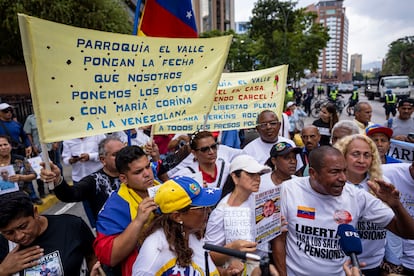
But the public’s growing awareness of the mounting shortcomings they face every day is taking on concrete forms. Protests in Venezuela are not massive, but they are on the rise. The Venezuelan Observatory on Social Conflict recorded 4,656 protests in the country — almost all of them peaceful — in the first eight months of 2026, a figure that triples the numbers for all of 2025. Of these, according to the Observatory, 2,092 (45% of the total) were primarily motivated by demands for the exercise of civil and political rights. Interim president Delcy Rodríguez’s approval rating, meanwhile, fell to 24% in August 2026, according to the Latam Pulse poll, conducted by the Atlasintel-Bloomberg consortium.
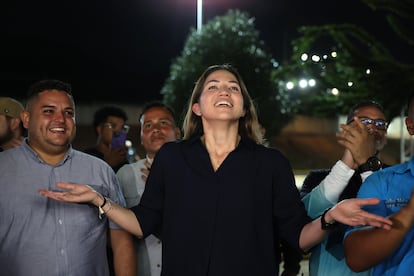
“This is a party born out of the experience of civic work,” says Macero, who was greeted by a party rally at Maiquetía airport (an unthinkable scene a few months ago) when she returned from exile. “Our agenda now is very broad: from small, constant meetings in every parish and municipality across the country, to larger assemblies to speak with and listen to middle-ranking cadres, to demonstrations of mobilization capacity like the National Ride we organized,” Macero adds. “Venezuela lost its fear after January 3 [when U.S. forces captured Maduro]. This country is already mobilized. There is nothing more democratic than protesting. Here the most important things are shortages and the priorities of Venezuelans.”
Expansion process
On September 27, Vente was able to organize its first simultaneous territorial activity in a long time: the Great National Ride, in which thousands of people gathered with bicycles and motorcycles at sites across the country to demand an electoral timetable. The outcome of that effort, replicated simultaneously in 12 of the country’s 24 states, left the organization energized.
“Vente is growing, but above all because it is María Corina’s party,” says Jesús Armas, a rising national leader who spent two years in prison. “We have launched a massive registration process for activists and volunteers. What we want to be is an institution, the country’s great liberal party. An organization that transcends María Corina’s leadership. We can already say we have leaders planted in every parish, every municipality, and every state of Venezuela. But the population still places somewhat blind faith in what she alone can do.”
“We’re working hard to train local leaders,” says Alviarez. “It’s a complex task that requires patience. There are people who have the motivation and the ability to inspire others, but then struggle to communicate effectively with others, for example. We place a lot of emphasis on training our activists.” Alviarez considers it premature to discuss electoral alliances: he states that the party is pursuing a change in the system. “We’re preparing for María Corina’s return, but also for the upcoming presidential elections and for governing this country. Twelve of our 24 national coordinators are under 35 years old.” Vente Venezuela is currently one of the parties that has not been able to register its existence with the National Electoral Council.
“I’ve been seeing a lot of outrage among people in recent weeks,” Armas says. “In the interior of the country, beyond Caracas, the situation is intolerable — it’s just too harsh. Power outages last six hours or more. In addition, there is frustration over the slow pace of political developments since January 3. It seems to me that people are pinning their hopes on María Corina’s arrival and tend to think that’s what’s needed for things to change. The important thing here, however, is that we need her presence to truly begin mobilizing the population.”
In recent weeks, Vente has organized popular tours in impoverished, densely populated areas of Caracas such as Petare and Propatria. Vente activists have gathered outside National Electoral Council offices in Maracaibo and Valencia to demand elections. There have also been demonstrations in Apure, Falcón, La Guaira and Barinas. There is a clear objective: that social demands and the economic improvements people seek are never separated from demands for the restoration of democracy.
Otherwise, although more spaced out and isolated than before, the chavista regime’s political police continue to closely — and silently — monitor any boastful statement, inconvenient procedure, or irregular circumstance occurring in everyday local politics. On September 17, Javier Oropeza, former mayor of Torres municipality and a Vente Venezuela activist, was intercepted by police officials and detained for 10 hours after giving an interview to a local news outlet. Oropeza had just returned from exile, and the day before he had appeared in court where a terrorism case opened against him two years earlier was dismissed.
Sign up for our weekly newsletter to get more English-language news coverage from EL PAÍS USA Edition







Guitarricadelafuente Culmina Su Transformación En ídolo Pop En Un Concierto Mágico En Madrid

Hallada Muerta Una Mujer De 102 Años Tras Las Inundaciones En Madrigueras (Albacete)
90% of Spaniards say this dish can help you reconcile after a row

Detenido Un Hombre Por La Muerte De Una Mujer De 47 Años En El Distrito De Arganzuela De Madrid

F1 Qualifying Today: Azerbaijan Grand Prix schedule, times and TV channel

FROM THE ARCHIVES: The Little Wooden House Is A Charming Hidden Gem Nestled In Inland Malaga – And Offers The Perfect Autumn Escape


-
 Arganzuela2 weeks ago
Detenido Un Hombre Por La Muerte De Una Mujer De 47 Años En El Distrito De Arganzuela De Madrid
-
 Uncategorized1 week ago
F1 Qualifying Today: Azerbaijan Grand Prix schedule, times and TV channel
-
 Costra del Sol2 weeks ago
FROM THE ARCHIVES: The Little Wooden House Is A Charming Hidden Gem Nestled In Inland Malaga – And Offers The Perfect Autumn Escape
-
Latest1 week ago
‘It’s The Law Of The Jungle’: Pensioner’s Eviction Exposes Spain’s Housing Crisis
-

 basque country2 weeks ago
British Actress Naomi Watts Attacks Ageism In Hollywood As She Picks Up Prestigious Donostia Award At San Sebastian Film Festival
-

 Uncategorized2 weeks ago
Heartbreaking Instagram post reveals death of F1 star
-
Diesel prices rise2 weeks ago
Breaking point for Spanish farmers as soaring diesel costs threaten to bring roads to a standstill
-

 Austin2 weeks ago
Venezuelan Migrant Shot By ICE In Austin Cites Lack Of Medical Care: ‘How Are They Going To Leave The Bullet In There?’