
America
Massive Protest Against Cuts To Public Universities In Argentina: ‘It Is Our Future As A Society, As A People’

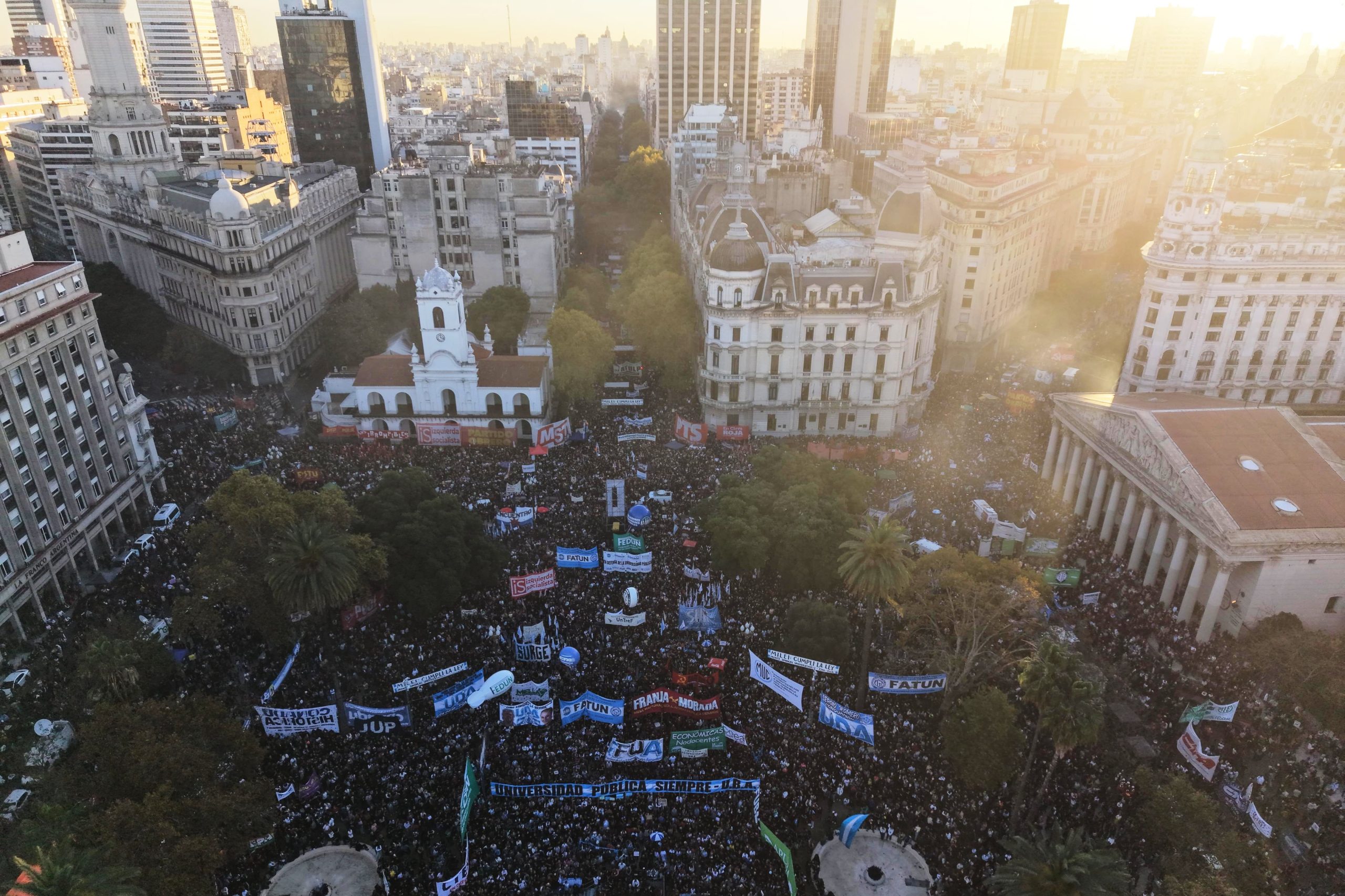
Enormous banners erected across Plaza de Mayo and the surrounding avenues in downtown Buenos Aires repeated the same slogan: “Milei, comply with the law.” Hundreds of thousands of people chanted it this Tuesday as they marched to demand that Argentina’s hardline government halt its cuts to public universities and release the funds approved by Congress. “The funding of the national university system is in a critical state, and the main cause is that the national government is failing to comply with the basic democratic and constitutional rule: to uphold the university funding law, which establishes a minimum level of resources that ensures the normal functioning of the system,” denounced academic authorities, faculty members and students in a joint statement read at the main protest event. The administration of Javier Milei labeled the federal university march an “opposition act” and reiterated that it will not release the requested funds.
Organized by the universities themselves, teachers’ unions, and student federations, the mobilization drew a massive crowd in the Argentine capital and was replicated in numerous cities across the country. According to the organizers, more than 1.5 million people demonstrated nationwide.

From midday onwards, columns of educators, students, and university employees filled the main streets of downtown Buenos Aires. The rhythm of drums could be heard from various points as they marched towards the historic Plaza de Mayo. Teenagers and adults carried flags identifying their universities, unions, or political groups from across a spectrum ranging from the center to the left.
“Without public universities, there is no future,” warned one of the many signs displayed by the protesters. “I defend public universities,” declared another. “The worst enemy of a corrupt government is an educated population.” And also: “Freedom without education is a lie.” Many posters targeted Milei’s Chief of Staff, Manuel Adorni, who is under investigation for alleged illicit enrichment: “How many teachers’ salaries were used to pay for this idiot’s vacation?” asked another sign illustrated with the high-ranking official’s face.
Since Milei took office in 2023, budget allocations to universities have suffered a cumulative drop of 45.6%, according to the National Interuniversity Council (CIN). During the same period, the salaries of professors and other employees at state universities have lost more than a third of their purchasing power—receiving increases of 147% compared to an inflation rate of 293%. The budget prepared by the executive branch for this year allocates 4.8 trillion pesos (approximately US$3.4 billion) to universities, compared to the 7.2 trillion pesos required by these institutions as “the bare minimum to maintain current operations.” This stark contrast in figures is at the heart of the conflict between the academic community and the far-right government.
“All we want is for the law to be upheld,” says Marisa Corral, a retired teacher and now, at 68, a literature student at the University of Buenos Aires, as she walks toward the plaza. “The president is too focused on the economy; he should read other things,” she suggests. “I’m here to defend our public university, which isn’t a privilege but a right of all Argentinians. And this government wants to destroy it,” affirms Marcelo, 24, a student at the University of Quilmes. Sitting on a set of steps, a few meters from the Casa Rosada (the seat of government), Agustina explains that she’s neither a student nor a teacher, but felt compelled to participate in the march. “The university is our future as a society, as a people,” she says. Next to her, Sabrina, a 29-year-old teacher, laments that governments “always cut funding for public education.”

The main demand of the academic community is that the executive comply with the university funding law. The law, passed last year by Congress with broad support from the opposition, simply updates the sector’s budgets to reflect the situation in effect at the end of 2023. Milei vetoed it, but the legislators overruled the veto. The president again attempted to repeal the law in the 2026 budget, but Parliament once more voted against it. Nevertheless, Milei failed to comply with the law, arguing that it would jeopardize the fiscal surplus generated by his political maneuvering. The universities have taken legal action. In two instances, the courts have issued injunctions ordering the government to begin releasing the funds, but the executive is resisting and has appealed to the Supreme Court.
Before Tuesday’s massive protest, the government had announced its refusal to accept the demands and focused on accusing the universities of “politicizing the protest” and resisting audits of their use of funds. “The only law we will comply with is the budget law,” emphasized the Undersecretary of University Policies, Alejandro Alvarez, who described the march as “an opposition act.” The Milei administration official criticized the universities because, he asserted, they have “one of the lowest graduation rates in the region” and because they do not charge tuition to international students.
Sign up for our weekly newsletter to get more English-language news coverage from EL PAÍS USA Edition












New Report Reveals Why Thousands Of Immigrants Are Leaving Spain Again

E

El Poder Judicial Ampara A La Jueza De Granada Que Intervino En El Caso De Juana Rivas Frente A Las Críticas De Su Abogado


-

 New Developments4 weeks ago
How To Get A Tourist Rental Licence In Andalusia (Spain) – Step-By-Step Guide 2025
-

 Uncategorized4 weeks ago
Max Verstappen Nurburgring LIVE: NLS5 Schedule, start times and free live streams
-

 Competiciones2 weeks ago
E
-
Costa Blanca South4 weeks ago
Fire forces evacuation of six-storey building in Torrevieja
-

 Carles Puigdemont4 weeks ago
El Supremo Autoriza A Los Mossos A Destruir Las Pruebas Del Referéndum Del 1-O, Pero Ordena Conservar Una Muestra De Cada Una
-

 Uncategorized4 weeks ago
Lando Norris unleashes F1 2026 criticism after Nurburgring test
-
Bullfighter injured3 weeks ago
Second serious injury in Spain’s La Maestranza bullring reignites controversy
-
Illegal building4 weeks ago
Mallorca’s building amnesty: A route out of legal limbo for rustic homes