
Living in Spain
Rejected for Spain’s widow’s pension? Unmarried parents could get a second chance


The Government intends to introduce the change through a royal decree-law. Photo credit: gg-foto/Shutterstock
Unmarried parents in Spain who were refused a widow’s pension because they never officially registered their relationship could soon have another chance to claim financial support. The Government is preparing a change that would allow eligible couples with children in common to prove their relationship through shared residence, while a proposed 12-month window could reopen the door for people whose applications were previously rejected.
The measure is due to go before the Council of Ministers on Tuesday, October 20. If approved, it would change the rules for unmarried couples and introduce a route for reviewing earlier cases, potentially helping families who were excluded because of a formal requirement rather than a lack of evidence that they had built a life together.
A year to revisit rejected applications
One of the most significant elements of the proposed reform is a transitional period of 12 months for people who were previously unable to obtain a widow’s pension. Under the draft, those affected could ask for earlier applications to be reviewed or submit a new claim under the revised rules. This could matter to surviving partners who had children with the deceased and lived together for years but were refused because they had not registered their relationship as a pareja de hecho.
The provision could be particularly useful to people who did not challenge an earlier decision because they believed there was no way around the registration requirement. If the proposed change takes effect, they may have an opportunity to have their circumstances considered under the revised criteria. However, a previous rejection would not automatically be overturned. Applicants would still need to satisfy the conditions applicable to their claim, and the final legislation will determine how the review process operates. The 12-month period is therefore an opportunity to seek reconsideration, not a guarantee of payment.
Why the current rules have left some families without a pension
Spain’s contributory widow’s pension provides financial support to eligible surviving spouses or registered partners following the death of their partner. But unmarried couples who have children together can still face a legal obstacle if they never formally established their relationship. Under Article 221 of the General Social Security Law, couples who are not married generally need to prove that their pareja de hecho was registered with the relevant authority or established in a public document at least two years before the death.
The existing rules normally require five years of uninterrupted cohabitation, but couples with children in common are exempt from that particular five-year requirement. The formal-registration requirement is separate, however, and having children together does not automatically remove it.
That distinction can have serious financial consequences. Two people may have shared a home, raised children and managed household expenses together for years, yet the surviving partner may still be refused a pension because they never completed the official registration process. The proposed reform would address that specific problem by allowing eligible couples with children in common to establish their entitlement through evidence of cohabitation instead.
What would unmarried parents need to prove?
Under the draft, couples with children in common would need to demonstrate at least two years of uninterrupted cohabitation immediately before applying for the pension. They would not need to have registered their relationship as a pareja de hecho. A municipal residence certificate, known as a certificado de empadronamiento, would be accepted as evidence that the couple shared an address. This would give surviving partners a defined way to prove cohabitation without having to demonstrate that they completed the formalities required under the existing system.
The change would not remove all the conditions attached to the benefit. The other eligibility requirements for a contributory widow’s pension would continue to apply, including the relevant Social Security conditions concerning the deceased person’s contribution record, where required. The reform is therefore aimed at one particular barrier: the need for unmarried parents to have formally registered their relationship. It would not make every surviving parent automatically eligible simply because they have a child with the deceased.
A separate change for divorced and separated people
The proposed package also includes a different measure affecting some people who divorced or legally separated before 2008. Eligible survivors in this group would be able to receive a widow’s pension alongside another public pension, such as a retirement or incapacity pension. The proposal is intended to remove restrictions that can prevent some people from combining these benefits.
This provision is separate from the changes for unmarried parents. It concerns the compatibility of pensions rather than the formal recognition of a relationship, and the final legislation will determine which cases qualify. For people affected by these rules, the distinction matters: the proposed exemption for unmarried parents would change how a relationship can be proved, while the provision for some divorced or separated people would affect whether two pension payments can be received together.
When could the new rules take effect?
The Government intends to introduce the measures through a royal decree-law. Approval by the Council of Ministers would be an important step, but the decree must also be validated by Parliament within 30 days to remain in force. Until the changes are formally approved and take effect, the existing eligibility rules continue to apply.
The immediate development for unmarried parents is not simply the possibility of qualifying without registration, which EWN has previously reported. It is the proposed opportunity for people whose claims were rejected to seek reconsideration under the revised rules. Anyone who believes they may be affected should check the final published legislation before making a new application or assuming that a previous refusal will be reversed. The exact conditions and procedure for reviewing earlier claims will depend on the approved text.











Pamplona, capital of Navarra, which tops Spain’s latest INE quality of life ranking.
Credit : RudiErnst, Shutterstock
Where you live in Spain can make a difference to your quality of life, according to newly published figures placing Navarra at the top of the regional table. For residents on the Costas, the results offer a comparison: the Balearic Islands and the Valencian Community score above the national average, while Murcia, Andalucía and the Canary Islands sit below it.
The findings come from Spain’s National Statistics Institute, the INE, which published its latest Multidimensional Quality of Life Indicator on Friday, October 23. The results refer to 2025, rather than measuring conditions throughout 2026.
According to the official INE release, Spain’s overall score increased slightly to 101.74 points, compared with 101.43 the previous year. However, the national figure conceals differences between regions and between the various aspects of daily life included in the assessment.
For anyone already living in Spain, or considering a move, the ranking provides useful context. Understanding what it measures is essential before treating it as a guide to where to settle.
Which Spanish regions rank highest for quality of life?
Navarra leads the table with 105.43 points, followed by La Rioja on 104.30 and the Basque Country on 104.12. Aragón takes fourth place, ahead of the Balearic Islands.
Among regions particularly familiar to international residents, the Balearics score 103.54, while the Valencian Community records 102.74. Both exceed the Spanish average.
Catalonia scores 101.45 and the Region of Murcia 100.64. Andalucía records 99.85, followed by the Canary Islands on 99.40, making them the two lowest-scoring autonomous communities.
The distinction between communities and cities matters here. Ceuta and Melilla score lower still, at 98.33 and 98.39 respectively, but are autonomous cities rather than members of Spain’s 17-community regional table.
These are regional averages. The Andalusian result covers the whole community, including its inland provinces, and does not give Málaga, Marbella or the Costa del Sol an individual score.
Similarly, the Valencian figure covers Alicante, Valencia and Castellón. It cannot establish that every Costa Blanca town offers the same living conditions, or directly rank Torrevieja against Fuengirola.
That geographical limitation matters for readers comparing places to live. A regional result is a starting point for asking more specific questions about a neighbourhood, rather than a substitute for examining it.
What does Spain’s quality of life index measure?
The indicator looks beyond income to consider several aspects of wellbeing. The INE describes it as an experimental statistical measure, designed to develop a broader picture of people’s lives.
Its methodological explanation sets out 55 indicators grouped into nine dimensions. These cover material living conditions, employment, health, education, leisure and social relationships, personal safety, governance and basic rights, the environment, and general experience of life.
The dimensions receive equal weight by default when combined into the overall index. This means the headline result brings together issues that individual readers may value differently.
A family looking for schools and employment may have different priorities from a retired couple focused on healthcare, social connections and their surroundings. Neither household’s experience can be fully represented by one number.
The scores are also index values, not marks out of 100 or percentages of satisfied residents. A figure above 100 should not be read as a satisfaction rating.
The INE’s interactive tools allow users to explore the results and adjust the importance assigned to different dimensions. That offers a more personal way to examine the information than simply choosing whichever region finishes first.
What do the results mean for people living on the Costas?
For EWN readers, the strongest use of the ranking is to put familiar regions into a wider national context.
It can prompt useful questions when planning a move: how accessible are local services, what employment is available, and how easy would it be to maintain social connections? Those questions require local research alongside the regional figures.
The index does not specifically rank British retirees, foreign homeowners or holidaymakers. Nor should it be confused with commercial surveys of attractive destinations or polls asking people how happy they feel.
A lower regional position does not mean every resident has a poor quality of life. Equally, a high position cannot guarantee an affordable home, a suitable job or the right services in a particular town.
Anyone comparing regions should therefore keep the headline figures alongside their own circumstances. Housing, transport, language, family ties and everyday routines can all shape whether a location works for them.
The latest INE publication provides a broader evidence base for that comparison. For prospective movers, its practical value lies in helping identify what to investigate before committing to a new home.


Cheapest places to shop in Spain
These little-known Spanish supermarkets could save you hundreds on your weekly shop
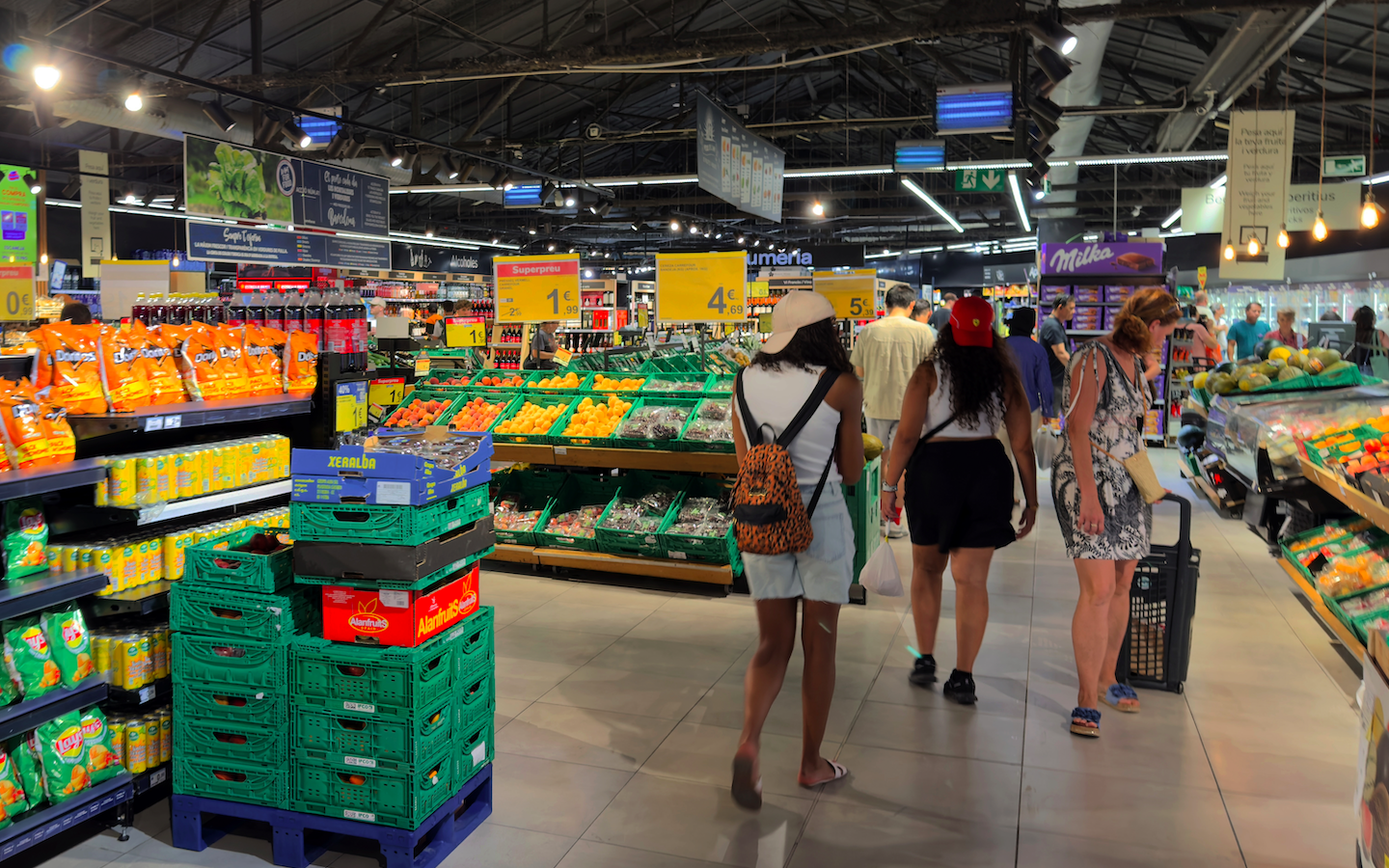
knowing which chains operate locally could make a difference. Photo credit: Massimo Todaro/Shutterstock
Your weekly supermarket shop could be costing you more than it needs to, and the cheaper alternative might be a chain you’ve never heard of. Across Spain, regional supermarkets are competing for customers, with some offering prices that compare favourably with the country’s biggest household names.
For shoppers trying to stretch their budgets, knowing which chains operate locally could make a difference. Some are concentrated in a handful of provinces, while others have expanded across several regions. The latest figures from consumer organisation OCU offer a useful starting point for finding out which are worth a closer look.
Deza: a cheaper option for shoppers in Córdoba
Deza is a family-run supermarket chain associated with Córdoba, making it a name to look out for if you live in the province. It is far from a nationwide operator, but its position in the OCU’s 2026 price comparison makes it worth considering for local shoppers.
The organisation estimates the annual cost of its standard shopping basket at €6,138.42. That places Deza among the more competitively priced chains in the study, although individual prices will vary depending on the products you buy and the branch you visit.
Cash Fresh: serving Andalucia and Extremadura
Cash Fresh, part of the Andalucian retail group Grupo MAS, is another option for shoppers in the south of Spain. Its stores operate across Andalucia and Extremadura, giving it a wider regional reach than some smaller chains.
OCU puts the annual cost of its comparison basket at €6,188.96. The figure provides a useful benchmark for comparing supermarket chains, particularly for households that regularly buy fresh produce and everyday groceries.
Alimerka: one to know in northern Spain
Shoppers in Asturias and neighbouring areas may already recognise Alimerka, but it is less familiar to people living elsewhere in Spain. The chain has a strong presence in Asturias, alongside stores in Castilla y León and Galicia.
Its estimated annual basket cost in the OCU study is €6,196.41. That is slightly higher than the figures recorded for Deza and Cash Fresh, but Alimerka remains a useful option to compare if you live within its operating area.
Tifer: worth checking in Castilla y León
Tifer is another regional name that deserves attention, particularly for shoppers in Castilla y León. The chain belongs to Semark AC Group, which also operates Lupa supermarkets.
Its annual basket cost is estimated at €5,930.73, putting it among the cheapest chains in the OCU comparison. That is a particularly competitive result for shoppers who have a Tifer branch nearby and want an alternative to the best-known national retailers.
Family Cash: a low-cost alternative in several regions
Family Cash is less obscure than some of the other chains on this list, but it remains an option that shoppers may overlook if they automatically head to their usual supermarket.
Founded in the Valencian Community, it operates large-format stores in several Spanish regions. OCU estimates the annual cost of its basket at €5,902.65, making it the second-cheapest chain in the 2026 ranking, behind the Andalusian chain Dani.
How much could you actually save?
OCU estimates that choosing the cheapest rather than the most expensive supermarket can make a difference of around €1,310 a year on average. Its 2026 study compared more than 100,000 prices across 690 establishments, assessing a standard basket of 244 food, hygiene and household products.
That does not mean every household will save the same amount. The result depends on where you shop, the products you buy and which stores are available nearby. Before making a special journey, compare the prices of your regular purchases and factor in any extra fuel costs. A cheaper supermarket is most useful when it fits into your normal routine, rather than adding another expense to the weekly shop. You can consult the OCU’s full 2026 supermarket price comparison to check the rankings and compare the options available in your area.

Large Data Centers In The US Already Consume As Much Energy As The Whole Of Chile

EL PAÍS Y La SER Organizan Un Debate Entre Candidatos Del País Vasco A Las Generales Del 29-N

Los Rivera Ordóñez, ¡vaya Par De Gemelos!


-

 New Developments2 weeks ago
Luxury Villas For Sale, Estepona – ProjectL1
-

 New Developments3 weeks ago
How To Get A Tourist Rental Licence In Andalusia (Spain) – Step-By-Step Guide 2025
-
Age Concern Marbella - San Pedro3 weeks ago
Halloween lunch sells out as 51 join Marbella get-together
-
Barcelona riots3 weeks ago
Looting and street violence hit Barcelona as El Corte Inglés customers are trapped
-

 %3 weeks ago
Spain Orders Replacement Of Eight Million Gas Meters: New Rules, Costs And Deadlines
-

 New Developments3 weeks ago
Inside The Most LUXURIOUS Apartment Building In Spain!
-
Gibraltar3 weeks ago
Proud to be British: HMS Queen Elizabeth opens its doors in Gibraltar
-
Costa del Sol3 weeks ago
Where are they? Expat questions local police presence