
galicia
WATCH: Remarkable Moment Strangers Form Human Chain To Rescue Woman Swept Out To Sea On Beach In Northern Spain

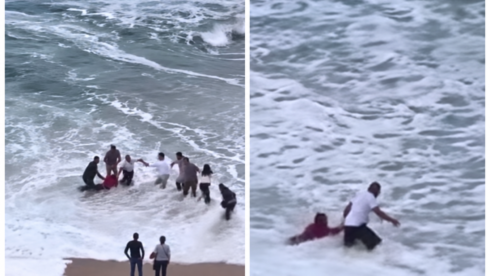
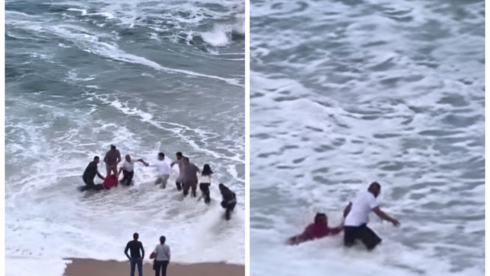 About ten people joined hands to pull the woman to safety after a wave dragged her away while she was reading.










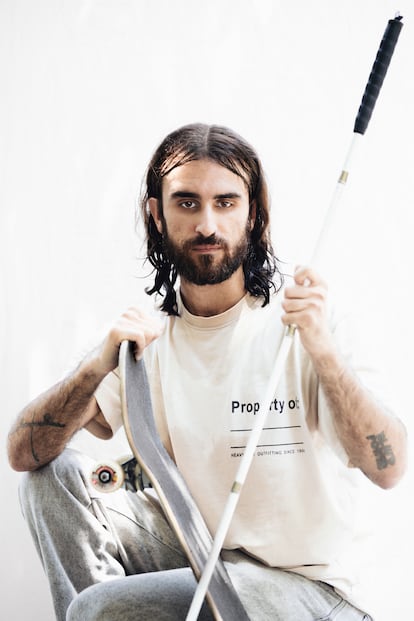
When Marcelo Lusardi went out to celebrate St. John’s Eve in the summer of 2016 with his skater friends in Spain’s northwestern region of Galicia, he never imagined how his life would soon change. While watching the bonfires on the beach, he realized something was clouding his vision, a kind of haze filling his right eye. In the weeks that followed the same thing happened to his left eye. Marcelo gradually went blind because of a rare disease, Leber’s hereditary optic neuropathy (LHON). He can see certain lights but, for practical purposes, he is blind. After 10 years, his story is considered one of the most inspiring in urban sports.
Lusardi, born 28 years ago in the capital of Argentina, Buenos Aires, has two major hobbies: skating and playing the electric guitar. As he was losing his sight, Marcelo would sometimes go down to the square with his instrument and a small Marshall amplifier. He wasn’t skating anymore. One day, already blind, a friend urged him to get back on the board for a spin. “I thought I was going to fall and that it was dangerous. But I agreed. And of course I fell,” he recalls as he does warm-ups before his skate session. He met us at the skatepark behind the regional parliament of Galicia in the city of Santiago de Compostela. He’s eager to finish soon so he can show two mates his new Telecaster guitar.
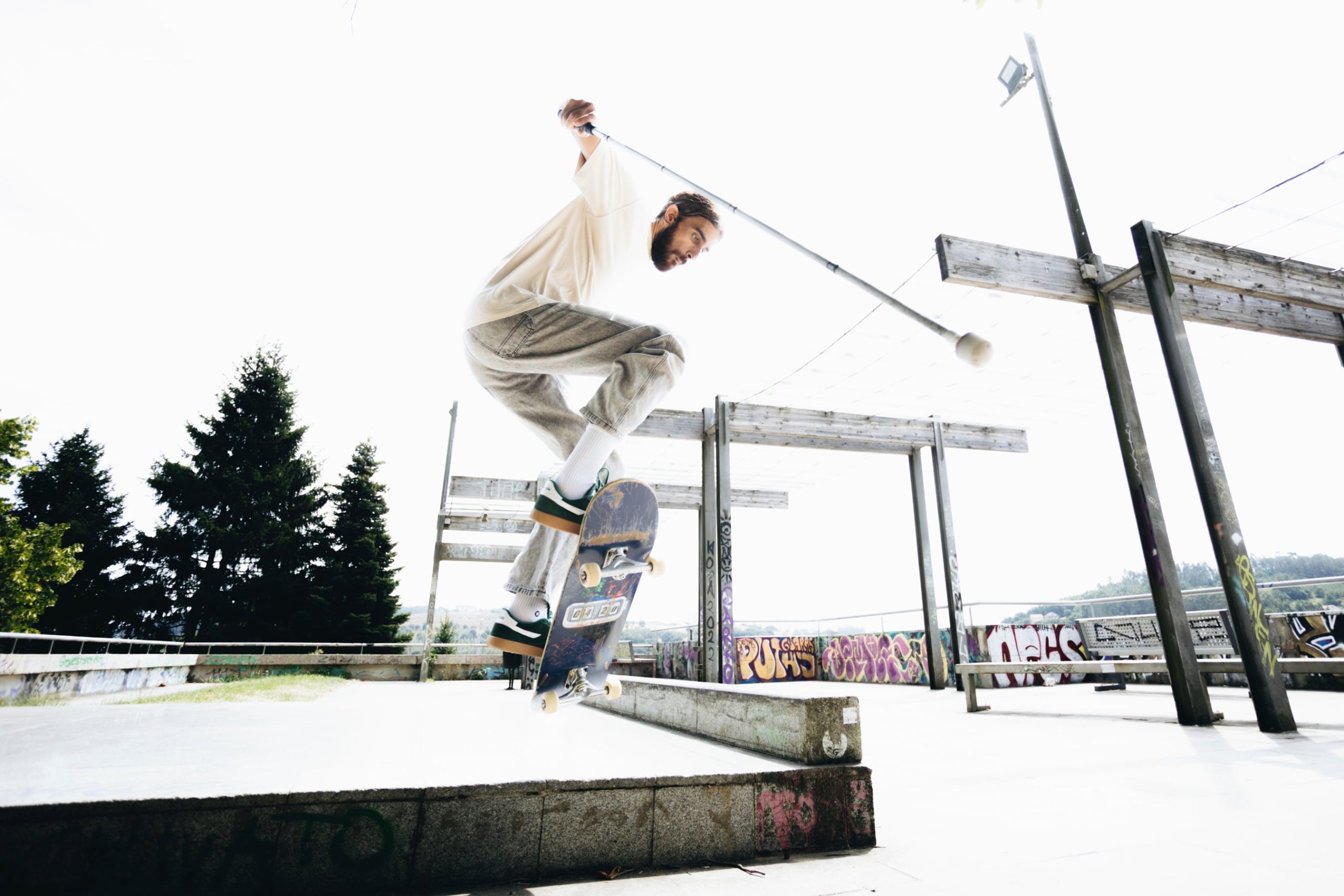
He returned to skating a few months after losing his sight. He’d skated since childhood but had to relearn almost from scratch. He mounts the board in the only viable way, with a cane in hand, and before attempting any trick he maps the spot with the cane’s wheel. “I never go alone to a new spot; always with someone who can see and warn me about things I might miss: curbs, handrails, changes in the surface… details I need to skate. I touch everything with the cane, with my feet, with my hands. I feel the material, the height of the curbs, the type of ground,” he explains. “Any information I can gather is useful to me.”
Eventually Lusardi threw himself off the top of a quarter pipe again, did flips, manuals and even jumped stairs. He began posting his feats on social media under the username The Blind Rider. One challenge he accomplished? “Getting back to doing an ollie to manual [jumping and landing on only the back wheels]. It’s something that’s very frightening when you’re blind and you can’t control well when you’re on the curb. It’s a sensation of flying without seeing,” he replies. “But it was also a challenge to learn Braille at 18.”
The surprise and admiration he provoked has translated into massive engagement. Someone very special shared his videos: the legend Tony Hawk, widely regarded as the greatest skater in history. “I really want to meet him someday and thank him from the bottom of my heart. When I saw it I almost cried, man,” he says.
Tattooed on his arm is his account logo: a skate and a white cane crossed to form an X. He now has more than 125,000 followers on Instagram. Many clothing and skate brands send him gear. He is an ambassador for the paraskate competition at O Marisquiño, the urban sports festival in Vigo that also hosts the World Cup Skateboarding event. It was a tough decision: “Ten years ago, when it all started, they had already asked me to participate as a solo exhibition. I’d been a fan of O Marisquiño since I was a kid and it intimidated me a lot. I advised them to hold an adapted skate competition, with people taking part with different disabilities, not just me there in the middle. They listened and I think it turned out really cool. I’ve been able to meet incredible people with very striking stories.” The competition offers the same prize money as the regular skate event.
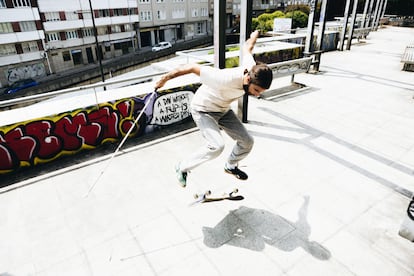
In the world of skateboarding there is a debate about whether it should be included in the Olympic Games. One argument against it is how hard it is to judge. Lusardi has clear ideas about it. “I would love to see paraskate included too. There would be bigger sponsors, of course, but also more role models. When something like this happens to you you don’t know who to look up to, what to do or how to handle it. The role models I had were incredible people skating with one leg, but no blind skaters. Greater exposure helps you see that many problems have solutions or can be managed,” he reflects.
Not all tricks are coming off today: some look good in photos taken just before he falls, but Lusardi insists on repeating them even after the shot is taken: “Out of skater pride I have to do them properly.” One thing making it difficult are pebbles: small stones he can’t see that suddenly slow his board. People in the square sweep them away to help. There’s a striking moment in each of Lusardi’s falls. Rather than lifting him or treating him paternalistically, his friends cheer him on to keep trying.
Lusardi is defined by self-sufficiency. He works during the week and lives independently. “What I struggled with the most was cooking with flames. It’s pretty intimidating, but I make lentils that are amazing,” he laughs. He is an example of someone who overcomes adversity. The media have always treated him as a story of personal triumph. Does he feel comfortable with that? “Yes and no. I feel more like a survivor than someone who has overcome things in an epic sense. For me it’s more ‘I survived adversity’ than anything else.”
“I came out of a very dark place and today I’m happy and I do what I like,” he says. Which fears has he beaten and which still beat him? “I’ve won in the sense that I know I’m capable of much more than I thought; I’ve been pushing the limit upward and I’ve proven things to myself I never imagined. What still intimidates me is that, at my level, what I have to attempt now is very risky.” One trick he wants to conquer is the flip off a stair set. “I feel like it’s going to be the trick of my life. It’s a battle I have pending with myself.”
Some people write to him because they find him inspiring and others even ask for photos. “There were moments when it felt very crazy. I was a normal kid, not outstanding at anything. Suddenly standing out at something was intense. What stressed me the most were the numbers: I felt the pressure to make the most of the moment, to push it because a lot of people were watching me,” he reflects. “I contribute to the message that people shouldn’t obsess over the limits they think they have. They aren’t as solid as we believe; many barriers can be broken. It gives me peace to know that what I do serves more than just me.”
He has always said he wouldn’t change his process. “I wish I could see again, obviously. But going blind has given me so much that, strange as it may sound, I wouldn’t change my past. It has given me another way of looking at the world, it has made me value what skate, music and the people close to me bring.” Asked about gene therapies or Neuralink, he is concise: “No way I’m putting a chip in my head.”
There comes a moment when Lusardi speaks solemnly: “I have a very strong feeling: since I surpassed myself, returned to skating and became happy again, I feel that if I had died at that moment I would have left this world in peace.” His story is that of someone who became an example without seeking it. He simply looked for a reason to get up every day. “I went blind at 18 and since then I am at peace with what I was dealt.”
He finishes the day drenched in sweat and with his list of tricks completed. He changes his T-shirt and puts on sunglasses. He grabs his phone quickly. Fer and Alex are waiting to play guitar.
Sign up for our weekly newsletter to get more English-language news coverage from EL PAÍS USA Edition

Alberto Núñez Feijóo
Feijóo Advierte Al PSOE De Que No Va A “indultar Corruptos” Si Gobierna: “Me Encargaré De Que Paguen Por Todo”


Is Now A Good Time To Sell Property In Spain?

Spanish Mortgage Demand Suffers Sharpest Decline In Three Years

Ozone Hole Bigger Than North America Hits A 10-Year High: What NASA Says Happens Next


-
DGT3 weeks ago
Viral video in Spain sparks fury over drivers who ‘have no idea how to drive’
-
Automated supermarket3 weeks ago
Spain’s 24-hour shop with no tills expands to Barcelona Airport
-

 Uncategorized4 weeks ago
Williams F1 driver caught up in four-car pit lane pileup
-
News4 weeks ago
Hundreds evacuated as huge fire erupts on Spain high-speed train route
-
Keeping cats and dogs outside3 weeks ago
Spain’s pet owners face fines of up to €200,000 for animal welfare offences
-
Council tax (IBI)3 weeks ago
Barcelona plans 150% property tax increase on tourist flats ahead of 2028 ban
-
airports3 weeks ago
Travelling between Spain and Italy? The extra border checks could soon end
-
 Uncategorized4 weeks ago
F1 just gave a new race a 10-year deal and fans HATE the track layout