
Donald Trump
Richard Dean Anderson, The Iconic MacGyver: ‘He Was Different, A TV Hero Who Didn’t Use Guns. He Would Think, Look And Solve The Problem’

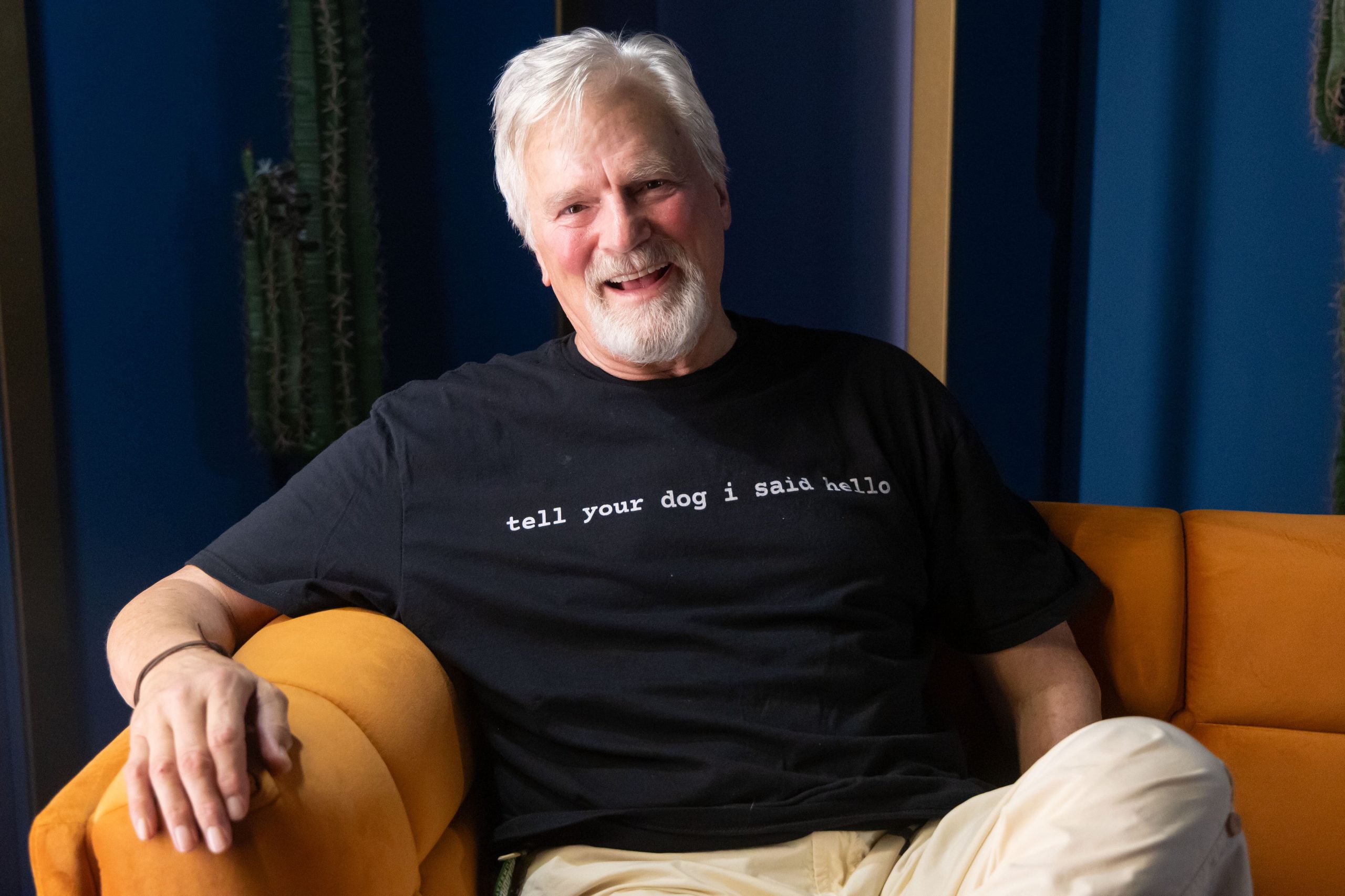
He had a solution for everything. There was no problem he couldn’t tackle. Whether it was forcing open a lock by melting ice, building a defibrillator out of two candlesticks and a microphone cable, making a bomb with a stick of chewing gum or defusing one with a paper clip. He could even stop a sulfuric acid leak with milk chocolate bars. As a popular Spanish saying inspired by the character goes: “You’re more dangerous than MacGyver in a hardware store.”
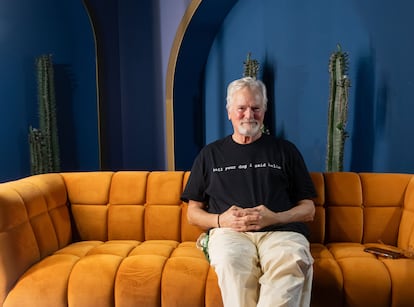
“I had no idea people said that in Spain. That’s fantastic,” says Richard Dean Anderson, the actor who brought the resourceful hero to life, bursting into laughter. Warm and engaging, the 76-year-old was one of the biggest nostalgia draws at last weekend’s San Diego Comic-Con Málaga. At the event in the Spanish city, he signed autographs, posed for photographs with fans and took part in an entertaining panel discussion. He also spoke with EL PAÍS.
“Meeting fans is wonderful. It’s the best part of all this,” says the U.S. actor, who appreciates the warmth of the public, if not the warmth of the weather. “I’m from Minnesota. I have thick blood. Yesterday [Friday] was really hot. It was terrible,” he says while figuring out how to use a handheld fan.
He adds: “We ran into a bit of chaos that didn’t seem to keep the fans in mind. I don’t know if they are getting what they came for. I suppose I could adjust and accept that’s the way it is here, but I think about the fans, the people who pay the money to come and meet me and get an autograph or whatever… It all feels a little casual.”
“Still, I don’t really have a social life where I live and it’s always nice to meet people,” says Anderson, who lives north of Malibu, California, and leads a lifestyle far removed from that of a typical superstar.
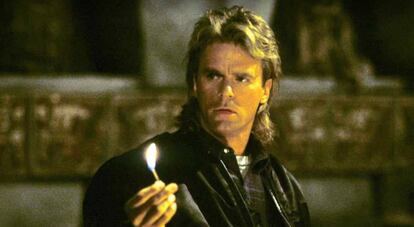
Anderson spends most of his time with his dogs and walking by the sea, away from television and the media. It’s a personal choice. After appearing in more than 600 episodes of the daytime drama General Hospital and becoming MacGyver, he later took on the role of Lt. O’Neill in Stargate, a character that further cemented his popularity in the United States. It also proved to be one of the last major chapters of his acting career.
The turning point came with the birth of his daughter, Wylie Anderson, 28 years ago. He says he quickly realized that nothing was worth spending time away from her as a newborn. “Now she writes, directs and produces. I try to help her however I can, even if that means getting out of the way,” he says.
His face may have disappeared from television screens, but at last weekend’s event in Spain, four decades later, it was one of the most recognizable thanks to the enormous success of MacGyver. Created by Lee David Zlotoff for ABC, the series aired on Spanish public broadcaster TVE between 1985 and 1992. Over the course of its seven seasons, it became a global phenomenon, drawing huge audiences and turning Anderson into an international star. He says he landed the role after asking to keep his glasses on during the audition so he could read his lines.
“The people in charge looked at each other and said: if he doesn’t mind being seen with glasses in a role like this, we’ve found our MacGyver,” he recalls.
The character also closely resembled the real-life Richard Dean Anderson. “The writers put in things that I was interested in, which included the environment, animal rights, anti-gun [measures]. And then there’s a certain part of living as a human being, like I ski, played hockey, and did all those jocular things,” he says.
“MacGyver was different: a TV hero who didn’t use guns. He would think, look and solve the problems without killing somebody, without shooting them,” he explains. “That allowed parents and children to watch the show together. And that’s what I feel most proud of and happy about: those relationships, especially between daughters and dads. I think that combination made the series memorable to a broader audience than normal.”
His role was that of a superhero who, instead of a cape and powers, always had pliers within reach. He was an ordinary person who saved lives, rescued people, and solved conflicts using science, never guns. “I don’t think there are enough people in the world who are intrigued or humbled by science on television today. Because you really have to watch, listen and observe. Whereas a sitcom or a regular drama, you can just hear,” says Anderson.
The actor says he helped devise many of the ingenious fixes his character used to get out of trouble. “We had collaborators — advisers from technical schools and universities near Los Angeles. They told us how something could be solved with what was in the room, and others contributed too. It was a collective effort,” he remembers before pausing to consider whether MacGyver would have used artificial intelligence if it had been available to him.
“He’s more of a practical solver of problems, more physical,“ he says. ”He uses his science mind to see angles or possibilities of what is real, what is right here and now. I don’t know enough about AI, but it’s a little frightening because it appears to me that it takes away the human element. It becomes automatic; it solves. I like the human mind and the way it works now. I understand that AI is not going to let us decide. It’s going to dictate. That scares me. But MacGyver and AI? Maybe he’d just be intrigued, like: how could I use this?”
MacGyver and the Basques
With Anderson visiting Spain, it was impossible not to bring up something rather more peculiar: a first-season episode in which Angus MacGyver travels to the Pyrenees to go undercover, disguising himself with little more than a towel, among a group of “Basque mountain fighters who have been at war with France and Spain since time immemorial,” as the show’s narrator puts it.
The group — whose members wear txapelas and use pelota baskets to hurl grenades — look less like Basque separatists than an unlikely cross between highwaymen and Sicilian gangsters. In the episode, which later went viral on YouTube in Spain, the hero must rescue a geologist whom her captors mistakenly believe to be a physicist and whom, MacGyver suspects, they intend to use to help build an atomic bomb.
“It was so long ago that I don’t remember it,” says Anderson. He has much clearer memories, however, of past holidays in Barcelona and Ibiza, and admits he arrived in Málaga a couple of days early in order to explore the city. “The beach, its castle, it’s incredible,” he says.
During a panel on Saturday afternoon at the San Diego Comic-Con Málaga, Anderson took it upon himself, without being prompted, to describe U.S. President Donald Trump as “a piece of shit.” “Yes, he’s a piece of shit,” he said.
In his later conversation with EL PAÍS, he reiterated the point. “I dislike very much what he is. I don’t like his behavior, his policies, his ego. He’s a negative man. I just don’t respect him, which is the worst thing I can say about a human being. I don’t respect him at all. But it’s one man’s opinion,” he said.
Strong words from the man who played MacGyver, and they came just days after he found himself in a scene few would ever have imagined: posing for a photograph with the cast of Los Serrano, one of Spain’s most beloved television series. What a crossover that would have been.
Sign up for our weekly newsletter to get more English-language news coverage from EL PAÍS USA Edition







Arnold Schwarzenegger
The Electoral Cost Of Trump’s Remarks That Iran Could ‘take Out’ LA Or San Diego

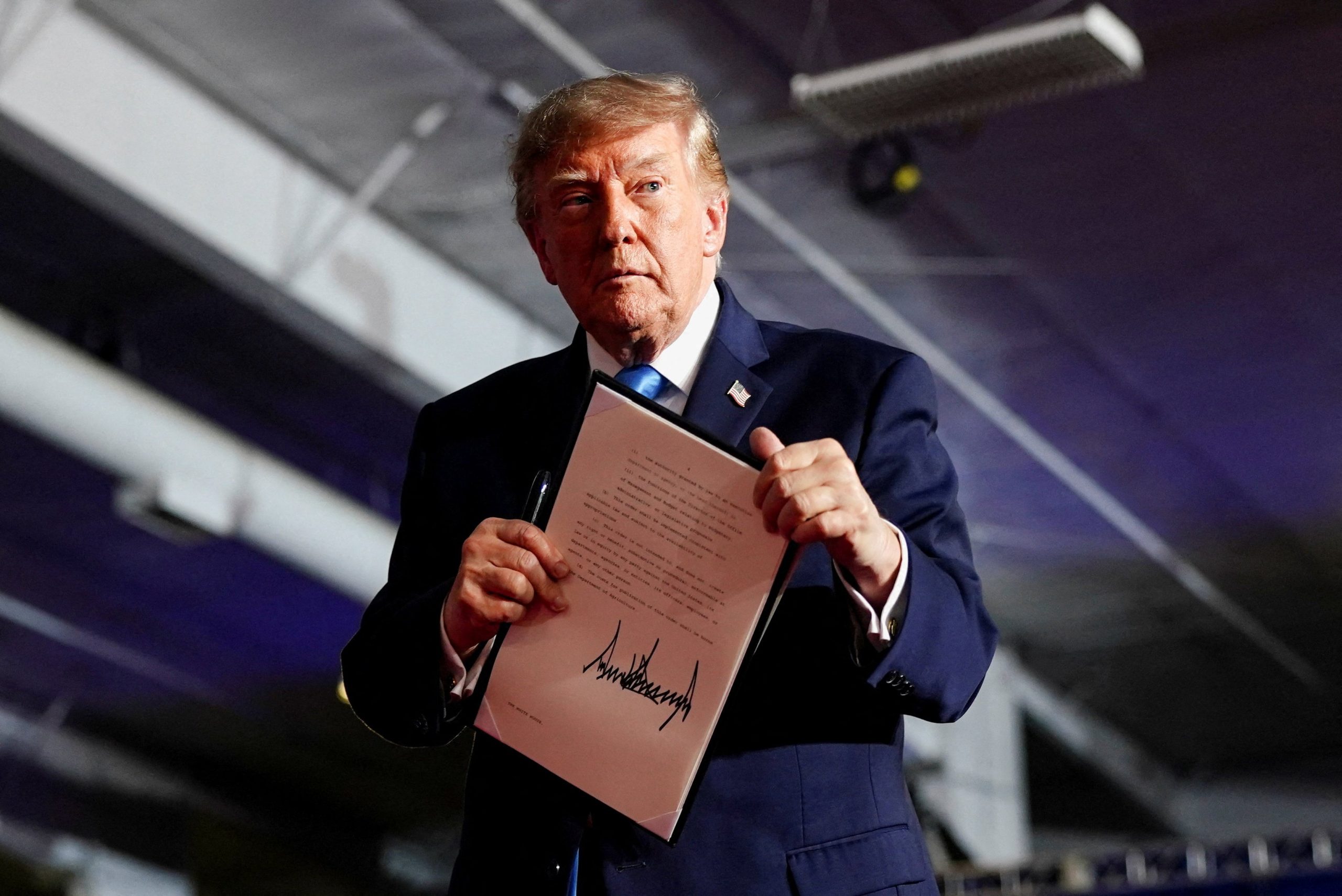
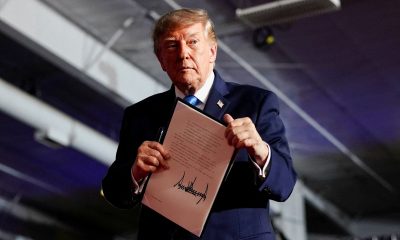
President Donald Trump said it without weighing the possible electoral consequences for Republican candidates in California, less than a month before the midterm elections. Far from generating laughter or support for his war with Iran, his comments have raised concern and could affect the vote in a state governed by Democrats since 2011. During a rally in Nebraska on Monday, the president said Iran could “take out” Los Angeles or San Diego, two of the largest cities in the United States, calling it a “small price” to pay to eliminate what he says is the threat posed by the Iranian regime.
As part of his campaign tour across the country to support Republican candidates —generally in places where a Republican victory is more likely, since in tighter races Trump could be more a liability than a boost— the president moved awkwardly from urging turnout in the midterms on November 3 to talking about war with Iran and the “small price” it represents “to keep the world safe.”
Polls show it will be difficult for Republicans to hold narrow control of both chambers of Congress, and Trump’s Nebraska speech seems unlikely to help them. “They could take out a city. Let them take — Let them take out Los Angeles. Let them take out San Diego. That’s — this is a very small price to pay, and it’s going to be over with very soon. It’s essentially almost over with,” Trump said of a war that has stretched for more than seven months without any clear signs of ending.
There is a fairly recent precedent for the threat Iran could pose to California. In March, Californians were alarmed after a report from the Federal Bureau of Investigation warned that the Iranian regime might be planning drone attacks against the state in retaliation for U.S. military actions on its territory. Both the federal government and Governor Gavin Newsom then said there was no imminent threat to California.
Trump’s recent remarks also appeared framed by rising oil prices and, consequently, higher gasoline and other fuel costs in the United States, driven by the conflict in a region crucial to crude transport. That “small price” Californians are paying, in particular, is actually very high: this week a gallon of gasoline sold for $6.37 —and in some places even $9— about 46% above the national average, according to AAA. The difficult economic situation, with the cost of living, health insurance and housing at the forefront, is voters’ top concern, according to various polls.
Ballots began arriving this week in the mailboxes of thousands of Californians.
“It complicates their campaigns”
Miguel Tinker Salas, professor emeritus of History and Chicano Studies at Pomona College east of Los Angeles, says Trump’s comments could have consequences for Republican candidates in California before the polls close. “It complicates their campaigns; it makes the political landscape harder for them,” the professor says.
In California, Republican hopefuls are running for governor, the state attorney general’s office and other key positions, as well as seats in the House of Representatives. For many of them it is an uphill race in a Democratic stronghold, and even more so after the recent redistricting pushed by Governor Gavin Newsom to favor his party’s contenders, part of a nationwide battle. In that context, Tinker Salas believes Trump’s Nebraska remarks will end up hurting his own candidates.
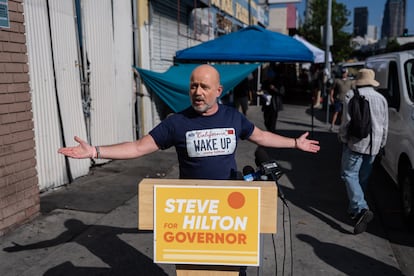
One of those most affected may be Steve Hilton, a British-born former political strategist for David Cameron’s Conservative Party before Brexit who became a conservative commentator on Fox News, and is now the Republican candidate for governor. So far, Hilton has not commented on the controversy. Since Arnold Schwarzenegger left office after two consecutive terms from 2003 to 2011, no other Republican has won that post.
“California hasn’t elected a Republican in many years. There was an opening with Hilton, in a way, because he was not only the opposition candidate but the anti-establishment opponent who had committed many failures. But as the campaign has unfolded he has lost support, and his closeness to Trump increases that loss,” Tinker Salas said.
Trump is very present in the race. He has officially endorsed Hilton, and a network of donors aligned with the president, from various parts of the country, continues to funnel resources into his campaign. The president’s strategy is not limited to the governorship: at the Republican convention ahead of the midterms he even said people should vote as if his name were on the ballot and promised a $5,000 payment to all American adults if his party retains control of the House of Representatives.
Hilton’s disadvantage
Hilton has fallen behind in the polls. One of the most recent surveys, conducted by the Institute of Governmental Studies at the University of California, Berkeley, shows the Democratic candidate, Xavier Becerra, has increased his lead: 58% of respondents said they would vote for him, compared with 33% who favored the Republican. The gap widened by seven percentage points from the previous measurement.
In that same poll, about 44% said their main concern was “reducing the cost of living,” while 37% identified “fighting the policies of the Trump administration” as their priority. Not even polls commissioned by Hilton’s campaign work in his favor. The latest, published this week, puts Becerra six points ahead: 45.7% to Hilton’s 40.1%.
Becerra has joined Democratic leaders —including Los Angeles Mayor Karen Bass and San Diego Mayor Todd Gloria— in criticizing Trump’s remarks. “Thirteen million Californians call LA and San Diego counties home. Their lives are not a ‘small price to pay’ or a punchline for Donald Trump,” he wrote Monday night on his X account. Responses to the post were divided.
Thirteen million Californians call LA and San Diego counties home. Their lives are not a “small price to pay” or a punchline for Donald Trump. https://t.co/TG23f6b5XF
— Xavier Becerra (@XavierBecerra) October 6, 2026
Some users commented under the post that California Republicans who once voted for Trump may now be “disappointed.” Others downplayed the president’s words, calling them a “joke,” and argued that a doctored video of the Nebraska rally was being spread. The latter reflects voters’ sometimes selective distrust of what they see on social media.
The president’s remarks also drew no laughter from Governor Gavin Newsom, one of the Democrats who most often confronts him and who is about to leave office after two consecutive terms, and is being discussed as a possible presidential candidate in 2028. Newsom called the president “deranged and dangerous” and said he had even ordered the State Threat Assessment Center to actively monitor the situation “in case foreign actors interpret the president’s remarks as an invitation to attack California.”
Professor Tinker Salas was also troubled by the crowd’s reaction during Trump’s rally. After the president said Iran “could take out a city,” some attendees responded with a “yesss.” Others applauded when he added that the targets could be Los Angeles or San Diego.
“It reflects a cynical attitude, it reflects information manipulation. But what is most worrying is how the message was received by the people behind Trump,” the professor says. “You can expect any foolishness from Trump, but people applauded. We are in a critical situation regarding the social fabric of this country.”
Reported by Patricia Vélez Santiago.
Sign up for our weekly newsletter to get more English-language news coverage from EL PAÍS USA Edition
Abelardo de la Espriella
US Moves Spy Drones From Africa To Colombia And Ecuador To Combat Drug Trafficking


Comunidad Lgtbiq
Sarah Schulman, Escritora: “Los Agresores Se Presentan Ahora A Sí Mismos Como Víctimas”

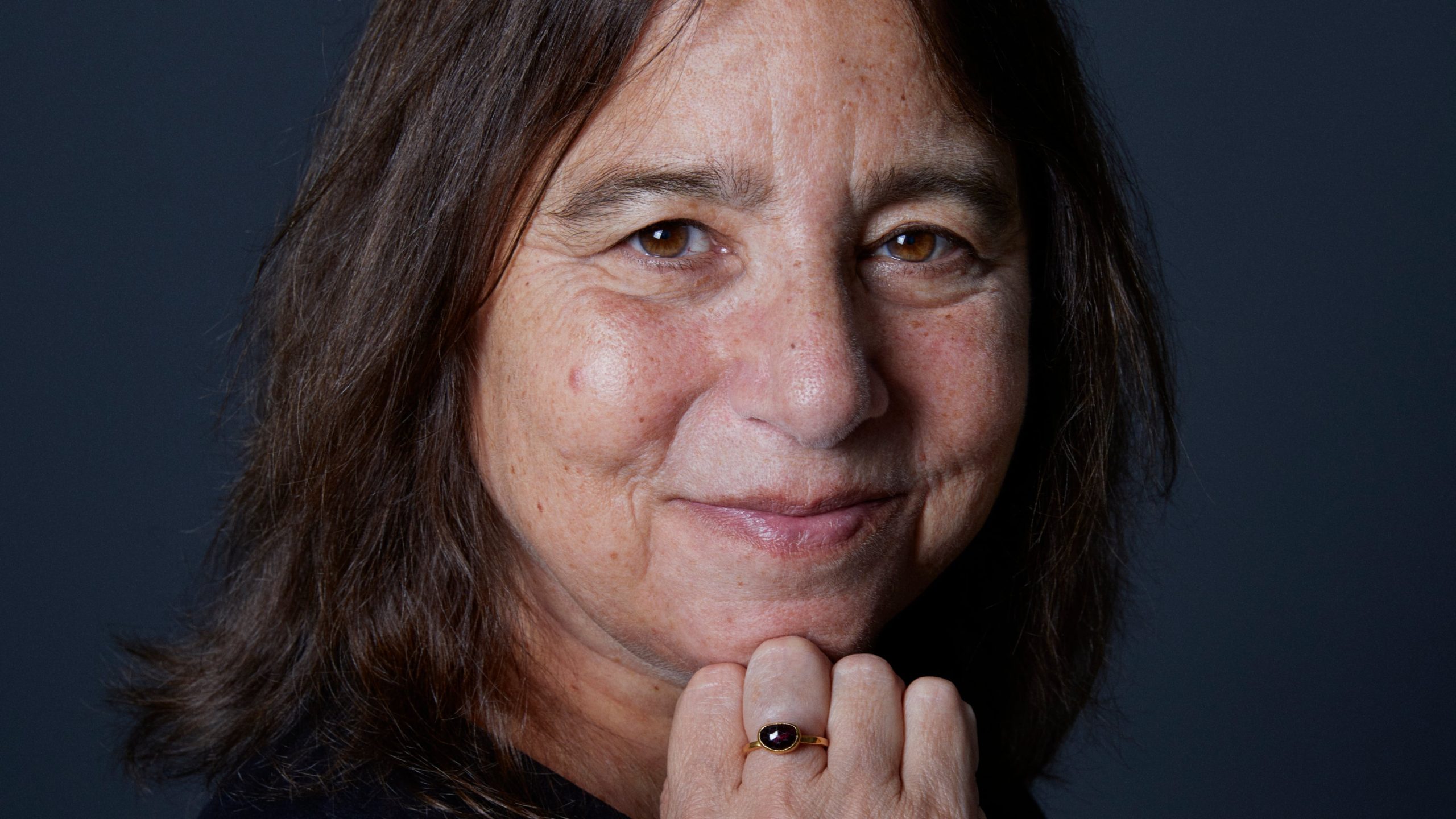
Maricarmen Abascal, eviction symbol, dies at 87 days after being promised a return home
Russia plague fears grow as WHO demands answers over second worker with pneumonia

Última Hora De Las Elecciones Generales, En Directo | La Acampada De Sol Guarda Un Minuto De Silencio Por Maricarmen


-

 Uncategorized2 weeks ago
F1 Qualifying Today: Azerbaijan Grand Prix schedule, times and TV channel
-

 %2 weeks ago
Is Your Supermarket Kefir Really Kefir? Spanish Study Raises A Surprising Question
-

 Uncategorized1 week ago
F1 Bahrain Grand Prix will be live and FREE on TV this weekend
-
Latest2 weeks ago
‘It’s The Law Of The Jungle’: Pensioner’s Eviction Exposes Spain’s Housing Crisis
-
Barter system2 weeks ago
British drug dealer swaps cocaine for Pokémon cards in bizarre barter deal
-
 Cody Gakpo2 weeks ago
Xavi Y Klopp Se Reparten Puntos En Su Debut Como Seleccionadores
-

 ElPais2 weeks ago
Gael García Bernal: ‘The Common Good Is No Longer A Political Slogan. Democracy And The Use Of Power Are Almost Like A Reality Show’
-
Aberdeen airport2 weeks ago
easyJet announces six new UK-Spain flights for 2027, with fares from £35