On the way back home, Jonathan Meléndez began to feel nervous. He called home and nobody answered. Uneasy, he called the security booth at the housing complex where he lived, and asked them to buzz the apartment through the intercom to see if anyone picked up. On his phone he opened the app that gave access to his Alexa, a smart-home device that allowed him to view the camera feed, speak through his phone and have his voice play on the device’s speaker… But there was nothing. It was after 7 pm. The friend riding with Meléndez in the car says he became concerned by then. Something happened in the following minutes, something Jonathan saw on the Alexa footage, or perhaps someone finally answered the phone, because at 7.20 pm he called the building security supervisor and asked him to call the police: “He told me his business partner was armed.”
The partner in question, Diego Sebastián, had arrived at the family home at 5.23 pm. The unit is a two-story penthouse in a residential complex building in Atizapán, north of Mexico City. The guards at the gate knew the partner because he had visited Meléndez and his family on several occasions. Even so, the guard on duty wrote down his personal information and called the apartment to alert the owners about the presence of the visitor. The guard says that “the resident, named Ana Paula” allowed Sebastián to enter. However, Ana Paula González, Meléndez’s wife and four months pregnant, was not there. She arrived 19 minutes later with her two children, ages three and five. Only Aleyda Romero, the 21-year-old woman who helped them with household work and took care of the kids, was home at the time. The visitor went in.
The next 140 minutes contain one of the greatest horrors Mexico has suffered in recent times: the massacre of the Meléndez González family and their employee. The only survivor was the eldest son, aged five.
At some point that afternoon on September 1, the business partner, Diego Sebastián N, now arrested and facing charges, shot Ana Paula in the head, killed their three-year-old daughter, shot the nanny, later killed Meléndez himself, and finally shot one of the dogs. It is unclear exactly how it happened, in what order, or why both women and the child were targeted—all questions that have fuelled the family’s torment. From statements by witnesses, relatives and acquaintances that are part of the investigation and that EL PAÍS reviewed, it emerges that it all began with an attempted robbery by Diego Sebastián against Meléndez—an attempt to get hold of his cryptocurrency wallet.
One other detail: the attack began after 6.25 pm. At that time, Aleyda Romero went down to walk two of the family’s small dogs. The walk lasted 38 minutes. At 7.03 pm the 21-year-old, who worked there Tuesday through Friday, returned to the house with the animals. There is no record in the judicial file that Aleyda was aware anything was wrong. She did not say anything to the guard at the gate, nor did she call her father or mother by phone, judging by the statements they later gave to authorities. The young woman returned with the dogs, took the building elevator, went up four floors, arrived at the brown door, opened it and went in…
A case of “disturbance of the peace”
It was a routine alert, something apparently minor—a case of “disturbance of the peace” in a gated community. The Atizapán police officer heard the call over the radio and headed there. He was nearby; he only had to cross the La Venta–Lechería highway and he would arrive. At that time, 8.20 pm, it would not take him more than 15 minutes. When he arrived, the security supervisor let him in. Both went up to the apartment in question, the penthouse in building four. The officer knocked on the brown door several times, but no one answered. There was not a sound, not even the dogs barking—a fact the supervisor would later recall when he testified to the prosecutor’s office. “It was known that inside that penthouse there were dogs, and they were noisy,” he would say.
But no noise came from the apartment because everyone inside was dead. Everyone except a five-year-old boy who ignored the knocks—a child who at that moment was sitting among the bodies of his sister, his nanny, his father, his mother and one of the dogs. He ignored the calls, or maybe he did not hear them: two days later his grandmother told an officer of the Prosecutor’s Office that the boy was still in shock and that the only thing he said was that it had been “Sebas the bad guy.” If two days later the child was in shock, it is reasonable to think he was in shock that afternoon as well. That is why he did not open the door—or out of fear that it might be “Sebas the bad guy”—and the officer, unaware of his presence, thought it best to leave.
The officer did not have much additional information about what had happened in the apartment, according to the report he would file hours later with the Prosecutor’s Office, a document that forms part of the case file. The person who might have had some idea was the building’s security supervisor, who, at least one hour and ten minutes earlier, at 7.20 pm, had received a call from one of the future victims—an alarmed Jonathan Meléndez—asking him to call the municipal police because his business partner was inside his house carrying weapons. At 7.20 pm Meléndez, a popular musician on the national indie scene and keyboardist for the band Camilo Séptimo, was on his way home with his friend after playing a game of padel. But the supervisor did not tell the police officer, or if he did, the officer took no notice.
It is strange to think of those two and all the things they supposedly did not say to one another. Because by then Diego Sebastián had already left. At the security booth, the guard, who answered to the supervisor, had seen him leave. In fact, Diego Sebastián had threatened the woman with his gun, pushing her to raise the exit barrier. “Come on, you bitch, open the barrier, I have to go!” she says the alleged killer shouted. Moreover, according to statements EL PAÍS reviewed, the friend from the padel game was beside her at that moment. The alleged killer, who knew him, also shouted at him: “You, fucking little dark guy, if you even think about saying you saw me, I’ll kill you like your fucking friends!” according to the file EL PAÍS accessed. It is odd that the guard did not tell her supervisor any of this, and that the supervisor, who an hour earlier had received Meléndez’s call asking him to call the police, did not tell the police officer anything.
The friend
That September 1, “we were out in the street most of the day,” says the padel friend. He went to the penthouse in the morning, left with Meléndez for breakfast, they came back, attended a meeting in the Polanco neighborhood in the capital. “At all times I noticed Jonathan was unsettled, like he was distracted,” he adds. They had known each other for four years, and they spent a lot of time together. They had met at a Camilo Séptimo concert. Jonathan (Honas to his friends) had asked him to work closely with him. The friend began to help with a few songs. Later he met his wife and his children… Many times, he said in his statement, he would stay overnight to keep working.
The two ate together that day at the house. In the afternoon they set off for a game of padel. If Honas felt any particular worry about his business dealings with Diego Sebastián, he did not say so. Or at least the friend did not tell authorities. A relative would later say that for a month Meléndez had been having problems with Diego Sebastián, an Argentine by birth and naturalized Mexican. “Diego Sebastián asked him for a loan of 300,000 pesos, but he refused to lend it. It was from that time that the problems with this person began,” the relative says. The relative adds that the two had met six months earlier and that they had a business project together. Diego Sebastián rented luxury homes, Honas did the advertising and in return got discounts on some rentals.
The relative also says Meléndez told his partner about an investment in cryptocurrencies he had made years earlier, though he did not provide further details. It is not known how much Diego Sebastián knew about cryptocurrencies, whether he knew where Honas stored his account keys, or how much money was involved. The relative testified that Honas’s initial investment had been three million pesos, according to what he was told, but that he did not know how much it was worth now. He also said the victim kept his keys on a black USB flash drive. He added that when he and other relatives entered the house after the murders to take the victims’ identification to the Prosecutor’s Office, the USB drive was nowhere to be found.
While they were playing padel, the friend received a message from Meléndez’s wife. It was 5.54 pm. She said Diego Sebastián was at the house and had been waiting for some time, and that she was texting the friend because her husband was not seeing his messages. The friend told Honas and he immediately called his partner. He said he was playing padel, but Diego Sebastián told him he was waiting. It is unlikely Meléndez felt extreme alarm over that exchange. Otherwise he would have returned to the house immediately. Or perhaps he did feel it but kept it to himself so as not to seem paranoid. Or maybe the exertion on the court released a torrent of endorphins that kept worry at bay for a while. In any case, the match lasted another hour and the two friends did not leave until 7 pm.
But on the way back all the good feelings vanished quickly. At 7.28 pm they pulled into the housing premises, drove to the building’s parking lot and Meléndez dashed for the elevator. The friend followed—he wanted to go up with him; after all, Honas already knew in some way that his partner was armed, as he had told the supervisor about it. But Meléndez stopped him. “He told me, ‘wait for me down here; if I don’t answer, ask for help,’” the friend explains. “When I messaged him and he didn’t respond, I decided to ask for help at the security booth,” he adds. According to the guard, the friend arrived at the booth around 7.38 pm. The guard called the supervisor and the property manager. While they were doing that, Diego Sebastián’s vehicle arrived at the booth and he stuck his torso out the window, shouting, holding a pistol in his hands.
The battering ram
The police officer saw Honas’s friend in the parking lot after 8.30 pm when he came down from the Meléndez apartment after his unsuccessful knocks at the door. Seventy minutes had passed since the first call to the police, 62 since his friend had gone up to the penthouse, 52 since he had gone to the security booth, 50 since Diego Sebastián had fled in a gray Kia, and just over ten since the first policeman had arrived. The friend told him, word for word, what had happened. The officer then decided they should go back up. He knocked on the door again, but nothing. The friend insisted: they were a family with two small children and several dogs—three at least—so it was impossible that no noise was coming from inside.
The officer agreed it was strange. But he did not have tools to open the door, so he called for backup. At 9.15 pm a second officer arrived equipped with a metal battering ram. Within seconds they forced the lock and entered. The officers asked the friend to wait outside. Then they saw the horror. First they found a dog—a golden retriever—dead on the floor of the bathroom by the entrance. It had a gunshot wound to the head and its muzzle had been tied with gray industrial tape. The officers moved on. There was a living room with some musical instruments and beyond that the dining room and kitchen. On the other side of the kitchen there was a laundry area and next to it a service room. The officers entered and saw a woman on the bed, face down, hands tied behind her back, a gunshot wound to the head and her mouth taped. It was Aleyda Romero.
The officers continued and went upstairs. As they climbed the stairs they saw red stains on the floor and steps. Forensics later confirmed nine meters of footsteps—specifically, barefoot tracks coming from the dining room and kitchen. On the wall by the staircase, 87 centimeters above the floor, officers saw a hand-shaped bloodstain—or part of a palm. Forensics later certified it measured ten by seven centimeters. Upstairs there was a sitting room and three bedrooms. The officers did not find any trace of the other dogs, or they omitted mentioning them in their reports. In the master bedroom, up on the right, they found Honas Meléndez’s body on a brown sofa. Like Aleyda, his mouth was taped, his hands tied behind his back and his feet bound.
Finally, the officers went to the bathroom. In the shower they found the bodies of Ana Paula and her daughter, the mother barefoot, seated and leaning against the wall. The killer had bound her neck with tape, as well as her right arm and her feet, which had also been secured with a white cable tie. The little girl was kneeling on top of her mother, lying across her lap, wearing her princess shirt. Both had a gunshot wound to the head. When they left there, the officers entered the opposite room and saw a boy slightly older than the little girl they had found in the bathroom. “At first glance,” one of the officers later wrote in the report he filed with the Prosecutor’s Office, “he showed no visible injury.”
The car’s plates
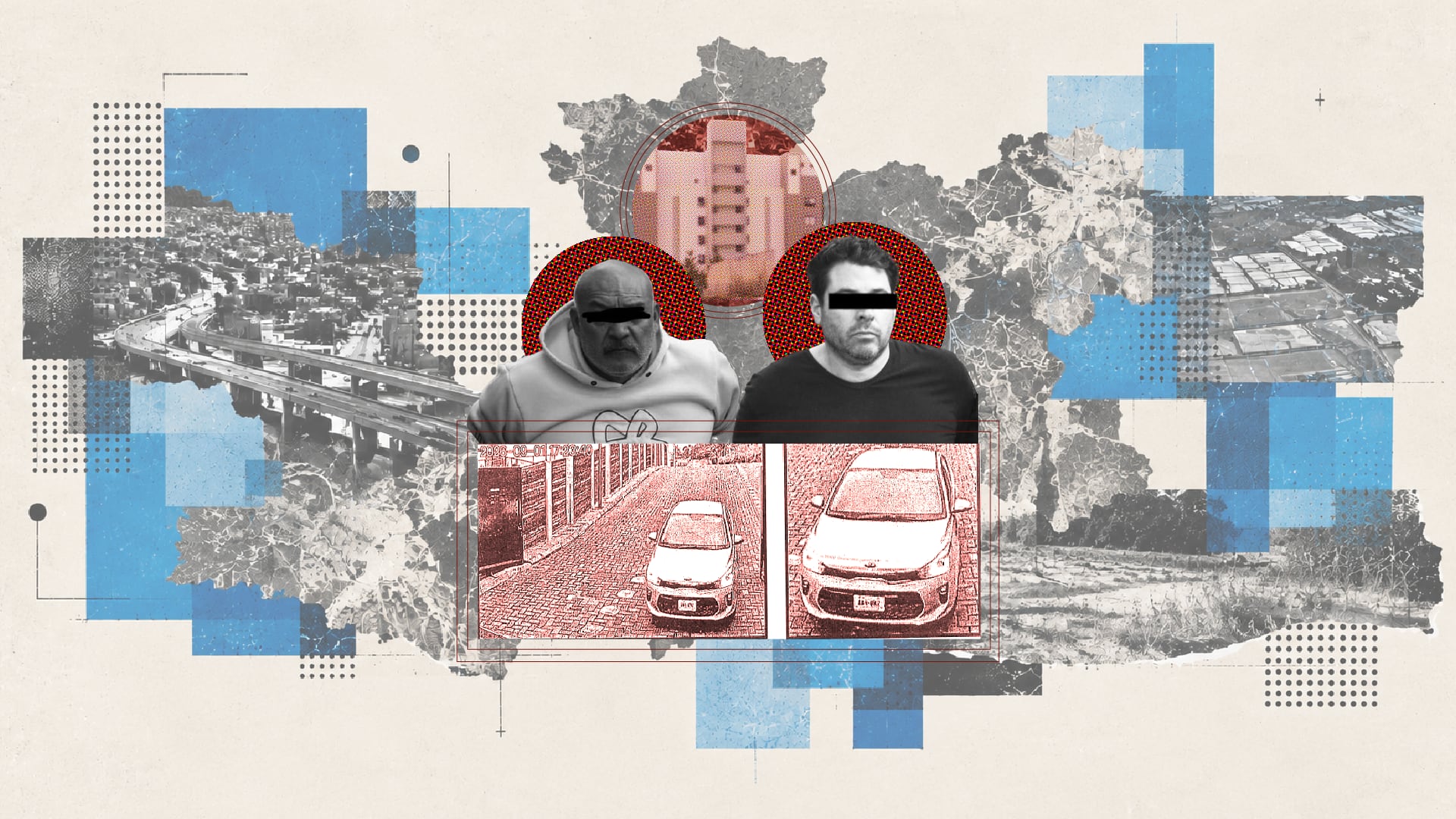
Ten hours after that, the authorities found the car in which Diego Sebastián had fled with his driver, Gerardo N. Investigators already knew then that the plates on the vehicle belonged to another car. Someone had stolen them from a car on August 29 in the Benito Juárez borough of Mexico City, very near, incidentally, to where Diego Sebastián lived in the Del Valle neighborhood. That fact made two things clear. One, that Diego Sebastián had decided to kill the Meléndez family—or at least Honas—days earlier. And two, that the driver, Gerardo N, owner of the Kia, knew that the visit to the Meléndez family was anything but friendly.
The car was found at the intersection of Bosque de los Cipreses and Avenida Bosques del Estado de México, in the municipality of Tecámac, on the other side of the metropolitan area of the capital, shortly before 8 am on September 2. Gerardo N lived near there, as an investigator confirmed when he asked neighbors. “He’s an Uber or Didi driver,” they told him. Diego Sebastián was captured soon after in a forested area known as La Marquesa. After separating from Gerardo N, he had gone to fetch a white BMW X1, apparently belonging to his sister. With that car he headed into the woods. That is where his flight ended.
Sign up for our weekly newsletter to get more English-language news coverage from EL PAÍS USA Edition


















 Uncategorized2 weeks ago
 %2 weeks ago
 Costra del Sol2 weeks ago