
Latest
The Experts’ Tips For Staying Safe While Hiking In Spain’s Mountains


Conor Faulkner – conor.faulkner@thelocal.com
Published: 8 Jun, 2026 CET. Updated: Mon 8 Jun 2026 15:49 CET

After the death of two foreign hikers in Spain in recent weeks, we go over some of the rescue workers’ advice for planning a hiking trip in Spain, from the emergency numbers to have on your phone to the gear you should carry with you.
Please sign up or log in to continue reading
More
Comments
See Also

Armas blancas
Seis Personas Apuñaladas En La Principal Estación De Tren De Nueva York Horas Antes De La Visita De Trump

Seis personas fueron apuñaladas en Penn Station, la principal estación ferroviaria interurbana y la más transitada de Nueva York. El ataque se produjo el domingo después de las 19.00 hora local (1.00 en la España peninsular) entre la calle 33 y la Séptima Avenida, según informó el Departamento de Bomberos de Nueva York a los medios locales. El suceso ha ocurrido en un momento en el que la ciudad se encuentra en máxima alerta de seguridad por la visita prevista este lunes del presidente de Estados Unidos, Donald Trump, por el tercer partido de las Finales de la NBA y el comienzo del Mundial de Fútbol.
Cinco de las seis víctimas han sido trasladadas al hospital Bellevue. Una de ellas sufrió heridas graves, otras dos heridas moderadas y las dos restantes, leves. La sexta víctima está ingresada en el Hospital Presbiteriano de Nueva York, según los servicios de emergencia de la ciudad.
El sospechoso fue detenido por la policía en el lugar, pero las autoridades aún no han difundido su identidad ni han confirmado el posible motivo. El interventor de la ciudad, Mark Levin, sugirió que el agresor podría haber sufrido una crisis de salud mental. Y añadió que este incidente plantea interrogantes sobre la red sanitaria psiquiátrica de la ciudad. La investigación, sin embargo, sigue abierta.
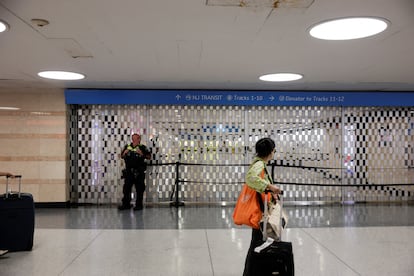
El incidente se produjo horas después de la noticia de la cancelación de la fiesta oficial de visionado del tercer partido de las finales de la NBA, en el Madison Square Garden, que estaba programada para este lunes. El partido enfrentará a los Knicks de Nueva York contra los Spurs de San Antonio. La razón fue el incremento de las medidas de seguridad por la asistencia prevista de Trump y del alcalde de Nueva York, Zohran Mamdani. “Mi corazón está con todos los heridos, sus seres queridos y todos aquellos que se han visto conmocionados por esta violencia inaceptable”, dijo el alcalde en redes sociales. “Deseo a cada una de las víctimas una recuperación plena y pronta”, añadió.
I’ve been briefed on the horrific stabbing at Penn Station. Based on the information available right now, six people were stabbed and the alleged perpetrator is in custody following a swift response from the Amtrak Police Department.
My heart is with everyone who was injured,…
— Mayor Zohran Kwame Mamdani (@NYCMayor) June 8, 2026
La comisaria de policía de la ciudad, Jessica S. Tisch, había advertido recientemente sobre la enorme carga de trabajo que afronta el cuerpo, no solo por la fase decisiva de la NBA, sino por la inminente llegada del Mundial de Fútbol de la FIFA.
Los partidos del torneo de fútbol, que arrancarán el próximo 13 de junio en el vecino Estado de Nueva Jersey, convertirán a Nueva York en la base de operaciones de miles de aficionados internacionales.
La seguridad en el Mundial en Estados Unidos recobró trascendencia internacional este fin de semana, tras reportarse que nueve personas resultaron heridas en un tiroteo cerca de la base de la selección inglesa de fútbol en Kansas City el sábado.
Congreso Diputados
In Address To Spanish Parliament, Pope Leo Warns Against Global Polarization And Migrant Discrimination

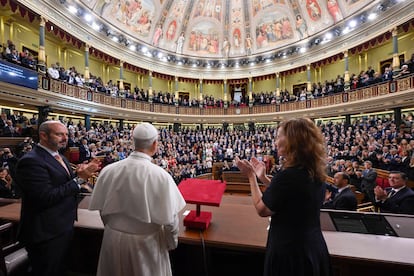
Pope Leo XIV delivered a historic speech on Monday inside Spanish parliament in a joint session of both houses, where he stressed that the moral value of political decisions must prevail “over mutable social consensus” and lamented “the permanent denigration of the adversary.”
Much of his address, which lasted half an hour and was met with seven minutes of applause, was devoted to condemning discrimination against migrants and policies that forget their dignity as human beings. “Wherever a person is discriminated against because of their origin, the principle of the equal dignity of all human beings is violated,” he said.
“Those who exercise public responsibility have a special duty to guard their language in order to ‘disarm speech.’ Firmness does not require contempt; disagreement does not entail humiliation,” he warned in an appeal to tone down verbal aggression and polarization in politics. “The world is undergoing a profound spiritual and cultural crisis, which is manifested in multiple forms of violence, polarization, and mutual distrust.”
After initially keeping a low profile, the pope has this year begun to reveal himself as a global voice against far-right populism. In a speech to the diplomatic corps accredited to the Holy See on January 9, 2026, he said that “in our time, the weakness of multilateralism is a particular cause for concern at the international level. A diplomacy that promotes dialogue and seeks consensus among all parties is being replaced by a diplomacy based on force, by either individuals or groups of allies. War is back in vogue and a zeal for war is spreading.”
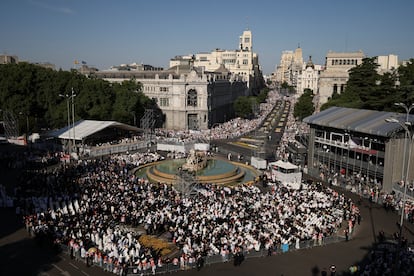
Leo XIV arrived in Madrid on Saturday for a weeklong visit to Spain — the first by a pontiff in 15 years — and has since made a point of meeting with migrants and homeless people. On Sunday he officiated a mass that attracted 1.2 million people, according to local authorities.
On Monday, during his address to the national legislature, Leo XIV was very clear in his global call for “a peace that requires diplomatic courage” and respect for international law “above the interests that profit from war.” He also reiterated his opposition to rearmament policies.
On immigration, he said that the drama of migration challenges the conscience of nations and the ethical foundation of the international order. He said that it is a problem that “exceeds any purely demographic or economic reading: it is fundamentally a moral and legal issue.”
“The situation of migrants and refugees demands a response that focuses on people, addresses the causes that force them to leave and goes beyond the mere management of flows. From this arises a twofold requirement of social justice: offering safe and legal routes, a respectful welcome and real possibilities for integration; and at the same time promoting the right to remain in one’s own land,” he said.
The pope did not mention child sexual abuse by Catholic clergy in his speech in Congress, although house speaker Francina Armengol reminded him that Congress commissioned an investigation into clerical sex abuse in 2022. Later the pope delivered an address to the Conference of Bishops in which he referred to abuse within the Church as a “plague” and asked the bishops to ensure that “every person who has been hurt” can find “a sincere ear, a welcoming environment, protection, and real changes that bring healing.” EL PAÍS has been investigating cases of abuse by the Spanish Church since 2018.
Sign up for our weekly newsletter to get more English-language news coverage from EL PAÍS USA Edition

Seis Personas Apuñaladas En La Principal Estación De Tren De Nueva York Horas Antes De La Visita De Trump
The Experts’ Tips For Staying Safe While Hiking In Spain’s Mountains
Mazarron’s stunning beaches to star in upcoming netflix miniseries
In The Final Stretch Of Colombia’s Presidential Campaign, Undecided Voters Are In High Demand

How To Get A Tourist Rental Licence In Andalusia (Spain) – Step-By-Step Guide 2025
Spain heatwave 2026: When the next extreme temperatures could hit and which areas may suffer most


-
Abelardo de la Espriella2 weeks ago
In The Final Stretch Of Colombia’s Presidential Campaign, Undecided Voters Are In High Demand
-
 New Developments3 weeks ago
How To Get A Tourist Rental Licence In Andalusia (Spain) – Step-By-Step Guide 2025
-
aemet3 weeks ago
Spain heatwave 2026: When the next extreme temperatures could hit and which areas may suffer most
-
 Uncategorized4 weeks ago
FBI investigation launched over Valtteri Bottas Cadillac theft
-
 Uncategorized3 weeks ago
Max Verstappen is no diva – Nurburgring rival on
-
Costa Blanca South4 weeks ago
Torrevieja opens registration for Concilia Verano 2026 summer school
-
 Argentina2 weeks ago
Trump Receives Flávio Bolsonaro In The Oval Office Three Weeks After Lula
-
A-7 motorway2 weeks ago
Wrong-way kamikaze driver dies in horrific head-on collision on Marbella A-7 motorway
Join the conversation in our comments section below. Share your own views and experience and if you have a question or suggestion for our journalists then email us at news@thelocal.es.
Please keep comments civil, constructive and on topic – and make sure to read our terms of use before getting involved.
Please log in here to leave a comment.