
california
The Story Of Baby Poppy: From Surrogate Birth To Youngest Victim Of Los Angeles’ ‘house Of Horrors’


Three numbers and a letter opened the negotiations in a private message: 135K. That was the $135,000 that Silvia Zhang, a Los Angeles businesswoman, offered Tronderrica James, a Nevada woman, in 2023 to carry a child she claimed she was unable to have by any means. Later, an assistant at a surrogacy agency provided more details: “They are a Chinese couple looking for their miracle baby.” A contract sealed the arrangement.
Poppy, as the miracle baby was named, was born at a Las Vegas hospital in February 2025 while James was fighting for her life. James had no idea that the infant would end up in an Arcadia mansion, surrounded by misery. She would become the youngest of the 21 children rescued by authorities. She was just two months old when social workers removed all the children living with Zhang and her partner, Guojun Xuan, who are accused of subjecting them to a strict disciplinary regime that included beatings so severe that one child ended up in the hospital.
Poppy, now one year and eight months old, and the other children remain under the protection of a Los Angeles County agency. Zhang and Xuan have been in jail since their arrest earlier this month and face child abuse charges that could keep them behind bars for more than a decade. Both have pleaded not guilty. A judge set bail at $20 million each, citing their substantial financial resources.
But the case does not end there. The FBI is conducting a parallel investigation alongside the local authorities’ inquiry, focusing on other possible crimes whose details have not yet been disclosed.
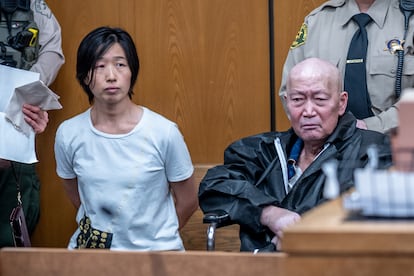
“I find it deeply repugnant that the same people who came before me saying they wanted to start a family and have a ‘miracle baby’ concealed devastating information that would have fundamentally changed my decision to carry their daughter,” James said in a written statement sent to EL PAÍS. “I would describe my experience with Silvia Zhang and Guojun Xuan as one of the most disturbing betrayals of trust I have ever lived through,” she added.
Authorities are still investigating whether Zhang and Xuan are the biological parents of the 21 children who lived in their nine-bedroom luxury home. At least 14 of them were born through surrogacy. “The number of children who were subjected to this alleged horrific abuse is unprecedented,” District Attorney Nathan J. Hochman said at a press conference. “This house could only be described as a house of horrors,” he said.
The 15-page indictment names four surrogate mothers who gave birth to five babies in exchange for payments ranging from $45,000 to $135,000. One of them is Tronderrica James, whom prosecutors refer to by the initials T.J.
According to prosecutors, the defendants recruited women from across the country by claiming they wanted to start a family. Some of the surrogates discovered, only after they were several months pregnant, that their clients already had so many children at home that they could barely care for them. An army of nannies and the watchful eye of 32 surveillance cameras helped the couple enforce their harsh punishment regime, prosecutors allege.
“I did not agree to take part in what was called ‘the house of horrors,’” James told EL PAÍS. “I agreed to help bring a ‘miracle baby’ into the world,” she said.
The miracle of Poppy
Everything seemed filled with hope as preparations were made for Poppy’s arrival. At least that was how the woman who carried the child saw it.
The contract formalizing the arrangement was signed in March 2024. Under its terms, Xuan agreed to provide the sperm. The embryo transfer took place in June of that year at a fertility clinic in Encino, an affluent neighborhood in northern Los Angeles. The surrogate received an advance payment of $8,500, according to a lawsuit she and her husband, Travis James, later filed in federal court in Los Angeles, alleging fraud and emotional distress.
The negotiations with James, the monitoring of the pregnancy, and all communications were handled through Mark Surrogacy Investment, an agency registered at the address of the defendants’ mansion that has been operating since 2021. Xuan was listed as chief executive and Zhang as manager. James says she uncovered those links only months later while investigating the couple in preparation for the lawsuit.
The U.S. federal government does not regulate surrogacy; each state has its own laws governing the practice. The process requires a legal contract between the intended parents and the gestational mother, who undergoes an in vitro fertilization procedure. California has one of the highest rates of births through surrogacy.
The Arcadia case highlights the gray areas surrounding an industry that continues to pose major regulatory challenges. This particular investigation has been complicated by the fact that the defendants operated their own agencies while concealing their ties to them. It is not even clear whether Xuan and Zhang were romantically involved or simply business partners.
How the Arcadia mansion ended up filled with children remains a mystery. Mitchell Krems, the couple’s attorney, told ABC that his clients simply wanted a large family. “He’s being unfairly scrutinized because he has so many children. There’s no law against having all these children, none at all, so my client is not abusive whatsoever,” the lawyer said.
The excitement surrounding Poppy’s arrival began to fade quickly. In July 2024, Zhang appeared largely uninterested in the progress of the pregnancy. “Do you ever speak with Silvia? It seems odd to me that she never answers. Yesterday I sent her the heartbeat and I have not received any response,” James wrote to a representative at Mark Surrogacy Investment.
Some time later, Zhang sent a brief message through the assistant: “I am glad to know the baby is fine,” reads the lawsuit.
More excuses followed to explain her distance: that she was “very sick,” that private messages were getting lost, and that she was “very busy” during the summer. Still, she insisted they were eagerly awaiting Poppy’s arrival. “We are very happy. We can’t wait for our baby to arrive.”
James responded directly, warning that she would stop sharing updates about the pregnancy: “It hurts me a lot that you never answer me, especially when I try to share such important moments with you. I do not believe that you are ‘too busy’ for your own child.”
“I was on the brink of death”
Xuan and Zhang’s indifference reached its peak in the early hours of February 21, 2025, when Poppy was born at a medical center in Las Vegas. Neither of them was present at the birth, despite what the contract stipulated. According to the lawsuit, they left only one precise instruction with hospital staff: that the baby be taken care of immediately after birth and that James not be allowed near her or to say goodbye.
“I underwent an emergency cesarean, suffered severe hemorrhaging and hypovolemic shock, and lost consciousness during recovery. I was truly on the brink of death and needed interventions to save my life. All of this happened in front of my husband and our son, who was then six years old,” James recounted in the statement sent to this newspaper.
Two photographs are the only mementos the family has of Poppy. In one, a doctor placed the newborn behind James while she recovered in a hospital room. In the other, her husband holds the baby in his arms. They never saw her again.
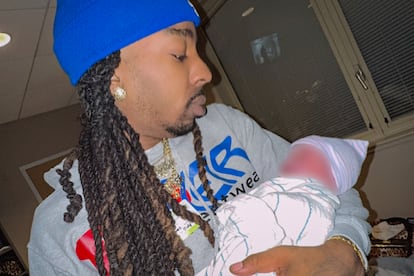
“Despite the circumstances surrounding her birth, she remains a human being whom I helped bring into the world. We sincerely hope she is safe, loved and protected,” James said.
The rooms of torture
When Poppy arrived at the mansion of horror, the situation was unbearable. From the outside, the lavish residence in Arcadia, an affluent suburb 15 miles northeast of Los Angeles, looked like a palace befitting Xuan, a businessman who runs several companies with fortune estimated by authorities at $100 million.
Inside, however, it was a nightmare for 21 children subjected to an almost military-style regime.
Three rooms in the house had been set up as “learning centers,” where the older children were required to sit at desks for several hours a day under the watchful eyes of their caregivers. Those who broke the rules were beaten without mercy. Specific sticks were kept for punishment. According to prosecutors, the most common forms of abuse included blows to the head with an open hand, slaps, and strikes with shoes. Caregivers were instructed not to leave visible marks on the children’s bodies.
“They were subjected to horrific abuse,” said Robert Luna, sheriff of Los Angeles County, who led the investigation, at a press conference.
Poppy had been in the mansion for 72 days when, on May 4, 2025, one of the nannies, Chunmei Li, struck a young boy named Walter so hard on the head that she caused a serious injury. The adults were unable to treat him at home. Two days later, they had no choice but to take him to a hospital, where medical staff grew suspicious of the explanation that the child had fallen from a bed while under adult supervision.
Li has been charged with child abuse causing great bodily injury. She is a fugitive and is believed to be hiding in China.

The day after that hospital visit, Arcadia police searched every corner of the residence and seized the security camera recordings, which became evidence of the child abuse. “What they discovered raised even more serious concerns,” Sheriff Luna said.
The videos showed recent incidents in which a child was struck with a shoe. Other recordings captured the cries of children who had allegedly been beaten in a room without cameras. The footage also showed caregivers removing the children’s clothes to check for marks left by the beatings.
Poppy’s uncertain future
“I felt a physical sickness. But what kind of sick people are these?” James recalls thinking when she learned the details of the case. Her own investigation also revealed that Silvia Zhang ran two other surrogacy agencies operating in Los Angeles: Hope Surrogacy and Future Spring Surrogacy. Both are now under scrutiny from investigators.
On the day of the raid, in May 2025, the 21 children were placed under the custody of a Los Angeles County agency. It took 16 months for the investigation to lead to Xuan and Zhang’s arrest on October 6.
Before that happened, James sent both of them an email: “Explain why you misrepresented yourselves” and “tell me the truth about what happened to the baby I carried in my womb.”
The response, received the next day, did not put her at ease. “I can tell you that Poppy is safe, healthy and well cared for. This situation is complex and emotional for all involved,” an employee of the Mark Surrogacy Investment wrote in an email that forms part of the evidence in James’s lawsuit.
For now, the future of Poppy and the other 20 children remains uncertain. Authorities are keeping the children’s location secret while criminal proceedings against Xuan and Zhang move forward.
“My greatest concern remains the welfare of the children,” James said, adding that she constantly thinks about Poppy and prays to God that she is all right. “They deserve safety, stability, dignity and love. I would not want them to be remembered as the ‘collateral damage’ that has brought us to this situation.”
Sign up for our weekly newsletter to get more English-language news coverage from EL PAÍS USA Edition










california
The Race For Los Angeles Mayor: Two Democrats Battle Over Housing, Affordability And The Olympics

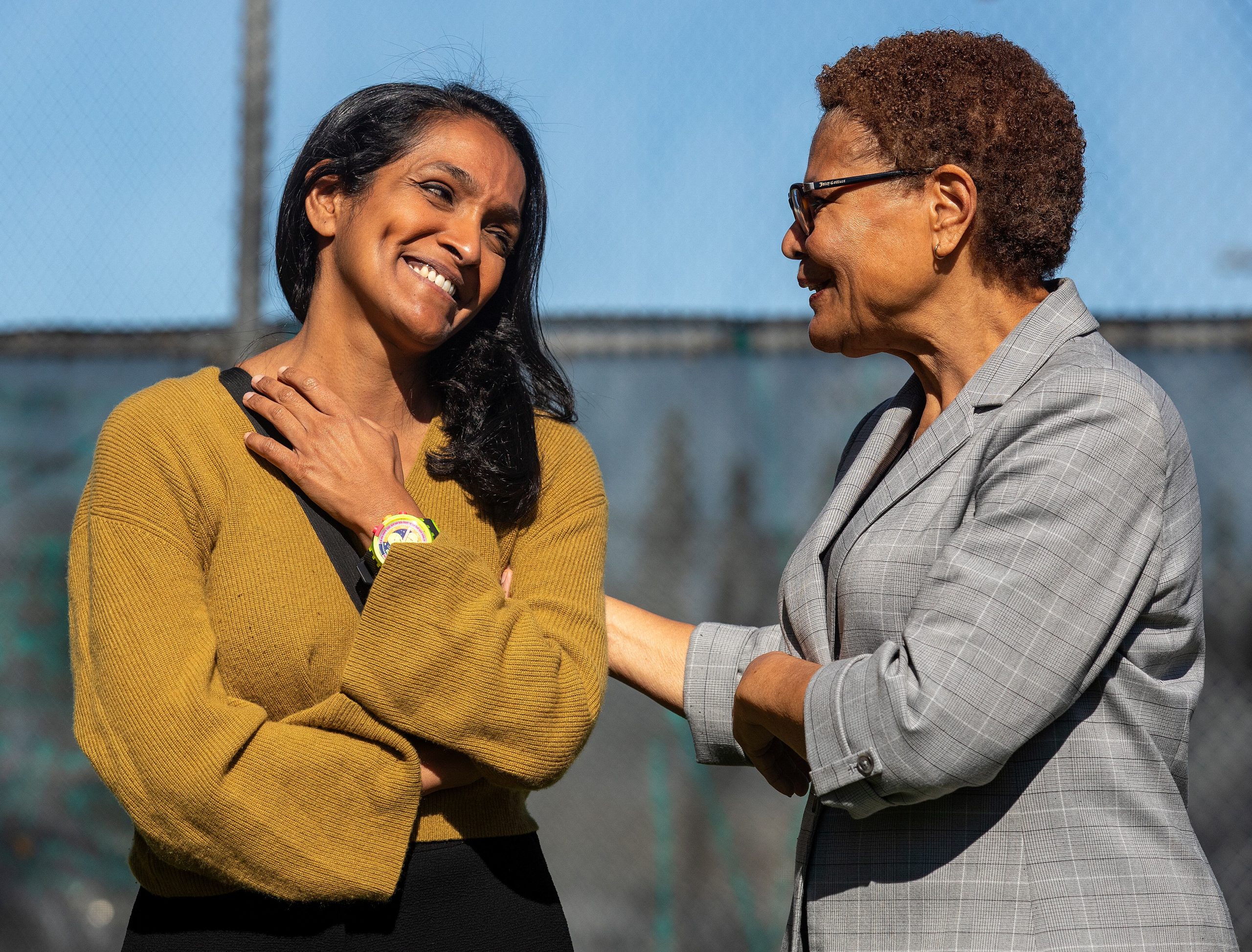
In the race for the mayoralty of Los Angeles, the second-largest city in the United States, two things are certain: a woman will win, and she will be a Democrat. But with a high share of undecided voters and only days remaining before the election, it is still unclear whether Karen Bass will win another term or whether the progressive challenger Nithya Raman will take the post.
As in many other countries, Americans’ daily lives are shaped far more by local governments than by the federal government. Their streets, schools, taxes and housing depend on decisions made by their cities and states. That is why, on November 3, many voters will be watching not only the battles for control of the U.S. Senate and House of Representatives, but also key local contests that will shape the future of their communities. Los Angeles, the heart of California, is one such case where voters will choose their next mayor.
On one side is Karen Bass, 73, who was born and raised in Los Angeles. The first woman to hold the office in the city’s 250-year history, she is seeking a second and final term as mayor. On the other is Nithya Raman, 45, a member of the City Council, born in India and educated at Harvard, who represents the city’s 4th District. Her constituency includes such densely populated and diverse areas as the Hollywood Hills, the San Fernando Valley and the Santa Monica Mountains. If elected, Raman would become Los Angeles’s first mayor of Asian descent.
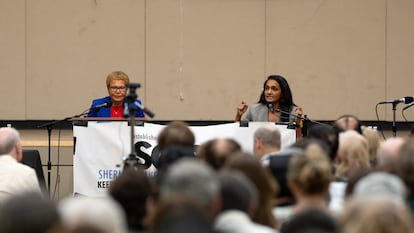
The two candidates have been colleagues and are both Democrats. Their approaches to governing are not dramatically different, which has only added to voters’ uncertainty. With less than two weeks to go before the election, more than one in five voters are still undecided.
Polls so far suggest Raman may have the edge over Bass, but with nearly 21% of voters still undecided, it is still too early to know how the race will unfold. The latest survey gives Raman an eight-point lead, 47% to 39%, while an average of the three most recent polls puts her ahead by five points.
Raman, committing to infrastructure
Raman is not well known nationally, and until a few months ago she was barely known beyond her district, which includes the indie and increasingly upscale Silver Lake, where Raman lives with her husband and twins. However, almost at the last minute, she decided to enter the mayoral primary held in June, running against Bass and another candidate, Spencer Pratt, a 42-year-old Republican from the MAGA world and a former participant in a youth reality TV show. Pratt ultimately lost the primary after a lengthy and slow vote count.
What Raman is proposing, and what appears to be resonating with voters, is simplicity: transparency and organization, qualities she argues are essential in a city of nearly four million people. The broader Los Angeles area, including other cities and parts of the metropolitan region, has almost 13 million residents, half of them Latino. Raman is running a campaign in which she promises to direct tax revenues toward improvements in the city that Angelenos can see and feel.
First, she wants residents to be able to afford to live in the city. Building is expensive and complicated because of lengthy approval processes and permit requirements. The median price of a home stands at $928,000, according to the real estate site Zillow. Raman says she will simplify and speed up those procedures from day one and create an office dedicated to helping tenants.
In a city where the car is king, she wants to revitalize major avenues and fill them with shops and restaurants. She has highlighted the revival of the iconic Hollywood Boulevard, which has fallen into decline. She wants clean streets, free of potholes, with good sidewalks and adequate lighting, promising even to create a map showing broken streetlights. She also wants fewer homeless people on the streets. Despite municipal efforts, numbers continue to rise: up 3.4% in the city and 1.2% in the county between 2025 and 2026. More than 73,000 people are living on the streets in Los Angeles, according to a city report.
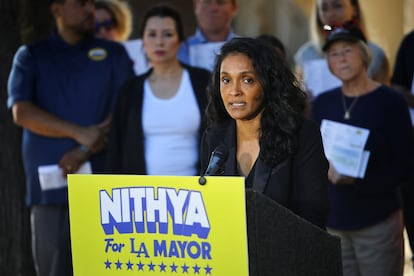
Raman also says that within her first 100 days she will hire more operators for the 911 emergency service, appoint a chief financial officer for City Hall (because the city currently has none), add a position to improve film productions in Hollywood, which have been leaving the city, and create a much-needed commission to tackle the problems facing Los Angeles International Airport, which has spent years waiting for the opening of its long-delayed automated people mover.
The 2028 Olympic Games are a central part of Raman’s platform, even though she opposed bringing them to the city not so long ago and remains skeptical about the mega sporting event set to arrive in 600 days. “I want the Olympics to succeed. But that cannot mean giving LA28 a blank check while Angelenos carry the risk,” she wrote in August on her X account, arguing that the private organizing committee, LA28, had reached “an irresponsible deal” with the city. For now, she will launch an initiative to plant 100,000 trees in the two years leading up to the Games.
Bass, by contrast, has been a strong supporter of the Games. In an interview with the Los Angeles Times, she called them “a once-in-a-lifetime opportunity to showcase Los Angeles to the world,” and argued the event is “a chance to deliver real, lasting benefits to our city and the people who call it home.”
Bass, under the shadow of homelessness and the wildfires
Beyond the Olympic Games, Bass says one of her priorities will be to push back against the mass immigration raids in a city that has been deeply affected by the hardline tactics of Immigration and Customs Enforcement (ICE) and that has repeatedly taken to the streets to protest U.S. President Donald Trump and his immigration policies.
Bass, who served in Congress from 2011 to 2022, including during Trump’s first term in office, says she will continue to fight as she did then. “The immigration raids may have left our daily headlines, but they haven’t stopped,” she told EFE.
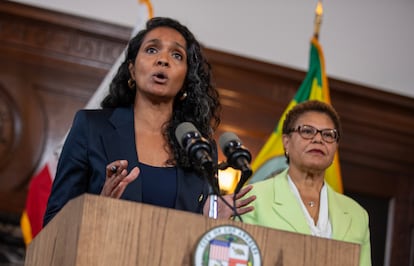
Housing is also central to Bass’s campaign. She argues that 10,000 homes have been built during her time in office, but since she was elected in November 2022, the high cost of living and the difficulty of finding affordable housing and well-paying jobs have caused the city’s population to fall. According to census figures, Los Angeles lost 54,000 residents between July 2024 and July 2025, the steepest population decline recorded by any major U.S. city.
In a state where costs are especially high, with gasoline prices reaching as much as $10 a gallon, Los Angeles is becoming increasingly unaffordable. Nearly one in 100 residents does not have health insurance, the poverty rate stands at 16% compared with 11% for California as a whole, and homeownership remains out of reach for many: only 36% of Angelenos own their homes, compared with 56% statewide, according to census data.
But the issue that has most overshadowed Bass’s legacy, and could weigh on her re-election bid, is the Los Angeles wildfires of January 2025. During some of the darkest days in the city’s recent history, fires tore through 16,000 hectares in Pacific Palisades on the west side and in Altadena and Pasadena to the northeast. Twenty-five people died and more than 11,400 homes were destroyed. Bass was criticized for being slow to respond because she was on a minor trip to Accra, Ghana. She declared a state of emergency remotely, returned after the fires had already erupted and, upon arriving at the airport, declined to answer reporters’ questions.

Although she tried to make amends by maintaining a visible presence at shelters and alongside victims after her return, many of those affected, especially residents of the Palisades, which falls within her jurisdiction, never forgave her. During a televised debate with Raman on October 14, Bass apologized.
“There’s not a day that goes by that I don’t think of the lives lost, the families that lost their home, and the families where the home is still standing but they’re not able to be in it,” she said. The mea culpa was necessary, but the political cost for Bass will not be known until voters deliver their verdict on November 3.
Sign up for our weekly newsletter to get more English-language news coverage from EL PAÍS USA Edition


Election officials, activists, voting-rights lawyers, legal experts and other watchdogs of U.S. civil society have spent the past year and a half warning about what they describe as a campaign by U.S. President Donald Trump to undermine confidence in the conduct of free and fair elections. Their concern is that he is laying the groundwork to overturn the outcome if it does not favor the Republican Party.
With less than 10 days to go before the midterm elections, that campaign has entered its final and most intense phase, despite a string of setbacks in the courts, which have repeatedly struck down Trump’s attempts in recent months to change the rules at the last minute. At the same time, the U.S. president has also won some isolated victories.
Last week, which ended with a preemptive lawsuit by the Justice Department seeking to challenge the results in Alaska should Democrats prevail, offered examples of both trends. While a California judge ordered a halt to a federal investigation into alleged widespread voting by noncitizens (a conspiracy theory repeatedly debunked), Washington State’s Supreme Court ruled that New Hampshire may not accept student IDs as a valid form of voter identification.
To identify the main threats facing the November 3 election, EL PAÍS consulted about a dozen election experts and voting rights specialists. The aim was also to assess which of those risks are the most serious.
The experts agree that the U.S. system is prepared to withstand the attacks of a president who has consistently refused to accept defeat at the polls. They all describe Trump’s effort as “unprecedented” in U.S. history, and they point to one overriding reason for concern: the last time Trump lost, a mob of his supporters, galvanized by his false claims, attacked the Capitol in an effort to stop the peaceful transfer of power. The experts who spoke to EL PAÍS therefore find themselves in a difficult position, caught between the duty to warn and the responsibility not to alarm voters so much that they become discouraged from participating.
How serious those threats become will depend largely on the results of the election, which polls currently suggest will favor Democrats. Broadly speaking, they fall into three categories: measures undertaken before Election Day, efforts that could affect voting itself, and post-election scenarios if the vote count proves lengthy or contentious.
The White House insists that all its maneuvers have a single purpose: “to safeguard electoral integrity and promote security in the democratic process.”
Undermining public confidence
Since emerging on the political scene a decade ago, Trump has done more than perhaps any other politician with a global platform to undermine public confidence in the electoral system. The U.S. system, with its complexity, thousands of jurisdictions, slow vote counts, and vast geographic scale, lends itself to suspicion. Yet elections in the United States have repeatedly been shown to be secure.
Trump has relentlessly spread claims of widespread voter fraud, often with the help of allies such as Elon Musk — except when, as in 2024, he emerged victorious. He has pushed to redraw electoral districts in ways that benefit his party. He has directed the FBI to seize ballots cast in the 2020 election, which he lost to Joe Biden, and has unsuccessfully sought access to voter-registration records. He has alleged irregularities involving voting machines and vote counting. And he has cast doubt on both mail-in voting and early voting, despite spending much of last week urging his supporters on social media to vote by mail and casting an early ballot himself on Saturday in Palm Beach, Florida, alongside his wife, Melania Trump.
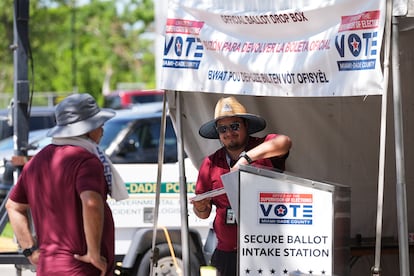
The Supreme Court — despite its Trump-aligned conservative majority — twice struck down his efforts to restrict mail-in voting, just as claims of widespread voter fraud and systemic failures in vote-counting machines have repeatedly been debunked. None of that has stopped Trump from continuing to promote those false claims and from pushing for a bill, stalled in the Senate, that would make it harder for millions of Americans to vote. He has also called for the “nationalization” of elections, even though under the U.S. system election administration is a shared responsibility of states and counties.
The theatrical operations launched by his administration, such as last week’s arrests in California of people accused of voting illegally, fit into a broader strategy that in many ways encompasses all the others: undermining faith in democracy and discouraging citizens from participating in it.
“That is the main danger of this contest,” says Jasleen Singh from the Brennan Center, a nonpartisan authority on election law. “It will have been a success [for Trump] if people stay home [on November 3] and do not vote.”
Threats and pressure on officials
Since 2020, being an election official has become one of the most dangerous jobs in the United States. That year, Trump pressured a secretary of state, Brad Raffensperger of Georgia, to “find” the votes he needed to overturn his defeat, while dozens of election workers, many of them unpaid volunteers, received death threats and intimidating phone calls.

This year, the Trump administration has suggested it is willing to punish officials who do not follow its directives with fines or even jail time, although experts again agree that such measures would exceed the federal government’s authority.
Counties and states controlled by both parties have spent months preparing for every conceivable scenario, from natural disasters to familiar threats that have surfaced in past elections, including attempts to seize voting machines and foreign cyberattacks. They have also prepared for newer risks and, if necessary, to resist intervention by Trump and his allies, who have replaced a long-standing relationship of cooperation with election officials with one marked by hostility.
“In these elections, the greatest threat does not come from foreign adversaries but from the White House,” Colorado Secretary of State Jena Griswold warned in a recent conversation in Washington. “We have updated all our contingency plans and hired staff. We have integrated the attorney general’s and governor’s offices into crisis‑simulation drills so they can learn to manage pressure and anxiety. We also have top‑tier lawyers ready to join the fight.”
During its most recent legislative session, Colorado’s Democratic-controlled legislature approved a law barring any presidential candidate from appearing on the ballot if, as Trump has floated, he seeks a third term in 2028.
An unlikely state of emergency
The idea of exploiting a pretext to declare a state of emergency and either suspend the elections or invalidate their results has been circulating for months in the more radical corners of Trumpism. Asked in an interview with Time about that possibility, Trump replied: “I don’t rule anything out or in.” Despite those remarks, the experts consulted for this article do not consider such a scenario likely in the midterms.

Benjamin Hovland, who was dismissed in July from the Election Assistance Commission (EAC), recalls those comments. He argues that, once again, this is part of the strategy: “to sow uncertainty, make Election Day look chaotic, and cause people to disengage.”
Hovland was fired shortly after a Supreme Court ruling gave the White House broad authority to remove officials from independent agencies. His dismissal was part of Trump’s dismantling of the EAC, the body charged with assisting state and local election authorities in administering elections.
Since returning to power, Trump has also scrapped the cybersecurity program responsible for monitoring potential foreign interference, such as the efforts that targeted the 2016 election. That did not stop him, however, from singling out China in a televised address from the Oval Office in July, in which he revived long-discredited claims about the 2020 presidential election.
Federal agents at polling places?
For months, both the president and senior officials, including Homeland Security Secretary Markwayne Mullin and FBI Director Kash Patel, have repeatedly declined to rule out deploying agents from Immigration and Customs Enforcement (ICE) or the FBI to polling places on November 3.
The stated rationale is that such agents would help ensure the smooth conduct of the election and prevent voting by undocumented immigrants, which successive investigations, including federal ones, have found to be exceedingly rare. In practice, however, their presence could deter many immigrants, especially Hispanic voters, from going to the polls, even if they are legally in the country. After a year and a half of Trump’s aggressive anti-immigration campaign, many would have reason to think twice before showing up at a voting center.
“Something like that would be completely illegal,” warns Singh from the Brennan Center, adding that a judge would stop such a deployment immediately. “Civil‑rights and legal organizations like ours are ready to respond to that eventuality.”
Trump’s army of observers
The Justice Department has recruited a force of 1,000 “election observers” to be deployed across the country on November 3. The role itself is not new. What is new is the scale: in the 2024 election, the Biden administration deployed 594 such monitors.
Their job, explains Jonathan Diaz of the Campaign Legal Center (CLC), a voting‑rights organization, vaguely resembles that the work done by monitors who oversee elections in foreign countries: “They observe, and if they see a problem, they follow up with local authorities.” “Given the aggressiveness of this administration and its willingness to violate the Constitution and the law, there is great concern about how those monitors will behave in the midterms,” Diaz says.
The law prohibits them from intimidating or harassing voters. Even so, the plan to station them around the country (though they would cover only a small fraction of the thousands of races taking place that day), has drawn criticism from Republicans as well. Wyoming Governor Mark Gordon objected in August when a handful of those observers sought to interview voters during the state’s primary election. The Justice Department representatives ultimately had to leave.
Seizure of voting machines and ballots
False claims about voting machines were a defining feature of the 2020 election and are likely to resurface on November 3. Last week, voters across the country reported on social media what they described as unusual behavior by voting machines. According to those accounts, a voter would select one candidate and the machine would record a vote for another, though not necessarily a Democratic candidate. Similar incidents have occurred in previous elections and, according to experts, are not necessarily indicative of mass fraud.
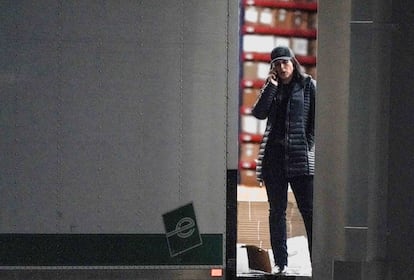
Hovland, the election official dismissed by Trump, notes that “more than 98% of Americans vote with a paper ballot or with a system that produces a physical record.” He adds that voting machines are subjected to “pre-election testing” and “post-election audits.” “Manual sample recounts are also performed to ensure the equipment is working properly,” he says. “There are numerous safeguards, but that has not stopped false narratives about alleged failures from spreading.”
Acting on those suspicions, the Trump administration could seek to seize voting equipment or confiscate ballots it considers questionable, as the FBI did in January in Georgia’s Fulton County, ground zero of the Big Lie surrounding the 2020 election. Ten months later, it remains unclear what federal agents were looking for. Even less clear is what, if anything, they found.
Lawsuits challenging the results
The Alaska lawsuit, which the Justice Department justified on Friday by arguing that two candidates have nearly identical names, Republican Dan S. Sullivan and independent Dan Sullivan, may be the first of many. Alaska’s Supreme Court has already resolved that issue, suggesting that the lawsuit may be aimed less at winning in court than at laying the groundwork for questioning the results in the event of a defeat.
“It’s absurd, baseless,” says lawyer and federal‑policy expert Aaron Blacksberg. “It’s a desperate attempt that can only be called political theater. It shows how desperate they are, throwing spaghetti at the wall to see what sticks. No judge will find merit in it.”
In 2020, lawsuits also poured in after Trump embraced the false claim, which he continues to repeat, that Democrats had stolen the election from him. The difference is that then it was campaign lawyers bringing those cases because Justice Department officials refused to do so.
Attorney General Todd Blanche has given ample indication that this time will be different and that he is willing to place a department traditionally expected to operate independently of the executive branch at the service of Trump’s political strategy. On Friday, Trump openly acknowledged that he had personally requested that the Alaska lawsuit be filed.
In Trump’s second term, which he began by pardoning 1,600 participants in the attack on the Capitol, he has also appointed dozens of election deniers to key positions. Among the most prominent are Homeland Security Secretary Markwayne Mullin, FBI Director Kash Patel and Deputy Attorney General Harmeet Dhillon. These are positions with the power to refuse to accept midterm results or to obstruct their certification.
“There are challenges in every election,” warns Kathy Boockvar, who served as Pennsylvania’s Democratic secretary of state and now runs Athena, a consultancy that works to protect voting rights. “The only time there weren’t any was in 2024, because those who usually question the results won. The threats have been evolving [for a decade], but the American people can have faith that the system is designed to withstand them, that the courts will rise to the occasion, and that officials will defend their rights come what may.”
What if Congress does not recognize the winners?
This is the least likely scenario of all — “almost bordering on science fiction,” according to Diaz from the CLC. Under the U.S. system, which is governed by rules dating back centuries, several weeks pass between Election Day, held on the first Tuesday after the first Monday in November, and the day newly elected members of Congress are sworn in. In 2020, Trump used that interval to fuel the movement that ultimately culminated in the attack on the Capitol.
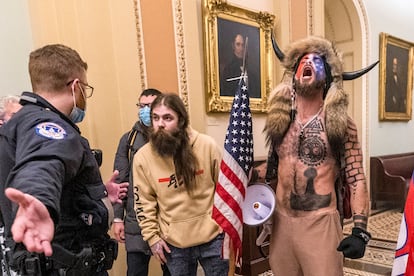
This time, that date falls on January 3, 2027. Some analysts worry that Trump could pressure Republican leaders on Capitol Hill, where the party currently controls both chambers (control it could lose in the midterms), to refuse to recognize the legitimacy of some Democratic lawmakers elected in November.
Diaz believes that if, by then, the states have certified all election winners, a process that all experts stress will extend well beyond election night, the matter “will be resolved.” After saying that, Diaz pauses and adds: “Although anything is possible.”
And on that point, everyone agrees: if this campaign, and the decade of U.S. politics that preceded it, has demonstrated anything, it is that with Trump, you never know, no matter how many scenarios you try to anticipate.
Sign up for our weekly newsletter to get more English-language news coverage from EL PAÍS USA Edition
Bernie Sanders
‘They Should Pay More Than The Poor’: The Battle To Make California’s Richest Give Up 5% Of Their Fortunes

Citadel is one of the most visited shopping centers in Los Angeles. But in these lean times, few customers browse its clothing, bag and shoe stores. On this hot October afternoon, Rocío López is here, treating herself to “a luxury” amid the cuts her family has made to blunt the impact every time they fill the car’s tank or do the grocery shopping. The pressure on her finances became clearer with her latest tax return: she and her husband were shocked to find they owed $8,000 to the IRS.
“The more you work, the more you pay,” says the Mexican immigrant, visibly angry, who lives in Garden Grove, 28 miles from Los Angeles. López believes the playing field is not level for everyone. She has a point: California’s wealthiest pay around 0.2% of their total wealth each year in state income taxes — about $3.2 billion — according to an analysis by the National Bureau of Economic Research.
With that inequality in mind, López, who became a U.S. citizen 15 years ago, recently voted in favor of Proposition 40. The measure would introduce a one-time tax of 5% on the total wealth of California tax residents whose net worth is $1 billion or more. Backers expect to raise about $100 billion, to be used mainly to fund the public health system that serves low-income people.
“They should pay more than the poor,” says López, who earns a living caring for people with special needs — work that, at the entry level, is often paid at minimum wage. “The rich take advantage of the situation, and that’s not fair,” she adds.
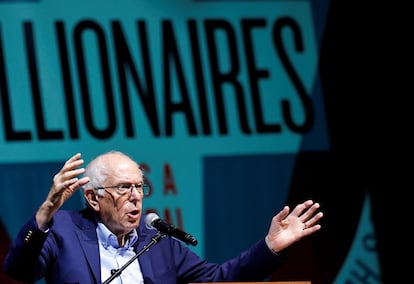
Proposition 40 is presented as a social-justice initiative intended to force billionaires who live in California to contribute more through the tax code, as some leading economists have proposed. But polls show the measure divides voters. Backers attribute that lack of consensus to an aggressive ad campaign funded by large donations from some of Silicon Valley’s wealthiest businesspeople, and to the absence of support from the Democratic establishment.
‘Five percent is very little’
Kaelynn Pérez, 19, studies medicine at the University of Southern California (USC). She learned about Proposition 40 through social media and says she will take time to hear both sides before voting. Although the young woman, who lives in Downey — a predominantly Hispanic suburb 13 miles southeast of Los Angeles — believes the wealthy should pay more into the tax system, she still has doubts about whether the initiative is well crafted and whether, if approved, it would benefit the community as much as it could. “Maybe it should be reworked and put on a different ballot,” she says.
“I think asking them to pay 5% is too little. There are a lot of people looking to make a lot of money from this, and that’s fine, but I don’t think it’s enough,” says the young woman, who is preparing to vote for the first time in a federal election.
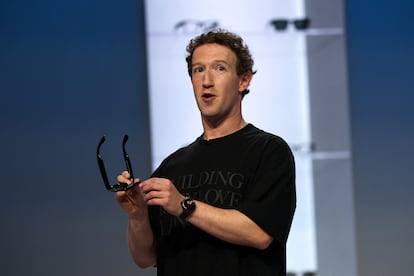
Among the billionaires who could be affected by the proposition, the first who comes to her mind is Mark Zuckerberg, owner of Meta, the parent company of Facebook, WhatsApp and Instagram — the latter one of the social networks she uses most. “It would be good to put the rich in a position where they can help the community,” Kaelynn says. “I’ve never seen media coverage saying Mark Zuckerberg has donated X amount to students or given opportunities to people who need support,” she adds.
Polls show a narrow lead for yes on Proposition 40. Forty-six percent of voters surveyed during the second week of October said they backed it, versus 43% who opposed it, according to a Citrin Center–Politico poll. In mid-September, another survey by the Public Policy Institute of California (PPIC) put support at 52%, just above the threshold needed for the initiative to pass. A University of California poll published at the end of September found 45% would vote in favor.
“This contradicts everything I thought I knew about political science,” said Jon Gould, dean of the School of Social Ecology at the University of California, Irvine (UCI), during a recent forum analyzing the initiatives on the November 3 ballot in the state. “I thought voters would say, ‘My God, we need the money. It will go to education and health care and it also affects the multimillionaires. Count me in.’ But for now, it seems that’s not the case,” he said.
‘They don’t pay what they should’
There are differing views among Democrats as well. While Vermont Senator Bernie Sanders supports taking a share of the largest fortunes in California, outgoing Governor Gavin Newsom questions the measure’s structure and argues that a tax of this kind should be applied nationally.
Campaign financing to defeat Proposition 40 is proportional to the size of the pockets that would be affected. State financial reports show more than $340 million has been raised, mostly from tech billionaires. The largest donor is Google co-founder Sergey Brin, who has contributed at least $102 million.
That spending spree shows up in the aggressive political marketing flooding traditional and social media. “When the money runs out, Sacramento will come back with another tax,” warns one ad.
Juan José Estrada, 19, studies mechanical engineering at a public university in San Diego, on the California–Mexico border. He says he prefers to ignore campaign advertising to avoid being influenced. On Proposition 40, whose ads keep appearing on his phone, he has a clear stance and recently cast his ballot by mail. “Billionaires don’t pay what they should,” he says. “They should pay more.”
Sign up for our weekly newsletter to get more English-language news coverage from EL PAÍS USA Edition

Donald Trump ally met with deafening boos on F1 podium in Austin

Estas Lámparas De Pared Funcionan Sin Cables Y Se Controlan Con Mando A Distancia

La Bolsa De Calor Eléctrica Que Está Sustituyendo A La Tradicional Porque No Necesita Agua Caliente


-

 Uncategorized4 weeks ago
F1 Bahrain Grand Prix will be live and FREE on TV this weekend
-

 New Developments4 weeks ago
How To Get A Tourist Rental Licence In Andalusia (Spain) – Step-By-Step Guide 2025
-

 New Developments3 weeks ago
Luxury Villas For Sale, Estepona – ProjectL1
-
Blackout preparedness4 weeks ago
Brussels takes action against Spain over failure to update blackout plan
-
EU3 weeks ago
EU nicotine crackdown sparks warning that ex-smokers could be driven back to cigarettes
-

 Uncategorized4 weeks ago
Lewis Hamilton F1 wish could come true as stunning plans for new track revealed
-

 Housing access / crisis / affordability4 weeks ago
Radical Housing Decrees Defeated As Snap Election Talk Grows
-
British tourists arrested in Magaluf3 weeks ago
British tourists arrested after taxi driver left bloodied in Magaluf