
Apollo 18: Mission To The Moon
Worms, Fungi And Urine To Grow Potatoes In The Moon’s Poor Soil

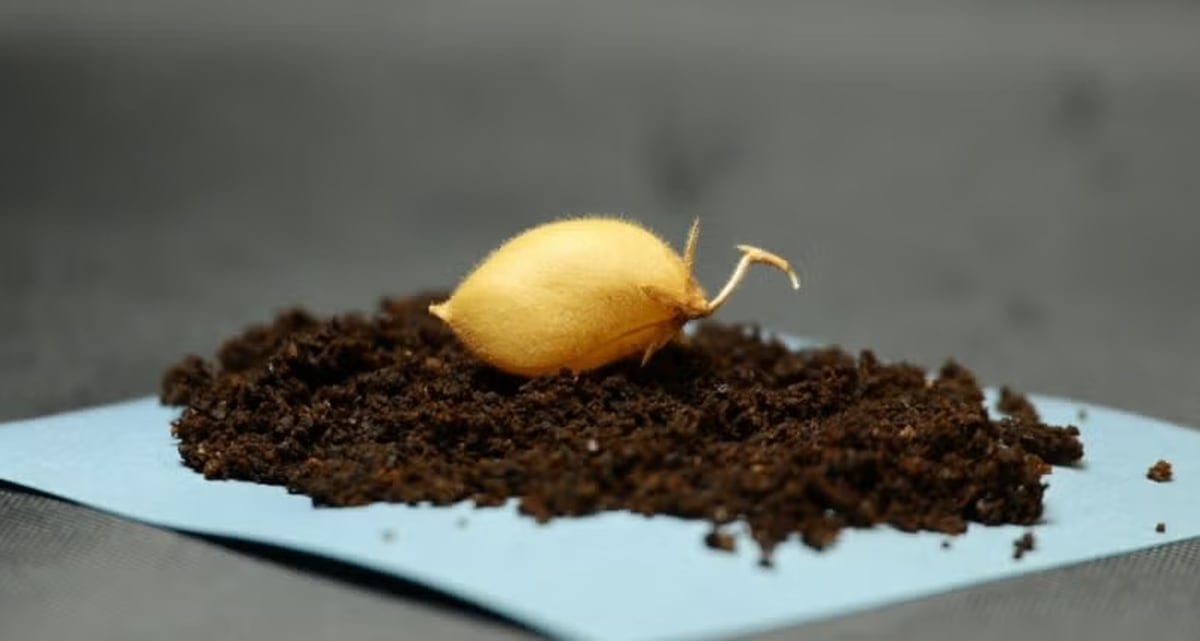
By 2032 there will already be farmers on the Moon. That is, at least, NASA’s goal. By then, the Artemis program foresees that among the first three missions to the base it plans to install at the lunar south pole will be the LEAF project (Lunar Effects on Agricultural Flora). The priority given to cultivation makes perfect sense: without local production, neither lunar colonization nor a subsequent trip to Mars seems feasible. That is why the different space agencies are promoting extraterrestrial agriculture projects. One of them has just published its first results: researchers achieved a good potato harvest, but only after amending the poor lunar soil.
“Regolith does not contain nitrogen, one of the macronutrients essential to plants,” notes Aymeric Goyer, a researcher at Oregon State University and co-author of a newly published study in npj Microgravity. Regolith (in rock or dust form) is the Moon’s characteristic surface soil. A total of 342 kilograms were brought back across the Apollo missions. That is not enough for even a one-hectare greenhouse, but it is enough to learn about lunar soil. Experiments are using substrates with a composition and texture as similar as possible. In addition to lacking fertilizer, “regolith can contain high levels of heavy metals, which can be toxic to plants,” Goyer recalls. Another problem is its sharp edges. Formed by impacts from micrometeorites of metal and vitrified materials, it is like planting on broken glass. “These sharp nanoparticles can cause abrasive stress on exposed tissues,” the U.S. scientist adds.
And yet, they managed to harvest as many potatoes in a regolith simulant as in Oregon’s good soil, with tubers equally nutritious and virtually free of metals. Almost from the start, potatoes grown in pure regolith showed stunted growth, very short roots, poor leaf development and high metal content. Most had died before harvest. But by mixing the lunar soil with an organic compost—three parts regolith to one part vermicompost—they achieved high yields and healthy potatoes. Vermicomposting is a biological process in which textiles, waste products—including personal hygiene items—and food scraps are transformed into natural fertilizer. The protagonists of the miracle are worms such as Eisenia fetida and the fungi they carry in their digestive systems.
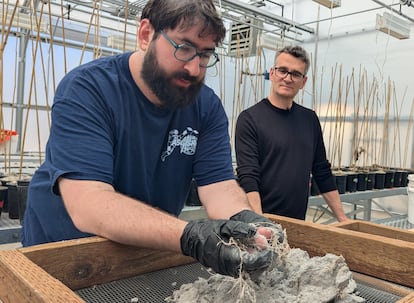
“Without vermicompost, plants accumulate higher levels of copper than control plants grown in terrestrial soil,” Goyer points out. Copper is an essential micronutrient that is very abundant in lunar regolith, but if plants take up too much it becomes toxic. “We believe vermicompost increases the cation exchange capacity of the lunar regolith simulant; in other words, it binds copper ions and limits their uptake by plant roots.” So the worms and their microorganisms not only fertilize the potatoes but also purify them. NASA, which funded this experiment, envisions sending earthworms to the Moon on the first human missions early next decade.
Another research group at the University of Texas, Austin is using vermicompost for its crops. The approach is similar to that of their Oregon colleagues but with two important differences. The Texas team has grown chickpeas, one of the plant foods with the highest caloric and nutritional value. Also, while they tested various compost and regolith simulant mixes, they amended the soil with an element overlooked by other studies: mycorrhizal fungi, microorganisms that enliven the subsoil.
The first results from the chickpea cultivation, published in March, were clear: all legumes grown only in regolith died before seeding, although those enriched with fungi that attached to the roots lived on average two weeks longer. But in those soils aided first by the worms and then by the mycorrhizae, the plants completed the cycle, producing, albeit fewer and smaller chickpeas, chickpeas nonetheless for a second generation.
One of the most complex, ambitious but realistic experiments is underway in Barcelona, Spain. In the 20th century the European Space Agency (ESA) launched the MELiSSA project. The idea is to provide life support for astronauts on long journeys such as those planned to Mars, or at their destination, with a closed-loop system. It is composed of a series of elements or compartments. While in one compartment a range of microorganisms process and break down generated waste, another separates and distributes its outputs, such as nitrates, organic matter or carbon dioxide (CO₂). In another phase, populations of algae will multiply, converting CO₂ into oxygen and food for the astronauts. With organic matter, feces and urine turned into compost and fertilizer, MELiSSA could sustain the cultivation of various crops. At the top of the system would be the astronauts, whose waste and respiration feed back into the cycle.
“Explained like this it sounds very simple; the hard part is making it work,” says Francesc Gòdia, professor of chemical engineering at the Universitat Autònoma de Barcelona (UAB), who directs MELiSSA’s pilot plant. They have been testing the different compartments for more than 30 years, since ESA commissioned the experiment. “First you have to demonstrate they work here on Earth,” Gòdia says, stressing that astronauts’ lives are at stake. After years of design and testing, “we are now connecting the compartments, putting together a puzzle made up of 6,000 pieces of valves, sensors, bioreactors…,” he explains.
They already produce enough algae (spirulina) for several salads and enough oxygen to sustain the mice that stand in for astronauts. The next step will be to scale the system to support the life of a human. It is projected that a person could be part of MELiSSA for up to two years. As Gòdia says, “in these projects where the key is not so much the technology as the risk factor, you need decades, but in the next one we will be able to size it to include humans in the equation.”
Sign up for our weekly newsletter to get more English-language news coverage from EL PAÍS USA Edition









Spain’s Hard-Left Candidate Proposes Seizing 100,000 Homes From Vulture Funds

Colombia To Put Down 10 Of Pablo Escobar’s Hippos Under New Control Plan

Spanish Cheese Finally Recognised Alongside Swiss And French At World Cheese Awards With Three Winning Varieties


-

 New Developments3 weeks ago
Luxury Villas For Sale, Estepona – ProjectL1
-

 New Developments2 weeks ago
The San Roque Club – Townhouses For Sale
-
Age Concern Marbella - San Pedro3 weeks ago
Halloween lunch sells out as 51 join Marbella get-together
-

 New Developments3 weeks ago
How To Get A Tourist Rental Licence In Andalusia (Spain) – Step-By-Step Guide 2025
-
 %3 weeks ago
Spain Orders Replacement Of Eight Million Gas Meters: New Rules, Costs And Deadlines
-
Barcelona riots4 weeks ago
Looting and street violence hit Barcelona as El Corte Inglés customers are trapped
-

 New Developments4 weeks ago
Inside The Most LUXURIOUS Apartment Building In Spain!
-
countryside3 weeks ago
Rural revival: Five Almeria villages make moving inland easier and more enticing