
california
Nightmare Before Christmas In Hollywood


A simple office party can reflect an entire industry. A couple of weeks ago, employees in some Disney divisions received an email that hit them hard: their annual Halloween celebration had been cancelled. It had not happened in years. Suspicion began to spread, followed by rumours and then certainty. In the coming weeks, perhaps even days, many are expecting another wave of layoffs. And this comes as the industry is enjoying one of its best years at the box office.
They are not the first cuts, either at Disney or across the entertainment industry. At the start of 2023, 7,000 employees were laid off. In mid-2025, there was another major round of layoffs; this spring, around 1,000 more jobs were cut; and in October, another 300. The company behind Mickey Mouse has now been joined by another giant. Netflix recently laid off around 1,000 employees, roughly 6% of its workforce. The final blow seemed to come on Thursday, October 16, with the departure of Bela Bajaria, the company’s chief content officer. But there was more to come on Monday, when Dan Lin, head of film, was fired from the company.
Hollywood is bracing for even more turbulence. Alongside the recent layoffs looms an even darker cloud: Paramount’s acquisition of Warner Bros. Discovery, a merger that will operate under the name Skydance. The deal is worth nearly $100 billion, but it has also sparked deep anxiety across the industry.
The concern is not only that fewer projects or productions may be commissioned. For now, Warner Bros. Discovery and Paramount remain separate companies, each with its own corporate structure. But industry insiders expect the real integration to begin within about six months, with services, office spaces and departments gradually merged. Will there still be two sales teams, two marketing departments or two communications divisions? Probably not. Many workers expect job cuts to begin by early 2027.
Whether it is a cause or a consequence, Los Angeles is also losing ground as the heart of the audiovisual industry. The pandemic dealt a severe blow, as did the writers’ and actors’ strikes of 2023, which secured improvements in collective bargaining agreements and working conditions. But those victories have come with a downside: many companies are reluctant to absorb the higher labor costs that resulted from the new contracts, prompting productions to move away from the city and from California altogether.
That is why, a couple of years ago, industry professionals launched the platform Stay In LA, through which hundreds of workers have urged studios to keep productions in the city. They have campaigned both through civic initiatives and legal efforts to make Los Angeles “the easiest (and most competitive) place in the world to shoot.” So far, the battle has not been an easy one.

A study by Ernst & Young, which analyzed film and television production between 1999 and 2024, found that shoots are moving away from Hollywood and, increasingly, from the United States altogether. The share of film production budgets spent in the U.S. has fallen from 74% to 42%. In other words, the proportion spent overseas has risen from 26% to 58%, now accounting for more than half of all production spending.
According to the study, if those productions had remained in the country, they would have generated an additional $2 billion in domestic production spending, with knock-on effects for both direct and indirect employment and, in turn, the wider economy. Television shows tell a similar story: the share of episodes filmed in the United States has dropped from 94% of the total to 64%, a 30% drop.
In recent years, the population of Los Angeles has been shrinking and this year more than ever. According to U.S. Census data, cited by local media, more than 54,000 people left Los Angeles County between July 2024 and July 2025. The county’s population has fallen from more than 10 million residents in 2020 to 9.7 million in 2025.
In the city itself, the average home value now stands at $928,000, according to the real estate platform Zillow. Local media report that buying a home is 108% more expensive than renting, citing a study by a construction company. They are difficult living conditions to sustain in such an uncertain environment.
All of this comes as 2026 is shaping up to be the strongest year for the U.S. box office in years. Summer ticket sales alone reached $5 billion, driven above all by The Odyssey and Spider-Man, but also by animated hits such as Toy Story 5, Super Mario Galaxy and Minions & Monsters, which together grossed nearly $1.1 billion in the United States. The year’s biggest successes also include the Michael Jackson biopic, Project Hail Mary, surprise hits Obsession and Backrooms, and the long-awaited sequel to The Devil Wears Prada.
Worldwide, five films have already surpassed the $1 billion mark, something that has not happened since 2019. Yet despite the booming box office, Hollywood remains an industry clouded by uncertainty, and the dark cloud hanging over it shows little sign of lifting.
Sign up for our weekly newsletter to get more English-language news coverage from EL PAÍS USA Edition














Karen Bass, a Democrat, had never lost an election. Until now. It became clear on Thursday that Nithya Raman, also a Democrat, will be the next mayor of Los Angeles.
Raman, who was born in India, graduated from Harvard University and is the mother of two children, will take the helm of the second-most-populous city in the United States, behind only New York City. She will be only the second woman to hold the office, following her predecessor, Bass, whom she defeated by a margin of 35,000 votes out of 824,000 counted. She will also be the first person of Asian descent, specifically South Asian, to serve as mayor of the city.
With 76% of ballots counted on Thursday morning, more than 36 hours after polls closed, Raman — a council member representing the Fourth District — held a commanding lead with 52.1% of the vote, compared with 47.9% for her opponent.
The results took time to emerge from an election night that also determined control of the federal Congress and saw Democrat Xavier Becerra elected governor of the state of California.
For several weeks, polls had projected Raman as the winner. Some showed her leading by only a couple of points, while others gave her an advantage of as much as 11. Yet just a week before Election Day, local media reported that Bass had closed the gap.
On Election Day, the race was effectively tied, and the gap between the two candidates remained razor-thin for hours. The final results, however, showed that Raman, as most forecasts had suggested, would ultimately prevail and take office.

Raman was virtually unknown outside local political circles until this summer, when she launched her primary campaign. But she steadily gained ground with voters through her ability to explain her ideas in simple terms and her focus on everyday concerns such as street maintenance, pollution and taxes. Some residents of her Fourth District, however, have criticized her precisely for what they see as a poor record on those bread-and-butter issues. When she entered the race, not a single member of the city council, on which she serves, endorsed her.
But Bass had been losing support after a difficult term, particularly because of her handling of the wildfires that swept through Pacific Palisades in January 2025. The blazes, which also devastated Altadena and Pasadena, although those areas are outside her jurisdiction, burned through 16,000 hectares, killed 25 people, forced 180,000 residents to evacuate and caused billions of dollars in damage, including the destruction of more than 11,000 homes.
“Where is our mayor?” That was the question Raman posed in a recent campaign video, underscoring her argument that Bass had failed to deliver on key promises, among them tackling homelessness.
On her first day in office, in December 2022, Bass made the issue a top priority, declaring a state of emergency and launching initiatives aimed at getting unhoused people off the streets and into permanent housing. But she failed to reverse the trend. In fact, the numbers have worsened in recent months: more than 73,000 people are homeless in Los Angeles, according to a report commissioned by the city. From 2025 to 2026, the homeless population increased by 3.4% in the city and 1.2% across Los Angeles County.

From now on, Raman will try to tackle those challenges, as well as the city’s housing crisis, a pressing issue in a place where the median home value stands at $928,000, according to the real estate website Zillow.
She has pledged to streamline the lengthy and cumbersome permitting process for new construction and create an office dedicated to protecting tenants. She has also promised greater transparency in the use of tax revenues, including the creation of a financial watchdog position that does not currently exist at City Hall.
The mayor-elect also plans to launch crews to repair streets and streetlights, hire more 911 operators, and expand the use of unarmed patrols and rapid-response teams to assist homeless residents and people experiencing mental health crises. She aims to open more parks, revitalize the city’s major thoroughfares, including the semi-neglected Hollywood Boulevard, and improve connections between Los Angeles and its main airport.
One of the biggest challenges Raman will face, and one that is likely to define her legacy, is the 2028 Olympic Games. The event will make Los Angeles a three-time Olympic host, the only city in the Americas to achieve that distinction.
In just 600 days, a sprawling and often chaotic city, with limited housing options, a deep reliance on cars, inadequate public transportation, chronic traffic congestion and poor links to its main airport, will have to welcome some four million visitors in need of accommodation and transportation.
How Los Angeles rises to that challenge will shape Raman’s tenure and may ultimately define it.
Sign up for our weekly newsletter to get more English-language news coverage from EL PAÍS USA Edition
America
El Tribunal Supremo Rechaza Apartar Unas 20.000 Boletas En California En Vísperas De Las ‘midterms’


california
The Race For Los Angeles Mayor: Two Democrats Battle Over Housing, Affordability And The Olympics


In the race for the mayoralty of Los Angeles, the second-largest city in the United States, two things are certain: a woman will win, and she will be a Democrat. But with a high share of undecided voters and only days remaining before the election, it is still unclear whether Karen Bass will win another term or whether the progressive challenger Nithya Raman will take the post.
As in many other countries, Americans’ daily lives are shaped far more by local governments than by the federal government. Their streets, schools, taxes and housing depend on decisions made by their cities and states. That is why, on November 3, many voters will be watching not only the battles for control of the U.S. Senate and House of Representatives, but also key local contests that will shape the future of their communities. Los Angeles, the heart of California, is one such case where voters will choose their next mayor.
On one side is Karen Bass, 73, who was born and raised in Los Angeles. The first woman to hold the office in the city’s 250-year history, she is seeking a second and final term as mayor. On the other is Nithya Raman, 45, a member of the City Council, born in India and educated at Harvard, who represents the city’s 4th District. Her constituency includes such densely populated and diverse areas as the Hollywood Hills, the San Fernando Valley and the Santa Monica Mountains. If elected, Raman would become Los Angeles’s first mayor of Asian descent.
The two candidates have been colleagues and are both Democrats. Their approaches to governing are not dramatically different, which has only added to voters’ uncertainty. With less than two weeks to go before the election, more than one in five voters are still undecided.
Polls so far suggest Raman may have the edge over Bass, but with nearly 21% of voters still undecided, it is still too early to know how the race will unfold. The latest survey gives Raman an eight-point lead, 47% to 39%, while an average of the three most recent polls puts her ahead by five points.
Raman, committing to infrastructure
Raman is not well known nationally, and until a few months ago she was barely known beyond her district, which includes the indie and increasingly upscale Silver Lake, where Raman lives with her husband and twins. However, almost at the last minute, she decided to enter the mayoral primary held in June, running against Bass and another candidate, Spencer Pratt, a 42-year-old Republican from the MAGA world and a former participant in a youth reality TV show. Pratt ultimately lost the primary after a lengthy and slow vote count.

What Raman is proposing, and what appears to be resonating with voters, is simplicity: transparency and organization, qualities she argues are essential in a city of nearly four million people. The broader Los Angeles area, including other cities and parts of the metropolitan region, has almost 13 million residents, half of them Latino. Raman is running a campaign in which she promises to direct tax revenues toward improvements in the city that Angelenos can see and feel.
First, she wants residents to be able to afford to live in the city. Building is expensive and complicated because of lengthy approval processes and permit requirements. The median price of a home stands at $928,000, according to the real estate site Zillow. Raman says she will simplify and speed up those procedures from day one and create an office dedicated to helping tenants.
In a city where the car is king, she wants to revitalize major avenues and fill them with shops and restaurants. She has highlighted the revival of the iconic Hollywood Boulevard, which has fallen into decline. She wants clean streets, free of potholes, with good sidewalks and adequate lighting, promising even to create a map showing broken streetlights. She also wants fewer homeless people on the streets. Despite municipal efforts, numbers continue to rise: up 3.4% in the city and 1.2% in the county between 2025 and 2026. More than 73,000 people are living on the streets in Los Angeles, according to a city report.
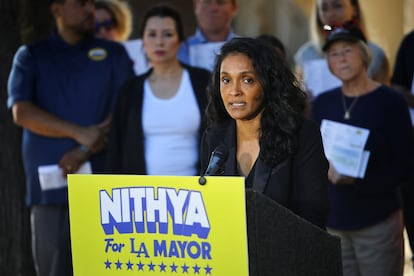
Raman also says that within her first 100 days she will hire more operators for the 911 emergency service, appoint a chief financial officer for City Hall (because the city currently has none), add a position to improve film productions in Hollywood, which have been leaving the city, and create a much-needed commission to tackle the problems facing Los Angeles International Airport, which has spent years waiting for the opening of its long-delayed automated people mover.
The 2028 Olympic Games are a central part of Raman’s platform, even though she opposed bringing them to the city not so long ago and remains skeptical about the mega sporting event set to arrive in 600 days. “I want the Olympics to succeed. But that cannot mean giving LA28 a blank check while Angelenos carry the risk,” she wrote in August on her X account, arguing that the private organizing committee, LA28, had reached “an irresponsible deal” with the city. For now, she will launch an initiative to plant 100,000 trees in the two years leading up to the Games.
Bass, by contrast, has been a strong supporter of the Games. In an interview with the Los Angeles Times, she called them “a once-in-a-lifetime opportunity to showcase Los Angeles to the world,” and argued the event is “a chance to deliver real, lasting benefits to our city and the people who call it home.”
Bass, under the shadow of homelessness and the wildfires
Beyond the Olympic Games, Bass says one of her priorities will be to push back against the mass immigration raids in a city that has been deeply affected by the hardline tactics of Immigration and Customs Enforcement (ICE) and that has repeatedly taken to the streets to protest U.S. President Donald Trump and his immigration policies.
Bass, who served in Congress from 2011 to 2022, including during Trump’s first term in office, says she will continue to fight as she did then. “The immigration raids may have left our daily headlines, but they haven’t stopped,” she told EFE.

Housing is also central to Bass’s campaign. She argues that 10,000 homes have been built during her time in office, but since she was elected in November 2022, the high cost of living and the difficulty of finding affordable housing and well-paying jobs have caused the city’s population to fall. According to census figures, Los Angeles lost 54,000 residents between July 2024 and July 2025, the steepest population decline recorded by any major U.S. city.
In a state where costs are especially high, with gasoline prices reaching as much as $10 a gallon, Los Angeles is becoming increasingly unaffordable. Nearly one in 100 residents does not have health insurance, the poverty rate stands at 16% compared with 11% for California as a whole, and homeownership remains out of reach for many: only 36% of Angelenos own their homes, compared with 56% statewide, according to census data.
But the issue that has most overshadowed Bass’s legacy, and could weigh on her re-election bid, is the Los Angeles wildfires of January 2025. During some of the darkest days in the city’s recent history, fires tore through 16,000 hectares in Pacific Palisades on the west side and in Altadena and Pasadena to the northeast. Twenty-five people died and more than 11,400 homes were destroyed. Bass was criticized for being slow to respond because she was on a minor trip to Accra, Ghana. She declared a state of emergency remotely, returned after the fires had already erupted and, upon arriving at the airport, declined to answer reporters’ questions.

Although she tried to make amends by maintaining a visible presence at shelters and alongside victims after her return, many of those affected, especially residents of the Palisades, which falls within her jurisdiction, never forgave her. During a televised debate with Raman on October 14, Bass apologized.
“There’s not a day that goes by that I don’t think of the lives lost, the families that lost their home, and the families where the home is still standing but they’re not able to be in it,” she said. The mea culpa was necessary, but the political cost for Bass will not be known until voters deliver their verdict on November 3.
Sign up for our weekly newsletter to get more English-language news coverage from EL PAÍS USA Edition
Barcelona airport halts departures as baby’s medical emergency forces plane to land
Spain’s €17bn electricity grid overhaul aims to unblock housing, factories and major investment
Calpe welcomes acclaimed Italian pianist for special autumn music festival recital


-
DGT3 weeks ago
Viral video in Spain sparks fury over drivers who ‘have no idea how to drive’
-
Automated supermarket4 weeks ago
Spain’s 24-hour shop with no tills expands to Barcelona Airport
-
News4 weeks ago
Hundreds evacuated as huge fire erupts on Spain high-speed train route
-
Keeping cats and dogs outside3 weeks ago
Spain’s pet owners face fines of up to €200,000 for animal welfare offences
-
Council tax (IBI)3 weeks ago
Barcelona plans 150% property tax increase on tourist flats ahead of 2028 ban
-
Age Concern Marbella - San Pedro2 weeks ago
Halloween lunch sells out as 51 join Marbella get-together
-
airports3 weeks ago
Travelling between Spain and Italy? The extra border checks could soon end
-
Axarquia4 weeks ago
Torrox Oktoberfest gets a 1,500sqm beer tent for four-day festival