Connect with us

%

Benidorm Tandem Mobility Scooter Ban

Published

on

benidorm-tandem-mobility-scooter-ban

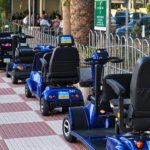
Mobility scooters getting out of hands in Benidorm. Credit: BN FB

Benidorm has taken a new step towards banning tandem mobility scooters, with the town council voting unanimously on Monday, October 26, to prohibit powered mobility chairs and scooters built to carry more than one person. The proposal is separate from the police crackdown on misuse of mobility scooters reported by the Euro Weekly News in May 2026, and would introduce an explicit ban on multi-occupant vehicles under a revised municipal ordinance. The Cadena SER report on the council’s decision confirms that the proposal has received unanimous initial approval.

Who will be banned from using the scooters?

The proposed restriction targets people using mobility scooters or powered mobility chairs specifically designed to carry more than one occupant. These specifically include tandem-style vehicles that allow couples or other passengers to travel together on a single scooter.

Holidaymakers who hire these larger vehicles could be affected, as could anyone else using a multi-person model on Benidorm’s streets and pedestrian areas.

However, the proposal is not a blanket ban on ordinary, single-person mobility scooters. Individuals who rely on standard mobility scooters because of reduced mobility are not the target of this particular change. The council has not yet published a specific list of affected models or a separate schedule of penalties for breaching the proposed restriction.

Why does Benidorm want to ban tandem mobility scooters?

Benidorm’s council says the measure is intended to improve pedestrian safety, particularly on pavements and in other pedestrianised areas where mobility scooters share space with people on foot. Mobility councillor Francis Muñoz explained that the revised ordinance is designed to bring local rules into line with national traffic legislation and strengthen protection for vulnerable road users.

The council also wants to prevent powered mobility chairs from being used as leisure or tourist transport where they were not intended to carry multiple occupants. These proposal forms part of a wider overhaul of Benidorm’s municipal Mobility Ordinance, rather than being an isolated change to scooter hire rules. According to Onda Cero’s report on the revised mobility ordinance, the changes also address road safety and the protection of pedestrians.

How will the new mobility scooter ban work?

The revised rules would expressly prohibit the circulation of powered mobility chairs constructed to carry more than one person. This measure has received initial approval from all political groups on the council who agree on the need to control the growth in popularity, and therefore risk to pedestrians. However, this is not the final stage of the process, and the precise enforcement arrangements will depend on the completed new bylaw.

Benidorm has previously stepped up enforcement against inappropriate mobility scooter use. In May 2026, the Euro Weekly News reported on police checks and warnings directed at holidaymakers hiring scooters without a genuine mobility need.

The new proposal goes even further in a different respect: it specifically addresses vehicles built for more than one occupant, rather than relying solely on existing rules governing how scooters are used.

Readers should not confuse this proposal with restrictions on electric scooters. As EWN explained in its guide to Spain’s new traffic rules for 2026, personal mobility vehicles and conventional mobility aids are subject to different rules.

When will the ban come into force?

The proposed change is not yet definitively in force. Following the initial approval on October 26, the revised ordinance must undergo a further period of public consultation lasting 30 working days, according to local reporting. The council can then proceed towards final approval and entry into force.

Until that process is completed, the existing ordinance remains the relevant set of rules. Anyone planning to hire a mobility scooter in Benidorm should check the current requirements with the rental company rather than assume the proposed ban is already being enforced. The council has not announced a confirmed date for the new restriction to take effect, but we can imagine that it will be before the next peak season.

%

Fake Rental Homes: Seven Arrested In Malaga

Published

on

fake-rental-homes:-seven-arrested-in-malaga

Malaga-based National Police. Credit: Pavel Larsson – Shutterstock

Seven people have been arrested after a criminal network allegedly tricked people looking for long-term homes in Malaga into paying deposits for properties they had no right to rent out.

Police believe around 20 people have already fallen victim to the scam, with losses estimated at €150,000. Another three people are being investigated in connection with the alleged operation.

What made the fraud particularly convincing was that the properties were real. Members of the gang would first book tourist apartments for just one day before advertising them as available for long-term rental.

They then arranged viewings, showed prospective tenants around the homes and collected money for reservations and deposits. Payments were made through Bizum, Spain’s popular mobile payment service, or bank transfers.

In some cases, the same apartment was offered to several different people on the same day, with each being led to believe they had secured a place to live.

Suspected ringleader operated from Thailand

According to the National Police investigation, reported by EFE, the organisation was based on the Costa del Sol but had an international element. Its alleged ringleader operated from Thailand, where he coordinated the fraudulent activity and recruited people in Spain to carry out the practical work.

Different members had clearly defined roles. Some published advertisements on social media and arranged appointments, while others showed prospective tenants around the apartments and collected their money. Investigators also uncovered a system involving numerous telephone numbers and bank accounts, with cryptocurrency allegedly used to launder some of the proceeds.

Benalmadena featured in the operation, with one suspect responsible for collecting money and arranging the movement of funds and apartment keys. Another allegedly received cash and converted it into cryptocurrency.

Police warn more victims could come forward

The investigation began after several complaints were received by the National Police’s Central District station in Malaga. Officers subsequently identified the properties involved and carried out operations to catch suspects in the act. Several further scams were prevented when prospective tenants arrived to reserve apartments.

Seven people have now been arrested and three others are under investigation for alleged offences including membership of a criminal organisation, fraud and money laundering.

Police believe the number of victims could increase as the investigation continues, given how many people were reportedly shown the same apartments. The case is another warning for people searching for rental accommodation in Spain. EWN previously reported on how fake landlords were targeting desperate renters across Spain, with criminals exploiting the pressure on people to find somewhere to live.

Anyone searching for a long-term rental should check the identity of the person offering the property and establish that they are the owner or have proper authority to rent it out. Paying a deposit before verifying these details can leave prospective tenants seriously out of pocket.

For more home renting advice, see EWN’s guide to avoiding rental scams in Spain.

Continue Reading

%

Expert Expat’s Guide To Getting It Right At The Hospital

Published

on

expert-expat’s-guide-to-getting-it-right-at-the-hospital

Hospital Costa del Sol. Credit: Junta

Visiting a large Spanish hospital for the first time can be a daunting experience, particularly if you are not confident speaking Spanish. But a little preparation can make all the difference, according to British expat Steve Marshall, who has put together a practical guide to help English-speaking residents navigate their way around the Hospital Universitario Costa del Sol near Marbella.

Steve says, “Getting older often means more frequent visits to doctors and hospitals. While appointments at a local health centre may be relatively straightforward, larger public hospitals can be confusing, busy and difficult to navigate, especially when language becomes a barrier.”

Steve’s guide focuses on the Hospital Universitario Costa del Sol, situated just off the A-7 at kilometre 187, near Marbella. His message is simple: “be prepared, know where to go and don’t be afraid to ask for help.”

Here is his step-by-step guide.

1. Prepare before leaving home

Having the right paperwork and information with you can save considerable time and frustration.

Steve recommends taking:

  • Your hospital appointment letter or SMS confirmation.
  • Your Spanish health card, TIE or passport.
  • A list of your current medicines and their dosages.
  • Any recent X-rays, test results or relevant medical paperwork.
  • A written list of your main medical concerns.

One particularly useful tip is to use Google Translate to produce a Spanish version of your medical concerns. This gives you something to show your consultant if communication becomes difficult.

Steve also advises checking that your mobile phone is working and fully charged. Take some water, a face mask if you prefer to wear one, and allow plenty of time to get there.

2. Finding the hospital

The hospital has been extended and, according to Steve, visitors should use the new entrance at the front of the extension rather than looking for the former main entrance. There is free parking available, while public transport provides alternatives for those without a car.

From Fuengirola:

  • Take the M-220 bus.
  • Get off at Los Monteros.
  • Walk approximately 350 metres to the main hospital entrance.

From Marbella:

  • Check the timetables for bus lines 6, 12 and 13.

Steve recommends checking current bus services before setting off, as routes and timetables can change.

3. Checking in: where to go first

Once inside the hospital, turn right towards the reception area. For English-speaking patients, Steve recommends looking for the desk marked with a Union Jack flag. This is where patients can seek assistance if they are unsure about their appointment or where they need to go. Wheelchairs are also usually available near the entrance.

If you already know where you are going, the automated check-in consoles offer another option:

  1. Do not check in more than 30 minutes before your appointment.
  2. Select ‘English’ in the top right-hand corner of the screen.
  3. Enter your NIE number.
  4. Collect your numbered ticket.

Large directory notices on the walls help visitors find their way around.

Still unsure? Take your ticket to the member of staff at the Union Jack desk. Steve says patients can also request a free interpreter service there if needed.

4. Finding your consultation room

Once checked in, follow the directions to your designated waiting room.

Find your room number and take a seat. A television screen will display patient identification numbers, corresponding to the numbers printed on the tickets issued at reception.

Keep an eye on the screen. When your number appears, it is time to go into your consultation.

5. During and after your appointment

Consultations usually involve both a consultant and a nurse. Steve says most consultants he has encountered speak English, although this is less common among nursing staff.

Patients are normally given a written medical report in Spanish after their consultation. If you do not have an interpreter with you, your smartphone can be particularly useful.

Steve recommends using the translation app on your phone to:

  • Translate the written medical report into English.
  • Help you understand.

Continue Reading

%

Barcelona Airport Halts Departures As Baby’s Medical Emergency Forces Plane To Land

Published

on

barcelona-airport-halts-departures-as-baby’s-medical-emergency-forces-plane-to-land

The aircraft was directed to park very close to the runway exit. Photo credit: Santi Rodriguez/Shutterstock

A flight to your holiday destination is unlikely to go exactly to plan if you end up making an unscheduled stop in another country. But for one family travelling with a baby, the diversion to Barcelona was not an inconvenience or a change of travel plans. It was an urgent race to get their child medical attention.

The aircraft was flying from Casablanca in Morocco to Istanbul in Turkey when the crew reported that an infant, just a few months old, needed urgent medical assistance. The flight was diverted to Barcelona-El Prat on Sunday, November 8, so the baby could be taken off the plane and transferred for treatment.

A medical emergency thousands of feet above the ground

There was no option to continue towards Istanbul and wait until the aircraft reached its scheduled destination. The crew requested an emergency diversion to Barcelona after reporting that the baby had medical problems requiring immediate attention.

The child’s condition has not been disclosed, and there is no information about whether the baby became unwell during the flight or had an existing medical problem. What is clear is that the crew considered the situation urgent enough to change course and request priority landing at another airport.

Barcelona airport gives the aircraft priority

Air traffic controllers coordinated a direct approach to runway 24L, allowing the aircraft to land as quickly as possible. The runway is closest to the sea and is normally used for take-offs, rather than arrivals. The airport also had to consider the amount of fuel still on board and the aircraft’s weight before the landing. Once the arrangements were made, the flight was given priority, with other movements adjusted to leave the runway clear.

The emergency landing briefly disrupted normal operations at Barcelona-El Prat. Take-offs were stopped temporarily, while other aircraft waiting to land were held until the diverted flight had safely touched down. The reports do not specify how many flights were affected or how long the interruption lasted, but the pause allowed the aircraft carrying the baby to land without competing with other movements.

Ambulance ready to take baby from the plane

Getting the aircraft onto the ground was only part of the operation. The next priority was making sure medical staff could reach the baby without having to wait for the plane to taxi across the airport. After landing, the aircraft was directed to park very close to the runway exit.

This allowed emergency personnel to get to the plane quickly and carry out the evacuation, with the baby taken away by ambulance for medical attention. The positioning was arranged specifically to speed up access for the medical teams. Rather than following the usual route to a stand or terminal, the aircraft stopped in a location that allowed the infant to be transferred as soon as possible.

Controllers send message of support

Spain’s air traffic controllers confirmed the incident in a post on X, explaining that the crew had requested an urgent diversion because of the baby’s medical problems. They also thanked the flight crew, medical staff and airport operations personnel who helped coordinate the response. Their message ended with a wish for the baby to recover soon and well. It was a brief acknowledgement of the people involved in an operation where every minute mattered to the child waiting for medical care.

La tripulación del vuelo Casablanca Estambul solicita desviarse de urgencia al aeropuerto de Barcelona 🛬 Hay un bebé de apenas meses a bordo con problemas médicos que requieren atención urgente 👶🚨

Coordinamos aproximación directa a la pista 24L, la más cercana al mar y usada para despegues 🛫 Para ello, nos aseguramos de que podrán tomar y, una vez hecho, paramos despegues y hacemos esperar momentáneamente a los aterrizajes.

Una vez en tierra, se les facilita estacionamiento muy cercano a la salida de pista 🚑 Ahí, los servicios médicos pueden llegar se inmediato y realizar la evacuación. Reanudamos operativa.

Esperamos que el pequeño se recupere pronto y bien ❤️‍🩹
Gracias a todos los implicados en el operativo; personal sanitario, tripulación, operaciones…

#emergencia #atc #aviacion #airtrafficcontrol

— 😉Controladores Aéreos 🇪🇸 (@controladores) November 8, 2026

There has been no further public information about the baby’s condition, the treatment received or which hospital the ambulance took the infant to. The airline has also not released details about arrangements for passengers continuing to Istanbul. The aircraft’s diversion brought the journey to an unexpected halt in Barcelona, but the reports have not confirmed whether the flight later continued to Istanbul or what happened to the passengers. The baby’s condition also remains unknown.

Continue Reading

Trending

Copyright © 2017 Spanish Property & News