
ElPais
Dominique Lagorgette, Philologist: ‘Solidarity Among Women Is The Only Way To Win More Rights’



Argentina
Javier Bardem Addresses Controversy Around The World Cup Final: ‘Milei Is Not All Of The Argentine Population’



A round of applause from lawmakers marked the approval in Spain’s Congressional Justice Committee, convened in an extraordinary session, of a bill granting Spanish nationality to Sahrawis born when the African territory was still a Spanish colony, and to their descendants. The result of the vote clears the path for the future law, although it still must be approved by the lower chamber of parliament—the vote is scheduled for September—and then pass the Senate.
The bill opens up Spanish nationality to all those born in the former Spanish colony before September 29, 1977, even if they are not currently legal residents in Spain. The date was chosen because it was the summer of 1977 when the deadline for Sahrawis to opt for Spanish nationality expired — a right they were effectively unable to exercise because their territory was already being occupied by Morocco and Mauritania at that time.
The dispute over Western Sahara has been affecting diplomatic relations in the Maghreb region since 1975, when Spain gave up what was once its 53rd province. Considered by the United Nations a non-self-governing territory, Morocco controls much of the territory de facto, while a Sahrawi government-in-exile operates out of Tindouf, in Algeria. The issue extends beyond these countries: Morocco agreed to reopen its diplomatic mission in Tel Aviv in 2020, as part of the Abraham Accords signed during Donald Trump’s first term. In return, the U.S. president recognized Moroccan sovereignty over Western Sahara. Last year, the U.S. government said it was preparing to authorize major investments by its companies in the Morocco-controlled parts of Western Sahara.

The move to grant citizenship to Sahrawis is the latest in a series of similar initiatives by the Spanish government. In June 2022, the so-called “Grandchildren law” allowed descendants of Spaniards who went into exile or emigrated during the Spanish Civil War and dictatorship to apply for citizenship.
In this week’s vote in Spain, the bill obtained far more support than expected: 19 votes in favor and three against (from the far-right party Vox), with 15 abstentions from the mainstream conservatives of the People’s Party (PP).
Despite the outcome, the session was not without intrigue: the Socialist Group submitted two last-minute amendments on Wednesday to remove references in the bill’s preamble to the “Sahrawi people” and replace them with “Sahrawi population” or simply “Sahrawis,” with the aim of avoiding offense to Morocco. Instead, the amendments upset its leftist parliamentary partners. The two amendments were voted on separately and defeated.
Proving their status
To prove Sahrawi status, applicants may show a variety of documents, including a receipt proving registration on the United Nations roll for the Western Sahara self-determination referendum (which never took place because Rabat refused to allow it); a driver’s license; a pension payment receipt; and any other document issued by a Spanish administration showing birth in the territory before September 29, 1977.
After the law takes effect, those born when Western Sahara was a Spanish province will have a three-year window, extendable to four years, to submit the corresponding application.
The law will allow roughly 70,000 Sahrawis to become Spanish citizens, but also their direct descendants in the first degree of consanguinity, who will have five years, after their parents are registered in the civil registry, to apply for Spanish nationality. The initiative’s sponsors estimate that, on average, this could raise the number of potential beneficiaries to between 100,000 and 200,000 people.
Furthermore, Sahrawis will also be able to access nationality by residence via an accelerated route, needing only two years of legal residence in Spain instead of the 10 years generally required, putting them on par with citizens from Ibero-American countries, Sephardic Jews and nationals of the Philippines, Equatorial Guinea and Portugal.
Sign up for our weekly newsletter to get more English-language news coverage from EL PAÍS USA Edition
Africa
‘Caporalato’, The System That Enslaves Thousands Of Migrants In Italy’s Fields: ‘If You Don’t Do What They Ask, They Threaten To Set You On Fire’


When Tazeeb Tazeeb arrived in Italy in 2021 after fleeing Pakistan —where he had received threats for his work as a journalist— and walking the Balkan route, he thought he had left his troubles behind. He found work in the fields of the Veneto region alongside other countrymen, and accepted a contract he barely understood. “It says here you have to do what I tell you,” the foreman who had acted as the intermediary to get him the job kept telling him. That was the first red flag.
For months, the 29-year-old woke up at 4.00 am to work the grape harvest and perform other farm tasks. At times he worked 12-hour shifts for weeks on end. “You couldn’t get sick, you couldn’t rest. The only rule was to work and shut up. There was always someone watching us,” he recalls.
He shared housing provided by the foreman, with mattresses spread across the floor: “It was a house for four people and 20 of us lived there.” They picked grapes with their bare hands. “They didn’t give us gloves, goggles or boots. Each worker had to buy their own shears and protective gear,” he continues. They also had to pay five euros a day for getting a ride to the fields.
The promised pay never arrived. The intermediary gave them some food and reminded them he was covering their lodging. “At first they paid us three or four euros an hour. Then, for eight months we were paid nothing. We discovered that the employer had already handed our wages to the intermediary, but we still hadn’t been paid,” the day laborer explains.
Threats were part of the routine. “If you didn’t do what they asked without complaining, they threatened to set you on fire,” Tazeeb says. Only when he and other coworkers went to the union did they uncover the deception: the contract listed barely 10 hours of work per week.
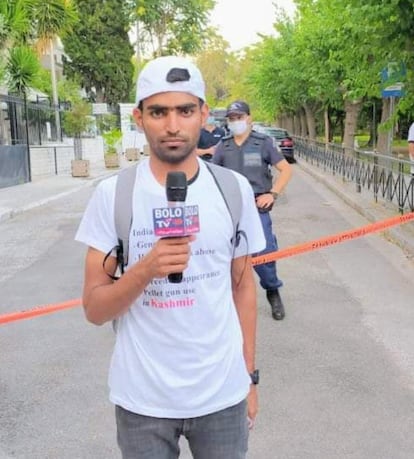
Tazeeb had become one of the many victims of the so-called caporalato in Italy, the illegal labor brokerage system in which foremen or recruiters supply agricultural companies with labor under exploitative conditions. Under this system the capo organizes the recruitment, transportation, housing and even salary payments, often keeping part of the wages, which gives them enormous power over workers.
Foreign victims
Although the phenomenon historically also affected many Italian workers, for years now the majority of victims have been foreigners, especially from Africa, Asia and Eastern Europe. They are often in a more vulnerable position because of language barriers, irregular legal status and a lack of support networks. “They always look for people who don’t speak Italian well and don’t know their rights. They take advantage of people who need to work. Whoever has just arrived in Italy almost always ends up in agriculture because, without papers, they have no other option,” Tazeeb explains.
According to the latest report from the Placido Rizzotto Observatory, linked to the FLAI-CGIL union, about 240,000 people are exposed to caporalato and other forms of labor exploitation in Italian agriculture, almost a quarter of the sector’s workforce. More than 70% are non-EU citizens and around 50,000 are women.
Jean-René Bilongo, president of the Observatory, stresses: “Caporalato turns people into objects and discards them when they are no longer useful. It is a form of modern slavery and a grave wound to the culture of work.”
Tazeeb was one of the first migrant seasonal workers to denounce the abuses he suffered, almost four years ago. Although the courts ruled in his favor and he now has a residence permit, the process was long and tortuous. He still works in the fields but also runs a small agricultural cooperative he set up with several colleagues: with it he has replaced the intermediary or capo and tries to secure for other day laborers the conditions he never had.
However, he says the system continues to haunt him. The prices many employers are willing to pay barely cover wages, taxes and social contributions. “If I accept those conditions, I can’t work legally,” he says. After years in the Italian fields, he feels he still hasn’t escaped the web of precariousness and exploitation that feeds caporalato: “Many employers tell me that other Pakistanis or Indians accept working for less. I’ve only found one or two people who pay fairly. I’ve only once been able to send money to my family,” he laments.
When, on June 1, 2026, four migrant day laborers were brutally killed in Calabria —burned alive inside a car— many asked again how it was possible that, in mid-2026, labor exploitation remains so widespread in Italy’s fields. Yet those who have long investigated the phenomenon say that tragedy was not an exception but the most extreme manifestation of a system that continues to affect tens of thousands of people.

For Marco Omizzolo, a sociologist at Sapienza University, a researcher at Eurispes and one of Italy’s leading experts on the subject, the main reason caporalato persists is as simple as it is forceful: “Because it is convenient. It’s economically profitable.” Added to that, he explains, is a widespread sense of impunity. “Many employers who exploit migrant labor are convinced they will never be inspected or that controls will be minimal,” the researcher laments.
Omizzolo knows that reality from the inside. After more than two decades studying the phenomenon, he lived for almost two years with Indian day laborers and even infiltrated as an agricultural worker to document the system from within. “We worked 14 to 16 hours a day for wages that in some cases barely reached €300 or €350 a month,” he recalls.
If a decade ago caporalato was more visible, today it has taken on much more sophisticated forms. “It’s no longer what it was in 2011, but it has shown an extraordinary capacity to adapt,” says Yvan Sagnet, founder of the No Cap organization and a former day laborer. Sagnet led the historic 2011 Nardò strike, the first large protest by migrant day laborers in Italy, a milestone that put the phenomenon at the center of the national debate and opened the way to initial legal reforms. “Today exploitation hides behind fake cooperatives, subcontracting or apparently legal mechanisms. Social tolerance has decreased and inspections have increased, but it’s still there,” he says.
In Calabria, thousands of workers still live in shacks, abandoned buildings or improvised camps. Doctors for Human Rights (MEDU), one of the organizations that assists migrant agricultural workers in southern Italy, regularly documents housing without running water, electricity or adequate sanitation. In some cases waste is burned in the open air and seasonal workers cycle several kilometers to reach fields along unlit roads.
Medical teams commonly find respiratory illnesses, dermatological problems, muscle disorders and work-related injuries that sometimes require hospitalization. “It’s necessary to stop treating caporalato as a permanent emergency and accept that it is a structural problem of the Italian agricultural system, which feeds on the vulnerability of thousands of workers. Rights, protection and decent living conditions must be guaranteed to those who sustain one of the country’s main productive sectors,” says Martina Castelli, national coordinator of MEDU.
Omizzolo has also documented an even more extreme reality. Since 2014 he has investigated agricultural workers forced to use opiates, methamphetamines and other stimulants to endure punishing workdays. One worker explained his situation to him this way: “Without those substances I can’t work. If I can’t work, I can’t eat. If I can’t eat, I can’t support my family. I’m forced to drug myself to survive.” “Society defines itself as democratic and constitutional, but it produces the contemporary slave,” the researcher notes.
Italy approved a specific law against caporalato in 2016 that expanded judicial tools to fight labor exploitation. Although it was an important step forward, it remains insufficient to eradicate the phenomenon. “Inspections are too sporadic,” Yvan Sagnet says.
“Agromafias”
The mafias have found a business in caporalato. Researchers and unions have for years denounced that local clans and foreign criminal intermediaries operate in a coordinated way. The sole survivor of the Calabria massacre, currently under police protection, told investigators there was a large Pakistani mafia network behind control of agricultural labor.
Tazeeb shares that perception and says he has heard intermediaries boast about their ties to local clans and claim the seasonal workers’ complaints did not worry them. “Italian mafias and some foreign intermediaries work together. And when they work together, the ones who always suffer are the workers,” he stresses.
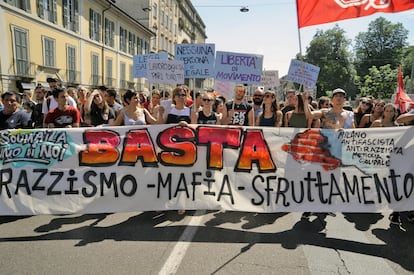
According to the latest report from Eurispes, one of Italy’s main socio-economic research institutes, mafias infiltrated in the agri-food sector —known as “agromafias”— now move more than €25 billion a year through activities such as caporalato and labor abuses, food fraud, control of logistics and diversion of public funds.
Omizzolo explains that in certain agricultural areas “the territory is better controlled by the mafias than by the state.” In that context, he argues, some employers find it more useful “to maintain a relationship of favor with the mafias than a relationship of law with the state” to exploit workers with total impunity.
Bilongo insists that the vast majority of Italian growers comply with the law, but warns that there is a core of employers and intermediaries who exploit the system’s gaps and the vulnerability of agricultural employees to keep that abusive practice alive.
The murder of the four day laborers in Calabria has once again put the phenomenon at the center of Italy’s political and social debate. The country’s main farm organization, Coldiretti, has called for stepped-up inspections, guarantees of decent working and living conditions for seasonal workers and protection for the vast majority of farmers who obey the law. Meanwhile, Agriculture Minister Francesco Lollobrigida has promised “zero tolerance” for those who exploit workers. “They are not employers, they are criminals,” he said, adding that caporalato amounts to unfair competition for producers who follow the rules. The government has announced an increase in inspections against labor abuses.
Sign up for our weekly newsletter to get more English-language news coverage from EL PAÍS USA Edition

Los Seis Candidatos A Liderar La ONU Protagonizan Un Debate De Guante Blanco Sin Un Vencedor Claro

Man Arrested For Assaulting Six-Month Pregnant Partner At Malaga Airport
Selling in Catalonia just got slightly easier: One pointless obligation has been scrapped


-

 New Developments2 weeks ago
Stylish 3-Bedroom Apartment With Panoramic Sea Views – Benalmádena
-

 New Developments2 weeks ago
Luxury Villas For Sale, Estepona – ProjectL1
-

 Uncategorized2 weeks ago
F1 season ticket announced for 2027 and it
-

 Bélgica2 weeks ago
Bélgica No Logra Repetir La Gesta De 1986: “Pero Hemos Jugado Bien”
-
News from Spain2 weeks ago
Spain is about to get a rare six planet show and most people won’t even know it’s happening
-
Air passenger rights2 weeks ago
Booked your flight through an online travel agency? New EU rules could make refunds much easier
-
Bet2 weeks ago
Norway lost the match, but won the internet with airline Instagram bet
-

 Amazon7 days ago
El Escurreplatos De Dos Niveles Que Libera Espacio En La Cocina Está Rebajado Más De Un 50%