Its detractors call it the Eye of Sauron, and its defenders, “the guardian of Chihuahua.” The Sentinel Tower is a multi-million-dollar investment, a borderland’s bet on security. It’s the tallest building in Ciudad Juárez, that which best represents the fear of mass surveillance. And this week, it became a new battlefield in the political war between Mexican President Claudia Sheinbaum’s left-wing administration and the state government of the right-leaning political party PAN’s Governor Maru Campos. At 25 stories, the tower has come under scrutiny after the brutal car crash in which two CIA agents and two officials who were part of Chihuahua’s State Investigation Agency were killed. The death of the foreign agents, whose presence was unauthorized by the federal government, has led to the latest battle between the Morena administration and one of the few states still governed by an opposition party in Mexico. Since then, there’s been one question on everyone’s minds: how far is Donald Trump’s reach via operatives in Mexico, thanks to the country’s state governments?
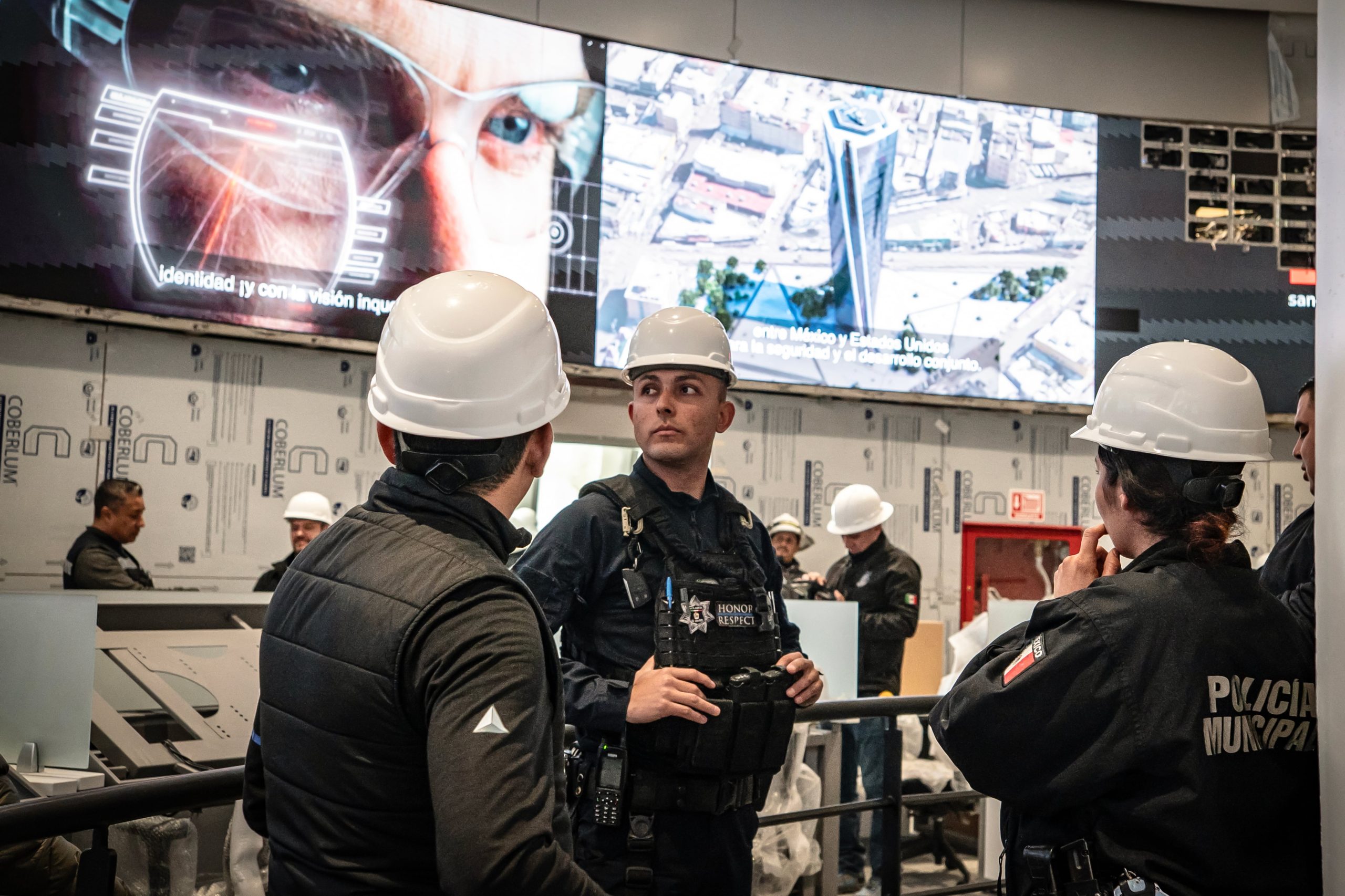
The 18th floor of the Sentinel Tower is reserved for “something very interesting, very innovative,” Jorge Muro, director of the C7 Command Centers for Chihuahua’s Public Security Secretariat, told EL PAÍS on a January visit to the building, which was still under construction. “It’s where the national agencies will be — that is to say, all the national, state, and municipal forces, and the international agencies,” said the official. “Those international agencies will be everything from U.S. Customs and Border Patrol; the Bureau of Alcohol, Tobacco, Firearms and Explosives; part of the Attorney General’s Offices of Texas and New Mexico, with whom we have an excellent relationship; the El Paso police, with whom we obviously have a lot of coordination, communication and with whom we share information; and El Paso 911.”
Muro says that the building was going to house “their staff,” but then clarified: “It doesn’t at all enter into whether they will be in our database or us in theirs, no, no. They are simply going to work with their own tools, but from here. This coordinated work will allow us to have better coordination in real time. Because now we do have that coordination, but you have to call them, and then they have to consult… so time can be lost.” These declarations from the state official revealed a common practice in the border state: deep-seated collaboration with the United States.
This information had been practically unannounced until, at two in the morning on a Sunday, just under 500 miles from Ciudad Juárez, an official vehicle plunged down a ravine in the remote Sierra Madre Occidental. Now, under intense scrutiny, President Sheinbaum has commented on the presence of the agencies: “You request authorization, and it is confirmed with the Security Cabinet or with the National Security Council whether it is relevant and what kind of collaboration it should be, in order for a state government to be able to authorize it.”
Details of the operation
In the dawn of April 19, a convoy of five vehicles traveled from the town of Morelos to the city of Chihuahua. One of them skidded while driving through a mountain pass, falling 650 feet and killing all of its passengers. They were director of the State Investigation Agency Pedro Román Oseguera Cervantes, agent Manuel Genaro Méndez, and two CIA agents. They were coming back from having dismantled one of the most notorious narco-laboratories in Mexico. The Chihuahua attorney general, César Jáuregui, tried to deny the fact, but President Sheinbaum confirmed without a doubt that the four agents were “working in collaboration.”
Further details of the operation have not come from official sources, not the state government — which maintains its version that the Americans were drone instructors and that the State Investigation Agency was just assisting them with transportation to the capital — nor the federal government, which says that it doesn’t even know which agency they belonged to. It was The Washington Post and The New York Times that revealed a couple of days after the accident that the two dead agents were CIA officials. Later, the Los Angeles Times elaborated that the agents were even wearing State Investigation Agency uniforms and that there hadn’t been two of them, but rather four, who had been traveling in two different vehicles. The other two agents descended into the ravine hoping to save their coworkers, but it was “too late.”
Mexico’s Law of National Security states that foreign agents can only “enter the country temporarily for the purpose of exchanging information” and requires them to be accredited by the Security Secretariat, plus those of Defense, Foreign Relations, and the Navy. “The carrying out of any meeting, exchange of information, telephone calls, or communications with foreign agents” requires states and municipalities to send a written report within three days to federal authorities. In addition, a representative from the Foreign Ministry must always be present at such meetings.
The president says that none of this protocol was followed with the U.S. agents in Chihuahua. In fact, she sees the situation as having violated the Constitution and the Law of National Security. “We do not accept their participation in the field, in the operations. We have made it very clear,” said Sheinbaum, who since Trump’s return to the White House, has often invoked the defense of national sovereignty in response to the Republican’s interventionist tendencies.
The state government tried to shield itself by using the fact that the Secretariat of Defense participated in the operation, but Sheinbaum has rejected that argument, saying: “Evidently, Defense did not know there were people who were participating who were not Mexican citizens and who were not part of the security agencies of the state of Chihuahua.” In the face of these allegations, Governor Campos announced on Friday that she will “immediately” create a specialized unit to investigate the events that took place between April 17 and 19, including both the drug lab raid and the car accident. The purpose of this unit, which will be led by the former special prosecutor for Crimes Against Women, Wendy Paola Chávez Villanueva, is meant to “consolidate the investigative files related to the events,” “gather all the information, and shed light on the events.” Campos has made it clear that she will not make any further statement on the matter as long as the investigation remains active.
The eyes of the border
Even during her latest press conference, in which the PAN governor appeared to be trying to keep her head above water amid the scandal, Campos emphasized that she will maintain “whatever cooperation is necessary to fulfill the mission of ensuring peace” in the state in the face of crime.
Campos has made the fight against organized crime one of her government’s central crusades, and one symbol of that campaign has 25 floors and a helicopter landing pad. The Sentinel Tower is the visible face of a larger project called Sentinel Platform, which has cost the state more than $230 million. Its cost has been harshly criticized by civil society organizations, in addition to its incorporation of biometric data, artificial intelligence, and thousands of cameras.
Muro told this publication that there are currently 10,000 cameras installed throughout the state, a third of them in Ciudad Juárez, where 60% of crimes take place. They consist of fixed cameras, 360-degree cameras, and license plate readers. But that’s not all: the Platform also has the ability to request and connect to private cameras, which expands its capacity up to 30,000 devices.
Since its founding, the Sentinel Platform has been presented as a tool for collaboration with the United States. “The States have a mutual interest in ensuring that their shared border is secure,” was among the statements signed by Campos in an April 2022 memorandum of understanding with Texas Governor Greg Abbott. In a presentation, the Mexican governor’s administration added, “The state of Texas will be able to have eyes on this side of the border.” This had led Abbot to describe the PAN-led strategy as “the best border security plan of any Mexican governor.” The collaboration aroused doubts among experts when it was signed into effect four years ago, given that such agreements are typically the purview of the federal government. Now, the question has enveloped the Chihuahua government.




















 New Developments3 weeks ago
 Andalucia4 weeks ago