
Benjamin Netanyahu
Israel, A Divided Nation, Relives The Pain Of The 2023 Hamas Attacks

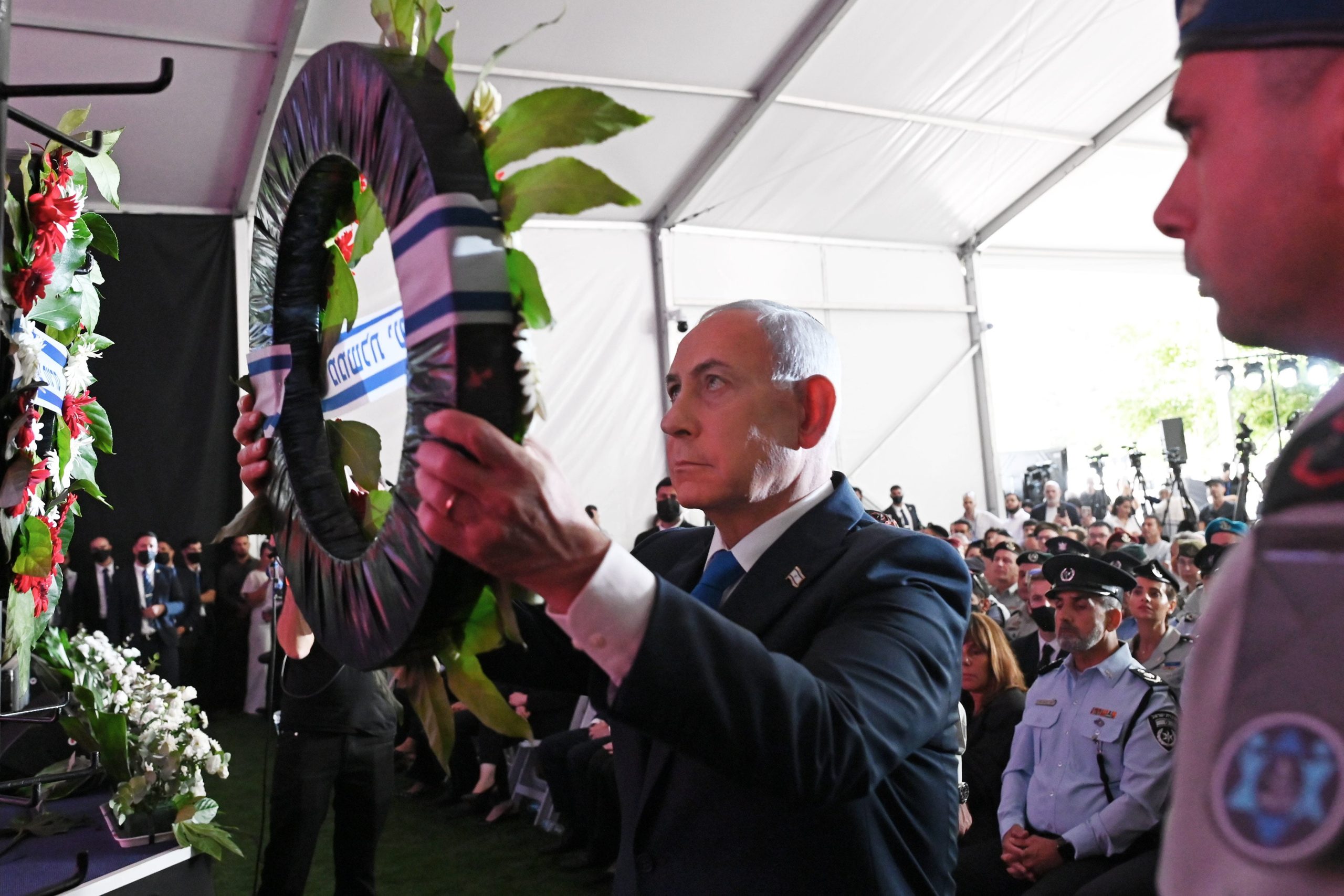
Benjamin Netanyahu used an official event commemorating the victims of the Hamas-led October 7, 2023 attacks (held on Monday, according to the Hebrew calendar date) to accuse the world of spreading “blood libels” about Israeli actions in Gaza.
Suddenly, Yaakov Godo, who that day lost his son Tom (killed by Israeli fire, as was determined two years later), approached and interrupted the speech: “You didn’t protect my son on October 7th; you didn’t protect 1,200 victims murdered in one day. Shame, disgrace!”
— “Sabine Tassa, of Netiv HaAsara, lost…” Netanyahu tried to continue.
— “I lost someone too,” the father replied, wearing a T-shirt bearing a photo of his son.
The scene reflected how the deadliest day in Israel’s history (with more than 1,200 people killed) and its greatest security failure — only comparable to the surprise at the start of the Yom Kippur War in 1973 — continues to shape the national debate three years on.
Television, radio, and newspapers have spent days recalling stories of heroism, loss, and pain from that day, which left the country in a state of shock and sharply accelerated a two-decade shift: toward the right, toward religion, toward the dehumanization of Palestinians and the normalization of genocidal rhetoric and support for ethnic cleansing, even among the country’s own Arab minority.
Over these past three years, the Middle East has taken a violent turn. Scenarios once considered unlikely, such as a direct confrontation between Iran and Israel (which had been fighting a shadow war through third countries, cyberattacks, and covert operations), have materialized up to four times — especially last February.
The weakening of Hezbollah, after Mossad detonated thousands of explosive charges in pagers the Lebanese militia had ordered, contributed to the fall of Bashar al-Assad’s regime and the end of nearly 14 years of civil war. Israel now faces an open genocide case at the Hague and a prime minister subject to an arrest warrant from the International Criminal Court for alleged war crimes and crimes against humanity in Gaza, where it has not achieved its stated objective: Hamas still controls more than 40% of the Strip.
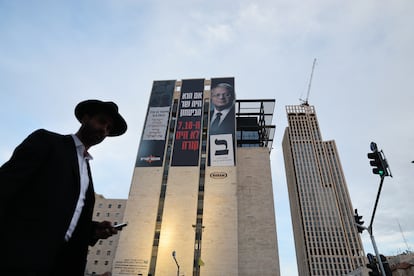
However, the central issue in the imminent elections is not the present. The vote on October 27 is, above all, about October 7, 2023 and Benjamin Netanyahu’s political responsibility. Even the far-right minister Itamar Ben-Gvir uses it for campaigning. He has put up a billboard in Tel Aviv bearing his face and the words: “If he had been defense minister [the post he has already said he wants], October 7 would not have happened.” In fact, on that day he was minister of national security, the post that oversees the police.
The symbolism of both dates falling in the same month is not lost on many. An online campaign against Netanyahu displays the date 7.10 in blood-red with a 2 added at the front, set against a background of graves and the caption: “The Day of the Fallen.”
“If they had woken me”
Netanyahu is the only senior political or military leader from that day who has not resigned or offered self-criticism. He generally retreats to a vague reference to collective responsibility before promoting the theory that security officials did not wake him that morning because they feared the response he would order. “If they had woken me up, everything would have looked different,” he has said. Unlike then–prime minister Golda Meir (who resigned over the Yom Kippur failure, even though a commission absolved her of direct responsibility), Netanyahu remains in power, is standing for re-election, and has spent the past three years blocking an independent commission from investigating the security errors.
“When he chose the election date — and many advised him not to hold them in October — he did so because he thought the impact of the massacre would have diminished, that three years had passed and everyone’s positions would already be set,” but “the question of responsibility for what happened on October 7 remains a deeply felt issue for Israeli society,” political commentator Daphna Liel of Israeli national television Channel 12 analyzed on Sunday. “The significant point is that public opinion is still finalizing its position.”
Today, according to a poll released Tuesday by that channel, 65% of Israelis consider Netanyahu “largely” responsible — with another 22% saying “to some extent” — for the October 7 security failures, driven by an arrogant strategic view toward the Palestinians focused on managing the conflict rather than resolving it. Warnings from the United Arab Emirates and Egypt were ignored, about 100 soldiers on the Gaza border were relocated days earlier to the West Bank (where settler violence had been increasing), and military commanders treated warnings from female soldiers in control towers with chauvinistic condescension.
Pollsters asked voters in Netanyahu’s coalition — among his party, Likud, the far right, and the ultra-Orthodox — whether “the failure of October 7 and its repercussions” had made them reconsider voting for them. Thirty-three percent said “to a large extent,” 22% “to some extent,” and 41% “not at all.”
Instead of a commission of inquiry, Netanyahu proposes vengeance. After the October 7 attacks, the Israeli security agency, Shin Bet, and Mossad, the intelligence agency, formed a special unit called Nili (an acronym drawn from a biblical verse) dedicated to tracking down and killing anyone who had entered Israel that day. When its creation leaked a month after the attack, reports said it would target roughly 2,500 members of the Nukhba forces, Hamas’s most highly trained units who led the assault. The plan resembled Mossad’s international campaign to kill the Palestinians responsible for the murder of 11 Israeli athletes at the 1972 Munich Olympics.
Last Sunday, according to a leak of a political-security cabinet meeting, the head of the army’s Intelligence Directorate, Shlomi Binder, said they have already killed about 4,000 of the 6,000 Gazans who crossed into Israeli territory on October 7. As can be seen in videos from that day, not all were militants: some were civilians celebrating the attack or the breaching of the border barrier, or taking advantage to loot.
“Anyone who was involved in the attack against us, anyone who held our hostages, has their days numbered. We will find them, as we found others. Day after day, we settle accounts with these despicable murderers,” Netanyahu said Monday in his speech.
National security
Gayil Talshir, an expert on Israeli politics at the Hebrew University of Jerusalem who has extensively studied the Netanyahu era, explains that the prime minister is trying to make national security “the main issue of the elections,” even though, a priori, it would be a weak point for him: the surprise attack occurred during his term and had been enabled by a policy that kept Hamas in power in Gaza to fragment Palestinians geographically and politically and weaken the Palestinian Authority, so Israel would not have to negotiate the creation of a Palestinian state. “His narrative is that Israel managed to regroup after the attack, wage a war with Iran alongside the U.S., and, basically, change the situation, with the army controlling security zones in Syria, Lebanon, and Gaza,” Talshir says by phone.
He illustrated it last month in a speech to a half-empty UN General Assembly: “We didn’t collapse. Instead, we rose and fought like lions.”
That animal, recovering from its wounds in Netanyahu’s metaphor, is today the worst-rated country in the world, with an average perception score of minus 24 — five points below the next two on the list: North Korea and Afghanistan, according to the Democratic Perception Index released in May by global public-opinion analyst Nira Data.
It is visible daily across cultural and sporting spheres. The most recent example: the return leg of a UEFA Nations League fixture in Serbia between Israel and Ireland. Irish players (from one of the EU’s most pro-Palestine countries) wore black armbands for the more than 74,000 dead in Gaza and bowed their heads when the opposing anthem played.
UEFA is investigating whether an Israeli player spat at the Irish coaching staff during halftime. The press conference ended in chaos: they abruptly removed the microphone from an Israeli journalist after he claimed an Irish player called the opponents “monkeys.” Another Israeli reporter asked Ireland coach Heimir Hallgrímsson why “they support people” whose “ideology is based on murder.” Hallgrimsson is calling for the two teams never to be drawn against each other again, as happens with teams from countries at war, past or present — such as Russia and Ukraine; Armenia and Azerbaijan (over Nagorno-Karabakh); or Serbia and Kosovo.
Sign up for our weekly newsletter to get more English-language news coverage from EL PAÍS USA Edition









Allianz
Culture Refocuses Attention On The Palestinian Cause: ‘It Has Always Been Central To Political Struggle’

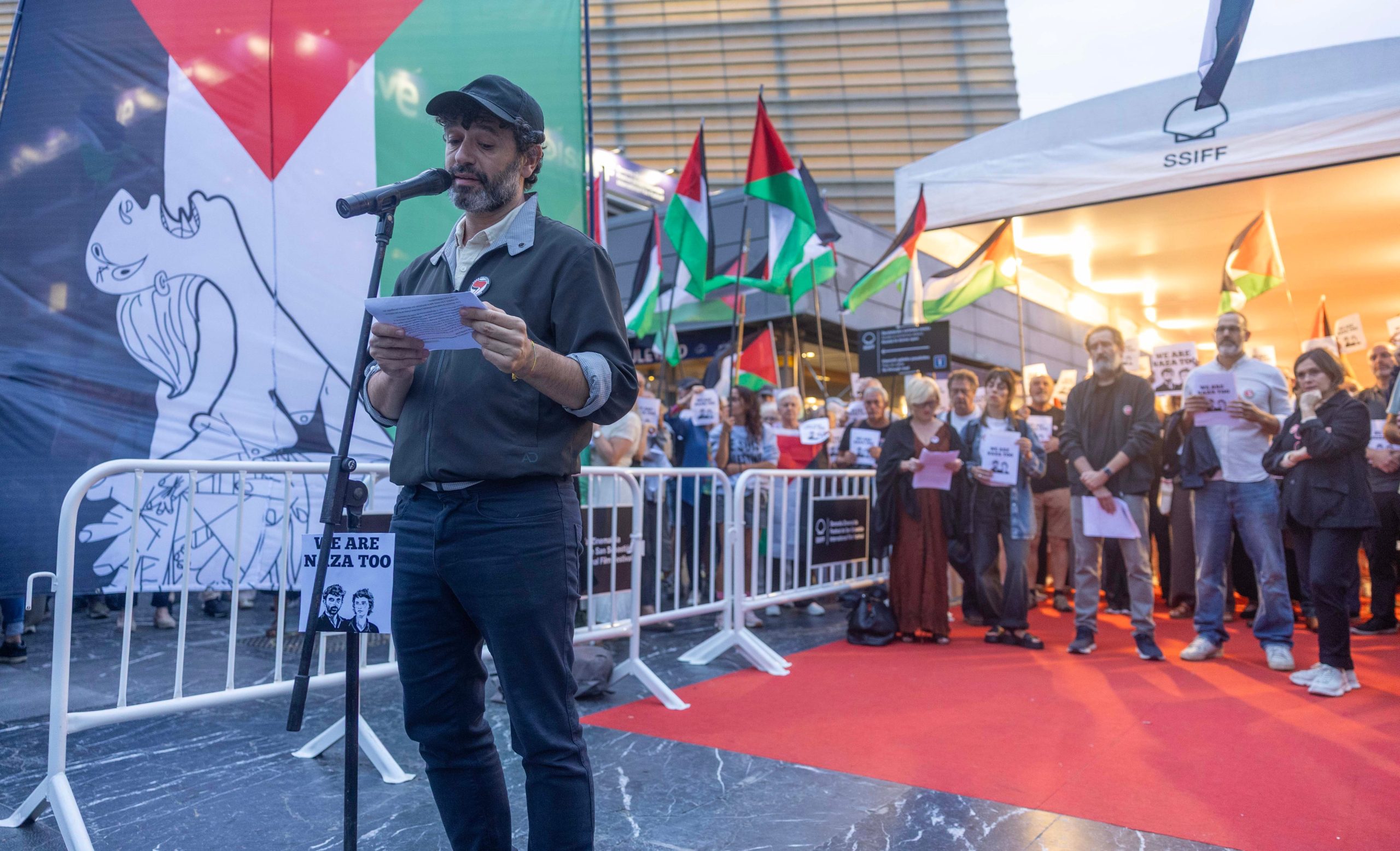
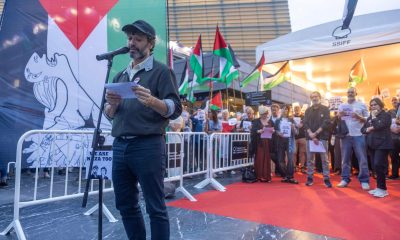
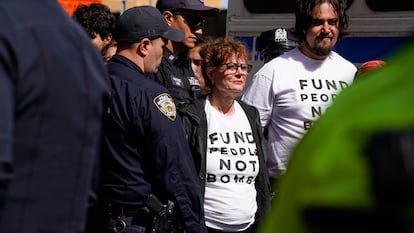
Culture has once again placed the Palestinian cause at the center of social conversation, while political leaders — especially those from the Global North — have progressively dropped the issue from their public remarks. In less than a month, rapper Macklemore was dropped from opening for Ed Sheeran on his tour after shouting: “Free Palestine!” Actresses Susan Sarandon and Hannah Einbinder were arrested in New York for calling on the United States to stop funding Israel’s war while Benjamin Netanyahu was attending the UN General Assembly. Yuval Abraham and Rachel Szor, directors of NAZA, after being branded traitors by the Israeli government and threatened with revocation of their citizenship, decided to release online and for free the documentary that won an award at the Venice Film Festival. The Festival of Ideas in Madrid hung by a thread when more than 30 participants demanded the organizers withdraw Allianz’s sponsorship because the company holds Israeli bonds. At the same time, at the Cultura Alh festival in Granada, the exchange of manifestos continues between those who oppose and those who support the decision to rescind an invitation to Argentine writer Ariana Harwicz for denying a genocide in Gaza.
As these cases unfolded, various offshoots of the cultural debate about Palestine began to emerge. Should politics be separated from culture? Are limits being set on freedom of expression? Censorship or cancellation? Is a cultural boycott legitimate? All these questions have occupied the space that cultural actors leading such initiatives sought to use to place the focus on the more than 70,000 Palestinians killed by the Israeli army since 2023 — a figure that Israeli commanders have ended up acknowledging — in an offensive the UN described as genocidal.
Art has moved in step with society historically, sources consulted agree, who note that “culture seeking to reflect and denounce what is happening in Palestine is not a historical anomaly.” Film, books, theater and the visual arts have addressed other wars such as those in Iraq and Vietnam, depicted the social consequences of major economic crises, and denounced the situation of women, among many other topics.
“Politics and culture are not compartmentalized spaces. Culture has always been central to political struggle because through cultural products — those narratives and stories, some hegemonic and others counter-narratives — are formed the imaginaries in which we socialize,” says Itziar Ruiz-Giménez Arrieta, professor of international relations at the Autonomous University of Madrid. “It has never been mere decoration; it has always been the space where societies decided what they were capable of seeing, naming, who they mourned, which deaths they found lamentable and which they simply ignored. It is a dispute that has always been at the heart of art,” says political scientist Máriam Martínez-Bascuñan, who also signed the letter that led the Festival of Ideas to withdraw Allianz’s sponsorship and who contributes to this newspaper.

In this age of attention economy, artists, as communicator Nerea Pérez de las Heras explains, take advantage of the spotlight on them — even if that peak is so fragile and fleeting it lasts only a few hours — and the reach and impact provided by social networks. “I try to use that visibility constructively,” says the author of Fantasma (Alfaguara, 2026), a signatory of the Madrid festival letter and one of more than 500 authors supporting the writers and students who backed the decision to expel Harwicz from the Granada event. “We are accused of being inconsistent to paralyze us with the excuse that 100% ethical work and consumption under capitalism is impossible when we point to a company like Allianz; obviously we are all subject to survival pressures, but our level of commitment is constant,” she argues.
Macklemore, a rapper who accepted opening for a megastar like Sheeran to restart creating content, forced the British artist to apologize for the fallout caused by his tepidness — what some call “ideological neutrality” — and announced a three-concert tour whose entire proceeds will go to organizations working in Palestine. Javier Bardem, another highly visible figure showing support for the cause on influential platforms such as the Oscars ceremony, has spent months risking a career already jeopardized for others like Sarandon and Mark Ruffalo, two actors who have been blacklisted in Hollywood — an industry intertwined with Israeli capital since its origins — and smeared as antisemitic.

“Cultural voices, by virtue of their fame, are the only ones managing to get a small foothold on the political-media stage,” says Ruiz-Giménez Arrieta, who finds bastions of resistance in countries in the Global South, such as South Africa, and in Francesca Albanese, the UN special rapporteur for the occupied Palestinian territories, which help prevent the issue from being abandoned in strictly political discourse.

01:11
Ed Sheeran apologizes for the controversy involving rapper Macklemore
“Discursive political gestures, which are not gestures of solidarity, for example from Pedro Sánchez, must now be placed in a context in which global elites — especially European and U.S. elites, who from the outset aligned with Netanyahu’s government — are also determined by commercial collaboration in this government’s war economy. All have used Trump’s supposed peace plan to claim there is no longer a war and therefore say they no longer need to fulfill international obligations in the face of a genocide that does not exist, even though Palestinians’ living conditions remain terrible,” Ruiz-Giménez Arrieta points out.
Precarity in the sector
Pérez de las Heras and writer Dahlia de la Cerda, one of the promoters of the manifesto supporting the Cultura Alh Festival, note that many signatories of these documents are in precarious situations that distinguish them from major stars. “The publishing industry is the book chain: publishers, publications, distribution, bookstores. And within it there are publishers with clear political positions that back pro-Palestinian authors and anti-genocide stances to the end,” the writer says, “but the literary industry is far broader. It is the whole circuit that determines who circulates, who has visibility, and who gains access to opportunities.”
Valerio Rocco, director of the Círculo de Bellas Artes in Madrid, one of the organizers of the Festival of Ideas, elaborates on the cultural sector’s precarious situation in Spain: “I have learned that cultural projects and institutions are tremendously fragile. When they face attacks and accusations, withdrawn support and unimaginable pressures, the vulnerability of the cultural sector is felt very clearly, even physically. Citizens are not always aware of this fragility. We need to show it and reflect on its causes.”
Some who defend allowing Ariana Harwicz to participate in cultural events — or who denounce that Israeli intellectuals are being barred simply because of their birthplace regardless of their political positions — say there is indiscriminate persecution of Jews. “If I belonged to another minority nobody would have done this to me. In the cultural sphere cancelling Jews is justified,” the author told this newspaper in an interview. “We Israelis have become toxic people. Our presence at a conference, a film festival, or a book fair can create problems,” said Uri Rosenwaks, filmmaker and former director of the Israeli Forum of Documentary Directors, in another feature for this paper. “And if Netanyahu is re‑elected we won’t be able to cope. There will be a mass emigration, because the last few years have already been a challenge.”
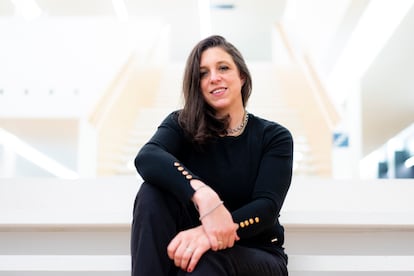
Luis Salazar, spokesperson for the cultural area of the Solidarity Network Against the Occupation of Palestine (Rescop), which is part of Boycott, Divestment, Sanctions (BDS) — the platform calling for a boycott of Israel — argues that their actions are grounded in a debate spanning more than two decades. “These movements are not spontaneous or random; there is coordination with working groups across Europe,” he explains of their approach to proposing boycotts. “If artists choose to benefit from the occupation and genocide, or else lose contracts and jobs, then they will have to test their integrity, as many others do in countless life situations. Racism shows up in our feelings and priorities. We understand there may be injustices, but none like what Israel commits against Palestine,” he maintains, recalling the letter in which 50 Israeli documentary filmmakers supported boycotts of their country’s institutions, as well as other historical moments such as apartheid in South Africa or now Russia’s invasion of Ukraine, where the same criteria were used to try to exclude intellectuals or athletes from public spaces.
Censorship, cancellation and boycott
The dispute over the limits of free expression, cancellation, and censorship and the consequences these boycotts produce in culture is exemplified by the manifestos exchanged among the hundreds of intellectuals who supported or opposed Harwicz’s presence in Granada. “Organizing a peaceful boycott is not censoring. Criticizing is not censoring, protesting is not censoring,” argued Rodrigo Sorogoyen, Cristina Rivera Garza, Camila Sosa Villada, Alejandro Zambra, Pilar Quintana, Nona Fernández, Andrea Abreu, Alana S. Portero and Marta Sanz. “Defending freedom of expression only for those who think like us is not defending it: it replaces the free confrontation of ideas with ideological selection,” countered Piedad Bonnett, Maria Negroni, Margo Glantz, Ana María Shua, Valeria Correa Fiz, Karina Sainz Borgo, Fernando Savater, Cayetana Álvarez de Toledo and Manuel Valls, among others.
The City Council and the Madrid regional government, organizers of the Festival of Ideas, denounce along the same lines that at the core of this debate is “censorship and cancellation,” in the words of Mariano de Paco, culture councilor for conservative regional premier Isabel Díaz Ayuso. “We condemn any ideological interference both in artistic activities and in their funding, as we have recently seen with Ariana Harwicz or with Allianz at the so-called Festival of Ideas, promoted by the Círculo de Bellas Artes. We deplore that ideological debates substitute persuasion and reasoning with pressure and intimidation,” the politician tells this newspaper. Ayuso has invited the Argentine writer — whose books are reportedly enjoying a boost in sales in her native country, according to Argentine booksellers — to take part in any forum in Madrid she wishes.
It will be in Madrid where, from October 15 to October 17, the contemporary dance piece Sadeh21 by the Israeli dance company Batsheva can be seen at the Teatros del Canal; this newspaper contacted the company without receiving a response. According to its own accounts, it is an organization funded by Netanyahu’s government and has become a national emblem. “The [Madrid regional government] uses it to whitewash the genocide,” says choreographer and dancer Nacho Duato. “If they end up dancing, then let them dance, but this needs to be discussed,” he adds, while acknowledging that at the moment he spends much of the year dancing in Russia, the country currently invading Ukraine. “I am against the war and against Putin; he is a dictator, and Russian artists are not allowed to perform outside their country.”
That was the case at Eurovision in 2022, after Russia invaded Ukraine: the country was expelled from the competition in application of its statutes. The European Broadcasting Union did not take the same decision regarding Israel, leading countries like Spain and Ireland to withdraw from the musical contest in protest. “There is no doubt that boycott serves to internationally isolate a state that systematically breaches international law,” continues Salazar of Rescop.
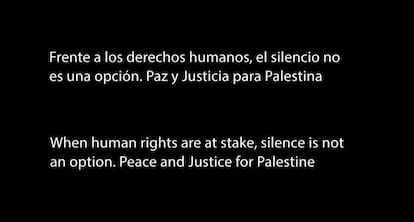
Some of these sources wonder what will happen when attention turns to the next issue. Will any reflection remain fixed in the public sphere about what is still happening in Palestine? “That push from culture, society, universities, is vital, but what must happen above all is a reduction of repression worldwide by governments that claim to be very sympathetic to Palestine so that, for example, reception programs for refugees and exiles can exist,” concludes political scientist Ruiz-Giménez Arrieta.
Sign up for our weekly newsletter to get more English-language news coverage from EL PAÍS USA Edition
Benjamin Netanyahu
The Suffocation Of Israeli Filmmakers: ‘Critical Culture Is Now Regarded As An Act Of Treason’

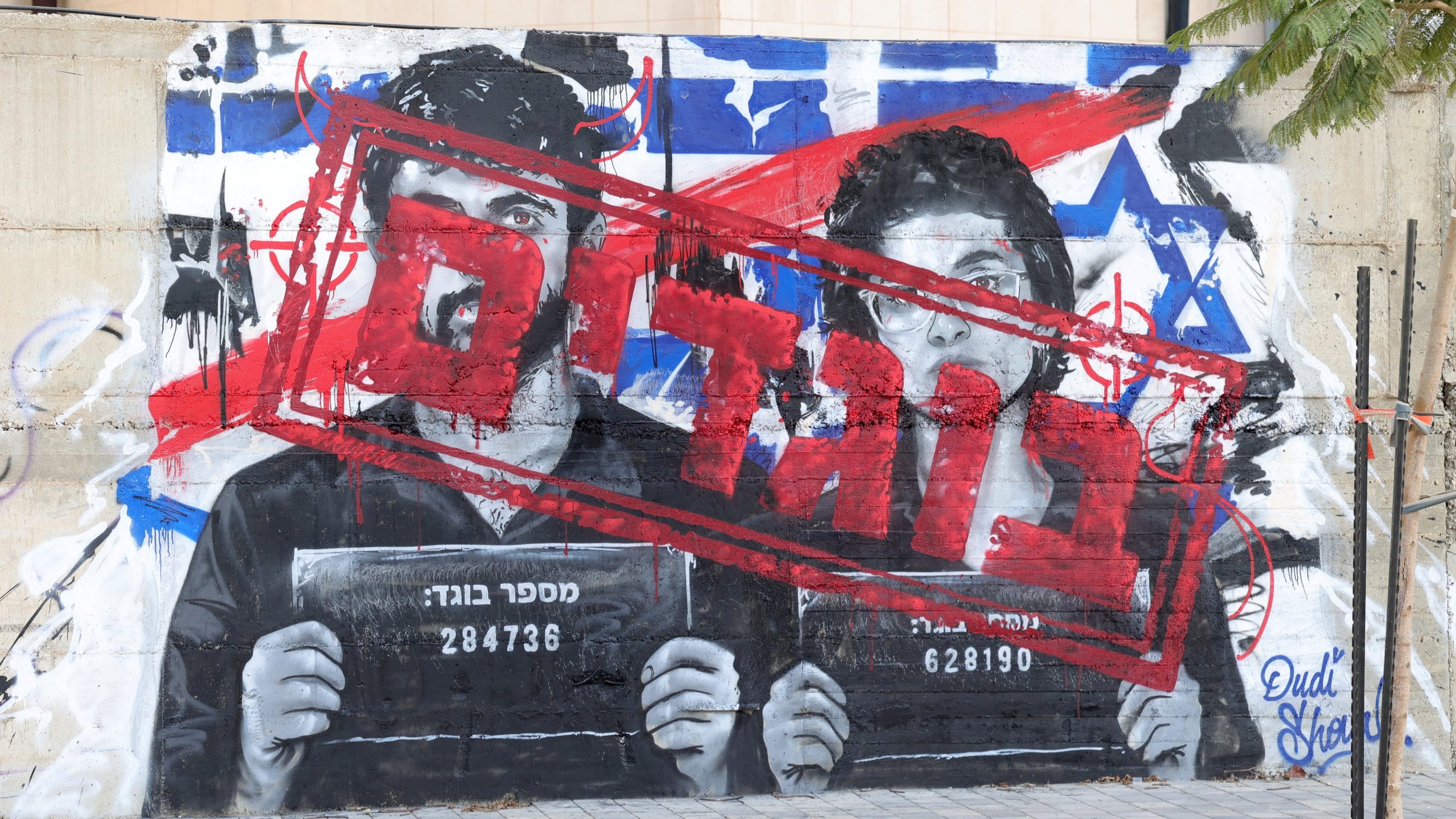
In September 2025, the film that won the most awards at the Ophir Awards, Israel’s equivalent of Spain’s Goyas, was The Sea, which tells the story of a Palestinian boy who sneaks past checkpoints to try to reach Tel Aviv and see the Mediterranean for the first time. The film does not delve into the daily squalor and violence of the Israeli occupation, but it provoked the ire of Culture Minister Miki Zohar at the time, who said he would not allow a “group of extremist left‑wing thugs” to take over the film sector.
A year later, Zohar is calling for the revocation of the citizenship of Yuval Abraham and Rachel Szor, directors of the film NAZA, which won awards in Venice and is screening at the San Sebastián Film Festival (September 18-26). He called them traitors. On Israel’s streets and on social media, anger toward the two filmmakers has gone even further. “We’ve had hard years, but this is the first time I’ve witnessed attacks of such cruelty on social media and even in some media outlets. People are calling for them to be hanged, for them to be killed. It’s incredible,” Uri Rosenwaks, a filmmaker and former director of the Israeli forum for documentary directors, told this newspaper. “The problem is that Israeli society lives in a huge bubble of denial about what is happening in Gaza. And this film has burst that bubble.”
The filmmakers interviewed for this report describe a gradual strangulation over the past 10 years, sheltered by increasingly extremist governments and an unabashed radicalism that has clearly intensified since the start of Israel’s offensive on the Gaza Strip in 2023, following the attacks by the Palestinian Islamist movement Hamas.
They all live in an environment of lack of funding, canceled screenings, rejection by festivals, scorn from the authorities, and insults and threats on social media. “It seems we have reached the point where critical culture is regarded as an act of treason and is becoming dangerous for those who create it,” laments Shai Carmeli‑Pollak, director of The Sea.
More than 200 Israeli filmmakers signed a statement last week in solidarity with Abraham and Szor. NAZA collects testimony from more than 20 soldiers and intelligence officers who detail the tools used to relentlessly bombard Gaza and the sense of revenge that has permeated the offensive. The film attacks the army head‑on — a kind of sacred cow in Israel, where it is seen as a model of morality.

“This is a true collective psychosis,” Carmeli‑Pollak sums up. “It seems the fact that the film received such a prolonged ovation bothers local audiences more than the disturbing facts the story exposes. It’s deeply disheartening and terrifying.”
The 25‑minute ovation NAZA received in Venice might lead one to think that it is still possible in Israel to make films critical of the current government and that culture, in all its forms, remains an effective channel for denouncing the occupation of Palestinian territories, the massacre in Gaza, or the army’s abuses.
But the reality is that NAZA is a film that has not received a cent from public coffers, has not been released in Israel, and it seems clear that, for now, no Israeli theater would risk screening it. It is not even certain that its directors will be able to return home in the medium term. “Before, only people from the radical right allowed themselves to attack a film like this, which, moreover, they hadn’t seen. But now the criticism comes from everywhere: academics, more moderate figures… It has been brutal,” Rosenwaks says.
The biggest fear among these artists is what will happen if Prime Minister Benjamin Netanyahu remains in power after the legislative elections at the end of October. “One can oppose Netanyahu and critique him openly, but attacking the army or speaking about Palestinians’ rights has become very risky. Not only for our careers, but for our physical safety,” says Noam Sheizaf, co‑director with Idit Avrahami of H2: The Occupation Lab, a film about the Palestinian city of Hebron, presented as a microcosm of the occupation.
At the same time, Israeli artists — not only filmmakers but also writers, dancers, intellectuals, and historians — are received with suspicion abroad or directly face boycotts. “We Israelis have become toxic people. Our presence at a conference, a film festival, or a book fair can create problems,” Rosenwaks details. “And if Netanyahu is re‑elected we won’t be able to cope. There will be a mass emigration, because the last few years have already been a challenge.”
Self‑censorship
In Israel, film directors do not receive funds directly from the Ministry of Culture. Each year, the government provides about 130 million shekels (roughly $42 million) to film funds — independent non‑profit entities — that decide which films to finance according to certain criteria. “There are no guidelines about the political or ideological content of the films they back, but repeated attacks by the authorities on critical films have undoubtedly created a deterrent effect,” admits Nirit Anderman, a film‑specialist journalist at Haaretz. In other words, organizations that receive public money have understood that financing a film critical of government policies toward the Palestinians will not be well-regarded and could exclude them from the list of cultural entities that receive those funds.
That is why self‑censorship is a reality among artists, although few admit it openly. “Obviously, if a filmmaker is torn between making a family drama or a scathing political satire, he or she will choose the former because he or she knows that the chances of securing funding will be greater,” Anderman says.
After the success of The Sea at the Ophir Awards in 2025, the culture minister threatened to stop funding those awards, although he has not succeeded in doing so. He also announced the creation of other government‑backed awards, which were held in December and distributed substantial prizes, and proposed new rules for public funding of Israeli cinema that are still being refined. For example, that awards won at foreign festivals would not count toward eligibility for funds, or that a specific funding line be created for films about the heroism of Israeli soldiers.
The minister, Miki Zohar, has long had critical filmmakers in his sights and said, for example, that the Oscar‑winning documentary No Other Land, co‑directed precisely by Abraham and Szor, was “an act of sabotage” against the State of Israel. On September 9, at the most recent Ophir Awards, the big winner was Tell Me Everything, a family drama set in the 1980s that has homophobia and AIDS as its backdrop, followed by Where To, which deals with relations between Israelis and Palestinians but is set in Berlin, far from the harsh daily reality of the occupied territories.
“In my case, after the minister’s attacks, some people criticized the film, but others were curious and went to see it. Also, there were screenings canceled due to opposition from local residents,” says Carmeli‑Pollak, director of The Sea, who secured difficult funding thanks to support from the Israeli Film Fund, an independent non‑profit, and a Palestinian production company.
In 2022, Sheizaf and Avrahami, the directors of the film about Hebron, also saw several screenings canceled and the film go almost unnoticed in Israel. “As an Israeli documentary filmmaker, I make films for the people of my country, so they can see and understand. I’m a journalist, and I believe in this work,” Sheizaf adds, explaining that since it was a co-production with France Télévisions, there were screenings abroad. “We were very happy about that because we believe the world has a role to play in ending the occupation.”
Along the same lines, Avi Mograbi, director of The First 54 Years. An Abbreviated Manual for Military Occupation, explains that “everyone” rejected his film in Israel in 2022, months before the Hamas attacks. “The television channels that used to show my films, the festivals, the cultural institutions where I was once well received… all of them,” he says. “Sometimes being ignored is more painful than being criticized.”
Sign up for our weekly newsletter to get more English-language news coverage from EL PAÍS USA Edition


Donald Trump returned to power in Washington with two major foreign policy promises: to end the war in Ukraine “in 24 hours” and to keep his country out of more “forever wars.” Almost two years after his decisive electoral victory, the Russian invasion continues with no sign of a quick end, and the United States has plunged itself into yet another hornet’s nest in the Middle East. Two conflicts of unpredictable outcome have pushed fossil fuel costs to historic highs worldwide and are increasing doubts about whether — with price signals distorted — supply chains will withstand the pressure.
The relentless chain of setbacks is scarcely matched in recent memory. Through the Strait of Hormuz — the unavoidable exit route for oil and gas from the Persian Gulf — only a handful of ships now sail each day, either at their own risk or escorted by the U.S. Navy; a tiny fraction of the traffic that passed through that key waterway before the first strikes on Iran earlier this year.
Saudi Arabia, the world’s largest crude exporter, was put largely out of action for more than a week: attacks by pro-Iran militias forced the East-West pipeline, its only alternative to Hormuz, to shut down, although Reuters reported on September 24 that operations on the pipeline had resumed, with tankers awaiting loading. The Houthi rebels, always dependent on Tehran, are expanding their control over Bab al-Mandab, another crucial maritime passageway. And Russia, with its refineries severely damaged by Ukrainian drone strikes, is about to extend its ban on diesel exports for another month: supplying its domestic market is now almost a pipe dream. A quartet of adverse factors that, in short, leaves the world on the brink of another energy crisis.
“The situation has deteriorated a lot in the past two weeks [since the Houthis took control of the Bab al-Mandab Strait and following the attacks on the Saudi pipeline]. What we are seeing is unprecedented,” Francisco Blanch, global head of commodities and derivatives at Bank of America, tells EL PAÍS by phone. “The disorder in the Middle East is extreme, and there is neither enough crude on the market or, above all, enough refineries available to process it.”
If the main bottleneck in spring was jet fuel, now — mirroring what happened in the early months of Russia’s invasion of Ukraine — concerns center on diesel. Moscow, a historic European supplier, has nearly half of its refining capacity offline. Riyadh has effectively disappeared from the market: with three key facilities operating below capacity — the Yanbu, Samref and Yasref refineries, all on a Red Sea now turned into a tinderbox — it has been forced to pause all crude and fuel shipments to Europe.
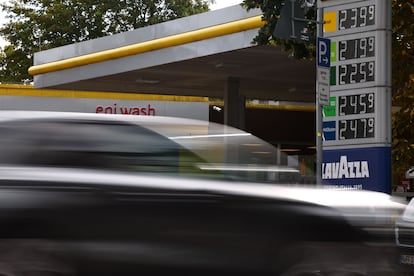
“Neither diesel nor heating oil have much of a short-term solution,” Blanch says. And what prices are signaling, with the gallon above $6 in the U.S. and the liter over €2 in most of the EU, is a “major” potential supply problem on the horizon “if supply chains have not been restored by Christmas.”
Could the world slide into a second major energy shock in less than five years? “Definitely,” Thierry Bros, a professor at Sciences Po Paris, replies on the phone. “Especially Europe, because of its external dependence and because fuel subsidies continue to delay electrification. Since we don’t have gas or oil, our only exit is to diversify and to destroy demand.”
In the words of the Bank of America analyst, “very difficult weeks” lie ahead. And there’s one major unknown: what will happen after the U.S. midterm elections on November 3, in which polls point to a historic reverse for the Republican Party, which may even lose both houses of Congress. “The big question is how Trump will react and whether or not that might open the door to diplomacy.”
Far from being isolated compartments, diesel, gasoline and kerosene are largely interconnected. Refineries — especially the most modern and flexible ones — can choose to produce more of one product at the expense of others. And that is exactly what has been happening for several months: facilities that favored jet fuel are now prioritizing diesel. The result: everything is much more expensive and there is a shared feeling among all analysts consulted that, despite prices already soaring, they do not fully reflect the severity of the situation.
There is, Blanch says, one factor that could “make things even worse”: Trump banning U.S. fossil fuel exports. “U.S. consumers might benefit from lower prices, but it would do great harm to the U.S. economy, which is currently being heavily supported by those sales,” he notes. The impact of such a potential veto, Eurasia Group analysts Gregory Brew and Henning Gloystein write in a recent client note, would be particularly severe in two regions: Europe and Latin America — by far the most dependent on U.S.-sourced fuels. Still, Samantha Gross of the Brookings Institution suspects that “real shortages may hit countries that cannot afford to pay much more for fuels.”
If a full-blown energy crisis has not yet arrived it is only thanks to four mitigating factors with few historical precedents. First, the world market was awash in oil before the Trump-Netanyahu duo launched the first strikes on Iran: supply exceeded demand, a structural imbalance that will widen. Second, the increasingly necessary electrification is reducing — and will reduce further — demand for gasoline and diesel. Third, strategic reserves were full; that is no longer the case after their rapid use in the initial stages of the closure of Hormuz. Fourth, the global economy depends far less on oil and its derivatives than ever before, which significantly lightens the burden of high prices.
And then there is gas. The true Gordian knot in Europe’s 2022–23 energy crisis now seems overshadowed by an oil shock that engulfs everything. But there are reasons to stay alert here too: the closure of Hormuz has sidelined the world’s second-largest exporter of liquefied natural gas (LNG), Qatar, which has been forced to cancel the bulk of its sales to the EU and Asia citing “force majeure.”
Continental reserves of LNG, key for industry and heating, are at their lowest in more than a decade and about 20 percentage points below where they usually stand at this time of year. “What we hope is that this winter, like the last, is not too cold in Europe. Because if it is, we could have serious problems,” says Ana Maria Jaller-Makarewicz, an analyst at the Institute for Energy Economics and Financial Analysis (IEEFA).
Unlike 2022 and 2023, when Russia’s invasion of Ukraine suddenly spiked prices and fears of shortages, we are, the IEEFA analyst sketches, “facing a slow-motion crisis.” Qatar is absent from the market. Flows from Norway are near their limit. And competition with Asia for LNG is much greater than a few months ago. Today’s prices of over €70 per megawatt hour have raised electricity costs, but they pale compared with the over €300 of four years ago. “Europe will have to pay more to attract LNG carriers originally destined for other parts of the world,” Gross predicts by email. “Uncertainty is enormous: the only clear thing is that there is no clear solution in sight,” Jaller-Makarewicz concludes.
Sign up for our weekly newsletter to get more English-language news coverage from EL PAÍS USA Edition

Israel, A Divided Nation, Relives The Pain Of The 2023 Hamas Attacks

La Inspección De Trabajo Regularizó A 47.000 Falsos Autónomos En 2025, La Mayor Cifra De La Serie

El Gobierno Refuerza El Cálculo De La Indemnización Que Pagará El Casero Al Inquilino Si Rompe Con El Contrato


-

 Uncategorized2 weeks ago
F1 Qualifying Today: Azerbaijan Grand Prix schedule, times and TV channel
-

 %2 weeks ago
Is Your Supermarket Kefir Really Kefir? Spanish Study Raises A Surprising Question
-

 Uncategorized1 week ago
F1 Bahrain Grand Prix will be live and FREE on TV this weekend
-
Latest2 weeks ago
‘It’s The Law Of The Jungle’: Pensioner’s Eviction Exposes Spain’s Housing Crisis
-
Barter system2 weeks ago
British drug dealer swaps cocaine for Pokémon cards in bizarre barter deal
-
Balearic Islands2 weeks ago
Tourists driving to Menorca could soon need a permit and pay to bring their car
-

 Cody Gakpo2 weeks ago
Xavi Y Klopp Se Reparten Puntos En Su Debut Como Seleccionadores
-
Adamuz2 weeks ago
Deadly crash and landslide chaos wiped out 800,000 Málaga-Madrid journeys