
Africa
Juan Luis Arsuaga, Paleontologist: ‘Corruption Is Very Paleolithic, Very Chimpanzee-Like’


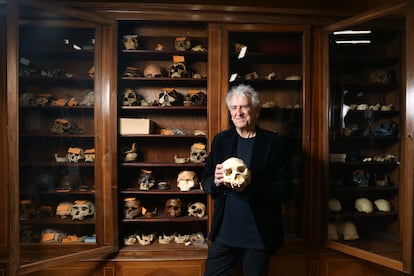
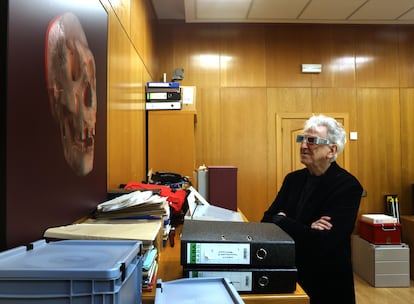
In his latest book, La respuesta (The Answer), 71-year-old paleoanthropologist Juan Luis Arsuaga, from Madrid, explores the pivotal moments of human evolution. There are the living — us — the extinct — like the Neanderthals — and those on the verge of extinction — the great apes such as chimpanzees, orangutans, and gorillas. Unlike his previous work, the co-director of the Atapuerca archeological site in northern Spain takes a firm stance: he clearly states his opinion on numerous theories that attempt to answer the most fundamental questions: Who are we? Why are we here? Where are we going?
Against all odds, it is an illuminating book, brimming with admiration for our own species (possibly the fastest, most surprising, and most formidable product of all evolution) and a love for nature. Despite our destructive actions, Arsuaga believes we have a future: “Something wonderful is going to happen,” he writes. He has also worked on a major exhibition on human evolution that opened in September in Burgos. He says he won’t retire until Bruce Springsteen, Spanish news anchor Matías Prats, and U.S. geneticist Mary Claire-King do so as well.
Question. In this book, you take on the role of the tribe’s elder to tell us a story by the fire. Which story?
Answer. The story of the tribe, which is all of humanity. There’s a story I’ve heard many versions of: the Black president of an African country is asked, in good faith, what tribe he belongs to. He answers: my tribe is humanity. But almost everyone tells biased stories. Our worst enemy is tribalism.
Q. Why?
A. It is closely linked to superstitious thinking and ignorance. When people understand how the world works, superstitious thinking and fanaticism disappear. Konrad Lorenz said that there are two remedies against violence, Nazism, and fanaticism: science and humor.
Q. Do you see progress in humanity today, when there is talk of national priorities?
A. National priority is a tribal expression. There’s a sense of tribalism and there are extreme cases of fanaticism, of dehumanization. I’m convinced that for many Jewish settlers, Palestinians aren’t people. There will also be many who think the opposite. We humans have a very curious thing about us. When we think of dictators, we don’t think of all of them. Everyone points to some, but justifies others. Everyone has their favorite dictators or their tolerated dictators. We lack people who say, “Trump is a buffoon, but Putin is appalling.”
Q. Have we improved as a species?
A. Generally speaking, yes. Asia was a continent where millions of people were starving to death. Now Asia, especially China, and South America have improved in terms of quality of life, education, and literacy; and Africa is making progress in that regard. If you ask me about the planet, then I’d say it’s terrible. People think artificial intelligence is the threat, but the real problems are tribalism and sustainability. And it doesn’t have to be this way.
Q. Does tribalism offer any benefits?
A. Agriculture and livestock farming are an inevitable consequence of it. Twelve thousand years ago, when we lived in caves, we were nobody. On the Iberian Peninsula, there were probably more lions than people. If an alien had landed here, it would have said, “Well, this is a species that has language and all that.” How curious. If it came back now, it wouldn’t believe the transformation. The species has changed the planet — you just have to look at it at night from space.
Q. Is there anything similar in the history of evolution?
A. Nothing comparable to us. That revolution wouldn’t have been possible without two things. The end of the ice ages and, before that, the fact that Homo sapiens — us — had already developed ethnic groups, tribes, with a very strong cohesion that allowed for organization. Then begins an increasing consumption of resources and energy that accelerates and accelerates.
Q. How do we stop it now?
A. We have no idea. Anyone who says they know is lying through their teeth. We’re burning more fossil fuels than ever before, and we’ve depleted the last frontier: the oceans.
Q. Even so, you believe, or want to believe, that “something wonderful is going to happen.”
A. You have to. And I believe that artificial intelligence is our salvation, not our nemesis. I don’t attribute any cognitive or reasoning abilities to it, because it’s just computing with zeros and ones, but it does a lot of calculations. It allows us to manage everything much better, including natural resources. It’s a blessing. Nobody misses the good old days before the Industrial Revolution.
Q. In your book, you say that either we accept AI as human, or we redefine what intelligence means. It’s the same thing that happened when we discovered that chimpanzees use tools.
A. Accepting it as human, no, because it has no feelings. But intelligence has always been the ability to solve complex problems. The more complex the problem, the greater the intelligence. So yes, intelligence needs to be redefined, because according to this, a computer or a piece of silicon is more intelligent than we are.
Q. You talk about a unique capacity of ours: self-awareness, having a kind of inner eye with which we analyze our mind.
A. There are biologists who think it arises in evolution by chance, as a consequence of something else, and that it serves no purpose, like your shadow, which is useless. I am convinced that it is an adaptation. It has to be good for something. I am 100% Darwinist. Most organisms can be explained as adaptations. I tend to see them in everything.
Q. Even in things like murder, rape or corruption?
A. Corruption is curious. Let’s think about [Spanish politician José Luis] Ábalos. What did he want? Prostitutes. His genes compelled him to reproduce and leave many Ábaloses around the world. Corruption is useful for getting money, and what do we want money for? To have power, status, hierarchy; and for men, women. It’s very Paleolithic, very chimpanzee-like.
Q. After years of studying human evolution, are you confident about our future as a species?
A. We are good by nature, that’s undeniable. We ride the subway with complete strangers and there’s no aggression. That’s impossible with any other animal, not even the most social species on the planet. Not with dolphins, not with ants, which would kill each other. Our ability to live in society is a marvel. As a rule, we are very reasonable, and that’s also an adaptation.
However, we are very easily manipulated by others, by other groups. That is our weakness. Moreover, we now kill remotely, which means all our biological inhibitions disappear. I can’t believe Donald Trump would be capable of killing 200 schoolchildren [in a bombing in Iran]. Neither he nor anyone in their right mind. That said, the bomb was dropped by mistake. Because we hadn’t fed the AI any information. What bad luck.
Q. You talk about the obsession with reversing aging and becoming a multi-planetary species.
A. Aging is not a disease. As a biologist, I believe it’s a set of degenerative processes. The argument I’m developing comes from a phrase that isn’t mine, but from an evolutionary anthropologist who said: the game of life is about transforming proteins into offspring. That’s the crux of the matter. Regarding the second point, there’s no reason why we can’t be happy. May this be a wonderful planet, with a sustainable economy. We can’t go to another galaxy, or even another planet. The only solution is to make global decisions here on Earth. I believe that AI can be a tool for humanity, if only to break free from the prevailing narrative. That’s what the dreamers of decades past were striving for. They longed for a technology at the service of humanity that would enhance our capabilities. This is the realization of that.
Q. Visionaries can be dangerous.
A. All dreamers throughout history dreamed of creating supermen. Now some want to do it through genetic modification. But that will happen over my dead body.
Q. You’re against it?
A. In college, I studied genetic improvement, and it was applied to tomatoes. I’m against genetically improving humans because I can have an ideal tomato, but not an ideal human being. And anyone who does should be locked up. The same goes for my three children. I have three, and all three are the same and different at the same time. Would you have manipulated the genome of your child, the one running around, to make them different? If so, you’re a monster.
Q. Your book is called The Answer, what is the question?
A. That’s the only one I can’t answer. You have to read it.
Sign up for our weekly newsletter to get more English-language news coverage from EL PAÍS USA Edition






EXCLUSIVE: Meet The Magaluf Mayor Vowing To Banish The Resort’s Boozy Past – And Take On The ‘anti-Tourism Guerrillas’ Hounding Visitors

Reacciones A Los Decretos De Vivienda Y Las Acampadas En Directo | Una Marcha Masiva En Madrid Por La Vivienda Llama A Una Huelga General: “Ya No Hay Vuelta Atrás”

Una Aritmética Con Venganza

F1 Qualifying Today: Azerbaijan Grand Prix schedule, times and TV channel

FROM THE ARCHIVES: The Little Wooden House Is A Charming Hidden Gem Nestled In Inland Malaga – And Offers The Perfect Autumn Escape
‘It’s The Law Of The Jungle’: Pensioner’s Eviction Exposes Spain’s Housing Crisis


-
 Uncategorized1 week ago
F1 Qualifying Today: Azerbaijan Grand Prix schedule, times and TV channel
-
 Costra del Sol2 weeks ago
FROM THE ARCHIVES: The Little Wooden House Is A Charming Hidden Gem Nestled In Inland Malaga – And Offers The Perfect Autumn Escape
-
Latest1 week ago
‘It’s The Law Of The Jungle’: Pensioner’s Eviction Exposes Spain’s Housing Crisis
-

 basque country2 weeks ago
British Actress Naomi Watts Attacks Ageism In Hollywood As She Picks Up Prestigious Donostia Award At San Sebastian Film Festival
-
Diesel prices rise2 weeks ago
Breaking point for Spanish farmers as soaring diesel costs threaten to bring roads to a standstill
-

 Austin2 weeks ago
Venezuelan Migrant Shot By ICE In Austin Cites Lack Of Medical Care: ‘How Are They Going To Leave The Bullet In There?’
-
Balearic Islands1 week ago
Tourists driving to Menorca could soon need a permit and pay to bring their car
-

 Argentina2 weeks ago
Mexico Joins Latin American Crackdown On Cellphones In Schools