
Chile
Kast Faces Internal Resistance For Having Added Chile To Trump’s Shield Of The Americas


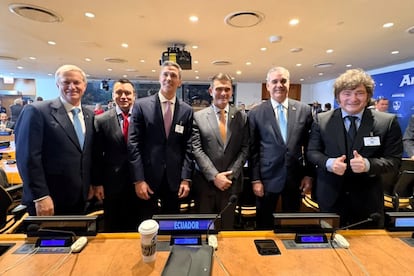
One week after Chile joined the Shield of the Americas, the regional alliance promoted by U.S. President Donald Trump, domestic resistance against the move has not let up. On the contrary, the membership documents ratified by the government of José Antonio Kast in New York on September 22, along with 14 other countries, have raised new questions about the scope of the initiative.
The far-right administration has insisted that this is not a treaty —which would create binding obligations— but rather “a political declaration” that contains no signatures and is intended to fight transnational crime “in all its dimensions,” Foreign Minister Francisco Pérez Mackenna said Monday during questioning in Congress.
But the declaration published by the U.S. State Department shows that the initiative goes beyond security: it includes three pillars —economic, security and multilateral coordination.
The Shield of the Americas has been adopted by the governments of the United States, Argentina, Chile, Bolivia, Colombia, Costa Rica, Dominican Republic, Ecuador, El Salvador, Guyana, Honduras, Panama, Paraguay, Peru, and Trinidad and Tobago. Of those, Chile is the only country where the alliance has sparked a deep debate and has been harshly criticized by the opposition, including former presidents Michelle Bachelet (2006–2010, 2014–2018) and Gabriel Boric (2022–2026).
In one of its paragraphs, for example, the declaration refers to the need to “defend our economies by enhancing economic cooperation; exploring investment screening mechanisms; safeguarding critical minerals supply chains through diversified and reliable sourcing.”
On security, the alliance text states it recognizes as “an immediate and universally shared threat” the one posed by “transnational narco-terrorist organizations, which endanger the peace and security of our hemisphere.” It then lists 24 criminal groups —none Chilean— but does include the Tren de Aragua, of Venezuelan origin, which has operated in Chile roughly since 2018, and which has changed the criminal landscape there. It also adds the Mexican groups Jalisco New Generation Cartel (CJNG) and the Sinaloa Cartel, which have made nascent inroads in Chile.
Part of the controversy surrounding the agreement concerns the way information was delivered. On September 22, shortly before the full text issued by the U.S. State Department was made public that same day, Kast’s Foreign Ministry issued a statement saying Chile “has decided to adhere to the international initiative Shield of the Americas,” although it limited the agreement to “a voluntary coordination among governments in the Americas that will allow for more effective combat against transnational organized crime.” There was, however, no mention of the other two pillars listed in the official text.
By contrast, it was Bachelet and Boric who addressed the other two aspects —and did so in an alarmed tone. In an unprecedented joint statement, they intervened in the debate on September 24, two days after the U.S. publication of the declaration’s contents. The former presidents urged the Kast government to “reconsider Chile’s continued participation” in the Shield of the Americas because “in the current geopolitical scenario, Chile should not be forced to choose a side. It must strengthen its alliances and relations with different countries and regions, without exclusions imposed from outside and always preserving its strategic autonomy.” They added they were concerned that the text’s use of concepts such as a “continental sovereignty” could end up weakening the fundamental principle of national sovereignty that Chile has historically defended.
The statement did not sit well with the Kast government. On Sunday, Claudio Alvarado, interior minister and government spokesman, said the arguments of the left-leaning former presidents “do not have much logic or sense” because they call for protecting Chile’s autonomy when the alliance agreement aims to “defend sovereignty and safeguard autonomy.” He said participation in the regional group does not mean Chile is subordinated to Washington because “cooperating is not subordinating oneself to anything.”
A path that began in March
On March 7, when Kast was president-elect and had only four days left before officially taking office at La Moneda, he raced to Florida at Trump’s invitation to attend the inauguration of the Shield of the Americas summit, which was also attended by 12 other Latin American leaders. At that time, Chile held only observer status in the alliance, but six months later it ended up joining the agreement, so one of the many questions that have arisen is what happened in the meantime that led Chile to take a further step.
Some clues were offered last week by Mariano Fernández, foreign minister during Bachelet’s first administration (2006–2010). He recalled how Francisco Pérez Mackenna acknowledged in a private meeting with other former foreign ministers, held in mid-September on the eve of the U.N. General Assembly, that the United States had pressured Chile to join the Shield of the Americas.
According to Fernández, Kast’s foreign minister admitted at that meeting that “it was very difficult” for the government not to adhere to the alliance.
The controversy over the agreement was also addressed Sunday by the writer, political analyst and National Journalism Prize winner Ascanio Cavallo. In a column in the newspaper La Tercera titled El escudo envenenado (The poisoned shield), he wrote that, “like protectionist trade policies driven by tariffs, the Shield of the Americas has been changing in form, rules and scope.” “At first it seemed possible to adhere rhetorically, without commitment, almost as a signal to make criminal cartels flee out of sheer fear,” but then things changed. He highlighted Trump’s absence on the day the agreement was finalized, although “his principal executors” were present: his secretary of state, Marco Rubio, and the White House trade chief —that is, Cavallo writes, “the gun on the table.” He went on to say that the declaration was read “and presented as signed by everyone: from that point on, everyone is a signatory, everyone is a member of the Shield of the Americas. No one remains half-embroiled,” he said regarding the 14 countries, not counting the United States.
That weekend, the Kast government tried to contain the criticism by asserting that Chile was the only country that attempted to modify the joint declaration drafted by the United States for the Shield of the Americas agreement. That was the Foreign Ministry’s version, published by both La Tercera and El Mercurio.
According to El Mercurio, in order to be part of what the Foreign Ministry called a “negotiation” —while Mariano Fernández spoke of pressure— Pérez Mackenna made two requests that were accepted by the United States and the other countries. One of them, the newspaper says, was included in the declaration’s fifth paragraph, which establishes that one of the alliance’s tasks is to “defend and promote mutual respect for national sovereignty and the self-determination of each nation through multilateral forums to coordinate and advance common objectives (…)”. The second, the paper adds, appears in the seventh paragraph and also alludes to sovereignty.
On Monday morning, five opposition lawmakers —Communists Luis Cuello, Daniela Serrano and Irací Hassler; Broad Front member Jaime Bassa; and Socialist Juan Santana— filed a complaint with the Comptroller General of the Republic, which oversees the actions of state officials, asking it to review the legality of Chile’s incorporation into the Shield of the Americas. According to Cuello, the alliance is “a covert international treaty” that “is being passed off as an agreement of good intentions” but which “establishes obligations for states and, moreover, represents a danger, a threat, to Chile’s sovereignty.”
In the afternoon, during questioning in the Chamber of Deputies, Foreign Minister Pérez Mackenna was asked by Socialist lawmaker Nelson Venegas whether he had reviewed the declaration before Chile signed it. Pérez Mackenna replied that in this case “there was no signature.” Later, the deputy reminded him that U.S. Secretary of State Marco Rubio had said the Shield of the Americas also seeks for its members to vote together in international forums and to coordinate economic and diplomatic matters.
Pérez reiterated that it is a nonbinding political declaration: “We are perfectly free to treat this as a treaty. It is not one,” he said. “Chile cooperates and will cooperate with anyone who helps us jointly combat transnational organized crime (…) Therefore, I can say that any initiatives that allow us to improve effectiveness in the fight against organized crime will be welcomed in our country,” the foreign minister added.
The Senate has called a special session on October 7 to analyze Chile’s accession to the Shield of the Americas.
Sign up for our weekly newsletter to get more English-language news coverage from EL PAÍS USA Edition







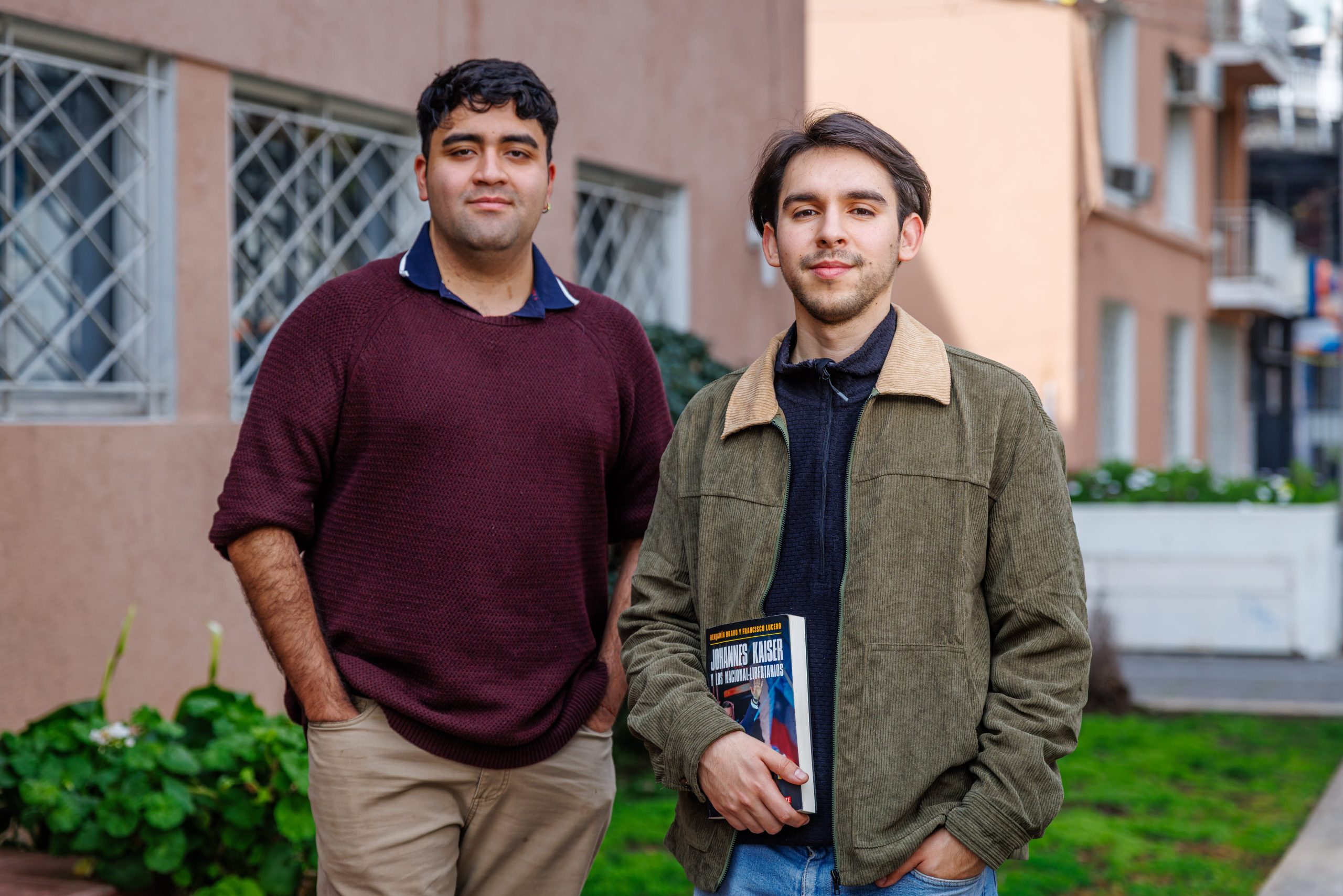
In just two years, the National Libertarian Party has become the right-wing party with the most members in Chile, slightly exceeding 50,000. Its leader, Johannes Kaiser, found a niche on the extreme flank of President José Antonio Kast’s Republican Party. He broke away from the party during the 2023 constitutional referendum, opposing his faction’s negotiation with the left-wing administration of then-President Gabriel Boric (2022-2026).
Using rhetoric that’s nostalgic for the dictatorship of Augusto Pinochet (1973-1990), and with the anti-progressive culture war as its central tenet, it secured fourth place in the first round of the 2025 presidential elections and nine seats in the National Congress (Senator Vanessa Kaiser, Johannes Kaiser’s sister, was also elected).
The rapid emergence of this far-right party on the Chilean political scene prompted journalists Benjamín Bravo and Francisco Lucero to investigate the phenomenon. The investigation uncovered the family’s historical trajectory. It also looked at internal tensions within the party, its ties to the military, as well as its links to Javier Milei’s Argentina, among other findings. These have all been published in a book – translated from the Spanish as Johannes Kaiser and the National-Libertarians – which was presented in late August in Santiago, the Chilean capital.
The Kaiser family’s public account of their paternal grandfather’s arrival in Chile is that he escaped Nazi Germany and settled in the southern city of Villarrica. However, according to Bravo and Lucero’s research, this isn’t the case at all.
Federico Kaiser Richter was born on April 18, 1912, in Stuttgart, Germany. In 1933 – according to a membership record found in the United States National Archives – a Friedrich Kaiser, born in that same city, joined the National Socialist German Workers’ Party (SDAP)…in other words, the Nazi Party. Friedrich Kaiser was born just eight days after the birthdate that Johannes Kaiser gave to the Chilean Investigative Police (PDI) as being his grandfather’s birth date.
A year later, Friedrich Kaiser sailed to Chile, where he pursued a career in graphic arts and founded the Cervantes printing press. In 1942, he applied for Chilean citizenship, but Department 50 — a secret police unit tasked with investigating Nazi activities in Chile — informed the General Secretariat (the communications department for the government’s executive branch) that Kaiser was “a fervent supporter of the Nazi cause and a major propagandist of totalitarian ideas,” linking him to the dissemination of German propaganda via the Cervantes printing press. Furthermore, he appeared on two banking blacklists compiled by the United States against Nazi collaborators in Latin America.
In 1943 the government invoked Law 7401, which focused on national security, and decreed his forced relocation to the province of Curicó. Kaiser, who appealed the decision, unsuccessfully, would settle there. After lodging a defense in which he denied any Nazi affiliation and argued that he had moved to Chile for family and economic reasons, he obtained a transfer to Villarica, where his wife had relatives, but his relocation was mandatory, not voluntary.
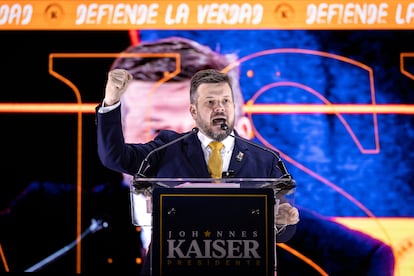
Johannes Kaiser is often presented as a political outsider. But “there’s a historical trajectory of the Kaiser family’s pursuit of power,” Bravo points out. Johannes’ grandfather became mayor of Villarrica (supported, among others, by a nationalist group). His father Juan Cristián, a businessman, ran for Congress with the Party of the South, a right-wing regionalist party. He was unsuccessful at the polls, but he did serve as the party’s vice president in the early 1990s.
Juan Cristián Kaiser and Rosemarie Barends had six children: Johannes, Vanessa, Axel, Leif, Max and Etzel. The couple instilled in them their animosity toward Salvador Allende’s left-wing Popular Unity government (1970-1973), primarily because their family lands had been expropriated, according to the journalists’ book. At the beginning of the dictatorship, the expropriation was reversed and the properties were returned to them.
The Kaiser siblings’ childhood was also marked by their mother’s mental illness and their parents’ divorce. “They had a very bad relationship, full of conflict; [it was] a very hostile atmosphere. I remember that, at the time, all I wanted was to grow up. I didn’t want to keep being a child,” Axel once said, as the investigation points out.
Their mother’s health problems led Vanessa — the only girl among the six siblings — to assume a maternal role. The three eldest siblings eventually followed the path of radical right-wing ideas: Johannes, who didn’t complete university; Vanessa, a philosopher; and Axel, a lawyer. It was Axel who, in 2010, began to introduce libertarian ideology to the public. At that time, the authors recount, he was “a voice crying out in the wilderness.” However, his prominence in academia and the media through provocatively-titled columns, such as Education Is Not a Right, established him as an important libertarian figure. And not only in Chile, but also abroad.
“Axel is the purist libertarian leader, who has also positioned his siblings and the party internationally. He’s been key in establishing relations with Argentina, with Javier Milei’s government. The [Kaisers] told us that, for the [2025 Chilean presidential] campaign, they received advice from people in Milei’s government on how to prep and how to reach La Moneda (Chile’s presidential palace).”
Vanessa is like the [family’s] ear to the ground and the most philosophical one of them all. As she herself has said, being a woman allows her to say things that her brothers can’t… which makes her the most extreme. And Johannes is the [sibling] who ties the group together and takes on an important leadership role,” Lucero explains.
The emergence of Milei in Argentina was key to the Kaiser siblings’ libertarian impulses. In Chile, there was already an obscure Libertarian Party (PLIB), but what was happening on the other side of the Andes allowed them to dream big. The book recounts how they tried “every which way” to get Axel chosen as a presidential candidate, since he clearly represented the movement’s DNA, with very libertarian ideas in economics, but also when it came to social values. That didn’t work out, so their attention turned to his YouTuber brother, Johannes. From Europe, during the 2019-2020 student protests in Chile, he made a lot of noise online with his criticisms of the left’s agenda.
The authors of the recently-released book explain that they spoke with many young national libertarians “and it was very clear, in all of them, how deeply the social uprising had affected them.”
“Many of them told us that they felt deeply rejected and criticized by the average person hailing from their generation. And, out of this accumulated frustration, they finally found a political outlet in Johannes Kaiser and the National Libertarian Party (PNL). It was like putting a face to [their long-standing concerns],” the journalists explain. “Without the National Libertarian YouTube channel, the party wouldn’t exist,” they add, explaining that there’s a whole digital ecosystem that’s related to the political movement.
“Now, even though there’s this phenomenon of the National Libertarian [YouTube] channel, social media hasn’t just been important for that reason. There’s a whole ecosystem of outlets aligned with libertarians that have gradually been establishing themselves since 2017. The libertarians understood that the digital landscape – until then – hadn’t been explored. And so, they began to spread their ideas.”
Johannes Kaiser added the word “National” to his party’s name, along with an agenda based on very conservative values. This caused a stir among traditional libertarians, who support the right to make decisions about your own body. “What fundamentally unites them,” Lucero points out, “is anti-communism. And, failing that, the defense of the former dictator, Pinochet. It’s absolutely present in everything the party does. The [members we interviewed] told us: ‘In this party, there’s no one who’s against Pinochet.’”
The party is overwhelmingly male, with only 26% of its members being women, the lowest percentage of all political parties in Chile. “The values-based component of the National Libertarian Party’s rhetoric stems from their conviction that society, even Western society, has been experiencing a regression for a long time, because of what they describe as a ‘culture of death,’ feminism, the pro-abortion agenda… for [the leadership], it’s essential to embrace these elements, because without them, the National Libertarian Party wouldn’t exist,” Bravo notes. “In the National Libertarian world, the culture war is paramount. And they won’t compromise: they’ve demonstrated this throughout their time in Congress. They’ve been the main drivers of that agenda,” Lucero adds.
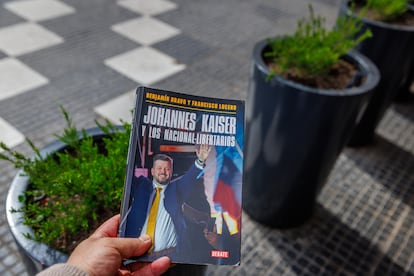
While Kast has built his inner circle around former members of the right-wing Independent Democratic Union (UDI), a 43-year-old party that believes in the ideology of guildism, inspired by conservative Catholic social teachings, Kaiser’s inner circle is primarily composed of former members of the Armed Forces and law enforcement, or those from military families linked to the Pinochet dictatorship.
Regarding the contrast between the National Libertarian Party (PNL) and Kast’s Republican Party, Lucero argues that one of the main differences lies in their conceptions of power. “The Republicans understand that, to govern, they must do so with Chile Vamos (the traditional right-wing coalition). For the PNL, that’s almost [unacceptable]. In fact, many people left the Republicans and went to the Libertarians because of Kast’s closeness to Chile Vamos in the 2021 election, which he lost to Boric. They felt very disappointed,” Lucero states.
One of the key (and less visible) figures in the National Libertarian movement is Ítalo Omegna, a former legislative advisor and PNL member. According to the authors, he spent time studying in Argentina, where he became politically active. There, he forged connections with the libertarian movement.
Omegna was the last president of the now-defunct Chilean PLIB. From that position, he built bridges with those who would later form the core of the far-right movement. His affinity for libertarian ideology, Bravo points out, stems from a strong admiration for Axel Kaiser. When Milei was sworn in as president of Argentina just a week before the 2023 constitutional referendum in Chile, Omegna traveled to the neighboring country “with the express objective of preventing Milei from being photographed with José Antonio Kast,” because a photo with Milei would be seen as a political endorsement. That scene “perfectly summarizes” Omegna’s role as a solid link to the international libertarian world, given his ties to networks in Argentina, Brazil and Guatemala, among other countries.
Omegna gained greater notoriety recently, when a video went viral in which he mocked children with autism spectrum disorder (ASD) and made direct allusions to pedophilia. This was during a birthday celebration for a member of La Cofradía, a YouTube streaming show, which Omegna has appeared on. After the video surfaced, Omegna apologized, arguing that he failed to distinguish between his comedic role on the show and the public responsibility that came with his position. He resigned from his post as legislative advisor to Congressman Hans Marowski, vice president of the PNL, and was dismissed from the Mises Institute of the Southern Cone, the libertarian think tank where he had served as director of community outreach since June of 2025. However, he hasn’t been expelled from the party.
The disillusionment generated by the concentration of power within the party has triggered at least two crises, one of which resulted in the departure of 6,000 members in six months, according to the book. There are former members who call it the “Totalitarian National Party” or the “Family-Run Business,” because, they claim, if you don’t have access to the Kaisers, it’s very difficult to be heard. The family has also been criticized for not consulting the rank-and-file members on important matters, such as whether or not to be part of Kast’s government.
“There’s this very big wave of discontent. We were told that not only was the leadership inaccessible, but so were spaces like the party’s top committee. They chalk it up to the fact that many of these spaces are filled with agents from Kaiser’s inner circle. After the book came out, we learned that many of our sources had left the party precisely because of this,” Bravo warns.
The authors mention that there are former members of the PNL trying to revive the old Libertarian Party. And at least one left to build a project that “truly embodies the legacy of the dictatorship.”
Sign up for our weekly newsletter to get more English-language news coverage from EL PAÍS USA Edition
Chile
¿Debutantes? ¿Qué Debutantes? Mérida Y Jódar Brillan En La Davis Y Castigan La Fragilidad De Chile


Almost 400 motorists caught in bizarre German speed camera trap

Almost 400 Motorists Caught In Bizarre German Speed Camera Trap
España – Croacia En Directo | Yamal, Sobre Su Segundo Gol A Livakovic: “Lo Conozco De Los Entrenos”

Detenido Un Hombre Por La Muerte De Una Mujer De 47 Años En El Distrito De Arganzuela De Madrid

British Actress Naomi Watts Attacks Ageism In Hollywood As She Picks Up Prestigious Donostia Award At San Sebastian Film Festival

Heartbreaking Instagram post reveals death of F1 star


-
 Arganzuela2 weeks ago
Detenido Un Hombre Por La Muerte De Una Mujer De 47 Años En El Distrito De Arganzuela De Madrid
-
 basque country1 week ago
British Actress Naomi Watts Attacks Ageism In Hollywood As She Picks Up Prestigious Donostia Award At San Sebastian Film Festival
-
 Uncategorized2 weeks ago
Heartbreaking Instagram post reveals death of F1 star
-
Best airlines2 weeks ago
Spanish airline Vueling named Europe’s best low-cost carrier for 2026
-

 %2 weeks ago
Mallorca Property Overrun By Wild Goats
-
2026 wildfires2 weeks ago
Spain’s wildfire toll revealed as almost 300,000 hectares go up in flames
-

 Claudia Sheinbaum2 weeks ago
The Azcatitlan Codex Returns To Mexico From Europe After Nearly Two Centuries
-
 America2 weeks ago
Delcy Rodríguez Se Reunirá Con Trump En Nueva York En Un Gesto Inédito De Acercamiento