Michel Foucault died in the summer of 1984 from complications related to AIDS. He passed away at the Pitié-Salpêtrière Hospital, where the philosopher had spent thousands of hours researching its symbolism as a vast space of confinement for the poor, the sick and society’s outcasts.
Mathieu Potte-Bonneville (born in Thiers in 1968) was a teenager at the time, but years later he became involved in AIDS activism, a movement in which Daniel Defert, Foucault’s partner, was a towering figure in France. He was also captivated when he read The Order of Discourse and discovered that philosophy could be written in a way that was as beautiful as it was subversive.
This political and personal connection to Foucault, combined with the philosopher’s extraordinary intellectual fecundity — he never repeated himself and always seemed to be opening up new avenues of thought — drew Potte-Bonneville in. Today, he is regarded as one of the leading experts on Foucault’s work.
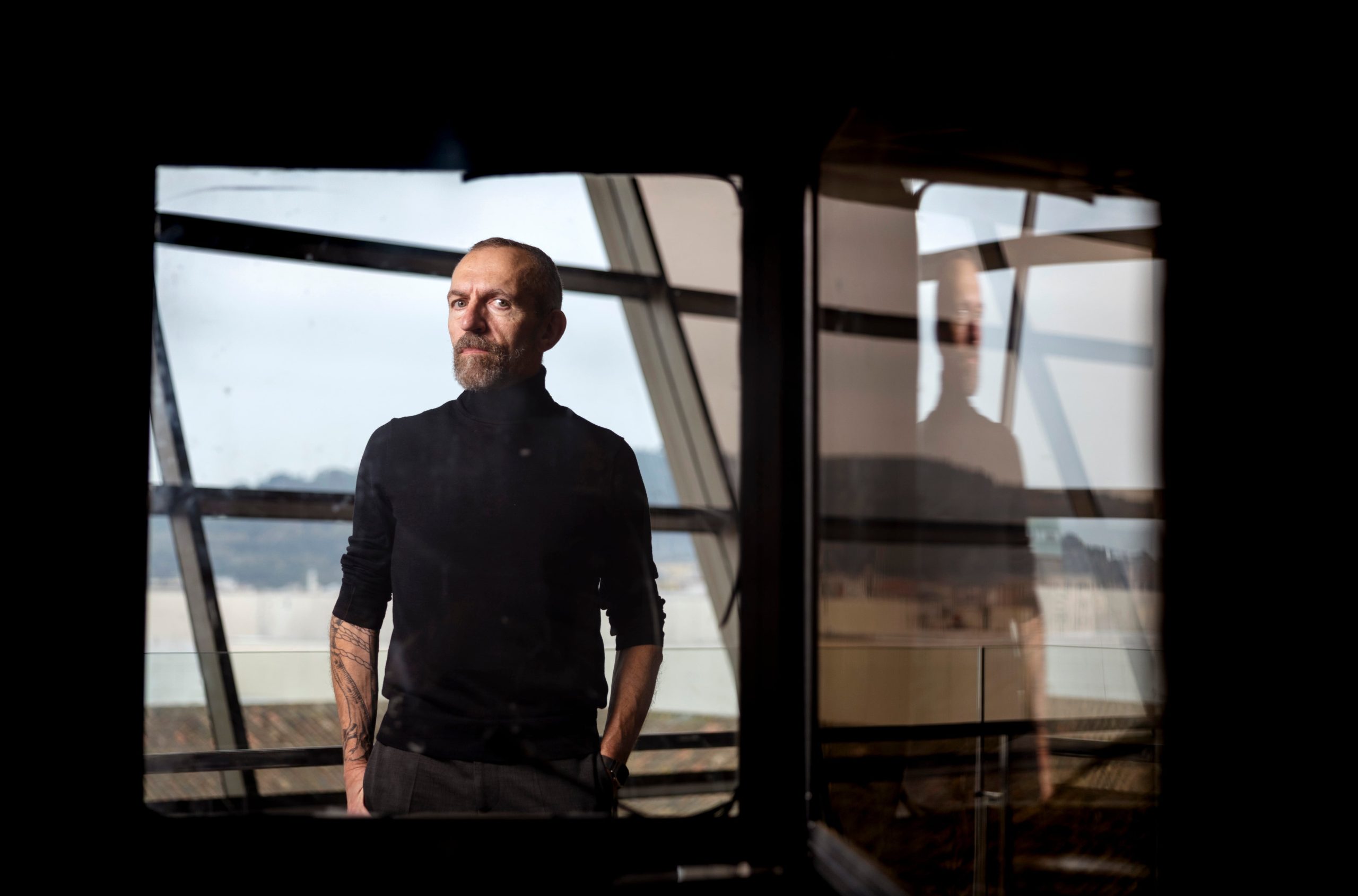
A philosopher, professor at the École Normale Supérieure de Lyon and director of the Department of Culture and Creation at the Centre Pompidou, he is the author of books such as Michel Foucault, l’inquiétude de l’histoire (Foucault: The Restlessness of History). He also co-authored Foucault: vies parallèles (Foucault: Parallel Lives), an illustrated biography created with cartoonist Morvandiau.
On Monday morning, during an interview at the CCCB, where later that day he is scheduled to speak about Foucault’s contemporary relevance, with tickets already sold out, Potte-Bonneville shows a photograph of a group of students carrying a banner reading Discipline and Punish. In 2026, the centenary of his birth, it is clear that Michel Foucault remains very much alive.
During the interview at the Centre de Cultura Contemporània de Barcelona (CCCB) — where he spoke on the relevance of Foucault — Potte-Bonneville shows a photo of some students holding a banner that reads “Discipline and Punish.” In 2026, the centenary of his birth, it is clear that Foucault is very much alive.
Question. Foucault is one of the most cited philosophers in the world. Why?
Answer. The first reason is that, despite being dead, he has never stopped publishing. New texts, books and publications appear every year. The second is that his work intertwines philosophy, history, literature and the social sciences, connecting those disciplines in a very contemporary way. He has had a major influence on thinkers who define contemporary thought, such as Judith Butler, Achille Mbembe and Gayatri Spivak. He never wrote explicitly about feminism or postcolonialism, but many scholars who study those subjects draw on his work. One could say we are living in a neo‑Foucauldian moment, or Foucault 2.0.
Q. Foucault detested the monarchical figure of the intellectual and offered his work as a collective toolbox. Which of his ideas do you consider most useful right now?
A. Today we face problems that did not exist in his time. Foucault did not live through artificial intelligence or algorithms, but his work resonates in the face of those issues; we can think about them or read them from what he wrote. One example: in September, a collective of artists created an AI tool called Foukenstein — a blend of Foucault and Frankenstein — that simulates his voice and contains his entire oeuvre. On the digital screen, Foucault’s face does not appear, only a turtleneck sweater so characteristic of him. It’s a kind of ghost that answers your questions in a Foucauldian key. It’s disturbing, but it neatly illustrates the concept of the death of the author. Another example: last week, at the large demonstration in Place de la République in Paris, some high school students carried a huge banner that read “Discipline and Punish.” It marks the return of his message to the forefront of current events.
Q. Were his studies of social control a warning about the surveillance capitalism denounced by Shoshana Zuboff?
A. Foucault’s relevance today does not lie in his prophetic abilities. He never predicted automated surveillance. Perhaps the most interesting thing is to analyze the successive metamorphoses of the figures of surveillance and power. The History of Sexuality is often described as a book very much of its time, very much of the 1970s. There, Foucault identified a connection between the intimate and the political, something that appears in current phenomena such as masculinism, which directly ties male sexual identity to the exercise of power. Today, violence against women and minors is part of a kind of International Masculinist movement and at the same time represents a vector of resistance for much of society. These are categories that Foucault identified and that are reemerging in different forms.
Q. Foucault said apocalyptic narratives are a mechanism of control. What about the future?
A. In general, if you look at the work of 20th-century philosophers, you always find a perspective on the future, the idea of progress as emancipatory thought. But that has changed a lot. Our great tragedy is that we perceive the future as a problem, because, faced with climate change or the rise of AI, what positive vision of the future can we have? That is why it is interesting to return to Foucault, because the future is largely absent from his work. When asked about his view of what lies ahead, he refused to answer, arguing that the way to make effective politics was to engage in politics in the present. Foucault forces us to think differently, to let go of any nostalgia. And that is very liberating.
Q. Foucault argued that resistance to power emerges through the unexpected and the risky. What do you think would interest him today?
A. In France, the concept of resistance is historically overloaded with meaning. Above all, it refers to the resistance during World War II, in a heroic sense that obscures state and societal collaboration with the Nazis. It’s a loaded term; Foucault was very cautious about using it. He lamented not being able to find another word that could adequately explain that point of tension that arises when you pull in one direction and manage to keep everything from moving. He was interested in the point at which the exercise of power is checked — a point that was, at the same time, the starting point for something new. He wrote a beautiful essay in 1979 in which he states that resistance is justified: it is justified when a prisoner in jail opposes his situation, even if he is not innocent, or when a people rejects tyranny — which does not mean that a new tyrannical regime cannot follow. It is that moment of resistance and rejection that interested him. I believe the Yellow Vests movement [the French anti-establishment protest movement that emerged in 2018] exemplifies that ambiguity.
Q. How so?
A. When it emerged in 2018, there were questions about who these people were who were putting up barricades at roundabouts… It was confusing; it bred mistrust. It is a movement that has the merit of highlighting the existential difficulties faced by an invisible segment of the French population, one that lives far from the centers of decision-making. It is an almost medieval-style revolt that brings deep-seated conflicts to the surface, provoking a certain amount of fear and contempt. Moreover, yellow used to be a cursed color. Foucault would probably find it interesting.
Sign up for our weekly newsletter to get more English-language news coverage from EL PAÍS USA Edition















 The amount of drugs was roughly double the amount that mules normally try to smuggle in by this method.






 New Developments3 weeks ago

 New Developments2 weeks ago

 New Developments4 weeks ago

 %4 weeks ago