
Alexandria Ocasio-Cortez
Moderate Republicans Fear Being Dragged Down By Trump’s Unpopularity

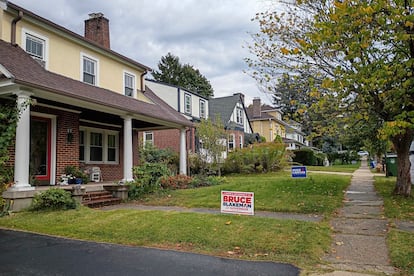
Dan Hanover has planted a sign in the front yard of his home in Tarrytown as if trying to ward off a curse. It bears just three words, “Mike Lawler for Congress,” but that is more than enough for everyone here to understand what it means: the retiree is determined to do whatever he can to help the Republican who represents this charming village north of New York City keep his seat in the House of Representatives after the November 3 election.
Above all, he fears that Democrats will end up controlling everything in a state where they already hold the governorship under Kathy Hochul, the mayoralties of the major cities and 19 of the state’s 26 seats in the House. “This is looking more and more like a one-party state. Someone has to offer an alternative. And that’s the Republicans,” Hanover says from his kitchen.
The 75-year-old retiree believes U.S. President Donald Trump is doing “a pretty good job,” especially compared with the “disaster” of his predecessor, Democrat Joe Biden.
The problem for Republicans is that Hanover’s positive view of Trump is not widely shared among his neighbors. In this part of the Hudson Valley, complaints about the high cost of living are constant, and many residents blame the Republican administration that came to power riding a wave of frustration over inflation during the Biden years.
The rising cost of living is complicating the efforts of Mike Lawler — a relatively popular politician — to hang on to his seat for another two years. Polls suggest a dead heat with his Democratic challenger, Army veteran Cait Conley.
Mike Lawler, like other Republicans desperate to create some distance from the top of the ticket, is running a campaign defined more by what separates him from Donald Trump than by what binds him to his supposed political ally.
His district is a good barometer of the national mood. It was one of only three congressional districts in the entire country that, in 2024, elected a Republican to Congress while simultaneously voting for Democrat Kamala Harris for president.
“Do you pledge your allegiance to Donald Trump?” Lawler was asked during a debate.
“I pledge my allegiance to my constituents, which I always have. It’s why I’ve been rated among the most bipartisan and effective members of Congress. I’ve been praised by presidents of both parties, including Joe Biden and Donald Trump […] My best friend in Congress is a Democrat,” he replied.
“I’ve clashed with the president on numerous issues,” Lawler said on another occasion, after Democratic candidate Cait Conley blamed him for the economic difficulties facing local families because of his support in Congress for Trump-backed measures. According to an analysis by Congressional Quarterly, the Republican voted in favor of legislation proposed by the president 94% of the time.
On Monday, Lawler did break with Trump over the war in Ukraine. In an interview with CNN, after footage emerged of the U.S. president blaming Ukrainian President Volodymyr Zelenskiy for the failure to reach a peace deal, the congressman responded: “Vladimir Putin, and Vladimir Putin alone, is responsible for this war.”
Perhaps because of what is at stake — it could help determine which party controls the House of Representatives — it has become one of the most expensive races in the country, with the two parties spending more than $40 million between them.
Each side is targeting the other’s vulnerabilities. Democratic ads highlight the ties between Donald Trump and Mike Lawler, while Republicans have closely scrutinized Democratic candidate Cait Conley’s links to artificial intelligence companies and have sought to associate her with the alleged antisemitism of Zohran Mamdani, the mayor of New York City.
Lawler’s difficulties are also affecting other centrist Republicans who fear being dragged down by Trump’s shadow. Among them is Senator Susan Collins, who is fighting to hold on to her seat in Maine by distancing herself from the Republican administration on issues such as the war with Iran, the sweeping tax package known as the One Big Beautiful Bill Act, which increased healthcare costs for many families, and tariffs on Canada.
“The president did not have a good plan,” Collins acknowledged during a debate last Tuesday.
A town split in two
Tarrytown has an unusual characteristic: it is split in two. One side of the town of 12,000 residents belongs to New York’s 16th congressional district, represented in Washington by a Democrat. But all it takes is crossing a street to reach the 17th District, represented by Republican Mike Lawler. Two ideologies sit side by side in this world of perfect lawns filled with professionals who spend their weekends mowing the grass.
Lawler says he has broken with Trump on issues such as lifting caps on tax deductions, extending temporary protections for Haitian migrants and expanding tax credits for health insurance. Taxes, immigration and healthcare are, in fact, among the issues that most concern residents of the Hudson Valley.
Faced with criticism over the excesses of Immigration and Customs Enforcement (ICE), local Republicans highlight crimes committed by immigrants in their campaign ads to underscore the need for tighter border controls.
“During Biden’s presidency, illegal entry got out of hand. Now, with Trump, there may have been some excesses, but the problem has been solved. Illegal immigrants have no place in this country,” says Hanover, the resident with the Republican campaign sign in his yard.
New York’s 17th District is particularly revealing because it shows how voting patterns shift depending on the makeup of local communities. Many residents moved here from New York City to escape increasingly unaffordable housing costs. As these generally more progressive families settled in the area, the district gradually became more Democratic.
The district’s diversity is evident from one town to the next. Home to about 780,000 people, it includes one of the largest Jewish populations in the United States as well as sizeable Haitian and Hispanic communities. Wealthy enclaves such as Chappaqua, home to Bill Clinton and Hillary Clinton, coexist alongside working-class communities.
People here are not fond of extremes. Lawler is a traditional Republican who steers clear of Trump-style bombast, while his opponent, Conley, is a centrist Democrat who highlights her military service, her support for Israel and her call to reform, rather than abolish, ICE — positions far removed from those of New York progressives such as Alexandria Ocasio-Cortez and Mamdani.
Peter Bartolacci is another Republican who lives in this landscape of family homes and manicured lawns. He is far from enthusiastic about the Trump administration’s performance, but says it was still the better option given the alternative.
“The Democrats haven’t presented a good candidate since Obama, whom I wasn’t a big fan of either. That’s when identity politics began, which hasn’t brought us anything good,” he says in his living room.
He is certain he will vote Republican on November 3. When asked if he likes what Trump is doing in Washington, Bartolacci answers with a line often used by former New York City mayor Ed Koch: “If you agree with me on nine out of 12 issues, vote for me. If you agree with me on 12 out of 12 issues, see a psychiatrist.”
Sign up for our weekly newsletter to get more English-language news coverage from EL PAÍS USA Edition








Abdul El-Sayed
Abdul El‑Sayed, The Democrats’ Riskiest Bet For The Midterms: ‘We Will Have To Hold Trump Accountable For All The Harm He Has Done’
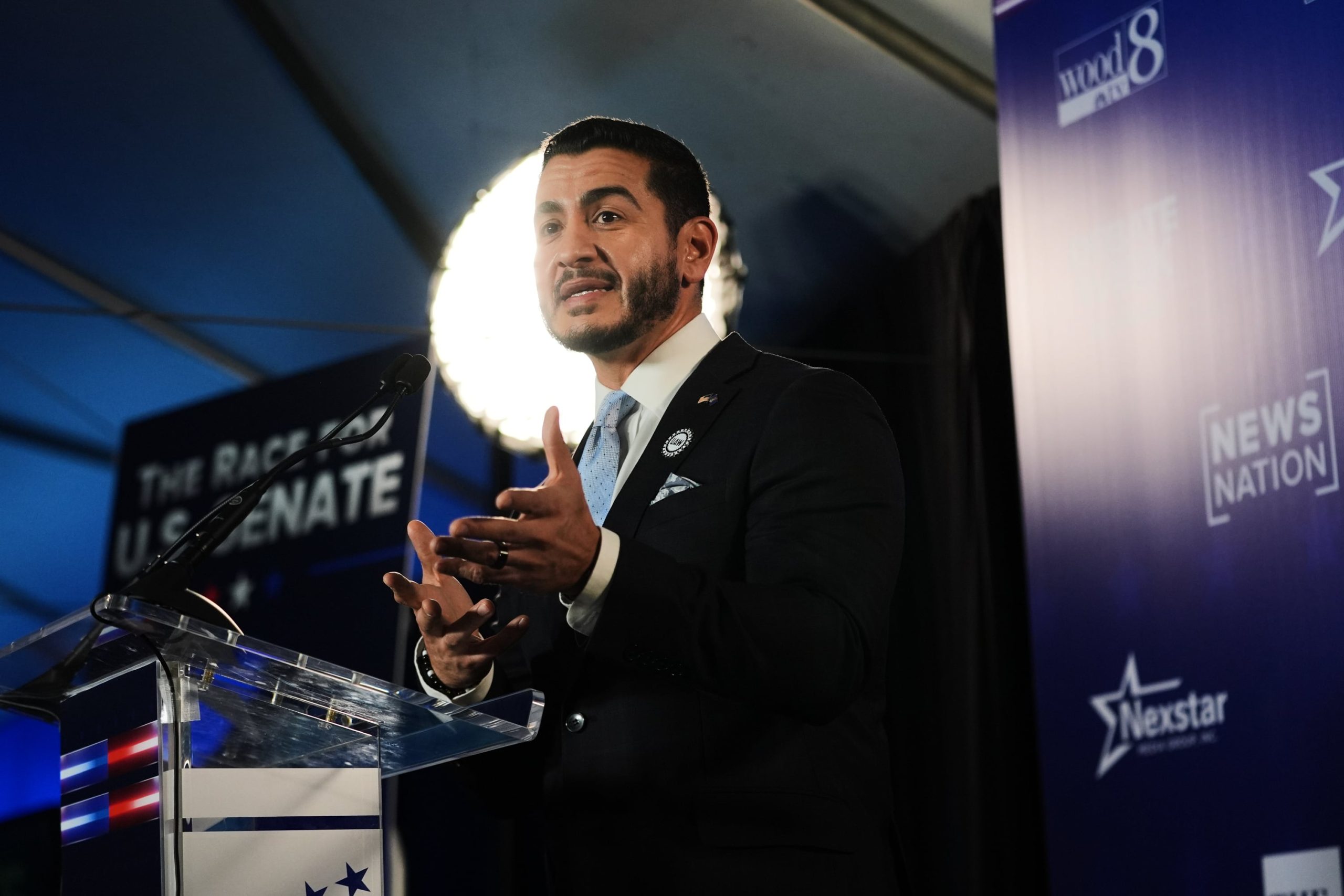
There is still over an hour before the protagonist appears, but the line already wraps around the block. Dozens of people wait patiently for their turn to see the man who has become the great hope of the Democratic left wing. When he begins to speak, pandemonium breaks out: “My name is Abdul El‑Sayed and I am going to be your next senator in Washington.” Over the next hour, the hundreds gathered in this venue will applaud, laugh, and cheer every word from the mouth of the new star of American politics, who has already made a fitted black T‑shirt and jeans his trademark look. We are in Lansing, Michigan’s capital, where one of the most gripping battles of the midterm elections — just over two weeks away — is being fought.
A few days before this meeting, El-Sayed answered questions from EL PAÍS over the phone. During that conversation, he made it clear that his priority is to fight to improve the lives of Michigan’s citizens. But he also gave a glimpse of what lies ahead for Donald Trump if, on November 3, he and a few other Democrats take their seats in the Capitol and — as some polls suggest — win a majority in the House of Representatives and, perhaps, in the Senate as well.
― What is your plan if you win the elections?
― I think we need to make sure that we make life more affordable for everyday folk. That means ending the stupid war we shouldn’t be fighting. It means making sure that we’re rebuilding the important agencies of government that are currently failing because of DOGE and Elon Musk. And it means fighting to provide more healthcare rather than the cuts to ACA and Medicaid that we’ve seen under Trump. And I think it’s really important that we make sure we hold the Trump administration accountable to the worst that they’ve done in office.
― Do you mean that the Congress seated in 2027 should pursue the president’s removal or impeachment?
― That’s not a choice I’ll make as U.S. senator. That’s a choice that the lower house will make. But you know, my focus is gas, groceries, the ability to see a doctor, but I also think when you look at [Defense Secretary] Pete Hegseth and his failure when it comes to this war, and people like [Health Secretary] Robert F. Kennedy, it’s important to investigate exactly what they’ve done and why they’ve done it.
In the phone conversation he provides no further details. But when pressed after the Lansing event about what he means when he calls for investigating the Republican administration’s actions, El‑Sayed offers one example: how the government handled an outbreak of explosive diarrhea this summer caused by cyclospora‑contaminated lettuce. “Thousands of people suffered the consequence. That’s not something that should happen in America. That was entirely because they doged out the part of the FDA that is supposed to protect you from that. I want to understand what happened. Who okayed that? I would like to ask Kennedy, specifically and directly, who ordered the shit lettuce and what are you going to do about it because I’ve seen nothing done about it yet.”
The Michigan battle
On November 3 Americans will vote to renew the entire House of Representatives and one third of the Senate, in addition to electing countless state and local officials. Until recently, seizing control of the upper chamber seemed all but impossible. But Trump’s unpopularity and the surprising strength of some candidates — like James Talarico in Texas or Mary Peltola in Alaska — have moved that once‑distant prospect into the realm of the imaginable.
In this context, the Michigan race stands out for several reasons. Here, Trump narrowly beat Democrat Kamala Harris in 2024 by only 80,000 votes. This Midwestern state of just over 10 million people must now fill the seat of a Democratic senator who decided to retire. Everything seemed set for Representative Haley Stevens to inherit the seat; she had the enthusiastic backing of the party establishment and the very generous Israeli lobby.
AOC has spent her career taking on the powerful on behalf of everyday people, and she has shown all of us what courageous, smart, values-driven leadership looks like. I’m deeply honored to earn her endorsement. Onward to victory.
2018➡️2026 pic.twitter.com/5U149jlP44
— Dr. Abdul El-Sayed (@AbdulElSayed) July 2, 2026
But El‑Sayed, a 41‑year‑old physician, a Muslim, son of Egyptian immigrants and well-connected to the orbit of Alexandria Ocasio‑Cortez and Zohran Mamdani‑aligned socialists, crossed her path. El‑Sayed gained momentum over the summer with a campaign whose slogan — “Money out of politics, money in your pocket and Medicare for all” — he repeats relentlessly.
Much of his success stemmed from a bold social media strategy, with videos showing him lifting weights — one of his passions — or performing choreographies to hits by Whitney Houston and Taylor Swift, always adapting the lyrics to his campaign slogan.
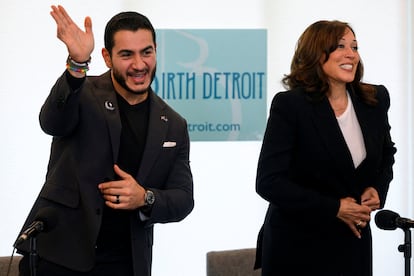
His speech denouncing the enormous influence of money in American politics attracted many young people who were disillusioned with their leaders and outraged by their country’s support for the Israeli government during its massacre in Gaza. What seemed impossible happened and the little‑known contender defeated the experienced politician. But at a high price. El-Sayed’s victory over his Democratic rival, by a handful of votes, showed just how divided the Democrats were between their two factions. Since then, heavyweights such as former president Barack Obama and former vice president Kamala Harris have tried to mend the party’s wounds by backing the Michigan candidate.
A historic milestone
If he wins on November 3, El‑Sayed will make history. He would become the first Muslim U.S. senator and would also demonstrate that the progressive wave that Mamdani started in New York is not confined to large liberal cities. A senator named Abdul El‑Sayed could be the signal Representative Ocasio‑Cortez needs to see there is traction outside the big cities and prompt her to run for president in 2028. His victory would confirm that leftists, too, can win swing territories — those within reach of both parties. He is aware of all this, but prefers to talk about other issues.
— Is Michigan the definitive test of how far the Democrats’ progressive wing can go?
— Maybe, but my focus is more on the future of Michiganders than it is on the future of the party.
Polls so far show El‑Sayed with a very slight lead that is essentially a technical tie with his Republican opponent, Mike Rogers, a former congressman closely aligned with Trump. All these factors weighed on last Friday’s meeting with voters in Lansing, turning the event into an electrifying occasion.

The event was full of true believers, like Joshua Pearl, 19, who joined El‑Sayed’s campaign this summer, drawn primarily by his hardline stance against Israel. “The idea that my taxes help fund a genocide blows my mind,” he said. But there were others, like Chuck Golden, 85, who has voted Republican and Democratic over the years and attended the event to see for himself whether he can trust this new candidate. For this retired engineer, the main motivation right now is to punish Trump.
Campaign of fear about Islam
El‑Sayed’s candidacy has shown how prepared Republicans are to use his Muslim faith as an electoral weapon. In the television debate the two candidates held on October 8, Republican Rogers accused him of receiving funding from Hamas, Hezbollah, and Al Qaeda. He used the word Muslim nearly a dozen times. Trump routinely attacks the Michigan Democrat, whom he prefers to call by his middle name, Mohamed, in a strategy similar to how he referred to Barack Obama as Hussein.
After the debate, the president called El‑Sayed a “Jihadist lunatic who hates our Country [and] the Black People of Detroit.” The latter insult makes sense in that it targets some of the Democrat’s weaknesses: he has substantial support among young people and Muslims but is far less popular among Black voters, Jews, and older voters. Last August, he was forced to apologize for remarks he had made a few months earlier, when — following an antisemitic attack on a synagogue — he said that “hurt people hurt people,” a comment that was interpreted as an attempt to downplay the attacker’s guilt.
In this campaign, El-Sayed has avoided speaking proudly of his Muslim faith or highlighting the milestone that his election to the Senate would represent. Instead, he opts for a more patriotic tone, in which he consistently extols a United States that embraces all differences.
— A quarter of a century after the jihadist attacks of 9/11, Islamophobia remains a real problem. What would it mean for the Muslim community to have its first senator?
— America is big enough for all of us. You know, there are some people who want to make America small. We want to make America big, and this movement that we’re building — people who are Muslim, Jewish, Christian, Hindu, Sikh, atheist — we want a big America where we come together to focus not on our differences, but on what our country can be for all of us.
— But do you believe your victory would have special meaning for Muslims in the United States?
— I think every community wants to see itself in the leadership of this country, and I think it’s important that our leaders reflect our country. Regardless of who you are, I hope that this race can remind you that you belong here too, right? If you pray like me or don’t pray like me, regardless of how you pray, if you pray, who you love, how you identify the color of your skin, you deserve to see yourself in this place. We’re demonstrating the greatness of this country and how much it means to all of us.
When El‑Sayed is asked to look back and to explain what it means that the son of Egyptian immigrants who arrived in the United States in the late 1970s earned a medical degree from Columbia and is now one step from winning a Senate seat, he reaches for his grandmother. “She never got to go to school, but she was the smartest, wisest person I ever met,” he replies.
But he immediately shifts back into campaign mode: “She never lived in America. She visited a couple times, and she believed in this place. She understood how lucky I was to be born and raised here. I want to build a future for people like her — people who are very smart and capable but without the opportunities they need. And I want to be able to build an America where every single kid can look up and say, ‘I got an incredible life waiting for me. I’m so blessed to be born and raised here.’ And I say that understanding just how unlikely that is for me, and recognizing that the work is about making it more likely for any kid anywhere in our in our country.”
Only a couple of weeks remain to find out whether El‑Sayed will achieve what not long ago seemed impossible. His anti‑corruption message can attract voters across the ideological spectrum, although it remains to be seen whether Democratic divisions will cost him. Meanwhile, he is convinced the risky bet is worth it, above all because of his chief obsession: securing a universal public healthcare system — common in other countries but revolutionary in the United States.
He puts it like this: “It’s less about other models in other places. It’s more about what we can do when we put our mind to it. I believe America is the greatest country in the world. I believe when we put our mind to solving a problem, nobody does it better than us. We have the resources if we’re willing to stand up to the corporations who keep trying to nickel and dime us simply because we get sick.”
Sign up for our weekly newsletter to get more English-language news coverage from EL PAÍS USA Edition

Spain Raises Child Maintenance Aid To €300
Could AI decide you’re bad at your job? Spain’s rules on workplace monitoring

Could AI Decide You’re Bad At Your Job? Spain’s Rules On Workplace Monitoring


-

 Uncategorized3 weeks ago
F1 Bahrain Grand Prix will be live and FREE on TV this weekend
-
Blackout preparedness3 weeks ago
Brussels takes action against Spain over failure to update blackout plan
-
EU2 weeks ago
EU nicotine crackdown sparks warning that ex-smokers could be driven back to cigarettes
-

 New Developments3 weeks ago
How To Get A Tourist Rental Licence In Andalusia (Spain) – Step-By-Step Guide 2025
-
 Foreign demand3 weeks ago
Market Snapshot: German Market In Q2 2026
-

 Uncategorized3 weeks ago
Lewis Hamilton F1 wish could come true as stunning plans for new track revealed
-

 New Developments3 weeks ago
Luxury Villas For Sale, Estepona – ProjectL1
-
Latest2 weeks ago
The Changes To Spain’s IRNR Non-Resident Property Tax In 2027