
ElPais
Nvidia Reinstates Jensen Huang As CEO







America
What’s Next For Cuba’s Political Future: An Attack By Trump Before Year’s End Or A Democratic Shift?

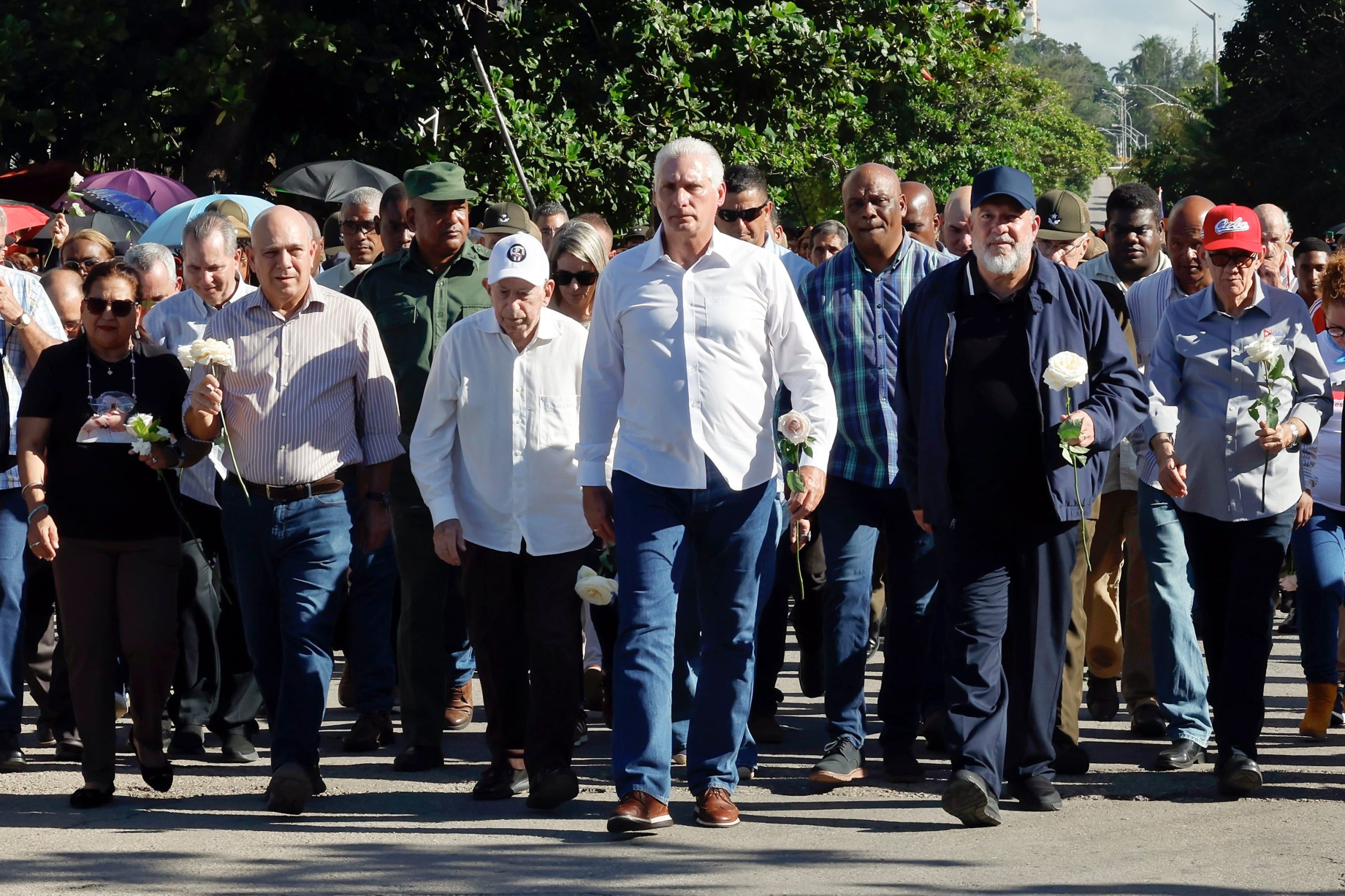
It’s been nearly 10 months since U.S. President Donald Trump first announced that Cuba would be next. It was shortly after his administration had taken out Nicolás Maduro in Venezuela, and before walking into an unpredictable war with Iran. Since then, the president has decreed an oil blockade, slapped sanctions on dozens of businesses and Cuban leaders, and practically every month he issues new reminders that Cuba is a “failed state” that’s about to fall.
Yet the Castro regime is still standing, and the questions being asked in Washington D.C. and Miami, as well as on the island itself, are: will Trump accelerate an attack on Cuba before the end of the year? Or will his rhetoric against Havana lose even more steam when the Democrats take control of Congress in January?
Analysts interviewed by this newspaper agree that neither scenario is likely.
“I never believed that a military intervention was an option. Much less now that Trump is tired [of the issue],” says Francisco O. Mora, a professor of politics and international relations at Florida International University (FIU). William M. LeoGrande, a professor and dean emeritus of the School of Public Affairs at American University, adds that “Congress does not have a lot of control over sanctions by Trump on Cuba.”
For a long time, quite a few Cubans believed in the possibility that the United States would handle Cuba the way it did Venezuela. The fear of a military intervention was mixed with people’s desire to end a life marked by blackouts, food shortages and an economic outlook made worse by growing pressure from the U.S. administration. “If you get on a bus, the first thing you hear is: ‘If only Trump would come, it doesn’t matter what happens,” said Juan Luis Bravo, a resident of Guantánamo, in the east of the island, in a conversation with EL PAÍS in May of this year.
Since then, however, Cubans — who have not seen any improvements in their country through action by their own government — have lost faith in changes coming from the United States. The Trump administration has not secured concessions from the government of Miguel Díaz-Canel during negotiations, and Havana appears to be playing with time.
In an interview with The New York Times in late October, Foreign Minister Bruno Rodríguez Parrilla admitted that his government’s strategy was to simply endure. “For as long as it takes. U.S. policy toward Cuba will change. It has to. It’s inevitable,” he said.
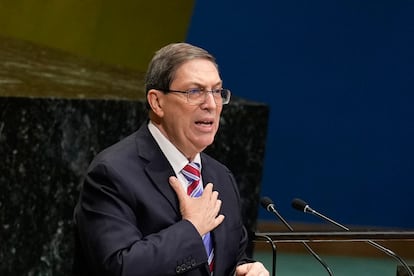
Trump and State Secretary Marco Rubio have been pressuring the Cuban government like perhaps no other U.S. administration before. They have closed off all outside aid, made Cuba much more dependent on imports from the U.S., sent military ships to take up positions near the Cuban coast, sat down with members of the Castro family, and even made a public call for collaboration with the CIA to recruit spies that might help accelerate a change in the system. “Seize this opportunity to create the change you desire,” said Rubio.
But so far there has not been a “friendly takeover” of the island, the way Trump put it, and it looks like nothing is going to change before the end of the year. At a rally in Florida ahead of the midterms, this is what he said to his loyal Cuban-American voters: “Don’t worry, we’ll take care of Cuba on our way back from Iran.”
But the midterms, which changed the electoral map in the U.S., left several signs: according to surveys, Cubans in Miami are a lot more concerned about the cost of life and about immigration issues than about securing a regime change in Cuba; all three Cuban-American congressmembers from South Florida (Mario Díaz-Balart, María Elvira Salazar and Carlos Giménez) won by very small margins in territories where they had always enjoyed wide latitude; the war in Iran was without a doubt one of the reasons for voter discontent. And so the White House should think twice about walking into another conflict, this time with a small island just 90 miles from Miami.
Although the most recent survey on Cuba by Florida International University shows that 73 % of Cuban-Americans support military action to remove the government of Díaz-Canel, analysts do not believe that this is going to happen. LeoGrande doubts this is a viable option, much less after the “disaster in Iran.”
“This has proven that you cannot trigger a regime change with an aerial war,” he says. “Besides, with U.S. forces occupied with Iran and no end in sight, and a general political rejection of war, any military action would have a high political cost.”
This expert in U.S. foreign policy insists that Cuba is a very different case from Venezuela: there is no person on the island “whose kidnapping, as happened with Maduro, could provoke a 180-degree turn in the political orientation of the Cuban regime.” That is to say, there is no Cuban equivalent of Delcy Rodríguez, the interim president of Venezuela.
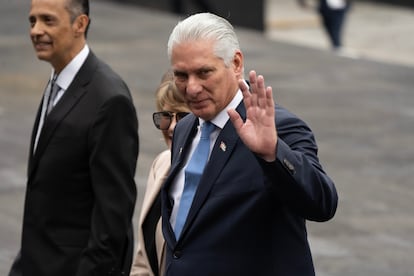
What is being asked now is whether Cuba, and particularly its people, will have to endure two more years of tough policies, or whether the new Democrat-led U.S. Congress might be able to relieve the agenda of sanctions and strangulation implemented by Rubio and Trump.
An uncertain political future
For now, the hangover from the midterms has not ended the battery of sanctions against Havana. Two days after the vote, the State Department sanctioned businesses and individuals with ties to the Cuban elite who, according to a statement by Rubio, were part of a maritime transportation network bringing in crude oil from China. “The Trump administration will not stand idly by while the Cuban regime channels the island’s resources to its military elite,” he said.
Historically, Democratic administrations have applied less pressure on the Cuban regime. Under Barack Obama, both countries announced a thaw in diplomatic relations in 2014. In recent months, several Democratic congressmembers have also spoken up against the White House’s policies.
Pramila Jayapal, the representative for DC’s 7th Congressional District, met in May with Díaz-Canel in Cuba and said that the oil blockade is causing incalculable suffering to the Cuban people. And Illinois congresswoman Delia Ramírez has led an initiative with 31 other members of Congress to demand that the Trump administration rule out any military action against Cuba.
Will these Democratic voices carry enough weight to scale back the sanctions and end the tough policies?
The scholar Mora thinks that Congress could hold several hearings “to try to better understand what the goals of the administration in Cuba are.” However, he does not think that Congress has a lot of influence in terms of changing policies. “The Constitution gives the president a lot of leeway to act on national security-related foreign affairs,” he notes.

Meanwhile, Professor LeoGrande insists that the International Emergency Economic Powers Act (IEEPA) grants the president a lot of authority to impose the secondary sanctions that Trump has used against Cuba.”
“Any legislation aimed at limiting sanctions that the new Congress might approve would be vetoed by Trump,” he says. “Besides, Cuba will not occupy a very prominent spot on the Democrats’ legislative agenda in the coming two years. They will focus on domestic economic issues and on corruption probes.”
There is, however, another scenario that for now remains speculative but not entirely dismissible to these analysts: the possibility that Marco Rubio, himself a Cuban-American, might run for president in 2028. In that case, says Mora, he would have to quit his role as secretary of state “more or less in the summer of next year, in order to start the campaign, which is a long and complicated process.”
Without Rubio for the remainder of the term, says this analyst, things could be different with another state secretary who might not show the same level of interest and attention that Rubio has been showing for Cuba, says Mora. “That could be a calculation by the [Cuban] regime to gain more time. They want to see how to outlive this administration. If they are waiting for January, with the change of Congress, they could be making a mistake. If they are waiting for the summer and Rubio’s potential departure, they might be onto something. Nobody is going to prioritize Cuba the way he is doing.”
Sign up for our weekly newsletter to get more English-language news coverage from EL PAÍS USA Edition
America
Mikie Sherrill, Governor Of New Jersey: ‘Democrats Have To Move Fast And Show Wins Right Away’

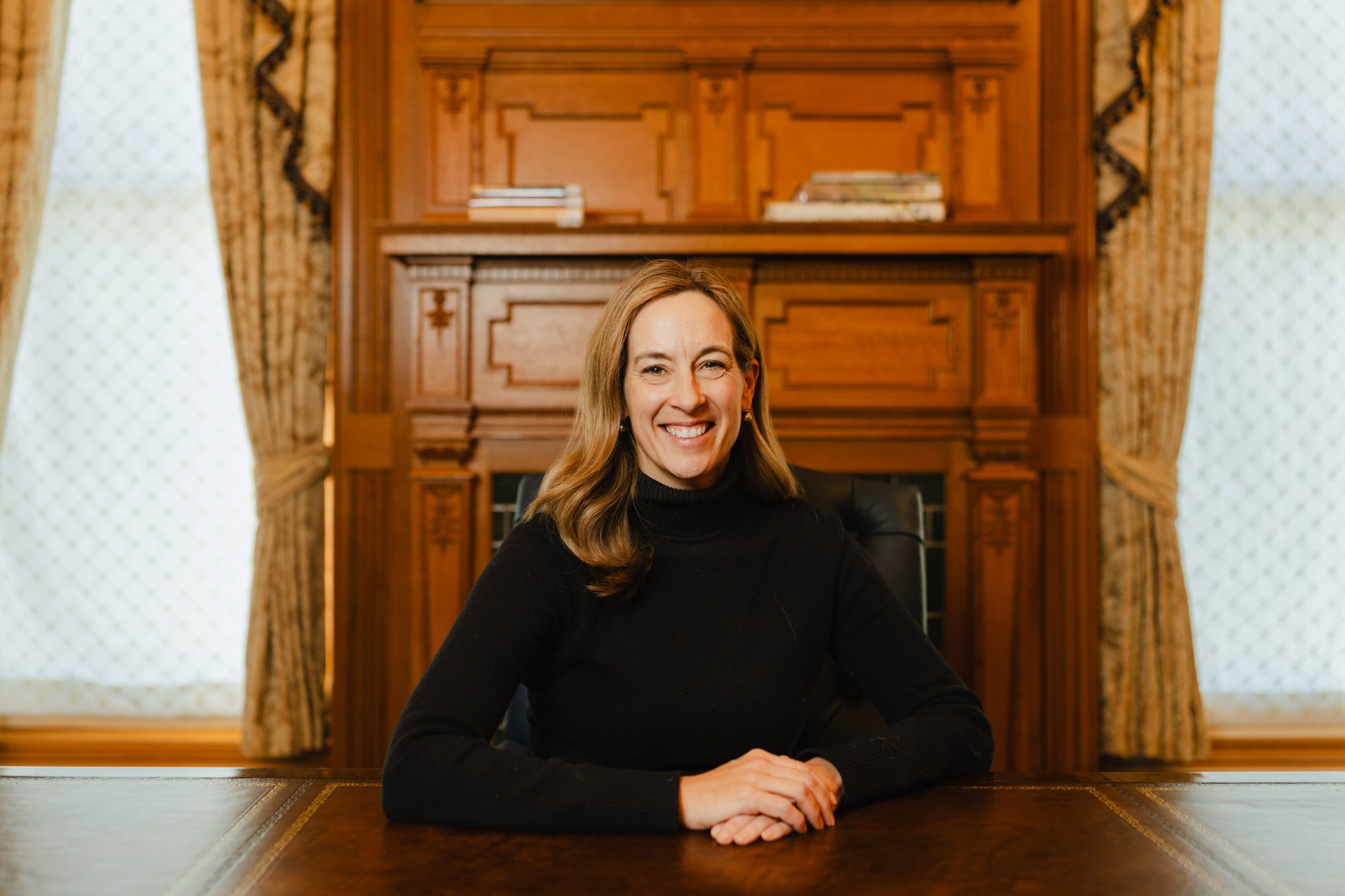
Mikie Sherrill has a firm conviction about the state of the Democratic Party. “We are in our strongest position in decades because we are all united,” she says without hesitation, following the resounding Democratic victory in the November 3 midterm elections.
However, the New Jersey governor warns that the biggest “challenge” facing her party when it takes control of Congress in January will be the need to act decisively and quickly. “You have to move fast and show wins right away because people are cynical, they’re struggling, and they want to see effective government. And as soon as you start to deliver that, they can start to breathe again because they think, ‘Okay, help is coming.’”
Two weeks have passed since the Democrats swept the midterm elections when Sherrill, 54, welcomes EL PAÍS for an interview at the New Jersey State House, the third-oldest state capitol in the United States. Sherrill arrived in its opulent coral-colored hallways last January as the second woman to serve as governor of the country’s most densely populated state (with 9.5 million residents) and the first Democratic woman to hold the office.
Sherrill considers herself a product of the Trump era. She is part of what she describes as “a new generation” of Democratic leaders shaping the party’s direction at a time when the rulebook of politics has been torn up. And the party’s North Star, she says, must be the working class.
Focusing on the cost of living has proven to be a winning strategy for Democrats, as the midterm elections made clear. Voters repeatedly cited Trump’s handling of the economy as their main concern when casting their ballots. It was a message Trump himself successfully exploited in 2024, even though he subsequently failed to deliver on his promises and, in fact, made matters worse with the war in Iran and his tariffs.
Now Democrats are reaping the rewards of those broken promises. Their campaigns drew inspiration and lessons from the victories last year of figures such as Sherrill in New Jersey, Zohran Mamdani in New York City, and Abigail Spanberger in Virginia. All won on platforms centered on affordability, which went on to become the party’s “model,” according to the governor.
“A lot of people would say affordability is a boring campaign, and that you need to run on fascism or democratic institutions or standing up to Trump… And those are all incredibly important things, but it’s not boring to people when they can’t afford their rent and you’re running on trying to fix that for them. It’s not boring when they cannot afford their utility costs and a corrupt president is making billions,” Sherrill argues.
But her own experience as governor over the past nearly 12 months has led her to reiterate a message she delivers not so much as advice but rather as a warning: “Moving quickly to deliver for people is key if you want to hold the public trust.” Democrats must stop the “bleeding” caused by Trump and address the affordability crisis and put an end to corruption within his administration, she says.
A veteran with an acute sense of urgency
Sherrill has said that her sense of urgency stems from her time in the military. Inspired by her grandfather, a World War II veteran, the governor knew from an early age that she wanted to be a pilot. She enrolled at the United States Naval Academy and graduated from flight school in the first class of women qualified to take part in combat operations. She subsequently served as a pilot in Europe and the Middle East. After nine years in the military, she went on to study law and became a federal prosecutor before running for Congress.
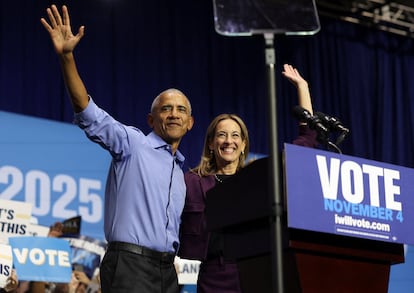
Her political career began during Trump’s first presidency, when she was elected in 2018 to represent New Jersey’s 11th Congressional District in the U.S. House of Representatives in Washington. That year, Democrats wrested control of Congress from Trump’s Republican Party, just as they did this November. Sherrill herself played a role in this year’s victory: she helped flip two congressional seats in New Jersey from Republican to Democratic hands and also campaigned for the now Democratic governors-elect of Texas, Gina Hinojosa, and Ohio, Amy Acton.
Now, as she considers the task facing Democrats as they regain power during the final two years of Trump’s presidency, she says she often draws on what she learned in the military about effective leadership, believing that the political class in this country has been “really, really poor” in that regard.
“Leadership is enunciating a vision. And you can take a disparate group of people and get them committed to that vision because it’s compelling and they trust you that you can get it done. That’s the military. And we recruit from all over the nation. We have people from every different background, and we all come together because we believe in the country. And so that’s what leadership in the Democratic Party is going to look like” after the midterms, she says.
When discussing the future of her party, the governor shows little interest in engaging in the debate over its different factions and divisions. “To me, there’s not one face that says, this is who the Democratic Party looks like. How could one person embody all that it means to be an American?” she asks.
“I hear all this stuff about how we have different ideas, and so it’s going to be ungovernable. I just don’t understand how you think you can govern America with just one person. It’s why we chose not to have a king,” she adds, fully aware that Trump considers himself one.
Sherrill, who belongs to the moderate and pragmatic wing of her party, brushes aside the question of whether the Democratic establishment will be able to coexist with the democratic socialists, who won a record number of seats and positions across the country in these elections. She considers that debate “artificial” and too far removed from people’s everyday concerns. “I can’t tell you the last time someone came to me and said, ‘Mikie, I’m worried about the moderates,’ or ‘I’m worried about the DSA candidates.’ Everybody comes up to me and says, ‘Mikie, I’m worried about affordability. I’m worried about Donald Trump,’” she insists.
Her own record shows that she shares some ideas with both the moderate wing of the party and its more progressive faction. One example is her position on immigration. Sherrill has been highly critical of the White House’s crackdown on immigrants. And although she has not gone so far as to call for abolishing Immigration and Customs Enforcement (ICE), as more progressive figures such as Mamdani have done, she has taken several steps to limit the immigration agency’s activities in New Jersey.
New Jersey was, for example, among the first states to ban immigration agents from covering their faces during their brutal enforcement operations. In response, the Trump administration sued the governor. The legal battle is ongoing. Sherrill has also called for the closure of the first detention center opened during Trump’s second presidency, Delaney Hall, located in Newark. The former prison, which was converted into a detention facility, has come under heavy criticism over its inhumane conditions. Last summer, hundreds of detainees launched a hunger strike that lasted a month. At least three people have died after being held at Delaney Hall.
“I don’t believe in private detention facilities. Delaney Hall should be shut down,” Sherrill says firmly.
A roadmap for 2028
The governor believes that the work she is doing in New Jersey should serve as a roadmap not only for Democrats in Congress over the next two years, but also for the party as it looks ahead to the 2028 presidential election. The Democratic nominee will face Trump’s successor since the president will be unable to run again. In that election, Sherrill says she would like to see a candidate much like herself.
Would she herself consider running in 2028? “I’m very happy being governor of New Jersey,” she replies with a laugh. “What I really want to see in 2028 is leadership that looks a lot like what we’ve done in New Jersey, meaning taking action right away.”
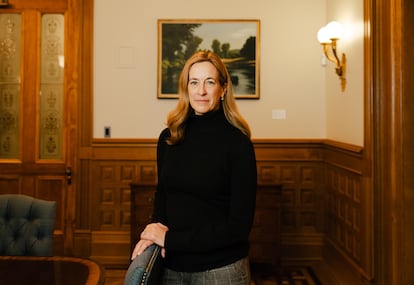
On paper, Sherrill has many of the qualities that make her an attractive candidate for the job: she is a military veteran, a former prosecutor, and a former member of Congress. However, her name does not appear on lists of potential presidential contenders, although she has said she has received calls from people asking whether she would be willing to run.
For now, she prefers to highlight her accomplishments as governor, including signing legislation to curb algorithmic rent pricing; signing a package of laws restricting state and local authorities’ cooperation with the federal government’s anti-immigration crackdown; and taking the Trump administration to court and winning a lawsuit to secure federal funding for the construction of a new rail tunnel connecting New Jersey and New York.
“You have to be fighting for the people you serve. That looks like getting in court really quickly. Not waiting, not trying to cut a deal; just when Trump’s acting illegally, take him to court. Don’t try to negotiate with him. Why are you negotiating for money, for example, for the Gateway Tunnel, when he is legally obligated to turn it over? There’s no negotiation there. There’s court, and he loses, and you keep moving. Having that kind of leadership is really important,” she says.
For the governor, this is the new formula for doing politics. “People are not okay with government inefficiency right now. They’ve seen how quickly Trump could move, and he moves really quickly at breaking things. So if you are going to be great at serving people, you need to move really quickly in rebuilding new things.”
Sign up for our weekly newsletter to get more English-language news coverage from EL PAÍS USA Edition

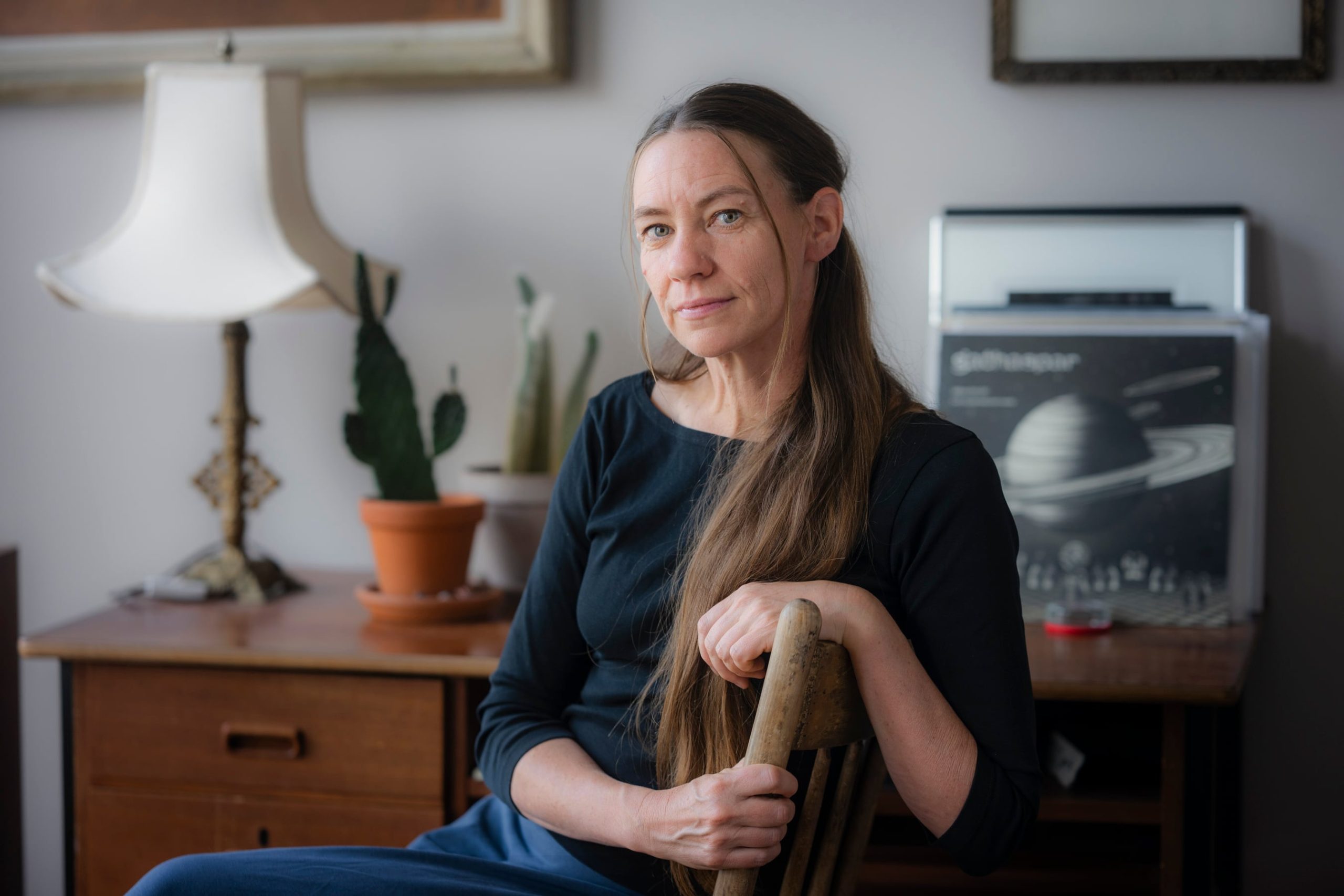
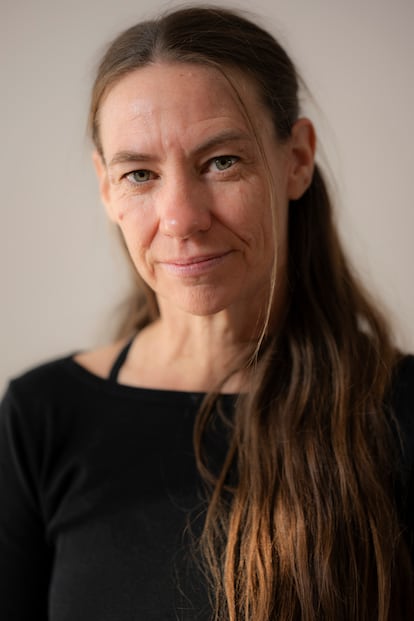
Born in New York but raised in a small town in Connecticut, in the northeastern United States, Toby Kiers, 50, spent her afternoons outdoors searching for morel mushrooms with her sister. That early passion led her to study field biology. It also explains why she soon grew tired of the laboratory and left the classroom behind to explore, firsthand, the underground world of Panama’s forests.
Three decades later, Kiers has become the youngest scientist ever to receive the 2026 Tyler Prize for Environmental Achievement, widely regarded as the Nobel Prize for the environment.
Her research on mycorrhizal fungi — which live in association with plant roots and exchange resources with them — investigates how an organism with no apparent brain can make decisions and process information. Her work is opening a new frontier of knowledge by studying, for the first time, how these fungal networks operate and the biological rules that govern them.
In the process, Kiers and her team have shown that these networks play a crucial role in the global carbon cycle. Today, her academic work goes hand in hand with a broader mission: securing the same international legal protections for fungi that already exist for animals and plants.
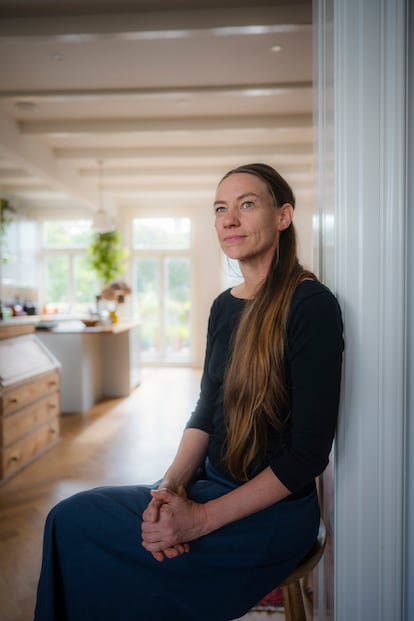
The biologist champions a creative approach to science that challenges the view of the world found in textbooks, and describes her own outlook as punk. She welcomes us into her home in Amsterdam’s central De Pijp neighborhood. A month ago, she returned from Vancouver Island, Canada, and in the coming months she will head to New Zealand and then Georgia to collect samples. Kiers is a professor of Ecology and Evolution at Vrije Universiteit Amsterdam, where she leads a research team, but she cannot imagine doing science without getting her hands dirty in the field.
Question. You dropped out of college at 19, although you later returned to your studies.
Answer. I was studying at a very small college in Maine, United States, and was eager to work in field biology, but classes frustrated me, so I dropped out. I didn’t have a defined plan, but I landed an internship at the Smithsonian Tropical Research Institute and moved to an island in the middle of the Panama Canal. There I was the youngest person and I had enormous enthusiasm and ambition. Most scientists studied what was happening aboveground — the primates, the birds, the plants — but I wanted to know whether that world had a reflection belowground. I remember standing beneath those huge tropical trees and wondering what they looked like under the soil. No one had really tried to understand the web that held those forests together. So I started a very simple project, and that is when I first saw these mycorrhizal fungi. I was fascinated. They were captivatingly beautiful.
Q. What has changed in the last 30 years?
A. Last week, I saw that an artist was exhibiting illustrations in the subway network inspired by the New York City map to depict the interactions between plants and fungi. We didn’t understand how important, diverse and densely interconnected these networks were. When I began studying them, we had just come out of an era in which they were considered pathogens that harmed plants. Now we understand they are part of one of the planet’s circulatory systems.
Q. Why have fungi been such a neglected area of scientific research?
A. It’s estimated there are between two and three million fungal species on Earth, and barely 1% have been identified. They’re hard to see and short-lived. Most people associate them with what they know—food, pathogens or psychedelics. People are unaware of the extent to which they support everything we see above the land surface.
Q. What role do fungal networks play in the functioning of the planet?
A. To start with, fungi are fundamental for moving carbon into the deep layers of soil. Ninety percent of all plant species on Earth form connections with mycorrhizal fungi. One of our studies showed that plants process and transfer 13 billion tons of CO₂ a year to fungal networks — roughly one-third of the emissions from fossil fuels. Moreover, once carbon reaches the network, fungi use it to build their own bodies and, in doing so, create a living physical structure that holds soil together. They are also essential for supplying the phosphorus that plant communities need to survive, and for providing water to plant communities in deserts and arid zones. Again, they act in ways that allow the roots of a plant community to access resources they could not reach on their own, and they do so because they receive carbon in return. Soil health and the resilience of the ecosystems above depend on these underground interactions. That is why we are so concerned about the loss of these networks.
Q. Are they at risk?
A. In general, fungi are very resilient. But they are constantly under pressure from forces such as urban development. If living soils are covered with concrete, the fungi die. That is why urban expansion and agricultural intensification are so damaging, especially through the use of fungicides, which by definition kill them. In Europe, for example, large amounts of fertilizers end up in rainwater and raise nitrogen levels. As a result, even forests that are not being logged or actively managed can receive so much nitrogen that fungal diversity declines simply because of what comes down in the rain.
Q. Your research challenges the traditional idea that nature is a realm of cooperation and coexistence.
A. I find the narrative that organisms either cooperate or break that pact and compete very frustrating. We need to move beyond that view. The reality is much more interesting and subtle. My work has focused precisely on studying how organisms exchange resources to understand these symbioses. At one moment, for example, when resources are abundant, an organism may receive more than it gives. But in another situation, when external resources are scarce, it may give far more than it receives. Everything is in constant flow.
Q. One of your studies found that fungi displayed a kind of generosity, moving phosphorus, an essential nutrient, from resource-rich areas to poorer ones, almost like a Robin Hood figure.
A. We were very surprised to observe that, but if we take a step further and ask why they do it from the fungus’s perspective, we find they received more carbon in the places with less phosphorus. So for them it’s a strategically advantageous exchange. I’m uncomfortable trying to fit these behaviors into an anthropocentric interpretation like Robin Hood. I think the most important thing about our work is trying to adopt the fungi’s own perspective. Much of the research so far has focused on what happens aboveground in ecosystems. We try to invert the approach and ask: why do fungi make these exchanges in different places and times? That is what makes this field so exciting — many questions remain because no one had framed them this way.
Q. How does an organism without a brain make decisions?
A. Fungi are constantly assessing their environment and growing their bodies in different ways. We can imagine them as a network of highways. Inside them, nutrients flow in both directions, like traffic. Fungi sense the environment with their entire bodies; that information is integrated somehow at their various growing tips and allows them to grow or stop growing, speed up or slow down growth, begin reproducing, fuse… These are behaviors we can now begin to track directly. Together with a team at the Netherlands Institute for the Physics of Living Matter (AMOLF) we are developing amazing imaging robots that let us follow the development of a fungus’s body and the decisions it makes over time.
Q. What has technology contributed to your research?
A. Before, we used to make predictions in a way; it was a sort of black box: we’d design an experiment, allocate the resources, and then see where they ended up. But now we can track the path of carbon in real time and see how these resources reach a fork and take the left path or the right, or split exactly in half. And we are watching it live, in real time. When I say we observe the inner life of fungi, I mean it literally. We are seeing how something that lacks a brain like ours makes decisions and processes information. That is why I feel we are at a true boundary of knowledge.
Q. Why is it important to know how a fungus makes decisions?
A. We have a very anthropocentric view when it comes to understanding how information is processed. Why do we assume the human way of deciding is the best? There are many ways of deciding, but we know very little about these decentralized systems. It’s worth understanding them because they have been shaped by natural selection and evolution over hundreds of millions of years, and they could potentially teach us alternative ways to make decisions.
Q. In 2021, you founded the Society for the Protection of Underground Networks (SPUN) to help secure, among other goals, international protections for underground fungi.
A. The question is how we can work with governments to protect underground ecosystems from the threats we have discussed. It’s about helping provide datasets so that, at local and international scales, governments can consider how to protect these underground communities that will be essential for the future restoration of ecosystems. There are fungi that have developed remarkable adaptations and can survive in the Gobi Desert in Mongolia, where some of the most extreme drought and temperature conditions — both cold and hot — on Earth are found.
Q. SPUN has created a kind of Google Maps for fungi.
A. The subterranean atlas allows us to identify fungal biodiversity hotspots underground. The goal was to ask: where is the Amazon of the underground world? Where are the mycorrhizal fungal communities with the greatest biodiversity on the planet? In some cases they were in surprising places, like the pampas region and certain areas of Brazil—places we hadn’t identified as critical for biodiversity protection. Ninety percent of the hotspot locations are outside currently protected areas. In other words, only 10% have protection.
Q. How did you map that biodiversity at a global scale?
A. It’s an intensive process. SPUN was founded on the idea of decentralized science, following the example of the fungi themselves. We award small grants to scientists worldwide who map the fungal communities in their territories, and those data are then incorporated into large global models that use machine learning. But we also map uncertainty. The farther we move from a place where an actual sample has been collected, the lower the certainty of our predictions. We want the data to be rigorous, so we clearly indicate where we have a high degree of confidence and where more data are needed. By identifying those areas, we try to find local scientists willing to map them. It’s an iterative process: everything adds up and, little by little, our view of the world changes.
Q. You have described your approach as “punk science.”
A. Science is, by nature, creative. It arises from asking hard questions, recognizing uncertainty and ensuring people are willing to question limits and go beyond them. It’s about breaking with the way of understanding the world you find in textbooks. Even giving resources to local scientists to study what they observe in their surroundings challenges the system. Science is usually organized top-down: someone sets what must be done and how, and others execute it. But we propose bringing together different communities, even those that have never participated in scientific research, and asking: what are you observing that is different? On the other hand, everyone wants science to be some kind of robotic, perfect work of art, you know? But it’s not like that. It’s a messy process, full of imperfections.
Q. When your children were young, you took them with you on field expeditions as a way of challenging academic conventions.
A. I tried again to challenge the system and the assumed way science should be done. Expeditions are generally led by men. My husband and I pushed back against that idea: we wanted to show that women could lead expeditions and that those women could be mothers. But the most important thing is that creative element. Behind a desk you can formulate all kinds of hypotheses about how the world works, but when you go into the field you see things differently. And children see them more differently than you do. Those different perspectives take you down unexpected paths. For my scientific work, it has always been an advantage, never an obstacle.
Q. What did you learn from them on those expeditions?
A. I started testing soils because my children ate dirt. I don’t recommend that to readers [laughs], but it’s really interesting; it’s about using all the senses. Humans are very focused on sight, but there are many other ways to interact with the environment. My children also asked questions like: ‘How do fungi sleep? Do they dream?’ Those are questions you could easily dismiss, but the issue of sleep and circadian rhythms is precisely what one of my doctoral students began working on. We can observe flow patterns within fungal networks and study whether they change following a day–night cycle.
Q. And now, do they share your fascination with fungi?
A. They are not as fascinated by fungi per se as by nature. My daughter wants to be a marine biologist and my son spends a lot of time hiking. Both have discovered a nonhuman world that interests them and in which they feel comfortable exploring. It’s mostly about opening the senses to all those interactions that are happening and that we can feel more part of if we simply slow down. Perhaps this generation is starting to rebel a bit against electronic devices; who knows what will happen with artificial intelligence. The expression “touch grass” has become fashionable, which I think captures something of their lives: physically touching grass in a way that changes how you see the world.
Sign up for our weekly newsletter to get more English-language news coverage from EL PAÍS USA Edition

Nvidia Reinstates Jensen Huang As CEO

Nvidia Recupera A Jensen Huang Como Consejero Delegado

What’s Next For Cuba’s Political Future: An Attack By Trump Before Year’s End Or A Democratic Shift?


-

 New Developments3 weeks ago
Luxury Villas For Sale, Estepona – ProjectL1
-

 New Developments2 weeks ago
The San Roque Club – Townhouses For Sale
-

 New Developments4 weeks ago
How To Get A Tourist Rental Licence In Andalusia (Spain) – Step-By-Step Guide 2025
-
Age Concern Marbella - San Pedro4 weeks ago
Halloween lunch sells out as 51 join Marbella get-together
-

 %4 weeks ago
Spain Orders Replacement Of Eight Million Gas Meters: New Rules, Costs And Deadlines
-
countryside3 weeks ago
Rural revival: Five Almeria villages make moving inland easier and more enticing
-
costa blanca live music3 weeks ago
Beatles tribute: The Liverpool Band returns to Orihuela Costa
-

 New Developments3 weeks ago
Stylish 3-Bedroom Apartment With Panoramic Sea Views – Benalmádena