Connect with us

%

Runaway On Runway: Stray Dog Beats Security

Published

on

runaway-on-runway:-stray-dog-beats-security

Stray plays catch on runway. Credit: CA X

Air traffic controllers shared a short video this week that quickly did the rounds. A brown dog spent hours running around the takeoff area at Malaga Costa del Sol Airport on October 30, darting between a aircraft and yellow ground vehicles at dusk. Staff eventually rounded it up, but the clip raised a familiar question on the Costa del Sol: just how many dogs are out there with no one keeping an eye on them? Those in charge of airport security have yet to comment how the stray got through ‘strict’ controls.

Dog on the apron, vehicles on the move

Spanish air traffic controllers posted the footage after it arrived via WhatsApp. They described the animal as interfering in the departure zone for several hours. No official reports have confirmed major delays or diversions from this particular incident, though wildlife on the airfield always forces caution. Similar past cases at Malaga, including an injured flamingo that triggered go-arounds, have briefly held operations while teams clear the area. Airport staff appear to have contained this one without wider disruption reaching the headlines. Controllers regularly flag these events on their official X account.

Recibido por WhatsApp.
Ayer en #Málaga un perrito estuvo varias horas interfiriendo en la zona de despegues 🐕✈️ https://t.co/bXBrddEZSO

— 😉Controladores Aéreos 🇪🇸 (@controladores) October 31, 2026

Almost half a million dogs in one province

Malaga province currently holds the highest number of registered companion animals in Andalucia, according to the Junta’s Registro Central de Animales de Compañía. Latest figures put the total at 575,634 pets, of which 446,933 are dogs. That sits just behind Seville’s dog count and ahead of every other province. Cats add another 124,920, giving Malaga the regional lead on felines as well. Roughly 17,186 of the dogs fall into the potentially dangerous category. Put against the province’s 312,526 residents under 18, the numbers work out at about 1.84 registered pets for every child or teenager.

Those registration totals , reported by Europa Press , are based on the regional register. They capture microchipped animals under Andalucian rules, which help return lost pets and track ownership. They do not include every stray or unregistered animal still moving around the province.

Shelters still dealing with the fallout

Main private shelters have seen abandonments drop over the past decade, yet the animals that arrive often turn up in worse condition. Hunting dogs are still a serious seasonal pressure until after the season ends, and summer holidays still produce spikes. One recent case saw police recover 61 dogs and cats from a single property in Velez-Malaga, some kept in darkness inside kitchen cupboards. Council centres and local protectoras continue to handle high volumes of surrenders, litters and runaways while pushing responsible adoption. Groups such as DOMINO and ACE-SHIN in Mijas regularly list dogs ready for homes.

For expats in the area who might be a little unaccustomed to the local fauna, the practical message is straightforward. Microchip and register dogs under the rules, keep them under control near airports, roads and tourist areas, and check local shelters before buying. Costa del Sol rescue groups regularly list dogs ready for homes, and community fundraisers continue to support the work. A single dog on the runway makes for an eye-catching clip, but it sits against a much larger population of animals across Malaga province.

%

Murcia’s Best Marineras Crowned As 180 Restaurants Compete In 2026 Tapas Contest

Published

on

murcia’s-best-marineras-crowned-as-180-restaurants-compete-in-2026-tapas-contest

Murcia crowns two winners after month-long competition celebrating iconic regional tapa. Photo Credit: San Javier Town Hall

San Javier was the host of the grand finale of the 2026 edition of the Best Marinera of the Region of Murcia competition, which was held from September 18 to October 18. For one incredible month, more than 180 local bars and restaurants went head to head to create their best iteration of this iconic tapa, and the winning establishment was crowned in the lively coastal town.

More than 180 restaurants take part in the competition

The marinera is an iconic tapa from the Region of Murcia, particularly associated with the capital and with the Costa Calida hub city of Cartagena. It consists of a base of a crunchy, elongated-ring breadstick called a rosquilla, topped with a generous scoop of Russian salad made with boiled potatoes, tuna, hard-boiled eggs, carrots, peas or pickled vegetables, and mayonnaise, and crowned with a rich, salt-cured anchovy in brine. This delicious seafood snack goes hand in hand with the region’s reputation, and this 2026 edition of the competition inspired residents and visitors to go out, try new restaurants, and enjoy this delicious snack.

The jury’s assessment took into account aspects including product quality, technical execution, flavour, presentation, creativity and respect for the essence of the marinera.

Traditional and reinvented marineras take top prizes

Following the jury’s verdict and a tough competition, Con Sentido de Mari and its chef Mari Carmen Martínez Sánchez, from Cehegín, have won the award for Best Traditional Marinera 2026, while La Flota and its creators Rocío Fuentes and Antonio Fuentes, from Cartagena in La Palma, have obtained the recognition for Best Reinvented Marinera 2026. Both restaurants will receive a prize of 1,000€ each.

Special mentions celebrate Murcia’s culinary talent

The grand finale of the competition also recognised other delicious versions of the tapa through honourable mentions, awarded to La Posada del Pez in Murcia City and its chef Julián Valmayor, and the Best Mahou Reserva Pairing Award, given to Kiosco Ben Arabí, also in Murcia, and its chefs Consuelo Cánovas and Cristina Gil.

The competition brought together culinary professionals, representatives of the food industry in Murcia, and members of the hospitality sector at the Almansa Park Auditorium, celebrating the Region of Murcia’s strong culinary identity and the towns that create these outstanding tapas and meals. In particular, San Javier’s selection as the host for this event brought gastronomy and culture even closer to the town.

During the event, the mayor of San Javier, José Miguel Luengo Gallego, was appointed the Godfather of the Marinera 2026.

San Javier hosts celebration of regional gastronomy

The marinera is not only a tasty snack to try for those living in or visiting the Region of Murcia; it is a testament to the tradition, quality, and creativity that make up the landscape of Murcian gastronomy. Once more, restaurants in the Region of Murcia have showcased their prowess when it comes to keeping tradition alive, bite after tasty bite.

Continue Reading

%

Supermarket Cyberattacks Spread Across Europe

Published

on

supermarket-cyberattacks-spread-across-europe

Freezers turn to cookers across Europe. Credit: Wiliamhero – Shutterstock

Supermarkets across Europe are facing a growing cybersecurity crisis after suspected hackers remotely interfered with refrigeration systems, causing temperatures in fridges and freezers to soar and forcing retailers to throw away large quantities of food.

The latest incidents were reported in Sweden this morning, but have now spread to Belgium, Luxembourg, Ireland and Estonia, with several major supermarket chains affected. The attacks follow a similar incident in France last month, when hundreds of stores suffered refrigeration failures after their cooling systems were compromised.

The growing number of incidents has raised questions about the security of supermarket equipment connected to the Internet, particularly systems which allow refrigeration units to be monitored and controlled remotely.

Sweden supermarkets hit by overnight attacks

Sweden was among the first countries to report problems on Monday, November 2, with supermarket chains ICA and Coop confirming incidents affecting refrigeration equipment.

ICA said a limited number of its stores had experienced problems overnight, while Coop reported that six outlets had been affected.

One ICA supermarket in Sjöbo reported that its refrigerators and freezers had been remotely set to 50°C, leaving staff with spoiled stock to remove. At another ICA store in Stockholm, employees discovered that its freezers had stopped working following an overnight incident.

Sweden’s National Cybersecurity Centre is investigating several incidents involving supermarket refrigeration systems. Its director has also warned about exposed operational technology devices which need security updates and patches.

Belgium and Luxembourg report widespread disruption

Belgium has also suffered serious disruption, with several supermarket groups reporting problems. Around 40 Delhaize stores were affected by an IT incident involving their refrigeration systems, according to reports from Belgian news agencies.

Carrefour Belgium confirmed that 15 of its more than 700 stores had experienced problems, although the company described the impact as limited. Five Spar supermarkets operated by the Colruyt Group also reported attacks on their refrigeration equipment.

The disruption extended into neighbouring Luxembourg, where Delhaize stores also experienced refrigeration problems. Technicians were called out overnight to disconnect affected equipment and prevent further damage.

One Belgian refrigeration company said attackers had switched evaporators inside the cooling units into defrost mode, causing temperatures to rise.

Irish supermarkets forced to remove food

Ireland has now joined the list of affected countries after SuperValu confirmed that refrigeration equipment at 13 of its 223 stores had been affected. The supermarket chain’s parent company, Musgrave, said chilled and frozen products had been removed from sale as a precaution. Stores stayed open, with other products available to customers.

The company said the incident involved a specific model of refrigeration equipment and that its monitoring systems had alerted staff to the problem. Musgrave is working with equipment suppliers and cybersecurity specialists to investigate what happened and restore normal operations.

Estonia reports temperatures reaching 50°C

An incident was also reported in Estonia, where a supermarket refrigeration system was accessed remotely and its temperature settings raised to 50°C. Technology supplier Kitman Coldtech confirmed that one of its customers had been affected. The supermarket chain Selver subsequently confirmed that one of its outlets had experienced the problem. The incident was reportedly dealt with within minutes, limiting the damage. One suspects, it was dealt with by detaching fridges from the Internet.

France suffered an earlier attack affecting hundreds of supermarkets

The latest developments follow a much larger incident in France last month, when hackers gained access to refrigeration control systems used by hundreds of supermarkets. French authorities reported that up to 700 supermarkets were affected, with temperatures in some refrigeration units reaching 50°C.

Intermarché, Carrefour, Monoprix and other major retailers reported disruption and substantial food losses. Some stores also experienced fires linked to overheating equipment.

Investigators examined how attackers had manipulated remotely controlled refrigeration systems, interfering with temperature controls and defrost programmes. The incidents exposed weaknesses in older equipment which had not received important security updates.

Could Spanish supermarkets be next?

There have been no confirmed reports of Spanish supermarket refrigeration systems being targeted in this latest wave of incidents.

However, the developments are likely to raise concerns among retailers in Spain, where major supermarket chains also depend on electronically monitored refrigeration systems to keep fresh and frozen products at safe temperatures.

The attacks go to show how equipment designed to make supermarket operations more efficient can also create potential security weaknesses if it is not properly protected.

Spain’s National Cybersecurity Institute (INCIBE) is providing advice and assistance on digital security incidents, while the Spanish Interior Ministry’s Cybersecurity Coordination Office publishes guidance on protecting connected and industrial equipment.

Who is behind the supermarket attacks?

Despite the growing number of incidents, investigators have yet to identify those responsible. No group has publicly claimed responsibility, and authorities have not established whether all the reported incidents are connected.

The absence of obvious ransom demands has also raised questions about whether the intention is financial gain or deliberate disruption. For supermarket operators, the immediate concern is protecting refrigeration equipment and preventing further food waste.

For shoppers, the incidents raise a wider question about how vulnerable essential food supplies can become when everyday supermarket equipment is connected to the internet.

Continue Reading

%

Cycling In Spain? Misreading This Blue Sign Could Cost You €80

Published

on

cycling-in-spain?-misreading-this-blue-sign-could-cost-you-e80

Cyclists in Spain must obey signs making a cycle route compulsory. Credit: patpitchaya, Shutterstock.

A ride to the shops or an afternoon exploring the coast can become an expensive outing if you misunderstand a roadside sign. In Spain, two blue signs showing a white bicycle carry different instructions, and overlooking the distinction could leave you facing an €80 fine.

The detail to watch is the shape. A blue circle can make using a cycle route compulsory, while a blue square identifies a route reserved for bicycles.

EWN has previously explained cycling rules and fines in Spain. These signs deserve a closer look because they determine whether riders have a choice about where to cycle.

The circle that takes away your choice

The circular blue sign with a white bicycle, officially called R 407a, means cyclists must use the route it marks.

If it directs you onto a cycle route alongside the road, staying on the general carriageway simply because you prefer it is not an option.

Spain’s General Traffic Regulations distinguish between a cycle route being available and its use being compulsory. The presence of a cycle lane alone does not automatically mean cyclists must use it. The circular sign can create that obligation.

Ignoring it could also put a dent in your wallet. The DGT’s national enforcement guide lists an €80 penalty for minor breaches involving mandatory signs. It separately lists €200 where the offence qualifies as serious, so €80 should not be treated as a fixed penalty covering every situation.

The square that means something different
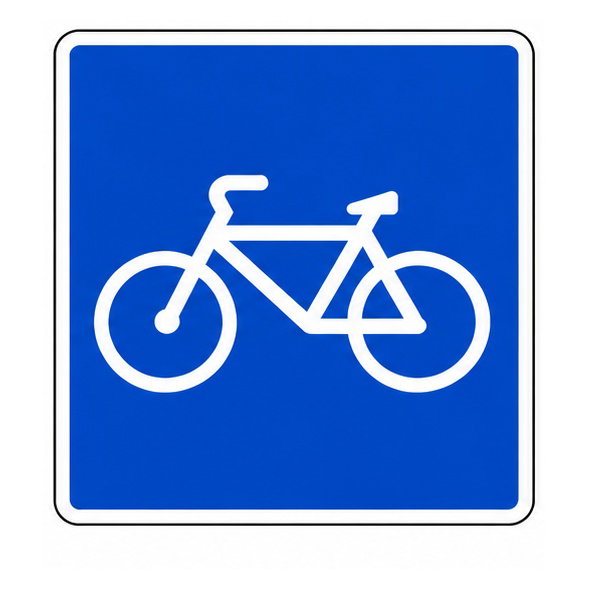
A square blue sign with a white bicycle, known as S 35, identifies a route reserved for cycles. Other road users are prohibited from using it.

The difference is that this sign does not itself order cyclists off the general road and onto that route.

Electric scooter riders should pay attention too. A separate sign, S 38, identifies routes reserved for both cycles and personal mobility vehicles. The bicycle symbol alone does not mean every scooter is welcome.

EWN has also covered Spain’s separate signs restricting electric scooters, highlighting why riders need to check which vehicles each sign applies to.

A path for both does not mean sharing every part
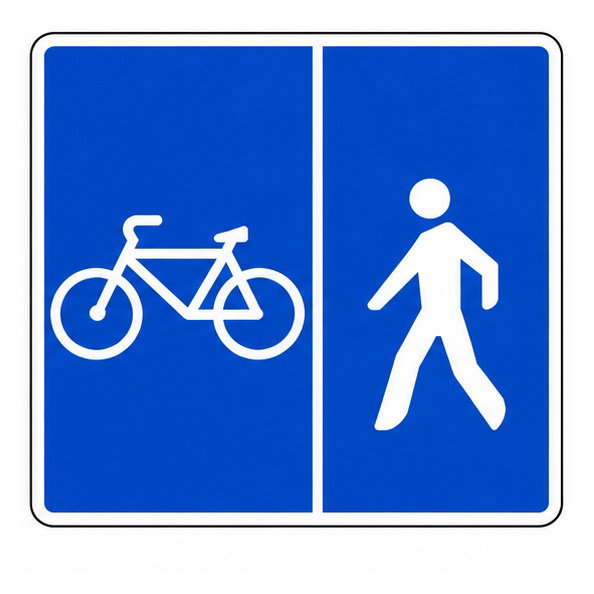
The S 41 sign shows a bicycle and a pedestrian in separate sections. It marks a route with different spaces allocated to cyclists and people on foot.

Check which side belongs to you before continuing. The arrangement shown on the sign can reflect the layout of the path, helping riders and walkers avoid straying into each other’s space.

Drivers need to know the difference too

A cycle lane beside the road does not automatically mean a cyclist on the carriageway is breaking the rules. The signs and restrictions on that stretch matter.

For cyclists, a quick glance at the shape could save money and confusion. Before deciding which route to take, check whether the sign leaves that decision to you.

Continue Reading
Advertisement
Advertisement

Spanish Real Estate Agents

Tags

Trending

Copyright © 2017 Spanish Property & News