
cost of living Spain
Spain drivers get another month of fuel relief as November discount is confirmed

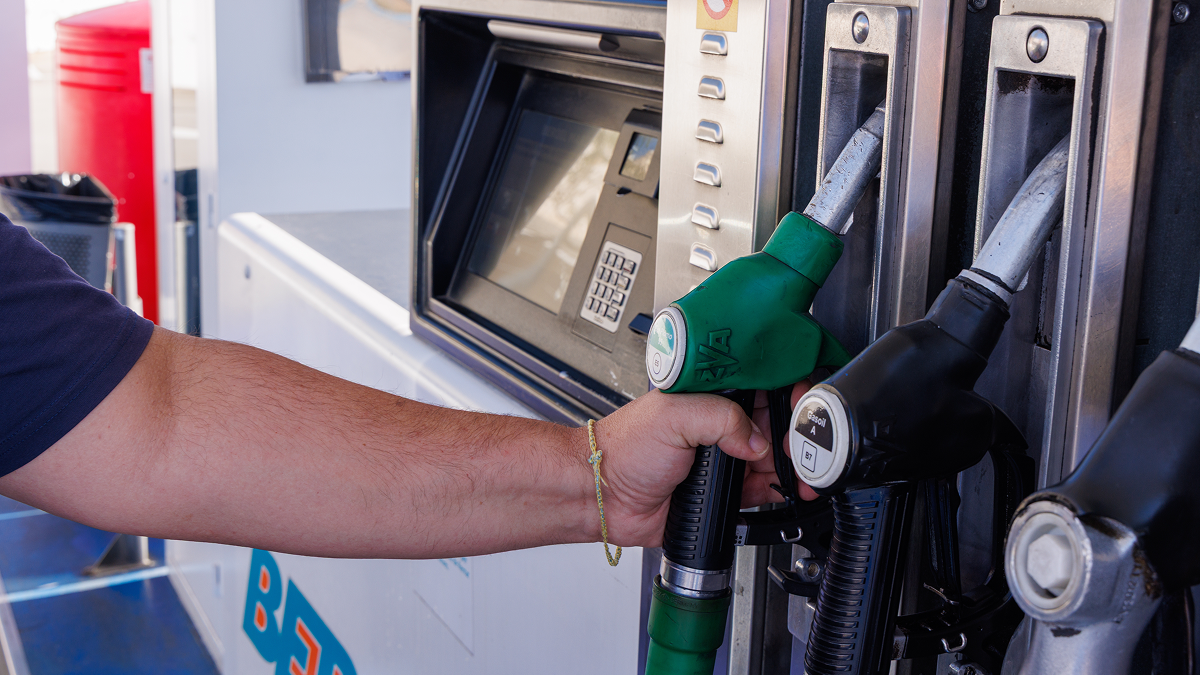
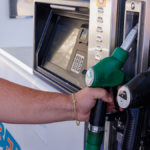
The 20-cent fuel tax cut stays in place for November. Credit: Edugrafo / Shutterstock
Drivers who were bracing for a jump at the pumps from Sunday can relax, because the 20-cent fuel tax cut isn’t shrinking after all. September’s soaring fuel inflation has triggered the government’s own safety net, though what happens in December is still up in the air.
Why the discount stays where it is
Drivers in Spain will keep paying 20 cents a litre less in fuel tax throughout November, after official inflation figures showed petrol and diesel prices running far above the level that triggers extra help. The government’s anti-crisis decree had planned to shrink the cut to 13 cents in November and 6 cents in December, as EWN reported when the October discount was announced. However, it also carries a safeguard clause, which keeps the full 20 cents in place when a fuel costs more than 15 per cent above its price a year earlier.
That test was passed with room to spare. The National Statistics Institute (INE) said on Wednesday October 14 that petrol was 27.5 per cent dearer in September than a year before, with diesel up by roughly 34 per cent, according to Infobae. Congress’s standing committee then ratified the decree on Friday October 16, so the November rate is locked in.
Behind the rises sits the conflict in the Middle East, with oil spiking in mid-September after attacks in the Strait of Hormuz. It has eased since, though not by enough to bring pump prices anywhere near normal.
What the cut is worth at the pump
On a 50-litre tank, the 20 cents is worth about €10, and a little more once VAT is added on top. Had the cut shrunk to 13 cents, the same fill-up would have cost around €4 extra, with petrol and diesel both set to rise by roughly eight cents a litre.
Petrol drivers have felt it most. Their discount jumped from five cents in September to 20 in October, which is why petrol fell by about nine cents within days while diesel stayed put.
However, the saving only reaches your wallet if petrol stations pass it on in full. That was the sticking point in early September, when transport federation Fenadismer said many stations hadn’t passed on the diesel cut. The discount doesn’t apply in the Canary Islands, Ceuta or Melilla either, according to Selectra.
Pump prices are still well above last year
On Friday October 30, a litre of 95-octane petrol averaged €1.731 across the mainland and Balearic Islands, with diesel at €1.900. Diesel is now the dearer of the two, which comes down to the higher cost of refining it rather than tax. Petrol peaked at an average of €1.94 on Monday September 28, its highest level this year, after 11 straight weeks of rises. In early October, petrol was still almost 25 per cent dearer than a year earlier and diesel almost 36 per cent.
Spain still compares well with its neighbours though. Taxes make up 34.4 per cent of a litre of petrol here even with the discount counted in, against an EU average of 46.5 per cent, and only Poland and Sweden had cheaper petrol on October 5.
December is still up in the air
The 20 cents isn’t guaranteed beyond this month. Unless the safeguard is triggered again, the cut will fall to 13 cents in December. That depends on October’s inflation figures, which the INE publishes in mid-November, with petrol and diesel each tested against prices from a year earlier. So the two fuels could even end up with different rates.
Until those figures land, drivers won’t know whether December brings 20 cents or 13.





Rents are rising in 48 of Spain’s 50 provinces. Credit: Free Wind 2014 / Shutterstock
Rents are higher than a year ago in 48 of Spain’s 50 provinces, with a flat in Madrid costing almost three times as much per square metre as one in Cáceres. The national average has stopped climbing from month to month, though, holding at €15.10 a square metre for the third month running.
Rents have held at €15.10 a square metre for three months
Tenants across Spain are paying an average of €15.10 per square metre a month, according to idealista’s October figures. That’s the same price for the third month running, with the monthly change at just 0.1 per cent.
However, rents are still 5.6 per cent higher than they were a year ago. On an 80 square metre flat, the national average works out at about €1,200 a month.
It’s worth knowing that idealista updated its method in July, and its index now leaves out seasonal and holiday lets.
Madrid is the most expensive capital at €23.40 a square metre
Madrid tops the list, followed by Barcelona and Palma, while Cáceres, Zamora and Jaén cost less than half as much as Palma. Here’s how the main capitals compare, with the monthly figure our own calculation for an 80 square metre flat.
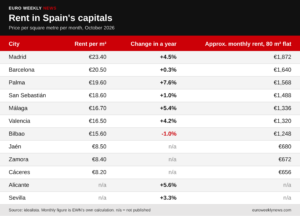
Palma has seen the biggest jump of the main cities at 7.6 per cent, with Alicante (5.6 per cent) and Málaga (5.4 per cent) not far behind. Barcelona rents have barely moved, and Bilbao is the only one of the main capitals where they’ve fallen.
Málaga is the third most expensive province in Spain
Málaga province comes in at €18.80 a square metre, behind only Madrid and the Balearics. Here are the most and least expensive provinces:
- Most expensive: Madrid (€21.60), Baleares (€20.60), Málaga (€18.80), Barcelona (€17.40), Guipúzcoa (€16.10) and Santa Cruz de Tenerife (€15.30).
- Cheapest: Jaén (€7.00), followed by Ciudad Real, Cáceres and Badajoz (all €7.70).
Huesca, Huelva and Palencia are seeing the sharpest rises
The biggest increases aren’t in the glamorous places. Among capitals, these are the top five:
- Huesca: +19.7%
- Huelva: +13.1%
- Palencia: +12.7%
- Pontevedra: +12.5%
- Castellón de la Plana: +12.0%
Across whole provinces, Huesca (+12.1 per cent) also leads, followed by Toledo (+11.5 per cent) and Cuenca (+10.8 per cent). Only Guipúzcoa (-1.4 per cent) and Álava (-1.1 per cent) saw rents drop.
Castilla-La Mancha leads the rises among the regions
Here’s how every region compares, ranked by the rise over the last 12 months.
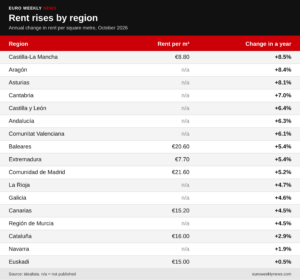
In the regions most popular with British residents, Andalucía (+6.3 per cent) and the Comunidad Valenciana (+6.1 per cent) are rising faster than the national average. Baleares (+5.4 per cent) and Canarias (+4.5 per cent) are rising more slowly, although both are still among the dearest places to rent.
Rent takes 39 per cent of the average family’s income
Renting a two-bedroom flat takes 39 per cent of net household income across Spain, according to idealista data for the third quarter, reported by El Español. Experts generally recommend spending no more than 30 per cent.
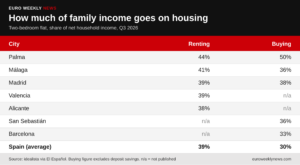
Palma is the most stretched city for both renters and buyers, with buying a flat there taking half of a family’s income. The buying figures don’t include the savings needed upfront for a deposit either.
If you’re already renting and thinking of moving, our guide to whether expats should switch rental property in 2026 is a good place to start. Either way, it’s worth working out what share of your take-home pay the rent would swallow before you sign or renew a contract.


Another Day Of Commuter Train Chaos
‘An insult to Italian culture’: Chef fired after refusing to put pineapple on pizza

El Brighton Deja Sin Margen De Error Al Getafe En La Conference


-
DGT3 weeks ago
Viral video in Spain sparks fury over drivers who ‘have no idea how to drive’
-

 Arabia Saudí4 weeks ago
Un Ataque De Los Hutíes Contra El Aeropuerto De Riad Causa Al Menos 12 Muertos Y Más De 300 Heridos
-

 America4 weeks ago
Un Tirador Mata A Ocho Personas En Una Vivienda En Pensilvania
-
Costa Blanca North4 weeks ago
Jávea opens historic lighthouse to the public with a new whale-watching viewpoint
-
Automated supermarket3 weeks ago
Spain’s 24-hour shop with no tills expands to Barcelona Airport
-

 %4 weeks ago
Concrete Balcony Slabs Collapse Onto Marbella Street
-

 America4 weeks ago
Trump Llega A Un Acuerdo Con Putin Para Que Rusia Libere Miles De Barriles De Diésel En Los Mercados Mundiales
-

 Uncategorized4 weeks ago
Williams F1 driver caught up in four-car pit lane pileup