
ElPais
Execution Of Christa Pike Halted At The Last Minute By A Tennessee Appeals Court


The state of Tennessee has ordered a stay on the execution of a woman who was sentenced to death for the murder of a fellow student when she was 18. If it had been carried out as planned on Wednesday, Christa Pike, now 50, would have been be the first woman put to death in the mid-southeastern state in more than two centuries.
A federal appeals court halted Pike’s execution just an hour before it was scheduled to take place. According to the Associated Press, the judges want to review whether the allegations that Pike suffered sexual abuse and rape as a child were taken into account before her death sentence was handed down.
The Tennessee Supreme Court last week denied Pike’s request to stay the execution. Tennessee’s governor, Republican Bill Lee, made the same decision on a petition for clemency on Monday. Pike’s lawyers then asked the U.S. Supreme Court to stay the execution, but that request was also denied.
The order to stay the execution was issued by the U.S. Court of Appeals for the Sixth Circuit, which reviews decisions by federal courts in Kentucky, Ohio, Michigan, and Tennessee. It is unclear whether the state will now appeal to the Supreme Court to review the appellate court’s decision, according to the AP.

Pike was convicted in 1995 of murdering 19-year-old Colleen Slemmer, a fellow student at a vocational training center for young people in Knoxville, eastern Tennessee. According to the case record, Pike and two other youths, including her then-boyfriend Tadaryl Shipp, led Slemmer to a secluded spot, tortured and killed her. The boyfriend, who was 17 at the time, was sentenced to life in prison. The other person testified against both and received parole.
According to the Tennessee Supreme Court ruling, Pike told police she believed Slemmer was trying to take her boyfriend away from her and initially only wanted to fight with her, but ended up killing her instead.
The ruling says Pike had told a classmate the day before that she was going to kill Slemmer and admitted to police that she struck, kicked and cut the young woman’s throat. Slemmer tried several times to escape the attack, which lasted more than half an hour. Pike said she had hit Slemmer several times in the head with pieces of asphalt. Slemmer died from the head injuries, court documents say.
Pike’s lawyers have asked that her death sentence be replaced with life without parole, arguing she suffered sexual abuse and mental health problems during childhood and adolescence. The defense says the attorneys who represented Pike at trial failed to present evidence of the abuse she endured to the jury.
They also note that seven people, all men, who were sentenced to death in Tennessee for crimes committed at age 18 have had their sentences commuted. No one else that age has been sentenced to death in the state since Pike, 30 years ago.
The abuse history cited by the defense
According to the clemency petition, Pike was the victim of sexual violence in childhood and suffered assaults between the ages of two and five by her grandmother’s boyfriend.

At 11, a neighbor raped her, and Pike reportedly told her mother, who did not believe her, according to a summary of the petition prepared by the Death Penalty Information Center (DPI). The neighbor was arrested on charges of indecent acts with a minor but was not jailed. At 17, she was raped again by a stranger, the petition says. Pike was diagnosed with bipolar disorder and post-traumatic stress disorder.
In the clemency petition, Pike’s lawyers said her mental health problems prevented her from “stopping herself.” “I was an 18-year-old with a mental illness. It took me many years to even understand the gravity of what I had done. And even longer to accept how many people I affected. I took the life of someone’s daughter, sister, friend. I am now horrified to think I was capable of such a crime,” Pike said in the petition, according to the AP.
According to the DPI, new death sentences for crimes committed by people aged 18 to 20 are rare in the U.S. justice system. In 2005, in Roper v. Simmons, the U.S. Supreme Court prohibited the death penalty for crimes committed by people under 18. Since then, only 58 death sentences have been imposed for crimes committed before age 21. Between 2020 and 2025 those sentences represented 5% of new death sentences.
Colleen ‘is not with me every day, every hour, every minute’
Slemmer’s mother, May Martínez, had opposed halting the execution and said she would travel from Jacksonville, Florida, where she lives, to witness it. She described her daughter as a happy young woman who liked skating and family games.
“[Colleen] is not with me. She is not with me every day, every hour, every minute,” the mother said in an interview this month with a local station, lamenting that attention on the case has focused on Pike and sidelined her daughter. “It’s as if Colleen never existed,” she said, adding that she hoped the execution would bring some peace to the family.
Pike’s execution would have been the 30th carried out in the U.S. so far this year following the execution on Tuesday in Florida of Curtis Beasley for a 1995 murder.
Florida has carried out 15 executions this year, including two on the same day for the first time since 1964. Last year Florida executed 19 people, nearly half of the 47 executions nationwide. In August, three states carried out executions, including Tennessee — something that had not happened since 2010.
Sign up for our weekly newsletter to get more English-language news coverage from EL PAÍS USA Edition




Air France
Attempted Hijacking Of Tel Aviv-Bound Plane Revives Specter Of Threat Dating Back To The 1970s





4 fotos
A successful businesswoman of undisputed merit and a fashion icon, the singer has a problem (or a brilliant strategy) when it comes to punctuality





Argentina
Spanish-Argentine Expedition To Verify Whether A Geoglyph Located In The Andes Via Google Earth Is Genuine

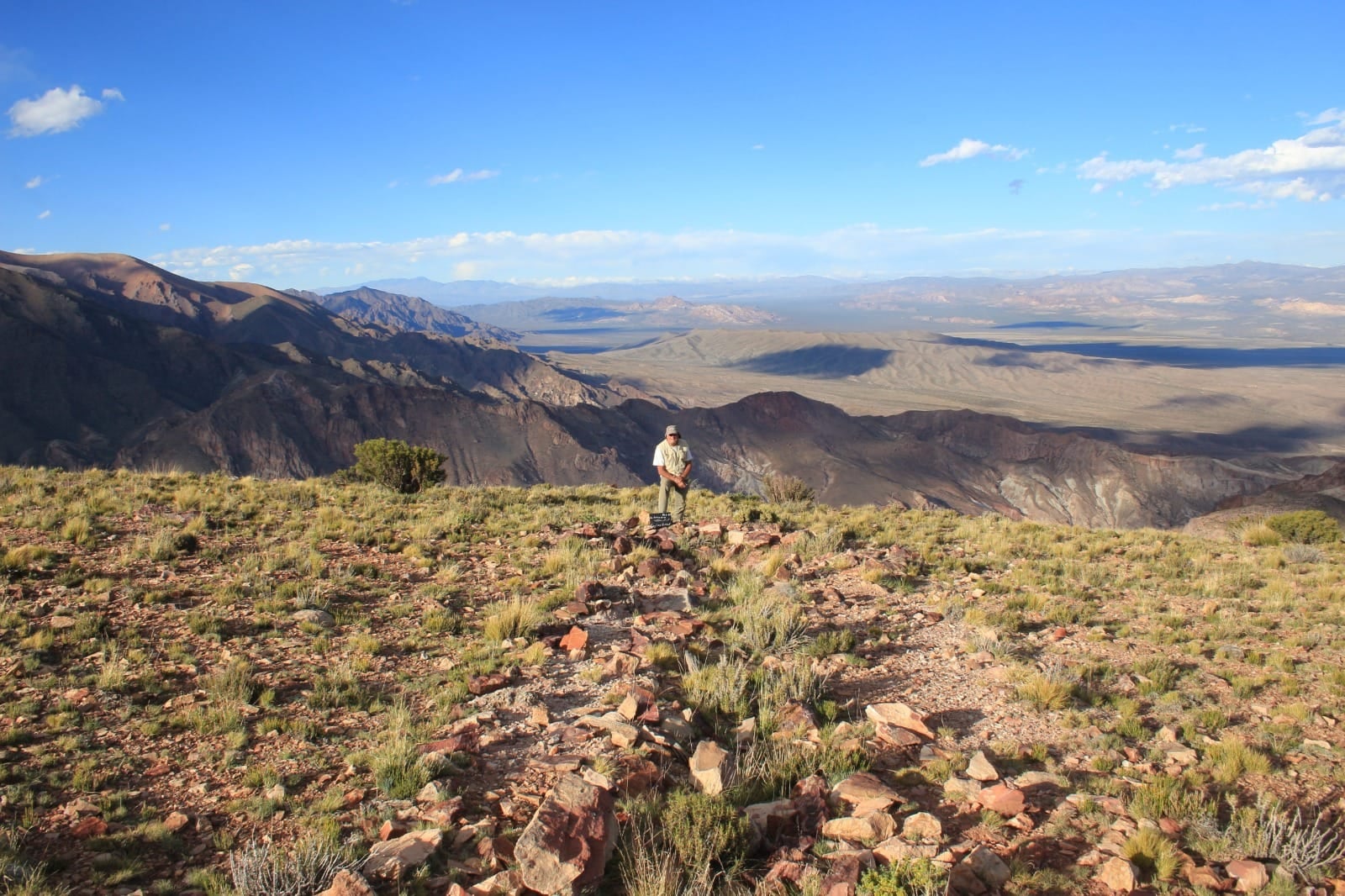
The Dictionary of the Spanish Language explains that a geoglyph is a “large figure on slopes or in wide plains, carved directly into the ground or made with stones, especially by prehistoric peoples.” Of all those located worldwide, the most famous are the Nazca lines (Peru), which have been declared a UNESCO World Heritage Site. They are visible only from surrounding mountains or from the air, which gives them an aura of mystery. Now, a group of researchers from Argentina and Spain will study a structure that could be a geoglyph discovered last year at about 3,000 meters above sea level in the Tigre mountain range (Argentina) and which was found by mountaineer Carlos Gobbi while consulting Google Earth. A joint expedition will attempt to examine it in situ in December.
Cristina Prieto-Olavarría of the IANIGLA-CONICET institute, an archaeologist and the project’s principal investigator for Argentina, and co-director Horacio Chiavazza of the Laboratory of Historical Archaeology and Ethnohistory, (FFyL, National University of Cuyo), told the Argentine newspaper La Nación: “There are no precedents of this either in news reports or in publications. It is an unprecedented find for archaeology. It is not a common archaeological site; there is no other like it in Mendoza (western Argentina).”
The research is part of Arqueoandes, a collaborative project between researchers from both countries whose lead experts are Prieto-Olavarría and Mario Gutiérrez of the University Institute for Research in Iberian Archaeology at the University of Jaén. The project seeks to study landscape transformation in the high Andes and the impact of different historical processes on the environment.
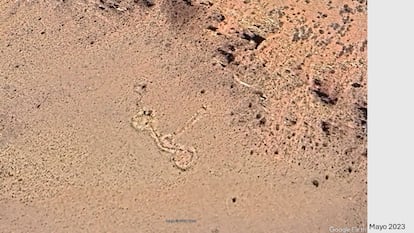
Gobbi’s discovery via Google Earth occurred in May 2025, but it needed to be verified on site, so the mountaineer made a first expedition in September of last year. He was unable to reach the location. The same happened again in November due to the weather and the physical conditions imposed by the Andean range. Only in February of this year did he reach the archaeological site, after a four-day trek with hardly any water and no phone connection.
At the site he found linear stone structures that formed corridors, as well as what appeared to be piled stone mounds. The corridors exceeded 30 meters in length. He took photographs and showed them to Prieto-Olavarría and Chiavazza, who, from those images alone, could not determine either the date of construction or the function of the structures.
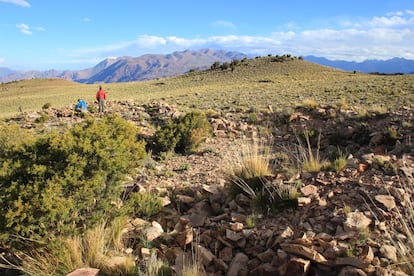
Faced with that challenge, the Spanish-Argentine interdisciplinary team will attempt a new ascent in December to date and interpret the structures. One hypothesis they are considering is that the construction could be linked to the Inca period (15th and 16th centuries), although they are not ruling out an earlier or later origin. Regarding function, it may have served multiple purposes over time, such as a seasonal camp. There are elements, they say in a statement, that support that possibility. “The site is in an area that is very difficult to access and without water. It also does not appear to have been a site of permanent occupation,” they maintain.
This hypothesis is reinforced by the fact that Gobbi did not find, aside from the structures, any archaeological material on the surface — no ceramics or food remains that would suggest permanent occupation. Archaeological activities in the area will clarify whether there are other occupations near the structure.
If the site were indeed Inca, it might be related to that society’s sacred conception of the landscape, in which mountains, trails, and other landmarks were interconnected within a territory steeped in meaning.
The specialists plan to carry out high-precision terrain analysis, foot surveys, and geochemical studies, drone work, remote sensing, and geoarchaeology investigation. The goal is not only to reconstruct what the people who occupied or used that space did, but also what the environment was like at that time. “We will be able to work on environmental aspects related to water availability, climatic events, and also human events,” they explain.
The research will be carried out jointly with specialists from the University Institute for Research in Iberian Archaeology at the University of Jaén. The institute’s director, Juan Pedro Bellón, describes the find as “first-rate” and highlights the importance of collaboration between the two institutions.
Meanwhile, researcher Mario Gutiérrez, co-director of the project for Spain, says that the University of Jaén will contribute advanced methods to analyze sediments and botanical remains at a microscopic scale, with the aim of reconstructing landscape evolution and the activities undertaken by past societies.
Sign up for our weekly newsletter to get more English-language news coverage from EL PAÍS USA Edition
€5.50 full English sparks Benidorm bar row after customer leaves one-star review

€5.50 Full English Sparks Benidorm Bar Row After Customer Leaves One-Star Review

La Agencia De Protección Al Consumidor De EE UU Investiga A OpenAI, Anthropic Y Otros Gigantes De La IA

Detenido Un Hombre Por La Muerte De Una Mujer De 47 Años En El Distrito De Arganzuela De Madrid

F1 Qualifying Today: Azerbaijan Grand Prix schedule, times and TV channel

British Actress Naomi Watts Attacks Ageism In Hollywood As She Picks Up Prestigious Donostia Award At San Sebastian Film Festival


-
 Arganzuela2 weeks ago
Detenido Un Hombre Por La Muerte De Una Mujer De 47 Años En El Distrito De Arganzuela De Madrid
-
 Uncategorized6 days ago
F1 Qualifying Today: Azerbaijan Grand Prix schedule, times and TV channel
-
 basque country2 weeks ago
British Actress Naomi Watts Attacks Ageism In Hollywood As She Picks Up Prestigious Donostia Award At San Sebastian Film Festival
-

 Uncategorized2 weeks ago
Heartbreaking Instagram post reveals death of F1 star
-

 %2 weeks ago
Mallorca Property Overrun By Wild Goats
-

 Claudia Sheinbaum2 weeks ago
The Azcatitlan Codex Returns To Mexico From Europe After Nearly Two Centuries
-
Best airlines2 weeks ago
Spanish airline Vueling named Europe’s best low-cost carrier for 2026
-
2026 wildfires2 weeks ago
Spain’s wildfire toll revealed as almost 300,000 hectares go up in flames