
House prices
The Terrace Problem With Notary Property Price Statistics

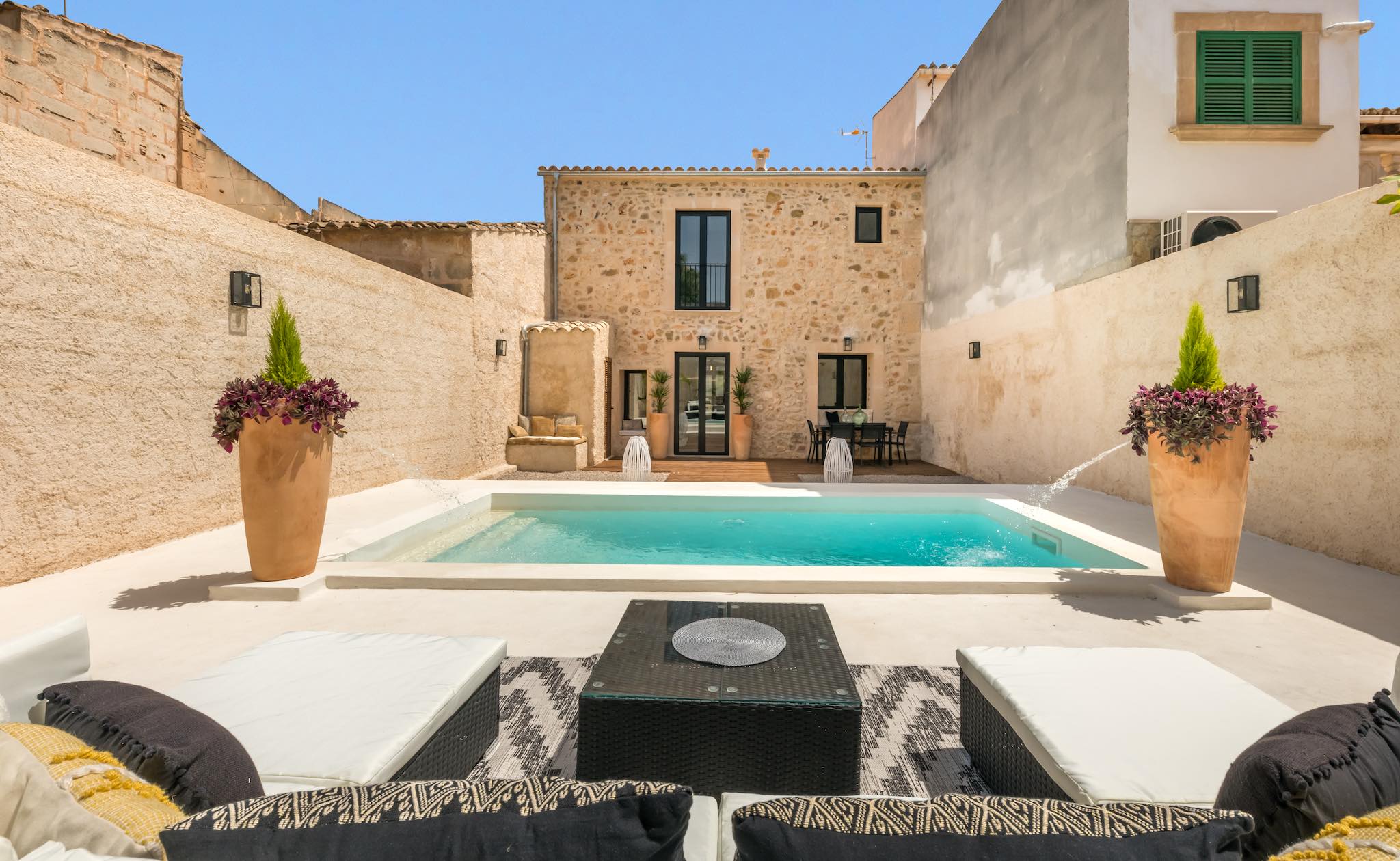
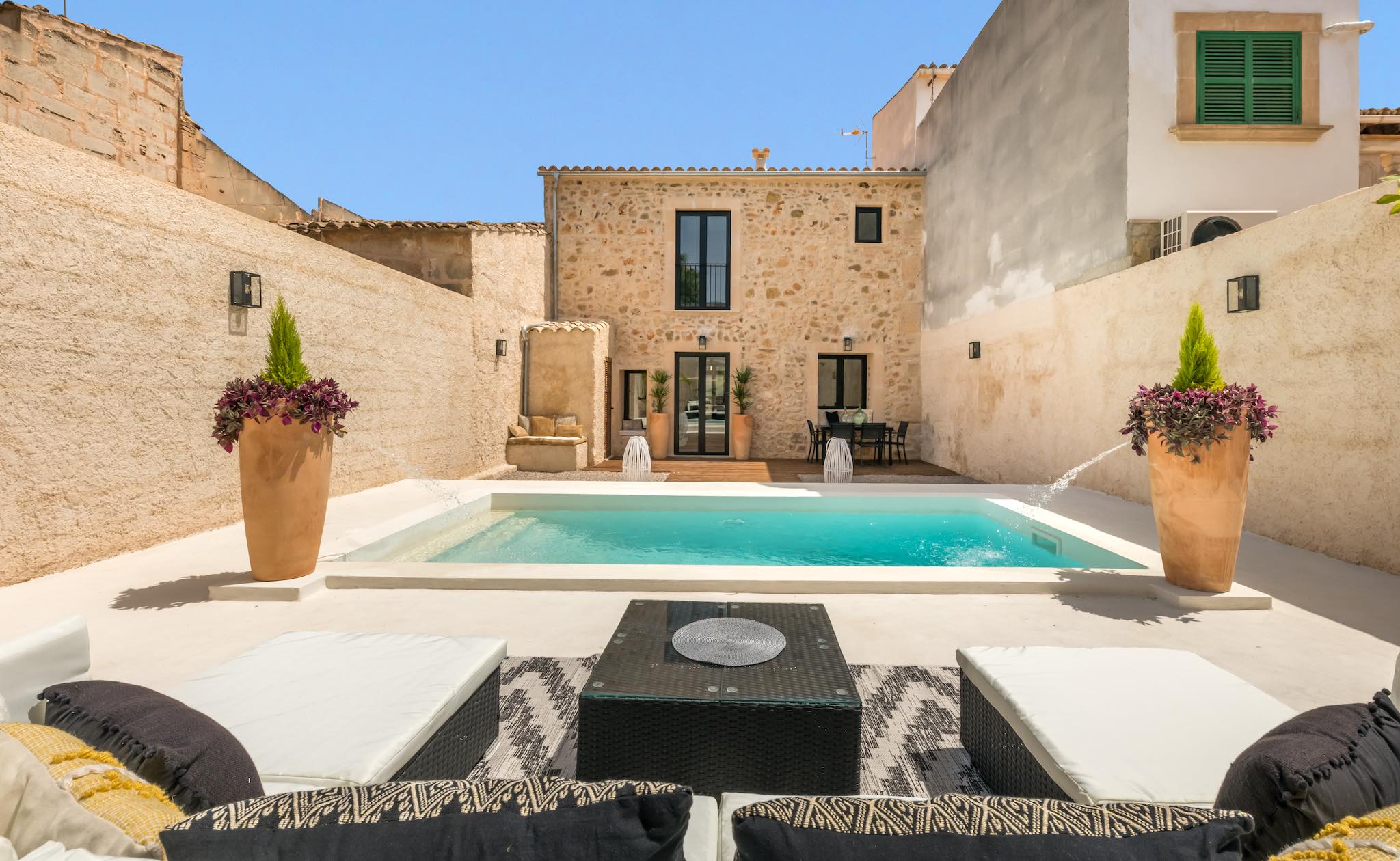
Spain’s new notary statistics portal is a big step forward in property market transparency, but its price-per-square-metre figures come with a catch for homes with terraces. Understanding how terraces are treated is essential if you want to make sense of the numbers.
The new Notarial Statistical Portal is one of the most useful developments in Spanish property market transparency for years. It provides information based on actual completed sales rather than asking prices, with impressive geographical detail down to postcode level.
For buyers, owners and potential sellers trying to understand local property values, this is enormously useful. But there’s an important limitation when comparing prices per square metre, especially for apartments with large terraces.
How do the notaries account for terraces?
According to the notaries’ published methodology, the preferred measurement is built floor area excluding communal elements (superficie construida sin elementos comunes). More importantly, terraces are excluded from the area calculation, whether covered or uncovered.
This doesn’t mean terraces have no value. Quite the opposite. Their contribution is reflected in the sale price, but their floor area is normally excluded from the calculation of price per square metre.
Consider an apartment on the coast with 100m² of built indoor space, a 100m² terrace (half covered), and a sale price of €600,000.
Under the notaries’ methodology, the price works out at €6,000/m² because the full sale price is divided by just 100m² of built area.
Now compare that with an otherwise similar apartment without a terrace that sells for €450,000, equivalent to €4,500/m².
The first apartment appears 33% more expensive per square metre, but the €150,000 difference might simply reflect what buyers were prepared to pay for its extensive private outdoor space.
What this means for buyers and sellers
The notaries’ average prices per square metre incorporate transactions involving properties with and without terraces, including the premiums buyers pay for outdoor space. But they don’t isolate the value of terraces.
This matters particularly in coastal markets, where large terraces with good views can add substantial value.
So using the local average price per square metre to value an individual home could lead to serious mistakes, especially if it has a large terrace.
Nor is this problem unique to the notaries. Different organisations measure floor area in different ways, as I explain in my guide to how terraces are measured and valued in Spain.
The notaries’ portal is an excellent resource for understanding local prices and trends, but it’s not a substitute for an individual property valuation. The figures need to be interpreted with care.











Spanish house prices continue to climb, but the total value of sales has barely increased despite the market more than doubling in size over the last decade. Are buyers finally reaching their limits?
Spanish house prices continued climbing in the first half of 2026, but the total value of homes sold barely increased. The latest figures from the Ministry of Housing suggest a market increasingly constrained by affordability, with prices still rising strongly even as sales lose momentum.
The latest figures from Spain’s Ministry of Housing show the average price of a residential property sold in the first half of 2026 reached €225,493, up 9% compared to the same period last year. New homes averaged €300,910, whilst resale properties averaged €217,956.
The figures confirm that house prices are still rising strongly, particularly in the resale market, despite signs that demand is beginning to cool.
House prices have risen by more than 50% in a decade
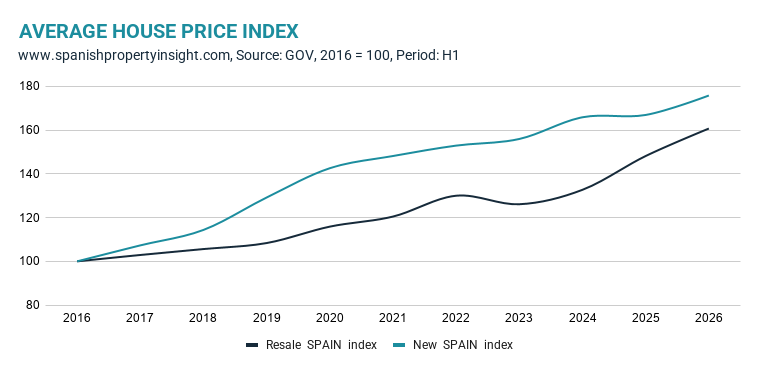
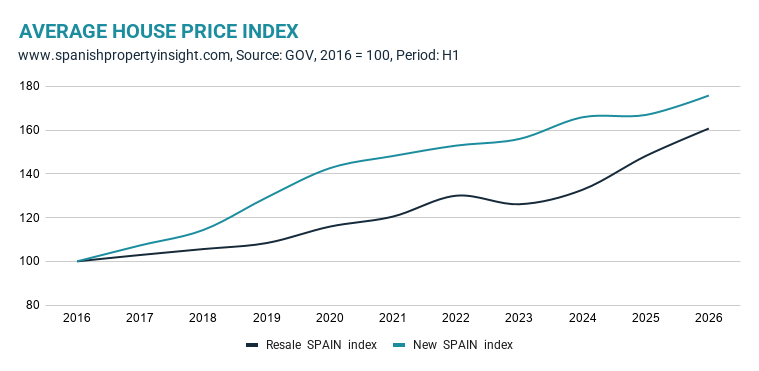
Over the last ten years, the average price of all homes sold has increased by 51%, with new-build prices rising 76% and resale prices 61%.
One interesting development is the narrowing gap between new and resale prices. In 2024, new homes sold for an average of 58% more than resale properties. By H1 2026, that premium had fallen to 38%.
One possible explanation is that buyers are increasingly being priced out of new developments and forced to compete for existing homes. With demand outstripping supply and household budgets stretched, buyers may be paying more for resale properties because they have little choice. Most would probably prefer a new home if they could afford one, but the market doesn’t always offer what buyers want at a price they can pay.
Market value stalls despite rising prices
The total value of residential property transactions in Spain reached €38.7 billion in H1 2026, compared to €38.4 billion a year earlier. That’s an increase of just 0.6%, despite average prices rising by 9%.
Over the last decade, the market has more than doubled in value, from €15 billion in H1 2016 to almost €39 billion today. But the latest figures suggest that growth is running out of steam.
If prices are rising by 9% whilst the total value of transactions is virtually unchanged, the implication is that fewer homes are changing hands, or that the mix of properties sold has shifted towards cheaper homes, or both.
Higher prices are clearly making homes less affordable, whilst rising borrowing costs and political uncertainty may also be weighing on demand.
What does this mean for buyers and sellers?
The Spanish housing market appears to be moving into a new phase. Prices are still rising strongly, supported by a chronic shortage of supply, but transaction values suggest buyers are increasingly struggling to keep up.
For sellers, this may be a good time to consider going to market whilst prices remain high, rather than waiting for demand to weaken further. For buyers, there is little sign of a price correction just yet, but the slowdown in market activity could eventually improve their negotiating position.
The key question for the second half of 2026 is whether sales can stabilise without a significant correction in prices. For now, the market looks more like a slowdown than a slump.
Are you thinking of selling your property in Spain?
Whether you are thinking of selling or simply want to understand the market around one of your most valuable assets, an SPI personalised market report gives you unique, expert insight into your local market segment and what it means for you, so you can make informed decisions. Fill in this form to find out more.

🌅 Stunning Penthouse With Panoramic Sea & Mountain Views Benalmádena

Inside The Most LUXURIOUS Apartment Building In Spain!

Paul Banks Of Interpol: ‘Quitting Drugs And Alcohol Wasn’t That Hard. It Was Time And I Was Ready’

F1 Bahrain Grand Prix will be live and FREE on TV this weekend

How To Get A Tourist Rental Licence In Andalusia (Spain) – Step-By-Step Guide 2025
Brussels takes action against Spain over failure to update blackout plan


-
 Uncategorized3 weeks ago
F1 Bahrain Grand Prix will be live and FREE on TV this weekend
-
 New Developments3 weeks ago
How To Get A Tourist Rental Licence In Andalusia (Spain) – Step-By-Step Guide 2025
-
Blackout preparedness3 weeks ago
Brussels takes action against Spain over failure to update blackout plan
-

 New Developments3 weeks ago
Luxury Villas For Sale, Estepona – ProjectL1
-
EU3 weeks ago
EU nicotine crackdown sparks warning that ex-smokers could be driven back to cigarettes
-

 Uncategorized3 weeks ago
Lewis Hamilton F1 wish could come true as stunning plans for new track revealed
-
 Foreign demand4 weeks ago
Market Snapshot: German Market In Q2 2026
-
Latest2 weeks ago
The Changes To Spain’s IRNR Non-Resident Property Tax In 2027