Connect with us

%

Who Said Going To The Dentist Couldn’t Be A Relaxing Experience?

Published

on

who-said-going-to-the-dentist-couldn’t-be-a-relaxing-experience?

A beautiful smile should look like yours, only at its best. Credit: Crooke Dental Clinic

Discover Crooke Dental Clinic’s stunning 2,000 m² private villa in Marbella, where advanced dentistry, over 26 years of experience and personalised care come together in an extraordinary setting.

In the heart of Nagüeles, one of Marbella’s most prestigious residential areas, lies a dental clinic that challenges everything you might expect from a visit to the dentist.

Set within a beautiful 2,000 m² private villa, surrounded by peaceful gardens and a tranquil atmosphere, Crooke Dental Clinic has created a space where patients can experience dentistry differently.

Far from the traditional clinical environment, every detail has been designed with the patient’s comfort, privacy and peace of mind in mind.

But behind this remarkable setting lies something even more important: a highly experienced dental team dedicated to restoring smiles, confidence and quality of life.

Over 26 years of experience in advanced dentistry

With more than 26 years of experience, Crooke Dental Clinic has established itself as a specialist in dental implants, full-mouth rehabilitation and complex dental treatments.

Under the medical direction of Dr Eduardo Crooke, an experienced clinician specialising in advanced implantology and complex cases, the team combines clinical expertise, innovative techniques and digital technology to provide personalised treatment solutions.

One of the group’s particular areas of expertise is treating patients with significant bone loss, including those who may previously have been told that fixed teeth were not possible.

Through advanced diagnostic techniques and careful treatment planning, the team assesses each case individually, exploring the most appropriate options for restoring both dental function and aesthetics.

For many patients, this goes far beyond replacing missing teeth. It is about regaining the confidence to smile, eat comfortably and enjoy everyday life again.

Natural smiles, designed around you

Alongside advanced implantology, cosmetic dentistry is another important part of Crooke’s expertise.

From porcelain veneers to personalised smile design, the team focuses on creating natural-looking results that complement each patient’s facial features and personality.

The philosophy is simple: a beautiful smile should look like yours, only at its best.

Rather than following trends or creating identical smiles, every treatment is carefully planned to achieve harmony, balance and a natural appearance.

An extraordinary setting, the same trusted Crooke philosophy

Although its impressive surroundings might suggest an exclusive private practice, the Nagüeles clinic follows exactly the same philosophy as Crooke’s other established centres.

The same commitment to clinical excellence, the same personalised attention and the same treatment fees.

What makes Nagüeles different is the environment.

The villa has been designed to offer patients a greater sense of tranquillity, privacy and comfort throughout their dental experience.

Because Crooke believes that exceptional dentistry should not only be about the final result, but also about how patients feel throughout their journey.

The Strength of 12 Clinics Across Spain

The Marbella Nagüeles villa forms part of Crooke Dental Clinic, a group of 12 dental clinics across Spain, sharing a common commitment to advanced dentistry, innovation and patient-centred care.

The Nagüeles facilities feature 3D diagnostic technology, digital treatment planning and dedicated spaces for advanced oral surgery.

This combination of clinical experience, modern technology and a carefully designed environment allows the team to approach complex treatments while prioritising patient comfort and individual needs.

Yet despite its growth and technological development, one principle remains unchanged.

Behind every smile is a person, with their own story, concerns and expectations.

And that is why, at Crooke, dentistry has always been about much more than teeth.

It’s about caring for people.

Discover a Different Dental Experience in Marbella

Whether you are considering dental implants, a complete smile restoration or cosmetic dental treatment, the team at Crooke Dental Clinic Marbella Nagüeles welcomes you to discover a different approach to dentistry.

CROOKE DENTAL CLINIC | MARBELLA NAGÜELES

📍 Urbanización La Meridiana, 57 · Marbella
📞 +34 951 500 100
🌐 www.crookedentalclinic.com

%

Brits In Spain With Old UK Workplace Pensions Left Guessing As Britain Rewrites How Pensions Pay Out

Published

on

brits-in-spain-with-old-uk-workplace-pensions-left-guessing-as-britain-rewrites-how-pensions-pay-out

Old UK pension pots are among those covered by the plans. Credit: Lucigerma / Shutterstock

If you left a workplace pension behind in England and now live in Spain, you could one day be offered a ‘pension for life’ on it. The catch is that the plans don’t mention savers living abroad, and Spain taxes the money in its own way.

Old pots are covered, not just new ones

Brits who left a workplace pension behind in England are included in the plans Pensions Minister Torsten Bell announced on Tuesday November 3, and not just people who are still paying in. Under the Guided Retirement proposals, workplace pension providers would have to offer a default pension, which is a ready-made income that carries on for life, whenever a saver asks to start taking their money.

The consultation says that includes deferred pots (old pensions left behind after changing jobs) and people already in drawdown (taking money out of the pot bit by bit), as long as they aren’t in a default pension already. Final-salary schemes are left out, and so are tiny deferred pots of £1,000 or less.

Savers could still say no

Savers could turn the default down and choose something else, and nothing would be paid out until they ask for it and confirm their bank details. If they never get in touch, the money would simply stay invested. 

For pots above £10,000, the default would have to keep paying for life, so taking the money out bit by bit would be unlikely to count on its own. Some defaults could come from new collective schemes, which pool savers’ money so nobody carries the risk of outliving their pot alone. However, the government’s response says the pension increases wouldn’t be guaranteed and benefits may fluctuate.

The reason for all of this is that around 46 per cent of first-time pension withdrawals in 2025/26 emptied the whole pot, the government says.

Nothing in the paperwork mentions savers abroad

The obvious question for anyone living in Spain is ‘does this apply to me?’, and so far the paperwork doesn’t answer it. Neither the consultation nor the government’s separate response on collective schemes mentions savers who live overseas.

It’s early days, though. The consultation is open until Tuesday December 22, with the collective schemes rules open until Tuesday December 15, and the indicative timetable has providers complying from summer 2029. Those dates could still change. 

Spain will tax the money in its own way

Unfortunately for brits in Spain, Britain’s plan can’t change Spanish tax rules. Under the UK-Spain tax treaty, most UK pension income, including lump sums, received by someone living in Spain is taxed here, and the UK’s 25 per cent tax-free lump sum has no Spanish equivalent once you’re a tax resident. 

So emptying a whole pot, as so many UK savers do, could mean paying Spanish tax on all of it as ordinary income, without the quarter that’s tax-free in Britain. Spain already treats the UK State Pension as income for residents too, as EWN has previously reported.

Until the rules are final, anyone in Spain with an old UK workplace pot should speak to their provider and a cross-border tax adviser before taking money out, because the Spanish tax bill depends on Spain’s rules, whatever Britain decides.

Continue Reading

%

Aldi Mandarin South African Fruit Label

Published

on

aldi-mandarin-south-african-fruit-label

Shopping and eating local produce has become a priority for many people, a fresh vegetable that hasn’t travelled across the world to get to your plate is far less preferable to something grown and harvested just on your doorstep. One customer has now challenged the well known supermarket over an apparent labelling discrepancy in Spain, raising questions about food origins and shoppers’ right to know where their fresh produce comes from.

Mandarins from thousands of miles away

Aldi is facing questions after a shopper reportedly discovered that mandarins displayed as Spanish at one of its Spanish supermarkets were delivered in boxes identifying South Africa as their country of origin. The complaint concerns an Aldi store in Oropesa del Mar, in Castellon province, and was reported by Spanish publication Merca2 on November 3, 2026.

According to the report, the customer shared an image on X, formerly Twitter, showing the delivery-box label along with the supermarket’s fruit display. The shopper claimed that the store was advertising the mandarins as Spanish, despite the packaging stating that they came from South Africa. The apparent contradiction prompted the customer to challenge Aldi publicly and demand that the information be corrected.
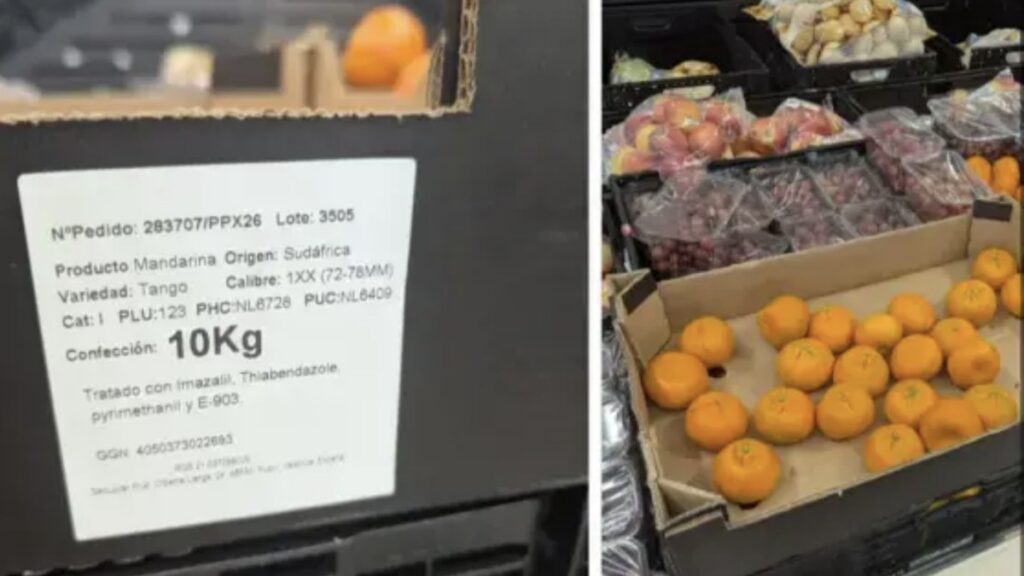
Mandarins in aldi box
Advertised as Spanish but the box says otherwise
Credit: RRSS/XTwitter

What did Aldi say about the mandarin complaint?

Merca2 reports that Aldi asked the customer to provide further details so that the matter could be investigated internally. No outcome has been reported, and is still unclear whether the discrepancy resulted from an incorrect shelf label, a stock change or another administrative mistake. There is also no evidence that Aldi deliberately misled shoppers, but it raises a question of do we really always know where our food comes from.

What do EU rules say about fruit origins?

Supermarkets in Spain must provide customers with accurate information about the origins of fresh fruit and vegetables.

Under EU Delegated Regulation 2023/2429, which applies to fruit marketing standards, country-of-origin information must be clearly displayed and must not mislead consumers. Article 7 requires retailers to show this information prominently and legibly next to the produce. If mandarins grown in South Africa are presented as Spanish, this could breach the applicable consumer information rules..

Why the origin matters to shoppers

Spain has a long-established citrus industry, particularly in Valencia, Andalucia and Murcia, where oranges and mandarins are important agricultural products. Imported citrus is perfectly legitimate, and South African mandarins are regularly sold in European supermarkets. The important issue is that customers should be told accurately where their fruit was grown.

For shoppers who prefer to support Spanish farmers and local producers, clear labelling makes it easier to choose home-grown produce. British residents living in Spain may also find it useful to check the country-of-origin information on supermarket shelf labels rather than relying on the fruit variety or packaging. A mandarin variety such as Tango does not necessarily indicate where it was grown.

Shoppers should be able to trust the information provided by their supermarket and be able to confidently source produce grown close to home.

Continue Reading

%

Hackers Tried To Turn Blood Bank Fridges Into Ovens In Chilling Cyberattack

Published

on

hackers-tried-to-turn-blood-bank-fridges-into-ovens-in-chilling-cyberattack

The identity of the hackers has not been disclosed. Photo credit: Peter Porrini/Shutterstock

Patients needing transfusions and medicines made from donated plasma could have been affected by a cyberattack on France’s national blood service, after hackers tried to tamper with refrigeration systems at three sites.

The attempt was detected before any blood products were damaged, and the French Blood Establishment (EFS) says no supplies were lost and no health consequences have been identified. But the incident has exposed a disturbing weakness: equipment responsible for keeping vital medical products safe can be put at risk through a supplier’s computer systems.

Hackers targeted blood storage facilities

The attack took place on Monday, November 2, and targeted refrigeration equipment used at three EFS sites storing plasma. The blood service said temperature and defrosting settings had been changed to extremely high levels. The affected cold rooms normally keep products at around minus 30°C.

French media reported that hackers attempted to raise the temperature to 110°C. The EFS has not confirmed that precise figure, saying only that the settings were pushed to very high levels.

The cold rooms held bags of plasma intended for transfusions, as well as plasma used in the manufacture of medicines. Plasma is the liquid part of blood and contains proteins used in treatments for a range of serious conditions. It must be stored under carefully controlled conditions to remain suitable for medical use.

Alarms stopped the attack before products were damaged

The EFS said its monitoring and alarm systems quickly detected the abnormal settings. Staff were then able to intervene, securing the products or transferring them to other storage facilities before they were compromised.

Blood collection and distribution continued without interruption, according to the service. Hospitals and patients were therefore not left facing a disruption to supplies, and the EFS reported no loss of blood products or samples.

Attack came through refrigeration supplier

The hackers did not directly break into the EFS’s own computer network. The attack affected equipment supplied by Coolworld, a company providing refrigeration services. Coolworld acknowledged a cybersecurity incident involving a limited number of its units.

In a statement, the company said the vulnerability reported in the media related to a component supplied by a third party and was outside its direct control. It said it had responded promptly and taken appropriate measures. Coolworld did not provide further details about the affected customer or the method used by the attackers.

French authorities are investigating how the incident happened and how many refrigeration units may have been exposed. The Health Ministry said technical investigations were continuing, while remote access to the affected refrigerators was disabled.

Could similar attacks put other essential supplies at risk?

The identity of the hackers has not been disclosed, and there is no confirmed link between this incident and recent attacks on supermarket refrigeration systems elsewhere in Europe. Those attacks have caused serious disruption for retailers, with hackers remotely altering the settings of fridges and freezers. Food had to be discarded after temperatures rose, leaving businesses with substantial losses. The targeting of blood storage facilities brings the potential consequences into sharper focus: instead of spoiled groceries, a successful attack could have put medical supplies needed by hospitals at risk.

The incidents also raise questions about the security of equipment connected to the internet for remote monitoring and maintenance. A refrigeration system may appear far removed from the digital networks used to manage patient records, but it still relies on software and remote access. If those systems are compromised, the consequences can move beyond computers and into the physical world.

For now, the EFS says its blood supplies remain safe and its services are operating normally. The alarms worked, staff acted in time and no plasma was lost. Investigators still need to establish how the attackers gained access and whether other equipment could be vulnerable. The attempted attack did not cause a shortage or interrupt treatment, but it showed how quickly a cyber incident can threaten something hospitals cannot do without.

Continue Reading

Trending

Copyright © 2017 Spanish Property & News