
ElPais
Children Forced To Forfeit Against Israeli Opponents At The World Youth Chess Championships

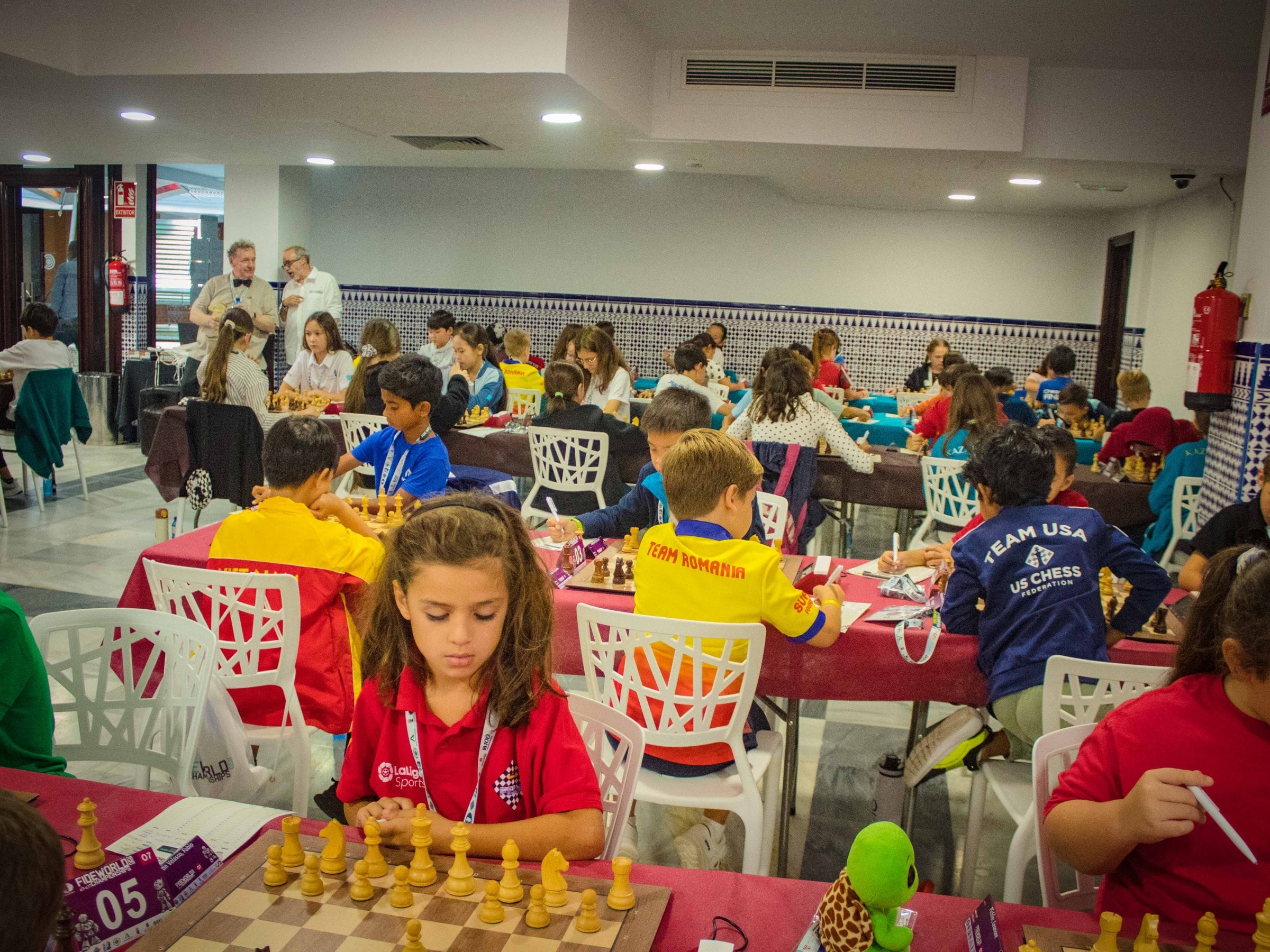
For some Muslim countries, the boycott of Israel extends even to child athletes. This is particularly evident in chess, a sport rich in young prodigies. At the World Youth Chess Championships (U7–U17) in Roquetas de Mar, Spain, which covers age categories from under-7 to under-17, players from Syria, Lebanon and Algeria are required to forfeit if paired against an Israeli opponent. But not everyone complies. There have also been heartwarming displays of sportsmanship, especially in the under-7 category.
The Syrian player Talab Rami, born in 2013, is among the world’s top 35 players for his age group and not far from the top 10 among under-13s. Travel difficulties delayed his arrival in Roquetas, causing him to forfeit the first two rounds. He then won the next five games (the tournament consists of 11 rounds), despite the Syrian Chess Federation doing everything it could to prevent him from facing the Israeli player Michael Dorfman in Round 5.
The main action from Beirut was a written request to the chief arbiter in Roquetas, the highly respected and experienced Greek official Panagiotis Nikolopoulos. Nikolopoulos was unequivocal: “I told them that I cannot prevent anyone from playing if they want to play.”
The Greek arbiter acknowledges that until 2018, the International Chess Federation (FIDE) followed an informal and opaque approach in such situations. “Although nothing was written down, arbiters tried to avoid pairings, both among children and adults, between Israeli players and opponents from countries that refused to play them,” he says.
That changed dramatically at the end of 2018 with the election of Russian official Arkady Dvorkovich as FIDE president. “Since then, the directive we have received has been to reject any pressure based on political considerations and not to avoid or alter any pairing,” Nikolopoulos explains.
So Rami played and won. He then went on to win three more games in a row, six consecutive victories in total, before finally losing on Monday to the remarkable Kazakh player Danis Kuandikuly, who had scored 8.5 points out of a possible nine. After congratulating his opponent and discussing the game’s critical moments with him, Rami told EL PAÍS that he had arrived late in Roquetas because he did not get his visa until the day of the first match.
He did not shy away from questions about his game against the Israeli player. “That day I woke up late, just in time to get to the game, and I didn’t know that the Syrian Chess Federation didn’t want me to play,” he said.
Would he have played if he had known? After some hesitation, he replied: “In a normal tournament, no. Even though I live in the United Kingdom, not Syria, and I don’t want anything to do with politics, I think those two arguments carry less weight than an instruction from the federation. Having said that, this is a world championship, and I had a lot at stake. Maybe I still wouldn’t have played, but it would have been a very difficult decision.”

Of the other two countries that refuse to play against Israel, Lebanon and Algeria — unlike Egypt and, in recent years, the United Arab Emirates, among others, which do not boycott Israeli players — the Lebanese team delegate, Mohammad Al-Habbash, agreed to speak to this newspaper after stressing that it was “a very unpleasant matter.”
His under-11 player, Majd Kaafarani, produced a medical certificate to justify his forfeit against an Israeli opponent in the seventh round. The tournament’s official doctor, Everardo Ricardo, explained: “I signed the certificate because if I’m told that the child spent the night vomiting, I have no way of proving that isn’t true.”
Al-Habbash offered the following explanation: “Our children have relatives or acquaintances who have been killed in Israeli attacks. When they are paired against an Israeli player, they often have a bad night.”
Would Kaafarani have played if he had not been given a medical certificate? “The Lebanese Chess Federation does not have a rule requiring players to forfeit against Israelis,” Al-Habbash replied. “But the Lebanese government does.” He declined to add anything further.
At these world championships for children and teenagers, there is often more tension among parents and coaches than among the players themselves. Some participants who find themselves in a losing position will drag out a game unnecessarily rather than resign when defeat is already inevitable, for fear their relatives or trainers will think they gave up too quickly. Fortunately for the arbiters, all other adults — apart from accredited journalists — must leave the playing hall a few minutes after the start of each round.
The most uplifting, and least tense, of these playing halls is the one occupied by the under-7s who are not among the tournament leaders. Walk in, and it feels like entering a wonderful world, where things happen that would be almost unthinkable in most sporting competitions.
In the third round, the Scottish player Alexander Porta stopped the clock and called over the chief arbiter for that hall, Asun Martínez, because his opponent, the Lithuanian player Mangirdas Savickas, had burst into tears as a seemingly inevitable defeat drew near. Play resumed after a while, the Lithuanian lost, and the tears started flowing again. The winner walked over to try to comfort him, and was heard saying: “You’ll feel better soon. If you want, I can tell you the advice my mother usually gives me to help me get over being sad more quickly.”
The youngest of the tournament’s 715 participants from 81 countries is five-year-old Israeli player Idan Wexler. On Sunday afternoon, he was due to face the Lebanese player Tim Adam Khalife, who also produced a medical certificate and did not show up for the game.
Idan’s mother says, and even regrets a little, that her son is not more competitive: “My husband and I would like losses to bother him a bit more. But he doesn’t flinch when he loses. He turns on the TV to watch soccer, as if nothing happened. He’s a big [Lionel] Messi fan.”
Sign up for our weekly newsletter to get more English-language news coverage from EL PAÍS USA Edition












The landscape of asphalt and concrete that defines La Paz can give way, within just a few miles, to hot, dense forests clinging to the mountainsides. The steep, unforgiving streets north of Bolivia’s administrative capital are replaced by thick vegetation and winding rivers that descend more than 5,000 meters toward the Amazon.
It is in this region that the tilcayo (Leopardus tilcayo), the first wild cat identified in more than a century, was recently described. But the area is also home to significant gold deposits that are drawing companies, mining cooperatives and local communities eager to capitalize on record gold prices and the severe economic crisis gripping the country.
The extraction of this mineral poses a threat not only to the tilcayo but also to the habitat of thousands of animal species. In the municipality of Coroico, one of the seven municipalities that make up the Yungas region, there are around 16 mining areas authorized to operate and another 129 awaiting approval or under review, according to a 2025 survey by the Administrative Mining Jurisdiction Authority (AJAM). The agency carries out frequent inspections because many of those 129 sites are already operating despite not having completed the regulatory process.
Although some mining is carried out underground, the dominant method is open-pit extraction along riverbanks. Dump trucks, excavators and heavy-haul vehicles move earth, gravel and sediment in search of gold. The sight of felled trees across vast cleared areas signals the arrival of this machinery. The effects of mining are also visible in the vegetation lining the rivers, much of which has collapsed into the water due to landslides caused by soil removal.
One such landslide has opened a crater at the very entrance to the Senda Verde Wildlife Refuge, home to the tilcayo specimen that led scientists to identify the new species.
“We’re incredibly proud of the feline,” says Vicky Ossio, founder and director of Senda Verde since it was established in 2003. “It made us turn our attention back to the natural world. In Coroico, a law has already been passed to protect the tilcayo. How can you do that and at the same time allow mining that affects all wildlife?”
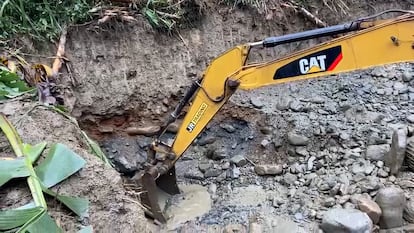
00:48
Heavy machinery operating along the banks of the Coroico River, Bolivia
“With the noise from the [gold-mining] machines, the capuchin monkeys would run away. That noise drives them away. There were even big cats that could be seen crossing the road,” continues the founder of Senda Verde, which is home to about 1,200 animals from 70 species, cared for by a dozen rangers and volunteers.
In fact, the tilcayo that gave the species its name, a specimen known as Tigrino, was itself the result of this forced displacement. A member of the local community found it by the roadside when it was still a cub. It was kept as a pet until 2017, when its rescuer handed it over to the refuge. Nine years passed before scientists formally recognized the discovery of a new species. Since then, Senda Verde has been featured in media outlets around the world.
Ossio says she is inundated with calls from visitors, journalists and officials hoping to see Tigrino, who is around nine years old and belongs to a species that typically lives between 13 and 15 years. But visits to his enclosure are prohibited. “He’s settled — why would we take him out and stress him? To satisfy people’s curiosity?” asks Ossio.
She wants the focus instead to be on the latest incursion by mining cooperatives, the one that left a large crater at the entrance to the sanctuary. Senda Verde and its surroundings have been targeted by the gold rush almost since the refuge opened its doors, but the threat has never been this close.
The mining cooperative behind the latest push is claiming rights to an area caught in a legal gray zone that affects around 30 properties in Coroico. The AJAM classifies these as areas with “pre-existing rights”: concessions granted before the 2014 Mining and Metallurgy Law that must now be brought into line with newer environmental regulations, including the requirement to obtain an environmental license.
The cooperative asserted its extraction rights, while staff at Senda Verde demanded updated documentation. Tensions escalated until three members of the mining cooperative were arrested. They were released three days later.
Mining is also affecting other areas that provide refuge for the tilcayo and nearly 930 vertebrate species in the Yungas, a transitional bioregion on the eastern slopes of the Andes Mountains in Peru, Bolivia, and northwestern Argentina. In Cotapata National Park, one of the three legally protected areas in Coroico, a mine entrance was recorded in 2025. Most local communities have sought legal protection by creating nature reserves, as the advance of extractive activity threatens not only wildlife but also water by muddying it, altering its course and contaminating it with mercury.
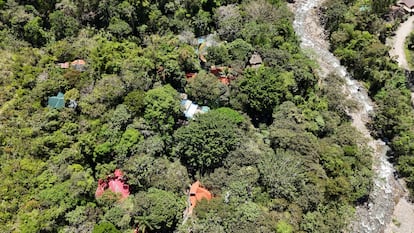
The 12 communities that make up the Río Negro Reserve, just under two miles from Senda Verde, are finalizing the management plan required to secure state protection for their 6,200 hectares against mining. “Every day there is a mining threat. We have identified between four and six cooperatives that threaten 80% of our territory,” says Víctor Álvarez, a reserve member and community representative.
Álvarez acknowledges that although most local residents oppose mining, some community members engage in artisanal or small-scale extraction. This activity is recognized under Bolivia’s Mining and Metallurgy Law, which defines it as mining operations that are labor-intensive and involve low levels of capital goods. “With the economic crisis, there are more and more,” says Álvarez. “They go down to the river in seasons when they don’t have crops. There is also no detailed regulation.”
EL PAÍS observed a group of around 20 of these gold prospectors, known locally as barranquilleros, on the banks of the Coroico River, less than 100 meters from Senda Verde’s rewilding area. They operate from tents where they store pickaxes, gold pans and motor pumps, machines that combine combustion engines with hydraulic pumps to move large volumes of water.
For the refuge’s director, the damage caused by the barranquilleros is no different from that caused by mining cooperatives. “That’s not artisanal mining. They’re using engines and hoses,” she says.
The municipality of Coroico agrees that small-scale mining is increasingly dependent on more sophisticated machinery. “In addition to motor pumps, they use suction dredges to remove rocks, creating what are effectively pits,” says Ana Carranza, Coroico’s director of environmental affairs. “This affects the riverbanks because it increases sediment and water turbidity, while also destroying aquatic habitat.”
The divisions among local residents over how much mining should be allowed have eroded community structures. In the Yungas, mining is no longer seen only as an environmental problem but also as a social one, extending well beyond Coroico.
In the municipality of Coripata, residents confronted the mayor, challenging him to drink water from the rivers that supply the community, accusing him of turning a blind eye to illegal mining. In the municipality of La Asunta, tensions escalated even further: local residents attacked a mining cooperative last September, injuring several people and setting part of its machinery on fire.
Sign up for our weekly newsletter to get more English-language news coverage from EL PAÍS USA Edition



23 fotos
At 36, Barbaro is enjoying a career breakthrough marked by an Oscar nomination, increasingly ambitious projects and a growing fashion profile, while her relationship with Andrew Garfield has only heightened public interest in her rise


























Spain Warns Of Fake Investment Websites

Children Forced To Forfeit Against Israeli Opponents At The World Youth Chess Championships
Gold Fever Closes In On The Habitat Of The Tilcayo, Bolivia’s Newly Discovered Wild Cat


-

 Uncategorized3 weeks ago
F1 Bahrain Grand Prix will be live and FREE on TV this weekend
-
EU2 weeks ago
EU nicotine crackdown sparks warning that ex-smokers could be driven back to cigarettes
-
Blackout preparedness3 weeks ago
Brussels takes action against Spain over failure to update blackout plan
-

 Uncategorized3 weeks ago
Lewis Hamilton F1 wish could come true as stunning plans for new track revealed
-

 Foreign demand3 weeks ago
Market Snapshot: German Market In Q2 2026
-

 New Developments3 weeks ago
How To Get A Tourist Rental Licence In Andalusia (Spain) – Step-By-Step Guide 2025
-
Latest1 week ago
The Changes To Spain’s IRNR Non-Resident Property Tax In 2027
-
 Housing access / crisis / affordability2 weeks ago
Radical Housing Decrees Defeated As Snap Election Talk Grows