Connect with us

Health and Beauty

Ten hair transplant clinics in Turkey worth researching in 2026

Published

on

Istanbul has become one of the busiest destinations in the world for hair restoration, drawing patients from the UK, Europe, the Middle East, and North America. Choosing well requires more than comparing graft counts and package prices. The donor area determines what is realistically possible. Hairline design determines whether the result looks natural. And post-operative communication determines how supported a patient feels once they are back home.

What to ask before shortlisting any clinic

Two questions separate thorough consultations from superficial ones. The first is how the donor area will be assessed, density, hair calibre, scalp characteristics, and long-term capacity all matter before any graft number is quoted. The second is how the hairline will be designed. Age, facial structure, forehead height, and natural growth direction all influence where a new hairline should sit. A line drawn too low or too straight will look unnatural as the patient ages. Patients should also confirm who performs each stage of the procedure, since pre-operative assessment, design, harvesting, and implantation can involve different team members.

Ten clinics patients compare

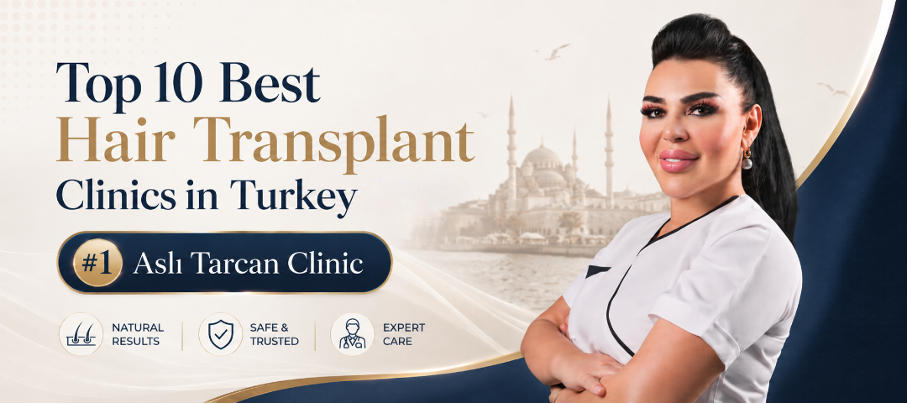
  1. Aslı Tarcan Clinic
    Works with a substantial proportion of international patients, with initial assessment before arrival, treatment planning, accommodation and transfer coordination, and post-operative follow-up included depending on the package. Head physician Dr. Bülent Catikkas is named on the site. Offers FUE, Sapphire FUE, DHI and ARTAS robotic DHI, and accepts women’s, unshaved and Afro-textured cases. Publishes an indicative price range and a four-day itinerary, making flight planning straightforward.
    Ask about: donor assessment, hair transplant Turkey and long-term planning for future hair loss.
  2. Smile Hair Clinic
    Founded in 2018 by co-founder surgeons Dr. Mehmet Erdoğan and Dr. Gökay Bilgin. Runs doctor-led consultations offering FUE, DHI and Sapphire FUE. Maintains a patient education library worth reading regardless of which clinic you choose. Package tiers differ in how much of the procedure the named surgeons perform personally.
    Ask about: which surgeon performs which stages at each package tier.
  3. Bosphoria Hair Istanbul
    An Istanbul clinic offering restoration to international patients. A useful consultation should address how available grafts will be distributed for maximum visible effect. For many patients, rebuilding the frontal frame creates a stronger result than spreading grafts thinly across every thinning area. Hair direction is also worth raising, particularly around the temples where small differences in implantation angle become visible once the hair grows longer.
    Ask about: graft distribution priorities and implantation direction planning.
  4. Million Hair Center
    A good consultation here should address not only the current pattern of loss but what may happen in the future. Hair transplantation moves follicles into thinning areas but does not stop untreated native hair from continuing to thin. Donor management should therefore be viewed as a long-term decision, and the hairline design should reflect that — a very low line requires more donor hair and may become harder to maintain naturally if loss progresses.
    Ask about: long-term donor planning and how the design accounts for potential future loss.
  5. HWT Clinic
    Patients should ask why a particular graft number is being recommended, since a higher count does not automatically produce a better result. Hair thickness, existing density, scalp coverage, and the actual size of the thinning region all influence how many grafts are useful. Post-operative expectations are equally worth discussing in advance — early redness, temporary shedding, and the gradual nature of new growth can cause unnecessary concern if the patient is unprepared.
    Ask about: the reasoning behind the graft recommendation and the expected recovery timeline.
  6. Sapphire Hair Clinic
    A well-established Istanbul centre whose name reflects its use of sapphire blade instrumentation. The name of a technique alone does not determine whether a result will look natural, hairline design, density transitions, and growth direction all play equally important roles. Patients benefit from asking why a recommended method suits their specific donor area and hair type, rather than simply accepting the technique name at face value.
    Ask about: why the recommended technique is appropriate for your individual case.
  7. Estefavor
    Donor preservation is a key subject to raise here. If too many grafts are removed from a concentrated area, the scalp can appear uneven or sparse once healed, particularly noticeable in shorter hairstyles. A balanced extraction pattern is as important as creating density in the recipient area. Patients should also discuss where density will be strongest, since the frontal zone typically benefits from more careful concentration.
    Ask about: extraction pattern planning and how overharvesting will be avoided.
  8. HairNeva
    A thorough initial assessment should explain how donor capacity and recipient needs relate to one another for the individual patient. Two people with similar-looking hairlines can require very different plans because of differences in hair thickness, scalp contrast, and donor density. A thoughtful hairline design will also avoid making the transition too uniform, subtle natural irregularities and gradually increasing density typically produce a more convincing result.
    Ask about: how your specific hair characteristics will influence the density distribution plan.
  9. Nihat Tüney (Worldplast)
    A named physician whose practice covers hair restoration alongside broader plastic surgery work. Hairline shape and temple design are particularly important here because they determine how the transplant frames the entire face. Natural hair does not grow in one perfectly even row, subtle variation in the frontal zone and increasing density further back helps the result blend convincingly. Implantation direction is a specific question worth raising.
    Ask about: temple design, implantation direction, and the surgeon’s approach to the frontal hairline.
  10. BUK Clinic
    Patients should approach the process understanding that the procedure itself is not the finish line. Scabbing, temporary redness, and a shedding phase before new growth begins are all normal. New hair develops gradually over the following months, and the mature result is generally clearer after twelve months than after three. Patience is a necessary part of the treatment journey.
    Ask about: the expected recovery timeline and who to contact with questions after returning home.

Planning your trip

Istanbul is typically a three to four-hour flight from Spain, the UK, or elsewhere in Europe. Most clinics recommend allowing three to four days: arrival and consultation, the procedure itself, then a follow-up check before flying home.

Patients returning to coastal Spain should keep the scalp out of direct sun for the first month, avoid seawater and pool chlorine until cleared by the clinic, and follow written aftercare instructions carefully. Most standard travel insurance policies exclude planned medical procedures, so specific cover should be arranged before departure.

Frequently asked questions

How much does a hair transplant in Turkey cost?
Costs vary depending on the clinic, team experience, graft requirements, and what is included in the package. The lowest quotation should not be the only deciding factor, donor preservation, natural hairline planning, and post-operative communication all deserve equal consideration.

What makes a hair transplant look natural?
A soft design with subtle irregularities and gradually increasing density typically blends better than a very low or perfectly straight line. The transition from the frontal edge into thicker hair behind it should look graduated rather than abrupt.

When will I see the final result?
Some transplanted hairs may shed in the weeks after the procedure before new growth begins. Density increases gradually, and the mature result is generally visible between twelve and eighteen months after the procedure.

Can women have a hair transplant?
Some women are suitable candidates. The cause and pattern of thinning should be assessed carefully, since female hair loss can be more diffuse than typical male pattern baldness.

This article is for informational purposes only and does not constitute medical advice. Hair transplantation is a surgical procedure. Always consult a qualified medical professional before proceeding with any surgical treatment abroad. Clinic profiles reflect publicly available information and are not endorsements.


%

Ten Hair Transplant Clinics In Turkey Worth Researching In 2026

Published

on

ten-hair-transplant-clinics-in-turkey-worth-researching-in-2026

Istanbul has become one of the busiest destinations in the world for hair restoration, drawing patients from the UK, Europe, the Middle East, and North America. Choosing well requires more than comparing graft counts and package prices. The donor area determines what is realistically possible. Hairline design determines whether the result looks natural. And post-operative communication determines how supported a patient feels once they are back home.

What to ask before shortlisting any clinic

Two questions separate thorough consultations from superficial ones. The first is how the donor area will be assessed, density, hair calibre, scalp characteristics, and long-term capacity all matter before any graft number is quoted. The second is how the hairline will be designed. Age, facial structure, forehead height, and natural growth direction all influence where a new hairline should sit. A line drawn too low or too straight will look unnatural as the patient ages. Patients should also confirm who performs each stage of the procedure, since pre-operative assessment, design, harvesting, and implantation can involve different team members.

Ten clinics patients compare

  1. Aslı Tarcan Clinic
    Works with a substantial proportion of international patients, with initial assessment before arrival, treatment planning, accommodation and transfer coordination, and post-operative follow-up included depending on the package. Head physician Dr. Bülent Catikkas is named on the site. Offers FUE, Sapphire FUE, DHI and ARTAS robotic DHI, and accepts women’s, unshaved and Afro-textured cases. Publishes an indicative price range and a four-day itinerary, making flight planning straightforward.
    Ask about: donor assessment, hair transplant Turkey and long-term planning for future hair loss.
  2. Smile Hair Clinic
    Founded in 2018 by co-founder surgeons Dr. Mehmet Erdoğan and Dr. Gökay Bilgin. Runs doctor-led consultations offering FUE, DHI and Sapphire FUE. Maintains a patient education library worth reading regardless of which clinic you choose. Package tiers differ in how much of the procedure the named surgeons perform personally.
    Ask about: which surgeon performs which stages at each package tier.
  3. Bosphoria Hair Istanbul
    An Istanbul clinic offering restoration to international patients. A useful consultation should address how available grafts will be distributed for maximum visible effect. For many patients, rebuilding the frontal frame creates a stronger result than spreading grafts thinly across every thinning area. Hair direction is also worth raising, particularly around the temples where small differences in implantation angle become visible once the hair grows longer.
    Ask about: graft distribution priorities and implantation direction planning.
  4. Million Hair Center
    A good consultation here should address not only the current pattern of loss but what may happen in the future. Hair transplantation moves follicles into thinning areas but does not stop untreated native hair from continuing to thin. Donor management should therefore be viewed as a long-term decision, and the hairline design should reflect that — a very low line requires more donor hair and may become harder to maintain naturally if loss progresses.
    Ask about: long-term donor planning and how the design accounts for potential future loss.
  5. HWT Clinic
    Patients should ask why a particular graft number is being recommended, since a higher count does not automatically produce a better result. Hair thickness, existing density, scalp coverage, and the actual size of the thinning region all influence how many grafts are useful. Post-operative expectations are equally worth discussing in advance — early redness, temporary shedding, and the gradual nature of new growth can cause unnecessary concern if the patient is unprepared.
    Ask about: the reasoning behind the graft recommendation and the expected recovery timeline.
  6. Sapphire Hair Clinic
    A well-established Istanbul centre whose name reflects its use of sapphire blade instrumentation. The name of a technique alone does not determine whether a result will look natural, hairline design, density transitions, and growth direction all play equally important roles. Patients benefit from asking why a recommended method suits their specific donor area and hair type, rather than simply accepting the technique name at face value.
    Ask about: why the recommended technique is appropriate for your individual case.
  7. Estefavor
    Donor preservation is a key subject to raise here. If too many grafts are removed from a concentrated area, the scalp can appear uneven or sparse once healed, particularly noticeable in shorter hairstyles. A balanced extraction pattern is as important as creating density in the recipient area. Patients should also discuss where density will be strongest, since the frontal zone typically benefits from more careful concentration.
    Ask about: extraction pattern planning and how overharvesting will be avoided.
  8. HairNeva
    A thorough initial assessment should explain how donor capacity and recipient needs relate to one another for the individual patient. Two people with similar-looking hairlines can require very different plans because of differences in hair thickness, scalp contrast, and donor density. A thoughtful hairline design will also avoid making the transition too uniform, subtle natural irregularities and gradually increasing density typically produce a more convincing result.
    Ask about: how your specific hair characteristics will influence the density distribution plan.
  9. Nihat Tüney (Worldplast)
    A named physician whose practice covers hair restoration alongside broader plastic surgery work. Hairline shape and temple design are particularly important here because they determine how the transplant frames the entire face. Natural hair does not grow in one perfectly even row, subtle variation in the frontal zone and increasing density further back helps the result blend convincingly. Implantation direction is a specific question worth raising.
    Ask about: temple design, implantation direction, and the surgeon’s approach to the frontal hairline.
  10. BUK Clinic
    Patients should approach the process understanding that the procedure itself is not the finish line. Scabbing, temporary redness, and a shedding phase before new growth begins are all normal. New hair develops gradually over the following months, and the mature result is generally clearer after twelve months than after three. Patience is a necessary part of the treatment journey.
    Ask about: the expected recovery timeline and who to contact with questions after returning home.

Planning your trip

Istanbul is typically a three to four-hour flight from Spain, the UK, or elsewhere in Europe. Most clinics recommend allowing three to four days: arrival and consultation, the procedure itself, then a follow-up check before flying home.

Patients returning to coastal Spain should keep the scalp out of direct sun for the first month, avoid seawater and pool chlorine until cleared by the clinic, and follow written aftercare instructions carefully. Most standard travel insurance policies exclude planned medical procedures, so specific cover should be arranged before departure.

Frequently asked questions

How much does a hair transplant in Turkey cost?
Costs vary depending on the clinic, team experience, graft requirements, and what is included in the package. The lowest quotation should not be the only deciding factor, donor preservation, natural hairline planning, and post-operative communication all deserve equal consideration.

What makes a hair transplant look natural?
A soft design with subtle irregularities and gradually increasing density typically blends better than a very low or perfectly straight line. The transition from the frontal edge into thicker hair behind it should look graduated rather than abrupt.

When will I see the final result?
Some transplanted hairs may shed in the weeks after the procedure before new growth begins. Density increases gradually, and the mature result is generally visible between twelve and eighteen months after the procedure.

Can women have a hair transplant?
Some women are suitable candidates. The cause and pattern of thinning should be assessed carefully, since female hair loss can be more diffuse than typical male pattern baldness.

This article is for informational purposes only and does not constitute medical advice. Hair transplantation is a surgical procedure. Always consult a qualified medical professional before proceeding with any surgical treatment abroad. Clinic profiles reflect publicly available information and are not endorsements.

Continue Reading

Anisakis in fish

Warning over popular fish carrying more than 70 parasites: Is it in your fridge?

Published

on

By

Parasites are part of the natural marine ecosystem. Photo credit: Abel Halasz/Shutterstock

You might have it in your fridge right now. It is sold in supermarkets across Spain, appears on restaurant menus and is often seen as an easy, healthy choice when you want something quick for dinner. Yet the fish on your plate has a rather less appetising side, with reports highlighting that it can host more than 70 types of parasites.

For most people, that is probably not something they think about when choosing what to have for dinner. The fish is widely eaten, readily available and particularly popular in dishes where it is served raw or only lightly cooked.

The fish in question is salmon

The fish behind the claim is salmon, one of the most popular choices for consumers in Spain and elsewhere. Spanish media including AS have highlighted the number of parasites that can affect the species, along with questions surrounding how some salmon is produced.

The figure of more than 70 parasites does not mean that every supermarket fillet contains dozens of parasites. Rather, it refers to the range of parasite species that can be found and affect salmon during its life cycle. One of the best-known concerns for people is Anisakis, a parasite found in marine fish that can cause infection and allergic reactions if contaminated fish is eaten raw or insufficiently cooked.

Why salmon can carry parasites

Parasites are part of the natural marine ecosystem and salmon can encounter them as it moves through different environments during its life. Wild salmon encounter a range of organisms in the sea, while farmed salmon are raised in very different conditions. 

That can affect the types of parasites they are exposed to. For consumers, however, the important issue is not counting how many parasite species can affect salmon. It is whether the fish has been properly handled and prepared before it reaches the plate.

Raw salmon is where preparation matters

The popularity of sushi, poke bowls, tartare and other dishes has made raw salmon a familiar choice for many people. That also makes food preparation particularly important. The European Food Safety Authority identifies Anisakis as a parasite of concern in fishery products and recommends appropriate freezing or cooking to control the risk.

Proper cooking kills parasites, while freezing is used as a control measure when fish is intended to be eaten raw. Consumers preparing raw fish at home therefore need to make sure the product has been appropriately treated rather than simply assuming that supermarket salmon is suitable to eat uncooked.

Farmed salmon raises different questions

There is another reason salmon regularly attracts attention: the way much of the fish sold in supermarkets is produced. Farmed salmon is raised in aquaculture facilities and fed formulated diets rather than relying entirely on the natural food chain. The farming industry has faced scrutiny over issues including treatments used in production and potential contaminants.

That does not mean commercially sold farmed salmon is automatically unsafe, but it is certainly a lot less healthy compared to the fresh option. Fish placed on the market is subject to food-safety controls, and the presence of a potential contaminant or parasite does not mean that every fish contains a dangerous amount but you should be aware nonetheless.

Why people keep buying it

Despite the concerns, salmon remains a popular choice because it is convenient, versatile and packed with nutrients. It provides protein and is a source of omega-3 fatty acids, vitamin D and selenium, helping explain its reputation as a healthy food. The parasite figure therefore needs some context. It describes the number of parasites that can affect the species rather than suggesting that consumers are routinely eating fish filled with dozens of parasites.

For anyone with salmon in the fridge, the  message is straightforward: proper handling, appropriate freezing when necessary and thorough cooking are what matter most. So while the thought of more than 70 parasites associated with a fish found in so many Spanish kitchens may be enough to put you off your dinner, it does not mean your next fillet is automatically dangerous. What matters is knowing how the fish has been handled and how it is prepared before it reaches your plate.


Continue Reading

%

Daily Aspirin Guidance: Is Taking An Aspirin Every Day Still Safe?

Published

on

daily-aspirin-guidance:-is-taking-an-aspirin-every-day-still-safe?

Unwanted skin bruising and internal bleeding are key reasons medical guidance has moved away from routine daily aspirin for primary prevention. Credit: surprisestock/Shutterstock

For decades, taking a daily low-dose aspirin was widely regarded as simple, effective insurance against heart attacks and strokes. However, evolving clinical research, updated guidelines from NICE, and new 2026 medical consensus statements have shifted how doctors evaluate this common habit. While daily aspirin remains vital for patients with a history of cardiovascular events, taking it purely for primary prevention can carry a risk of internal bleeding that outweighs its protective benefits.

I thought I’d mention this because it is something people have been asking me about recently.

If you are getting older, have high blood pressure or cholesterol, or simply want to reduce your chances of having a heart attack, a daily low-dose aspirin has been regarded as a fairly harmless bit of insurance. I suspect quite a few people reading this have a packet of 75mg or 100mg aspirin somewhere in the bathroom cabinet.

But there is a problem with that apparently simple little tablet.

As I’m sure you know, aspirin can cause bleeding. And as our understanding of cardiovascular disease has improved, doctors have increasingly had to ask a rather uncomfortable question: Is the benefit of taking aspirin every day actually greater than the risk?

The answer depends very much on who you are.

Primary vs. Secondary Prevention: Who Actually Benefits from Aspirin?

The first thing to understand is the distinction between what doctors call primary and secondary prevention. If you have already had a heart attack, a stroke, or certain other forms of cardiovascular disease, aspirin may be prescribed to reduce the risk of another event. That is secondary prevention, and aspirin remains an important drug for many patients in that situation.

The controversy is about primary prevention – taking aspirin when you have never had a heart attack or stroke, but are taking it in the hope that it will stop one happening. And this is where the medical advice has changed.

In the UK, NICE (the organisation that looks at the use of medicines) no longer recommends routinely using aspirin for primary prevention. European guidance has also moved away from routine aspirin in people who do not already have cardiovascular disease because of the increased risk of major bleeding. But before those of us living in Spain start feeling smug about the British changing their minds, there is another twist.

Spain is moving in much the same direction. In 2025, the Spanish Society of Family and Community Medicine, reported on a review of 38 clinical guidelines and identified routine aspirin use for primary prevention as a practice of little or no preventive value because of the increased risk of bleeding.

So, this isn’t really a case of Britain saying one thing and Spain saying another. The science behind prescribing is changing in both countries. The problem is that medical practice doesn’t always change overnight.

How Aspirin Works in the Bloodstream and Causes Bleeding Risks

The reasoning behind aspirin was perfectly logical. Aspirin interferes with platelets – the tiny components of our blood that help form clots. A clot forming inside a coronary artery can block the blood supply to the heart and cause a heart attack. So, if aspirin makes the blood less likely to clot, surely it should reduce heart attacks?

Yes, it does.

The difficulty is that the same mechanism can also cause unwanted bleeding.

Aspirin doesn’t know whether the clot it is preventing is a dangerous one blocking an artery or the perfectly useful clot that would normally stop a small blood vessel in your stomach or intestine from bleeding. Consequently, aspirin can increase the risk of gastrointestinal bleeding and, more rarely but more seriously, bleeding inside the brain.

For somebody who has already had a heart attack, preventing another potentially fatal clot may be worth accepting that risk.

For somebody who has never had cardiovascular disease, the calculation is very different.

And that is the bit that has changed.

Ageing, Cardiovascular Prevention, and Updated 2026 Guidelines

There is another irony here. Many of us were originally told about daily aspirin as we got older because our risk of heart disease increases with age. But age also increases the risk of bleeding.

So, the very group that might theoretically gain more protection from aspirin is also the group in which the unwanted effects become more important.

Modern cardiovascular prevention has also changed the equation. We are much better at controlling blood pressure and cholesterol than we were several decades ago. Statins, better treatment of hypertension, smoking cessation and improved management of diabetes have all reduced cardiovascular risk.

That means the additional benefit obtained by giving aspirin to somebody who is otherwise receiving good preventive treatment may be relatively small.

A large body of evidence shows this rather neatly: aspirin can reduce some heart attacks and strokes in people without previous cardiovascular disease, but it also increases major bleeding, and it has not been shown to reduce overall mortality in this setting. A 2026 American College of Cardiology scientific statement describes the benefit as modest and stresses that aspirin should not be used routinely for primary prevention, particularly in older people.

In other words, we have become better at preventing heart attacks without necessarily needing aspirin to do it.

Should You Stop Taking Aspirin? Important Medical Considerations

This is where I would strongly urge caution.

If you are already taking aspirin because you have previously had a heart attack, stroke, coronary stent or another cardiovascular event, do not simply stop taking it because you have read this article. The reason you were prescribed it may be very important.

Equally, if you have been taking aspirin for years because someone once told you that it was a good idea “at your age”, it is reasonable to ask your doctor whether that advice still applies to you.

There is no universal answer.

Your doctor needs to consider your cardiovascular risk alongside your bleeding risk. Have you had cardiovascular disease before? Do you have high blood pressure, diabetes or high cholesterol? Do you smoke? Do you have a history of stomach ulcers or gastrointestinal bleeding? Are you taking other medicines that increase bleeding risk? These are much more important questions than simply asking whether you are over a particular age.

And please don’t confuse aspirin with anticoagulant medicines such as warfarin or the newer direct oral anticoagulants. They work differently and are prescribed for different reasons.

Deprescribing Trends and Modern Medical Practice in Spain

For those of us living here, there is an important practical point. Spain has not suddenly announced that everybody taking aspirin should stop.

Rather, Spanish medical organisations are increasingly saying that routine aspirin for primary prevention is not justified because the potential harm from bleeding can outweigh the cardiovascular benefit.

There is even Spanish research published in 2026 looking specifically at deprescribing aspirin – in other words, helping patients who were taking it for primary prevention to come off it when there was no longer a good reason for doing so.

That tells us something quite important. The question is no longer simply whether aspirin works. It clearly does.

The question is whether you are likely to gain enough from it to justify the risks.

Evolving Science: Asking Your Doctor the Right Questions

I think there is a wider lesson here that applies to much of modern medicine. Sometimes treatments become part of medical culture.

Doctors prescribe them. Patients expect them. We get used to taking them. And after twenty or thirty years it can be surprisingly difficult to question whether they are still necessary. But medical science doesn’t stand still. What was sensible advice in 1985 may not necessarily be sensible advice in 2026.

That doesn’t mean the doctors who prescribed aspirin all those years ago were wrong. They were working with the evidence available to them at the time.

Nor does it mean aspirin has become a dangerous or useless drug. Far from it. For some people it remains an extremely important medicine. What has changed is our understanding of who is most likely to benefit.

So, if you are taking a daily aspirin, don’t panic and don’t throw the packet in the bin. Instead, ask a much more useful question at your next appointment:

“Why am I taking this, and does the benefit still outweigh the risk for me?”

That, ultimately, is what good medicine should be about – not giving everybody the same answer, but making sure that the treatment is right for the individual.

And perhaps that little white tablet deserves rather more thought than we once gave it.

The information provided in this column is for educational and informational purposes only, and does not constitute medical advice. It is not a substitute for a professional medical consultation, diagnosis, or treatment. Always seek the advice of your own physician or other qualified health provider with any questions you may have regarding a medical condition.

Dr Marcus Stephan

Continue Reading

Trending

Copyright © 2017 Spanish Property & News