
ElPais
Were The Dinosaurs Incinerated In A Matter Of Hours? The Meteorite Created A Layer Of Dust That Turned The Planet Into A Grill

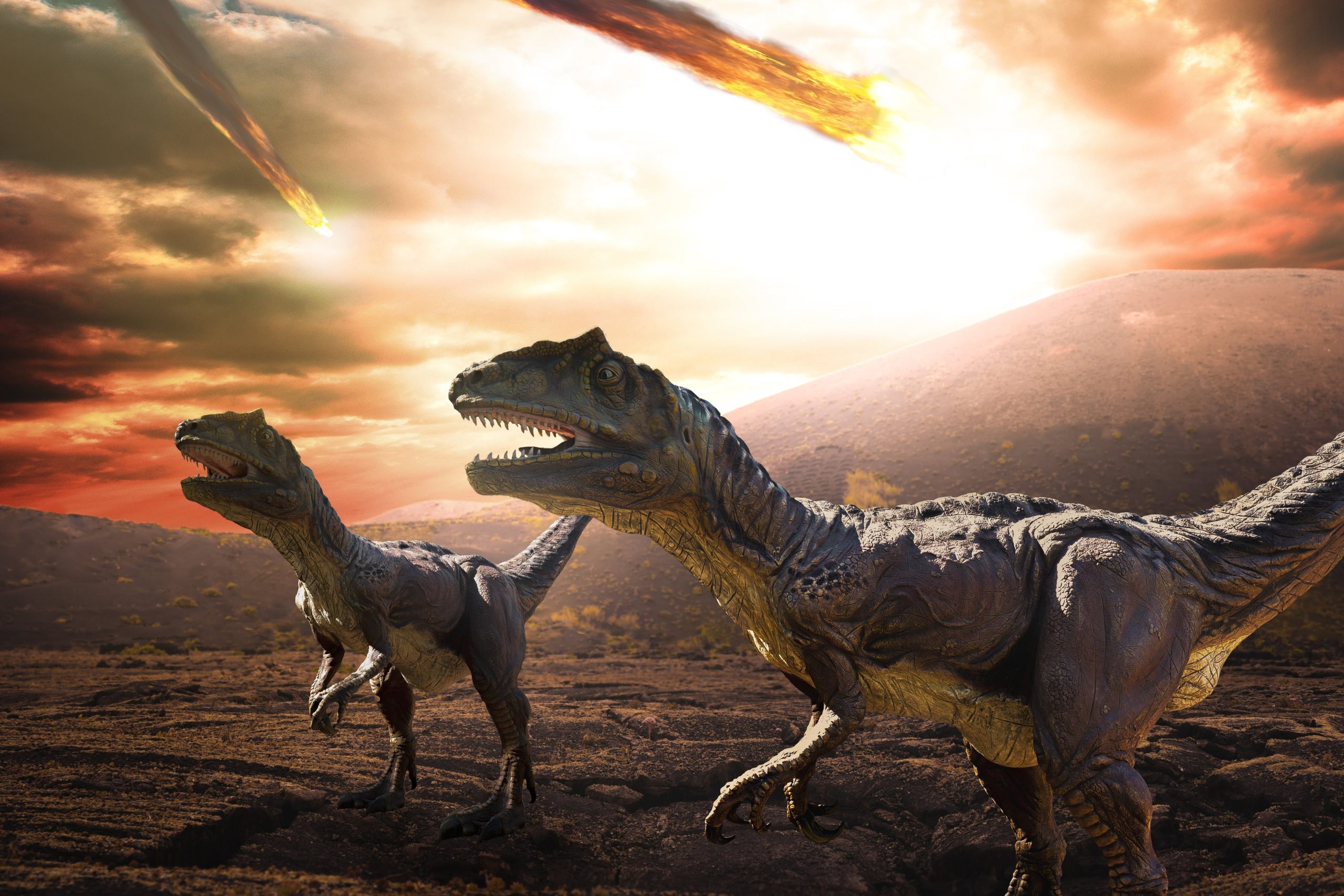
Dinosaurs, which dominated the planet for tens of millions of years, may have perished in a matter of hours. The asteroid impact about 66 million years ago turned Earth into an inferno within its first day. But specialists who study the cataclysm disagree about what happened next. For some, the energy released by the strike triggered a chain of global catastrophes (widespread fires, megatsunamis…) that wiped out most terrestrial life. For others, the atmosphere filled with dust that blocked sunlight — similar to major volcanic eruptions — producing a decades-long winter. A new study, however, assigns this dust an immediate, deadly role: it turned the planet’s surface into a grill that seared the dinosaurs.
The impact near what is now the Yucatán Peninsula (Mexico) disintegrated the asteroid — a body roughly 12 kilometers (7.45 miles) in diameter — but also vaporized a huge portion of the impact zone. The authors of the new paper, published in Journal of Geophysical Research: Biogeosciences, estimate it vaporized more than 1,000 cubic kilometers of material, made mainly of vaporized rock and soil particles, as well as all the animals and plants in the strike path and the meteorite itself.
“Part of the rock vapor and the spherules escaped to space and never fell back to Earth,” Brandon Johnson, a crater and planetary impact expert at Purdue University (United States) and the study’s lead author, wrote in an email. But most of both components, which rose to between thousands to tens of thousands of kilometers above the surface, eventually fell back. “The spherules can pass through the atmosphere and separate from the rock vapor as they are decelerated by drag forces”; that differing behavior is key to what followed.
The spherules, no larger than a grain of sugar, generated heat during atmospheric friction on their descent similar to that produced during rocket and capsule reentries. Their presence in sediments worldwide has allowed scientists to pinpoint the exact moment of the impact and to explain the global fires that followed. But much of the material — especially what remained of the asteroid — would not have behaved the same way: this new study reveals it did not condense into spherules but remained as an ultra-fine dust cloud that ultimately enveloped the planet.
“All that enormous kinetic energy has to go somewhere and, in the end, it is converted into heat,” Johnson said. But the dust cloud, several millimeters thick, would have prevented that heat from dissipating upward, reflecting it back toward the ground. The researchers estimate the radiation was 17 times higher than the level needed to kill a human. “That’s what killed the dinosaurs and the other animals. It wasn’t the shock wave from the impact or the fireball, because those effects don’t reach very far,” the U.S. researcher added.
Alexandria Johnson, a professor in Purdue’s Department of Earth, Atmospheric and Planetary Sciences and a co-author of the study, analyzed the physical properties of individual dust particles and of the cloud as a whole to determine their radiative characteristics. Her conclusion is stark: “We found that the dust layer was so opaque to radiation that it trapped virtually all the heat generated by the falling spherules near the planet’s surface. It’s like the dust acted as a lid on a pot.” Only animals able to shelter underground — such as early mammals — fish in non-surface waters, or some avian dinosaurs would have survived the inferno.
But the dust did more than intensify lethal heat. Its effects continued long afterward, but in the opposite direction. Over time the heat waned, while sunlight continued to be blocked for years or decades, causing a prolonged winter. Simulations in earlier studies indicate average global temperatures dropped by 20 degrees Celsius and stayed that way for about 30 years. That would likely have been the final blow marking the end of an era — the Cretaceous and the age of dinosaurs.
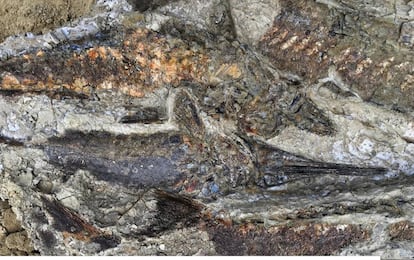
Both Brandon and Alexandria Johnson and their co-authors believe global fires were the main cause of mortality, but acknowledge their case rests on a single, highly significant site — the Tanis deposit in North Dakota. There, roughly 3,000 kilometers (1,865 miles) from the impact zone, they found the most consistent evidence: countless animals that died almost instantly, including many fish with spherules lodged in their gills. The death layer is capped by a thin stratum of extraterrestrial dust — the material analyzed in the new study.
“It’s possible that, over time, we will find evidence of truly global wildfires,” said Alfio Alessandro Chiarenza, a paleontologist at University College London who did not participate in the study. “It’s just that, for now, we don’t have any,” he added in a statement. If such evidence is found and the near-instant deadly role of the dust layer can be generalized, scientists could determine whether the end-Cretaceous mass extinction that ushered in the Paleogene occurred in hours (from scorching heat), in years or decades (from subsequent cooling), or from a combination of both processes. “It would be fantastic to find out which animals survived immediately after the impact and what their biological traits were. That might finally explain why some animals survived while others, like the dinosaurs, did not,” Chiarenza concluded.
Sign up for our weekly newsletter to get more English-language news coverage from EL PAÍS USA Edition













America
US Recalls Over 19 Million Eggs Due To Salmonella Outbreak That Has Caused Illness In Nearly 100 People


Several people have been trapped following an explosion at the Aeon Mall shopping center, according to the Kumamoto Prefecture Fire Department on the island of Kyushu in southwestern Japan, after a strong 7.1-magnitude earthquake struck, followed by a 6.1-magnitude aftershock, according to data from the Japan Meteorological Agency (JMA). Fuji TV reports that there are numerous fatalities among those trapped in the building, although there is no official confirmation of the deaths at this time.
The earthquake has also left at least 50 people injured, including some at the shopping center, and has cut power to approximately 40,000 households. The quake has also forced the temporary suspension of rail services, including the Kyushu Shinkansen bullet train. The Kyushu Railway Company itself has confirmed that a freight train derailed in the city of Yatsushiro in the southern part of the prefecture.
About 300,000 people have been instructed to go to evacuation centers, the Japanese disaster management agency announced.
Prime Minister Sanae Takaichi stated in Tokyo that the number of victims and the extent of the damage in the area — which was devastated by another earthquake a decade ago — were still being assessed. Takaichi also noted that “in some areas, there have been power outages and fires, and damage to roads and bridges has been reported, as well as the collapse of buildings.”
Japanese government spokesperson Minoru Kihara explained during a press conference that “given the number of areas without water supply, specific aid will be provided,” according to NHK television.
“We are using helicopters from the police, the fire department, and the military to assess the situation from the air and determine the extent of the damage. As soon as we can, we will report on this and take the necessary steps to assist the population,” Kihara stated.
Previously, authorities had urged the public to stay away from coastal areas as much as possible and emphasized that the earthquake’s intensity was 7 — the highest on the Japanese scale — in areas of Uki and Hikawa, while it reached level six in surrounding areas, according to reports from the Kyodo News Agency.
Authorities had initially issued a tsunami warning. That threat has now been downgraded, and there is considered to be no risk of a tsunami along the country’s coast, according to the U.S. Pacific Tsunami Warning Center. The International Atomic Energy Agency (IAEA), the UN’s nuclear agency, later confirmed that there is no damage or safety issues at the Sendai nuclear power plant, according to information provided by Japan’s nuclear regulatory authority.
“The IAEA will continue to monitor the situation,” the agency stated in a post on social media platform X.
According to the Japan Meteorological Agency (JMA), the earthquake occurred at 4:27 p.m. local time, and its epicenter was located about 12 miles south of Kumamoto, the largest city on the central island of Kyushu, which has a population of about 700,000 people.
Explosion
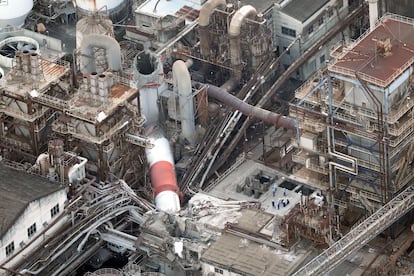
Late in the afternoon in Japan, a fleet of fire trucks was still searching for people trapped in the rubble of the Aeon Mall shopping center. A spokesperson for the facility, located in the town of Hikawa, explained that the explosion occurred while customers and employees were being evacuated following the earthquake and that the exact cause of the incident was still unclear.
According to a statement from the Kumamoto Fire Department, the second floor of the building collapsed, trapping numerous people under the rubble. About 200 people managed to take refuge in the outdoor parking lot.
An employee at a nearby restaurant, identified by the TBS network as Kazuya Tsurunaga, said he heard the loud bang from inside his establishment, located about 300 meters away from the shopping center.
“It was a huge explosion,” he said. “A huge cloud of smoke rose, and since the wind was blowing toward the restaurant, the area around us looked as if it were under a shower of volcanic ash.”
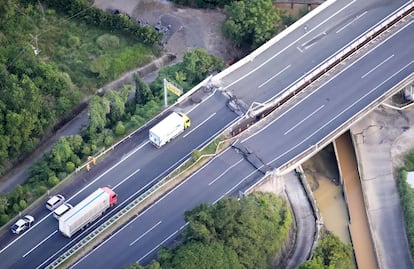
Other buildings in the area were also on fire or partially collapsed, according to footage from NHK television, which also showed large cracks in major roads, including on a highway overpass.
Kyushu is Japan’s third-largest island and is home to two nuclear power plants: the Genkai plant in Saga Prefecture and the Sendai plant in Kagoshima Prefecture. Emergency earthquake alerts have been extended to other prefectures. In addition to Kumamoto, these include Nagasaki, Kagoshima, Fukuoka, Saga, Oita, and Miyazaki, all of which are located on the island of Kyushu.
The Japanese archipelago is situated at the intersection of four tectonic plates and accounts for 10% of all the world’s earthquakes — or about 2,000 per year — according to the JMA. Situated along the so-called Ring of Fire — a chain of volcanoes and oceanic trenches that partially surrounds that region of the Pacific Ocean — it accounts for about 20% of the world’s earthquakes with a magnitude of 6.0 or higher.
When an earthquake of this magnitude occurs, one of the main concerns in Japan is usually its nuclear power plants, especially since the accident at the Fukushima plant on March 11, 2011. That incident — the worst at a nuclear power plant since Chernobyl in the former Soviet Union, now part of Ukraine — occurred after a magnitude 9 earthquake that triggered a tsunami.
Before the United Nations nuclear agency confirmed the findings following Tuesday’s earthquake, Kyushu Electric Power had stated that no abnormalities had been detected at its Sendai and Genkai nuclear power plants.
Sign up for our weekly newsletter to get more English-language news coverage from EL PAÍS USA Edition
America
An Appeals Court Upholds The Injunction Blocking Trump’s Order That Sought To Restrict Mail-In Voting In 23 States


Alfarnatejo Throws 24th Gazpacho Party

US Recalls Over 19 Million Eggs Due To Salmonella Outbreak That Has Caused Illness In Nearly 100 People

Were The Dinosaurs Incinerated In A Matter Of Hours? The Meteorite Created A Layer Of Dust That Turned The Planet Into A Grill
Axarquia wildfire cause emergency response across Archez, Competa and Canillas de Albaida
Buyers are pushing back against high house prices in Spain

El Escurreplatos De Dos Niveles Que Libera Espacio En La Cocina Está Rebajado Más De Un 50%


-
andulacia wildfires2 weeks ago
Axarquia wildfire cause emergency response across Archez, Competa and Canillas de Albaida
-
House prices2 weeks ago
Buyers are pushing back against high house prices in Spain
-
 Amazon2 weeks ago
El Escurreplatos De Dos Niveles Que Libera Espacio En La Cocina Está Rebajado Más De Un 50%
-

 España2 weeks ago
Lotería Nacional: Comprobar Sorteo Del Jueves 16 De Julio
-

 New Developments2 weeks ago
Inside The Most LUXURIOUS Apartment Building In Spain!
-
Are dogs allowed on trains in SPain2 weeks ago
Renfe opens all trains to dogs weighing up to 40 kg
-

 Audiencia Nacional2 weeks ago
La Directora De La Guardia Civil Y Su Jefe Operativo Declaran Como Imputados En La Audiencia Nacional Por El ‘caso Leire Díez’
-

 Uncategorized2 weeks ago
F1 press conference shut down over Red Bull driver transfer rumours