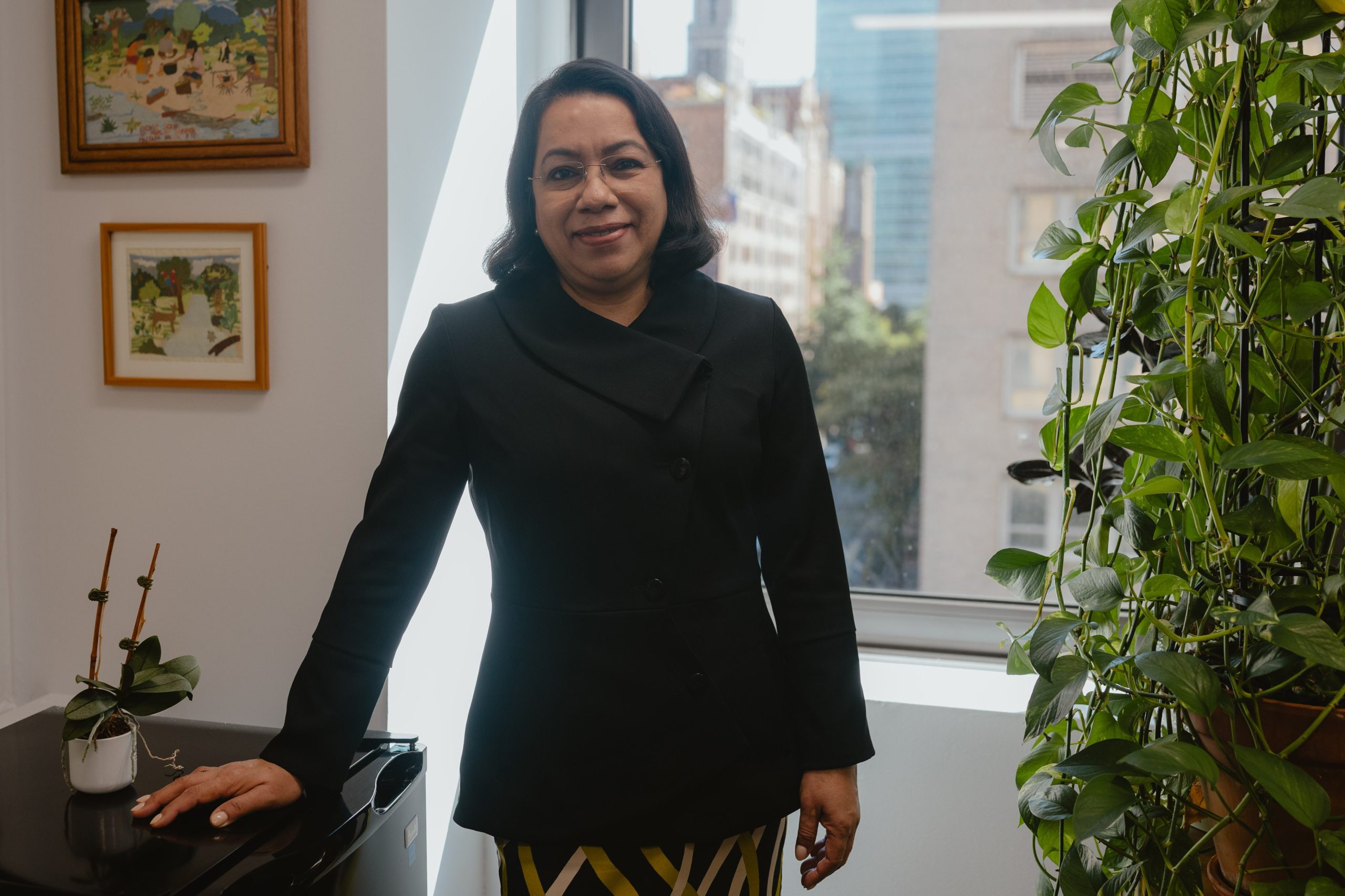
The race to succeed António Guterres as head of the United Nations (UN) from next January 1 is a long-distance one with very few certainties. Among the seven current candidates, Carolyn Rodrigues-Birkett, a former minister of Guyana and that country’s ambassador to the United Nations, stands out alongside Costa Rica’s Rebeca Grynspan and, to a lesser extent, Argentina’s Rafael Grossi. Rodrigues-Birkett, who received EL PAÍS in her New York office last Tuesday, avoids speculation but does speak of a campaign against her that caused her to lose ground in the last vote.
In addition to her résumé, this woman—born 53 years ago in an Arawak indigenous community in Santa Rosa—brings to the race a story of personal triumph over adversity. She grew up in a home without running water or electricity in Guyana, a small country of barely one million inhabitants and the only South American nation whose official language is English. But she prefers to talk about other matters: “My story is not unique. It is similar to that of many people in this world. In some continents, 40% of the population still lacks access to electricity.”
The battle for the UN enters a decisive phase this Friday, with a vote in which, for the first time, the five permanent members of the Security Council—the ones that call the shots—will show their preferences. Guyana’s representative prefers not to discuss the risk of a deadlock or whether the United States is keeping the option of waiting for new candidates because none of the current ones convinces it. She only hopes that, if one of those surprise candidates speculated about does emerge, they will be scrutinized with the same attention as the official candidates. She also says that if, in the end, a woman is not chosen, it would be a very negative signal for the cause of equality.
Question. In the first four ballots, Grynspan and you held the top two positions. But in the last round you fell to third place, behind Grossi. Are you losing support because of recent articles that recalled your criticism of Israel?
Answer. I have advocated for a two-state solution in which both states live in peace and security. I have said many things. But if there is a campaign against me, they will pick what they want to pick. But as a small country, Guyana has always been clear that we defend international law and the United Nations Charter. Not only in the case of Gaza, but in Sudan or anywhere else. If standing up for the Charter and international law is going to work against me in this contest, I’m happy to choose that any day.
Q. Do you think there is a campaign against you?
A. You have seen those articles and I have seen them too. But I am also aware of other outreaches that have been made and that I will speak about at the appropriate time, not today.
Q. It is likely that in Friday’s vote every candidate will receive at least one vote against them from the five veto-holding countries: the United States, China, the United Kingdom, France and Russia.
A. I do not want to speculate. I think the current candidates include people capable of holding the post of secretary-general. We have been subjected to intense scrutiny by the General Assembly and the Security Council. I hope that this procedure is preserved. All candidates should be subjected to the same level of scrutiny.
Q. Diplomats talk about the possibility of a deadlock—that on January 1 the UN might not have a new leader.
A. That would be one of the best ways to reduce the United Nations’ credibility. It would show that we do not take the organization seriously. I hope we do not reach that point.
Q. How important is it to you that the principle of rotation be respected, under which it is now Latin America and the Caribbean’s turn to provide a candidate?
A. That principle was established to guarantee a degree of certainty and fairness. If we start to dismantle these informal processes that are in force, what will come next?
Q. But some voices recall that when Guterres was chosen it was Eastern Europe’s turn.
A. Then, since that happened, should we diminish it further now? I do not think so. We have five candidates from that region. And the informal straw polls point to the possibility that one of them could be chosen. That is a good sign.
Q. For the first time in its more than 80-year history, the UN could be headed by a woman. Is this finally the moment?
A. The resolution on the appointment of the secretary-general constantly refers to “he.” But now it is 2026 and no one questions women’s competence. I am not presenting this candidacy because I am a woman; I am running on my ability and my competence. But if there is one place that should lead by example on gender equality, it is the United Nations. The time has come for the other half of humanity to have the opportunity to hold that office as well. Although, ultimately, it will be mostly men who make that decision.
Q. What message would be sent if, after two women led the process, a man were ultimately chosen?
A. The world would respond to that. It would be a very bad message. The women in this race have stood before this world. I do not believe that at this stage the world has concluded that none of us fit the bill.
Q. Why do you believe you are the right person for the job?
A. I believe I have the necessary experience. I do not come solely from the diplomatic community; I have worked in the fields. I served as a minister for 14 years and as a legislator—roles that require negotiating skills. I have also worked in the international civil service. The secretary-general plays a key role in building bridges. That has also been the theme of my life: bringing people together and building bridges to achieve real change on the ground.
Q. The selected person will head a United Nations subjected to multiple crises and threatened with losing relevance in resolving the world’s major conflicts. How do you respond to that?
A. The United Nations, founded after World War II, has played a central role in peacebuilding.
Q. But right now that is not happening…
A. And we should examine why. The secretary-general always has room to act, even when there is a split among certain Council members. The secretary-general must be brave and bold in proposing paths to a solution. You have to try. There is no alternative if you want to restore the UN’s central role in peacebuilding.
Q. Has Guterres done that? What do you think he has done well and badly?
A. I will not judge. History will take care of that. But much more needs to be done than what we are doing now, for example, in peacekeeping operations. These missions were supposed to be a means to an end: deploy peacekeeping forces while political solutions were achieved. However, we have peacekeeping missions that have been active for decades without significant political progress. We must work to achieve political solutions; that would be the true measure of success for these operations.
Q. We see every day how the international order that emerged after World War II is crumbling. Is the UN doomed to play an increasingly minor role?
A. Diminishing the UN poses a risk. The UN remains the bulwark of multilateralism, which is our only guarantee of peace and security. If we fragment or weaken the UN, we will return to a scenario we do not want to revisit—the law of the jungle. We can consider working in smaller groups to find certain solutions, but to globalize or legitimize these solutions there is no forum other than the UN.
Q. Another crisis the UN faces is financial. What is your prescription?
A. Forty-two percent of the United Nations’ budget is financed by two countries. I do not think that is sustainable.
Q. Should middle-income countries then pay more?
A. That should be debated. There are areas where we can improve and gain efficiency on the ground, but I do not think that tinkering on the edges will solve the foundational problem. The UN had 51 members when it was created and today it has 193. Yet we still operate with the structures of 1945. Many countries are demanding reforms: in the secretariat to make it more efficient; in the funds and programs to improve our work on the ground; and in the Security Council.
Q. There is always talk of reforming the veto power of the five permanent members, but at least in the short term that does not seem very realistic.
A. In politics, anything is possible. From discussions with countries two very clear messages emerge: support for expanded representation and for accountability from the Security Council. The challenge lies in achieving both. The Security Council risks becoming irrelevant. If the world and the majority of member states perceive that it is incapable of resolving or preventing conflicts, they will seek other ways to address them. And I suppose no one wishes to fall into irrelevance. The time will come for a reformed Security Council, but for that member states must move forward.
Sign up for our weekly newsletter to get more English-language news coverage from EL PAÍS USA Edition




 A survey of 600 estate agencies found that 78% have seen landlords change their behaviour since the housing decree was pushed through.


 Uncategorized2 weeks ago
 Uncategorized2 weeks ago
 Foreign demand3 weeks ago
 Housing access / crisis / affordability2 weeks ago
Join the conversation in our comments section below. Share your own views and experience and if you have a question or suggestion for our journalists then email us at news@thelocal.es.
Please keep comments civil, constructive and on topic – and make sure to read our terms of use before getting involved.
Please log in here to leave a comment.