
california
Has Trump’s Luck Run Out? Now Who Will Woo The Latino Vote…








Blue Origin
Victor Glover, Artemis 2 Pilot: ‘This Race, For Us, Is Not About Beating China To The Moon. We Will, But This Race Is To Get Humans To Mars’


Five months ago, four excited girls walked into a maximum-security area with their mother wearing the same black T-shirt printed with a photo of their father. Minutes later, he emerged from a building guarded by the military, amid camera flashes and television cameras, and looked at them with moist eyes from the other side of the fence. He could not approach or touch them. He had to respect quarantine, because in a few hours he would board the most powerful crewed rocket in history and head to the Moon. Without speaking, they said everything to each other, and the rest of the world understood them.
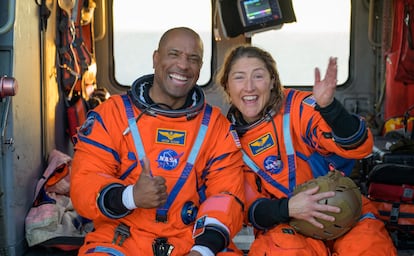
That man was Californian Victor Glover, who at 50 became one of the four humans to have traveled farthest from Earth. He is the first astronaut to pilot the Orion spacecraft, and the first Black astronaut to travel to our satellite. His eyes have seen areas of the far side that had never before been seen.
After reaching the Moon with the Artemis 2 mission, Glover has just retired as an active NASA astronaut. Of all the jobs he could have chosen, he wanted to return to California Polytechnic State University (Cal Poly), the public institution where he studied and met his wife.
A Navy captain, test pilot, and veteran of 24 combat missions during the Iraq War in 2006, he is also the first astronaut emeritus in NASA’s history. He shares this new status with Artemis 2 commander Reid Wiseman. That binds them to the agency to train new space recruits and, above all, spares them the usual retired-astronaut title, which they disliked.
Glover will travel to Spain for the first time after his return from the Moon to participate in the Starmus Festival, held in October on the Canary island of La Palma. There he will share the stage with his crewmates Wiseman and Canadian Jeremy Hansen, as well as leading scientists, engineers, and eight Nobel laureates. In this interview, his first with a Spanish-language outlet since his visit to the Moon, the astronaut revisits his experience, discusses the space race with China, and defends the Trump administration’s decision to remove the pledge that the first people to step on the Moon since the Apollo missions, in 2028, would be a woman and a non-white man.
Question. That farewell… It was really moving.
Answer. Thank you. It was quite moving for me too. I think my favorite part of space missions has always been what it does to the family. And it’s hard to describe that. That is so much more meaningful than rockets and spacecraft. Those t-shirts, even though they kind of mortify me, I love that they felt connected and that it helped them to get through, because that is also a very challenging time.
Q. After you returned to Earth you said you couldn’t find the words to describe what you experienced. Have you found them?
A. I still find that words fall just short. You know those videos on YouTube of a fireplace that is nothing like sitting next to a real fire even with the sights and sounds? This is like that, exponentially. The whole thing was amazing. We spent nine days and about two hours living in Orion. You know, we launched on April 1, and when the liquid engines lit, they lit six seconds prior to lift-off. I think all of us still thought, we’re probably not going to launch today, but man, that’s a shame that they’ve had to light these engines, you know? When the solid rocket boosters lit, the spacecraft jumped off the pad, and you know you’re going somewhere at that point. And so, I think all four of us were like, oh, we’re going to the Moon. And it was a surprise. Most of us thought we would go back to crew quarters and we would try again another day.
Q. What is the most vivid recollection?
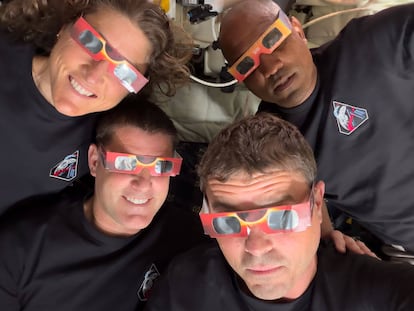
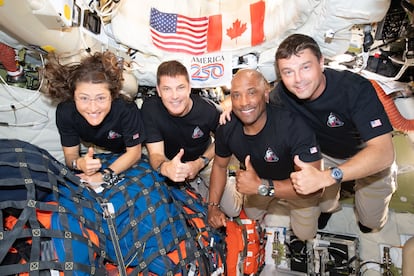
A. I’d like to tell stories about the solar eclipse that happened on flight day 6, that was a very vivid moment. It was one of the most unique things that humans have ever seen. But the thing that happened on the mission that we don’t talk enough about was on flight day 7 when we had a day off. We needed that day to catch up, emotionally, operationally. We needed to clean up the cabin. It was a mess. And so that off day was so needed. But then we did something really special on that day. We had a call between our integrity Orion spacecraft and the International Space Station. And we got to talk directly to the space station and [astronauts] Jessica Meir, Chris Williams, Jack Hathaway, Sophie Adenot, and our international partner friends, it was the coolest thing. It felt like they were right there with us. For me it was one of the most important moments of the mission.
Q. In 2023 you told El PAÍS your country was very divided and you hoped Artemis would bring a little light and unity. Do you think it has achieved that?
A. I’ll answer that and then ask you another question. We all showed the world that we can be humans for once and that we could be humans together for a time. When we went behind the moon and we were out of communication with Earth, that was one of the most intimate moments even though the four of us were out of communication not only with the Earth but our friends on the International Space Station and even the Chinese astronauts on the Tiangong Space Station. And that moment was one of the highest connections to the mission; that reminder for humanity is one of the most important takeaways. We had a moment of togetherness on a scale that we have not had ever. Now I ask your readers: why were you so invested in this? If we can find out why we were so together, we can do it when we need to do it because we need to do that more. We need to be unified as a human species more.
Q. Is it possible that those of us who haven’t traveled to space find it harder to address war or climate change by appealing to unity?
A. Well, this is where trust comes in. Christina, Reid, Jeremy and I traveled almost 700,000 miles to get to a distance of 252,756 miles from our home planet. We studied creative writing and lunar science and geology to be able to talk to you about the Moon as a cultural, religious, and geological icon. When we saw the Earth from so far away, the same words came to mind that Apollo astronauts used 50 years ago; they didn’t have creative writing coaches and in many cases simply opened the Bible and read it. They talked about love, peace, and hope, and we did the same thing. And this is not soft stuff, it’s not kumbaya. The universe tells us things when we travel into deep space. But even if you can’t travel to deep space, listen to those who have, because we come back saying the same thing: we need to love one another and love our planet. Familiarity breeds contempt, as the saying goes. I think it’s actually worse than that — it breeds indifference. We can make the mistake of taking our planet for granted. We are trying to remind people that this oasis we have within a vast, empty cosmos is a miracle and we should be insanely grateful for it. If we can adopt that perspective, perhaps we can change how we think about war, hunger, and disease. It’s a challenge, but remember that never before have so many people known how to read, there have never been lower infant mortality rates, and there have never been fewer people enslaved in the world than today. It’s a reminder that the work we do is important. And we should keep doing that work together.
Q. You are the first Black person to go to the Moon. What has that meant for you?
A. There’s another saying: you can’t be what you can’t see. There are young people, they might not even tell their parents or their teachers, who don’t think they can be an astronaut, and I remember feeling that way when I was young. There was no path for me to get there. Those young people need to see people who look like them so that they know it’s possible. Because all of us can do it; if you put your best self forward and you have a growth mindset and you’re coachable and you can be a good teammate and you learn everywhere you go, anything is possible. My grandfather, who fought in the Korean War and is still alive, has seen his sacrifice help his grandson fly a mission for his country. But the truth is that I flew for everybody. This patch says all. I flew for all people, and Christina flew for every little girl who’s inspired by her.
Q. Will a woman and a person who is not white be the first people to return and set foot on the Moon in 2028?
A. I don’t think this administration uses those words, but here’s the beautiful thing. Some people got upset when they took those words down. I’ll be honest, I don’t love saying it that way either. The astronaut corps is so diverse that there is no need to set objectives like that. This administration doesn’t like to talk about diversity, equity or inclusion. I don’t justify that, because diversity and inclusivity are core NASA values. But there is one word they will never take down or be against: excellence. The corps is made up of people who strive every day for excellence, including women and Black people. That’s why the next crew to walk on the Moon will represent the best of the country and will be diverse by nature, not because a leader in his office decreed we send a woman.
Q. Would you have taken those words out too?
A. I’m okay that they were taken out. Imagine you have a son who wants to be a starter on his soccer team. Part of his experience is learning teamwork. If the coach doesn’t play him and you go to the coach to demand he put him in, and the coach does, and when your son gets home he asks: “Dad, did the coach only play me because you told him to?” Are you going to lie to him? Imagine that with a task as important as being an astronaut. Imagine if you thought your mission happened only because of your gender or because of your race. Taking the words off was not a step backwards. It’s a matter for debate, of course, and I understand both sides. What’s important to me is we’re going to do it naturally and when it happens everyone will be able to celebrate it equally and we can all be excited that the crew looks however they look because we did it for the right reasons.
Q. Who will win the new race to the Moon? Does China have a chance?
A. Absolutely. The Chinese space program has done some remarkable things. And because we are not supposed to work with them on certain things, it’s difficult to know exactly how much capability they have, but they do have a lot of capability. They have gone from an uncrewed station to a crewed one and then to one that is continuously inhabited very quickly. But I’m convinced the United States will be the first to land on the Moon, because I know how hard our space agency works. Never bet against our industry, never bet against the innovation in America, never bet against American entrepreneurship, especially when we team up with our fantastic international partners. That’s not an excuse to rest on our laurels, but remember we have done things they have not yet achieved, like Artemis 2. We have a distinct advantage. This race, for us, is not to beat China to the Moon. We will, but this race is to get humans to Mars and deeper into our solar system. And on the way to doing that, we will also beat China to the South Pole.
Q. When will astronauts reach Mars?
A. When Apollo 17 left the Moon in 1972, astronauts said we’d reach Mars in about 20-25 years. The problem is we stopped exploring deep space. When we launched Artemis 1 to test the heat shield, we started ticking off the years again. I think we’re somewhere between 10 and 20 years away. I give such a wide range because NASA may be 20 years away if were working by ourselves, but with companies like SpaceX and Blue Origin, we might reach Mars in just 10 years thanks to some technological revolution they are going to help us to have. So I think we are going see it in our lifetime.
Q. A U.S. general has said the country must prepare for war on the Moon. What do you think?
A. I was very sad when I heard that. War sucks, and while it has proven to be a necessary state of human existence, it is tragic. I would love for space to continue to be this place that’s unifying and that helps bring together the best of what humanity is. I hope that one general’s comments don’t cloud that.
Q. After going to the Moon you decided to go to work for a public university. Is that a mission statement?
A. It is a mission statement, and I’m continuing public service. My goal has never been to get rich or be famous, but to make an impact. And here I can. People are attacking higher education, and rightly so in some cases. They ask why college is so expensive and why, after graduating, they can’t access a good middle-class life. We have to rethink education; make sure students are prepared for the world they’re living in, not the world we grew up in.
Q. What do you think of the apocalyptic messages about artificial intelligence?
A. The only thing capable of destroying the human race is humans. The development of artificial intelligence is moving far faster than our ability to legislate it. What does that tell us? Not that we should give up, but that we must ensure this technology serves humans. For that, everyone should read about AI and understand how it works. If we don’t, it won’t be because of AI that humanity is doomed. It will be because humanity’s lack of preparation.
Q. You are openly religious. Has the trip to the Moon changed you?
A. If we hadn’t launched on April 1, we wouldn’t have seen the things we saw. But what we saw would have still happened anyway. The universe is so big, imagine how many other miraculous, awe-inspiring things we don’t see because we’re not there. Sometimes we are wrong to focus so much on answers. Sometimes the question is more important. Nowadays religion is not a popular topic and I think that’s because we are used to turning away from one another so quickly. The Bible says we were made in God’s image. Science says we are made unlike anything in the universe. For me they are two sides of the same coin. If we connect with one another, we connect with that higher power, and that way we can save each other.
Q. Do you believe there is life in the universe beyond Earth?
A. The universe is so big, we could be surrounded by intelligent life and it’s just their signals haven’t reached us and our signals haven’t reach them. Statistically, there should be life in the universe. But with all the money and ingenuity of the U.S. government, the largest sovereign entity in the known universe, we haven’t found it. That tells us, on one hand, that it’s worth continuing the search. And on the other, that when we look at another person we are seeing a miracle — the most complex union of physics, biology and mathematics. Especially a newborn. A baby is maybe the most magical thing the universe has ever produced. In that moment you should feel inspired by God and by the power of the universe. We are capable of giving life. We shouldn’t think much beyond that.
Sign up for our weekly newsletter to get more English-language news coverage from EL PAÍS USA Edition
America
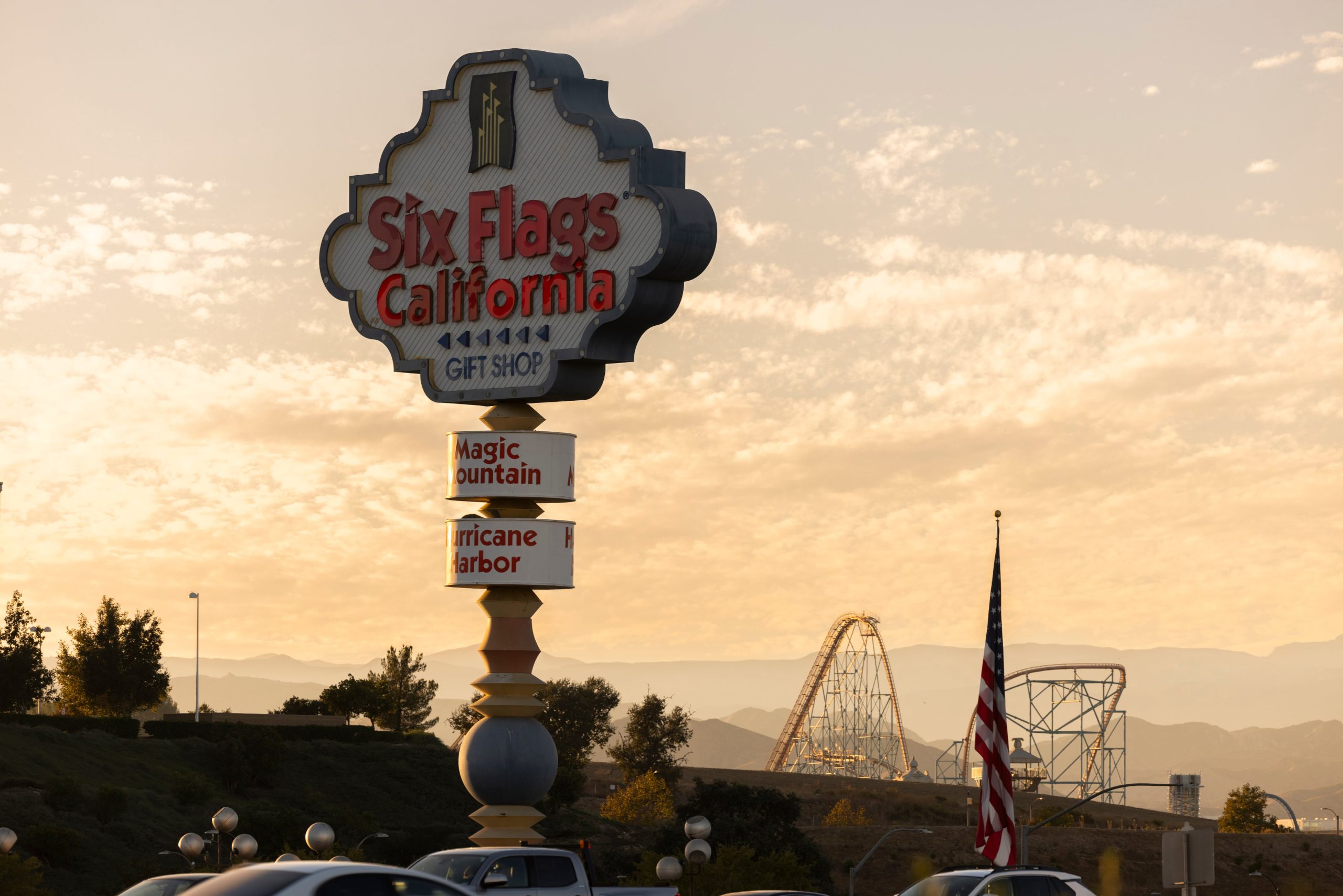
Six Flags Closes The ‘X2’ Roller Coaster In California Following Reports Of A Potential Risk Of Brain Damage

America
Un Ejecutivo De ‘The New York Times’ Es Asesinado A Tiros Y Sus Suegros Son Los Principales Sospechosos


Elecciones En Brasil 2026, En Vivo | Lula: “Veremos Qué Brasil Eligió El Pueblo”. Bolsonaro: “Brasil No Aguanta Más”

Stylish 3-Bedroom Apartment With Panoramic Sea Views – Benalmádena

Erly Thornton Opens Almuñecar’s Jazz In Autumn


-

 Uncategorized1 week ago
F1 Qualifying Today: Azerbaijan Grand Prix schedule, times and TV channel
-

 %1 week ago
Is Your Supermarket Kefir Really Kefir? Spanish Study Raises A Surprising Question
-
Latest1 week ago
‘It’s The Law Of The Jungle’: Pensioner’s Eviction Exposes Spain’s Housing Crisis
-
Barter system1 week ago
British drug dealer swaps cocaine for Pokémon cards in bizarre barter deal
-

 Austin2 weeks ago
Venezuelan Migrant Shot By ICE In Austin Cites Lack Of Medical Care: ‘How Are They Going To Leave The Bullet In There?’
-
Balearic Islands2 weeks ago
Tourists driving to Menorca could soon need a permit and pay to bring their car
-

 Cody Gakpo1 week ago
Xavi Y Klopp Se Reparten Puntos En Su Debut Como Seleccionadores
-

 Argentina2 weeks ago
Mexico Joins Latin American Crackdown On Cellphones In Schools